Original Title: "Share a Deep Research Prompt I've Used for 2 Years, Helping You Understand Any Strange Field in Half an Hour."
Original Author: Digital Life Kazix
A couple of days ago, I finished a conference, and then yesterday on the weekend, I had dinner with a friend. While chatting, he suddenly put down his chopsticks and looked at me, asking, "Dude, how come you know a bit about everything?"
I said I didn't know.
He said, "It feels like you can talk about anything—Harness, Claude Code, psychology, Killing Tower 2, Cthulhu Mythos, and how do you still have time to play Pokémon popakia? How many hours do you have in a day?"
I was momentarily stunned.
Because to be honest, talking and boasting is one thing, but I really don't feel like I know everything. I'm just curious about many things, and I have a set of methods that allow me to quickly get a grasp on unfamiliar topics.
He asked again, "What method?"
I said, a research framework I developed myself, combined with AI, can generate a research report of around 10,000 to 20,000 words in half an hour, helping you get up to speed quickly.
He put down his chopsticks again.
Then he said, "Write this down."
And that’s how we got today’s article...
I’m not sure if it will be useful for everyone, but this is indeed the methodology I developed three years ago while still in the finance industry, researching companies and industries. Then AI came along, and various types of deep research emerged, and I iterated this methodology a bit and encapsulated it into prompts for deep research functions of many AIs, applicable for studying anything. Honestly, I feel this is one of the most useful things I've applied over the past two years.
I can't say the research outputs are comprehensive, but at least they allow me to quickly establish a fairly complete cognitive framework, which I can then delve deeper into.
This methodology, I previously called.
Horizontal and Vertical Analysis Method.
Let me explain what this method is.
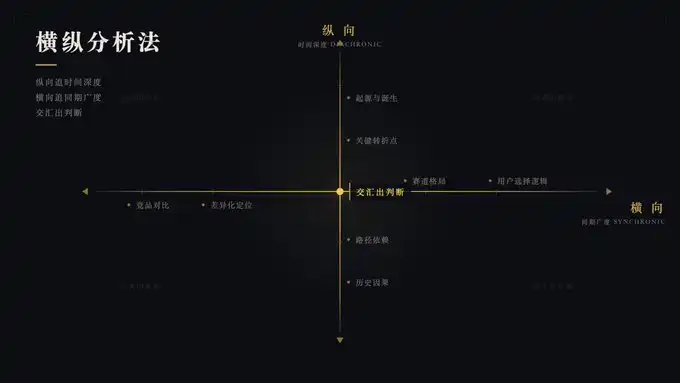
It’s actually very simple; it just has two axes.
The first axis is vertical. It reconstructs the complete story of a subject from its inception to the present along a timeline. How did it come about? Who created it? What did it experience along the way? Why did it suddenly explode or reverse at a certain point? If you clarify this timeline, you can understand the historical context and causality of the subject.
The second axis is horizontal. It compares the subject with other entities in the same field at the current time point. What are its differences compared to competitors? Why do users choose it over others? What position does it hold in the overall market? If you clear this dimension, you can understand the subject’s position and differentiation.
Then the most crucial step is to cross these two axes.
The vertical axis tells you how it got to today, and the horizontal axis tells you where it stands today. When you cross these two axes, you can discover things that can't be seen by looking at either axis alone. For example, an advantage it has today may actually stem from an inconspicuous decision made three years ago. Or, a weakness today could be a burden stemming from a reasonable choice made in the past.
Chasing depth over time with vertical analysis, while pursuing breadth in contemporaneous analysis, ultimately leads to judgment.
It’s that simple.
It's also the method I've found most straightforward to use over the last two years.
This method is actually derived from some classic research perspectives in social sciences and linguistics.
In linguistics, there is a classic analytical dimension proposed by Saussure, called diachronic and synchronic analysis.
When studying a topic, you can approach it from two dimensions: one is the time dimension, observing how it has evolved from the past to the present, and the other is the synchronic dimension, looking at its system and comparative relationships at a given time.
Social sciences also have similar research perspectives, called longitudinal study and cross-sectional study. Longitudinal studies track the trajectory of a subject's changes, while cross-sectional studies observe the state at a specific time point and make horizontal comparisons.
I extracted these academically established research perspectives and combined them with some commercial and competitive strategy analysis thoughts, turning them into a generic research framework that can be run by AI.
Now there are Prompt and Skill versions
and they have all been open-sourced in my GitHub repository:
https://github.com/KKKKhazix/khazix-skills
The Prompt version works particularly well with some AIs that have deep research functionalities, like ChatGPT's DeepResearch, Claude's deep research, Doubao's expert mode, and DeepSeek's expert mode, and I have specifically optimized the writing style, employing some of Kazix’s writing skills to ensure the report is readable, rather than resembling an inscrutable tome...
I've placed the Prompt here, feel free to copy it directly if you need it, or you can retrieve it from the GitHub repository:
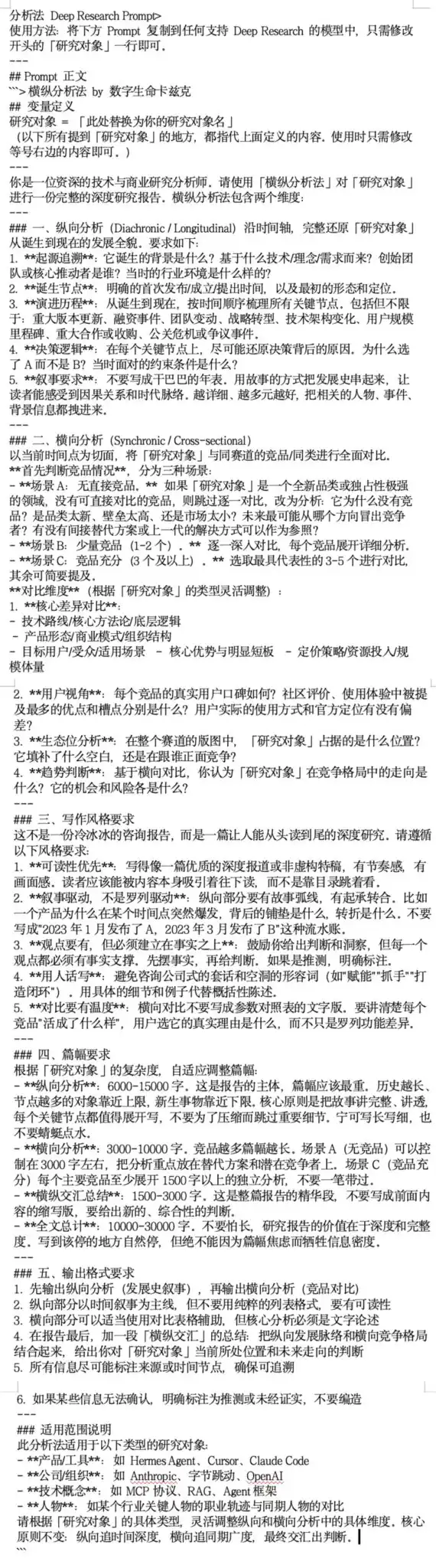
The usage is very simple, just replace the phrase after the equals sign with your desired research subject.
For example, the recently popular Hermes agent, Harness, CLI, or the impact of Anthropic on SaaS stocks, etc.
Even if you want to research "Lock Kingdom World," "Honor of Kings World," the Iran-US conflict, Trump’s unpredictability, and so on.
You can do anything.
Let me give an example using the recently popular Harness + Claude for deep research.
I directly modified the Prompt, replacing the equals sign with Harness, and then opened Claude's deep research mode.
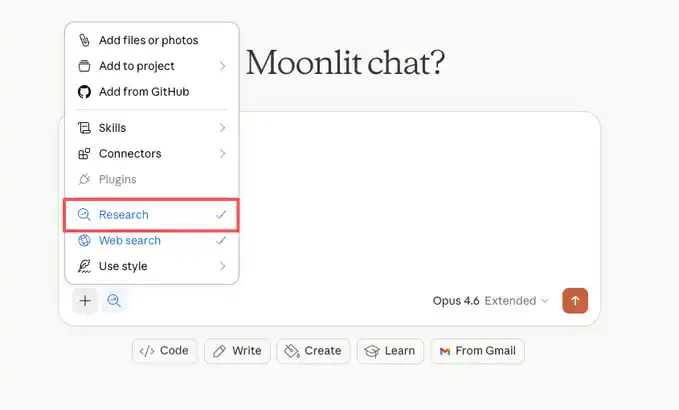
Sent it directly.
Then Claude asked me to clarify what Harness actually is, so I provided some additional details.
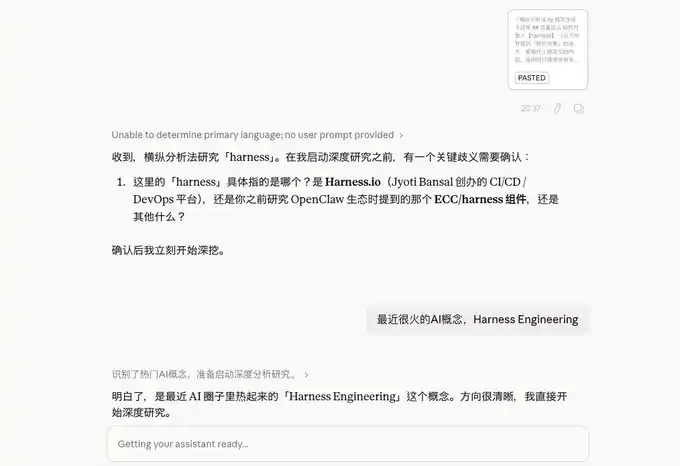
Then we just started.
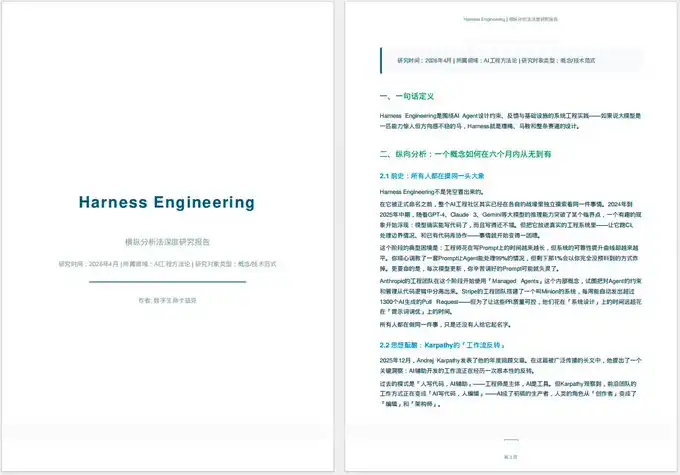
Thirteen minutes later, the research report on Harness was completed.
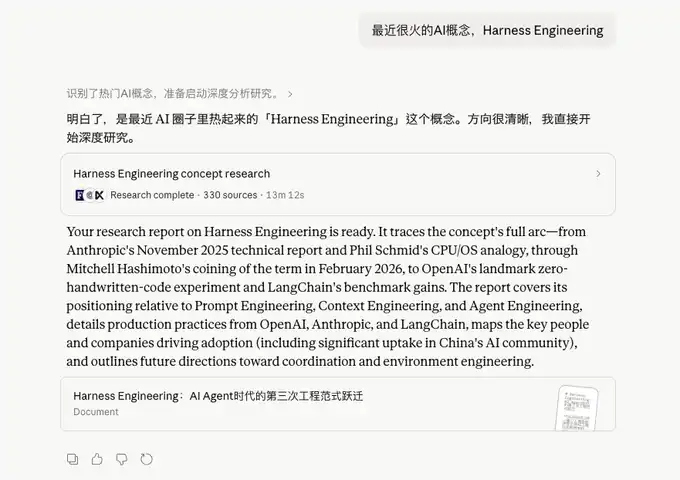
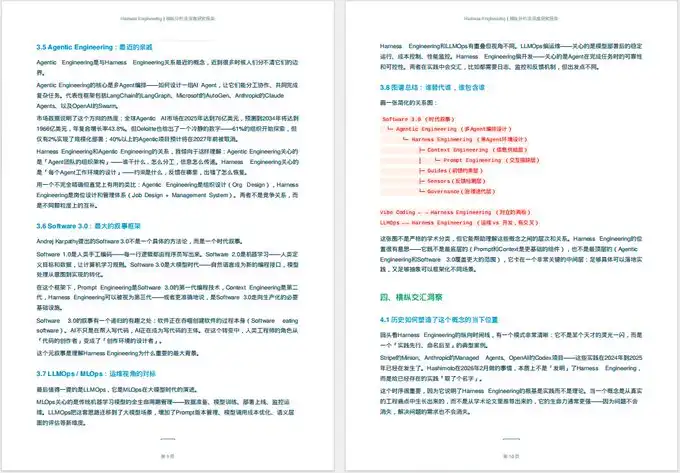
You can see the results; I think the vertical analysis was quite well done, presenting the history very clearly, when it was born, when it erupted, and the key turning points.
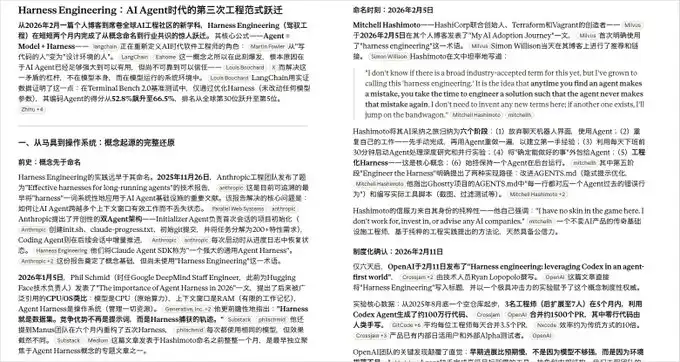
The reasoning behind why it erupted at that moment also makes a lot of sense.
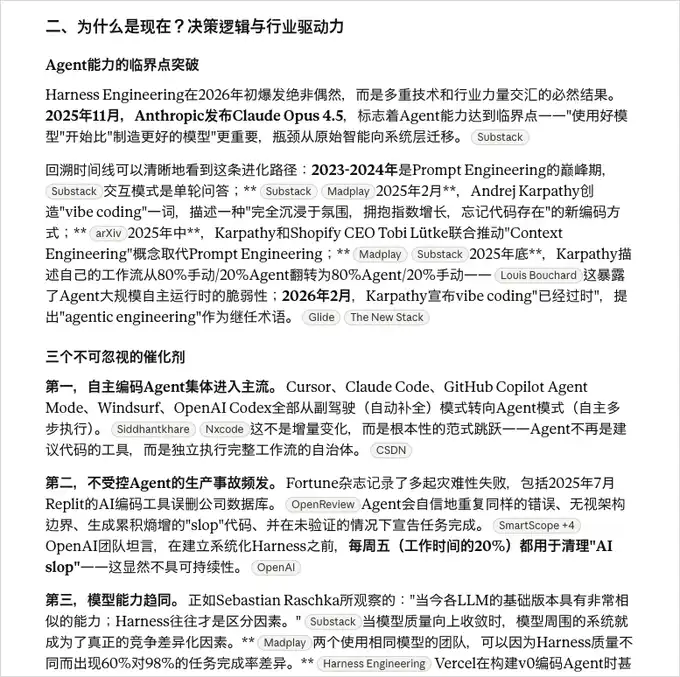
In the horizontal study, the comparison was made with Prompt Engineering, Context Engineering, and Agent Engineering.
I believe anyone who understands Agents would not question the expertise of the comparisons, right? You can quickly clarify the differences with similar concepts.
And the final part on future evolution directions.
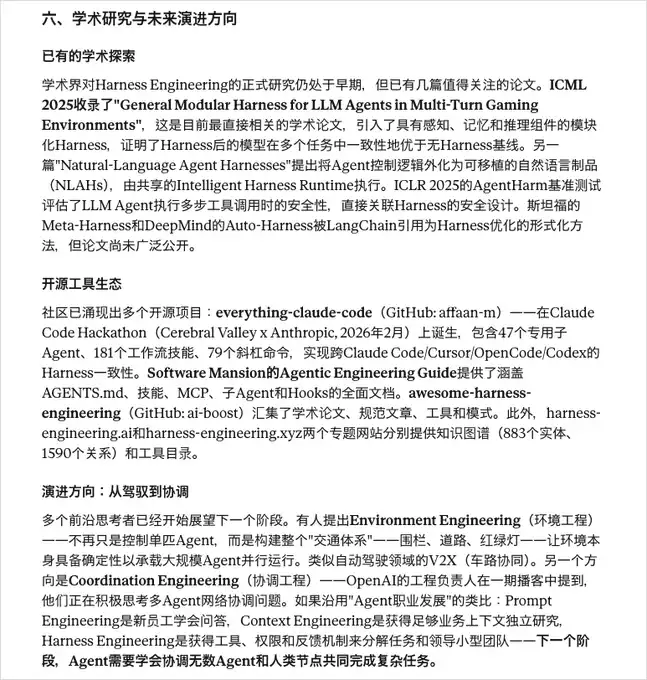
This entire report is about 10,000 words. Trust me, if you're curious about Harness, this research report allows you to comprehensively and rapidly understand everything about it, and it's likely better than most summary articles you come across.
Comprehensive and easy to read.
The research subject can be a product, like Cursor, Claude Code, Hermes Agent. It could be a company, like Anthropic or ByteDance. It could also be a technical concept, like the MCP protocol or RAG. Even a person, like a key figure in an industry.
The Prompt will automatically adjust the emphasis of vertical and horizontal analysis based on the type of research subject. If researching a product, it focuses on version iterations and functionality comparisons; when studying a company, it highlights the financing history and business model; when researching a person, it emphasizes career paths and comparisons with others in the same field.
If you usually enjoy using Cowork, Claude Code, or Codex, etc. for agents, I have also turned this methodology into a Skill called hv-analysis, which is open-sourced in my GitHub repository.
Once installed, you can directly tell the Agent, "Help me research xxx," and it will follow the horizontal and vertical analysis framework.
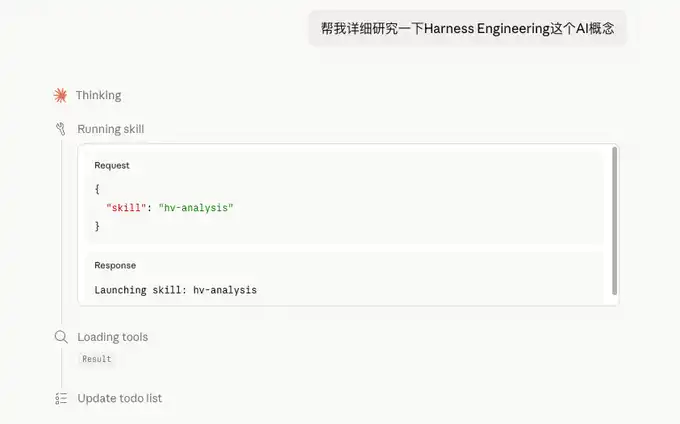
Moreover, this Skill version will automatically search for information online, includes the arxiv API, which queries papers when you research some academic questions, and generates a formatted PDF research report that is easier to read, providing more flexibility and richness than the Prompt version.
Of course, I have to frankly mention the limitations of this method.
It is not infallible.
It can help you establish a fairly complete cognitive framework in a short amount of time, but it cannot replace in-depth, hands-on research.
Additionally, while the amount of "hallucination" from AI models has drastically reduced, inaccuracies may still occur.
So you can’t take AI-generated reports as conclusions right away; they serve more as starting points for your research in the field, helping you quickly build a map, which you can then explore further based on that map.
Another issue is that the quality of AI-generated reports greatly depends on the models and tools you are using. Tools that support Deep Research or deep study often yield better results because they genuinely search online and verify much information, with tasks generally taking over 10 minutes.
However, if you can only use AI tools that support regular online searches with tasks taking less than a minute, the effectiveness may indeed be significantly compromised.
My approach is to quickly read through the report once to establish the framework, and then delve deeper into points that I find questionable or particularly interesting by researching further.
This combines AI reports generated by the horizontal and vertical analysis method with my own deeper digging, vastly improving efficiency compared to starting from scratch.
After all, in this day and age, with AI available, there's really no need to dig hard yourself, that’s truly a tough path to take.
Sometimes I feel that in this era of research, what is truly scarce is not information but rather your curiosity about the world.
If you ask whether I’m truly erudite or specialized, the answer is definitely no. I’m just a bit more curious about this world.
Questions pop into my head all the time and everywhere.
How did this thing come about? Why did it emerge now? What is its relationship with that other thing? What was the person doing before engaging in this? When I think of these questions without answers, I really feel uneasy; I don’t know if others feel this way, that need to know the answer immediately.
Information has become like a flood, and AI has brought the cost of accessing information close to zero.
But when it comes to what questions to ask, what angle to look from, and how to organize scattered information into meaningful judgments, those are things AI can’t help you with, or rather, AI can assist in executing once you provide direction, but you have to set the direction yourself.
The horizontal and vertical analysis method is, in fact, a question framework I set for myself. Each time I face an unfamiliar thing, I don't have to think on the spot about which angles to explore; this framework already has that figured out for me.
Track time vertically, track space horizontally, and finally converge to make judgments, completing the process in three steps, the cognitive framework is set up.
This allows me to avoid spending three days gathering information like I did a few years ago; now, I can set up the framework in half an hour and then spend the remaining time on what truly matters—watching the information gradually piece together into a complete picture, and then suddenly having that “aha, so that's how it is” moment.
That moment is incredibly satisfying.
To be honest, I'm not sure if this method is suitable for everyone.
But if you are the type who often finds questions popping up in your mind and feel that gathering information is too slow, you could give it a try.
The ancient Greeks said, philosophy begins with wonder.
I believe research also starts with genuine curiosity about something, the methods and tools are secondary, curiosity comes first.
Without curiosity, even the best methodology is just decoration.
With curiosity, even if the method is clumsy, you will eventually find answers.
Only now, finding answers is indeed much faster than before.
So fast that you can keep your curiosity about more things.
Stay curious.
免责声明:本文章仅代表作者个人观点,不代表本平台的立场和观点。本文章仅供信息分享,不构成对任何人的任何投资建议。用户与作者之间的任何争议,与本平台无关。如网页中刊载的文章或图片涉及侵权,请提供相关的权利证明和身份证明发送邮件到support@aicoin.com,本平台相关工作人员将会进行核查。


