Written by: Hazel Hu
Recently, there has been an explosion in AI payments, making a protocol standard battle surrounding "how AI Agents spend money autonomously" unavoidable.
In 1996, when Tim Berners-Lee and his team at CERN finalized the HTTP/1.0 specification, they left an empty slot in the status code list: 402 Payment Required.
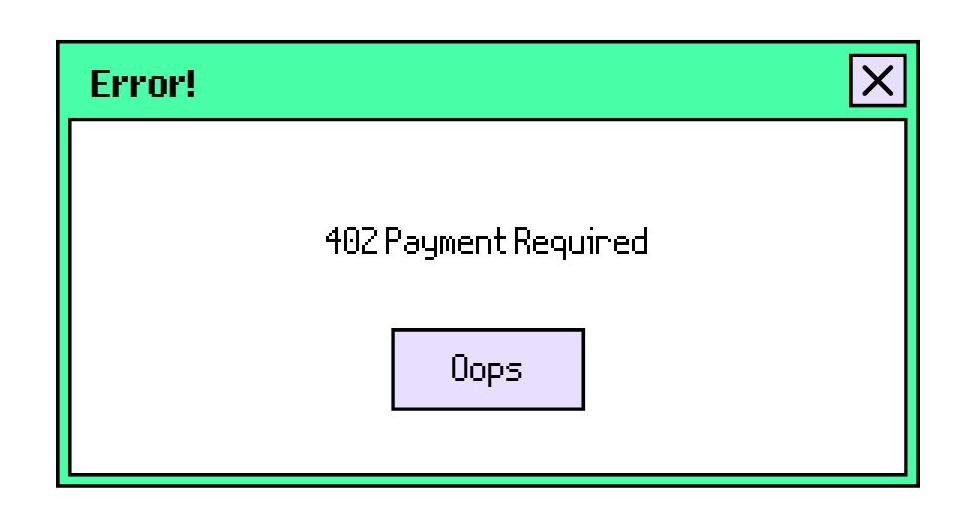
This was an interface reserved for future digital cash or micropayment solutions. The creators of the internet foresaw thirty years ago that the information highway would eventually need a toll lane.
But 402 was never activated. No browsers supported it, and no servers truly used it. It lay dormant in a corner of the HTTP protocol like a letter with the address written but never sent, sleeping for a full thirty years.
Until the AI Agents arrived.
In the third week of March 2026, the payment industry experienced rapid developments within 72 hours. On March 17, Mastercard acquired the stablecoin infrastructure company BVNK for $1.8 billion. On March 18, Stripe launched the mainnet of the public chain Tempo, incubated in collaboration with Paradigm, and simultaneously released the Machine Payments Protocol (MPP). On the same day, Visa Crypto Labs released visa-cli, a command-line tool allowing AI Agents to directly swipe cards at terminals, with Visa's crypto business head Cuy Sheffield dubbing it "command-line commerce." Before this, the x402 protocol jointly launched by Coinbase and Cloudflare had already been running for nearly a year.
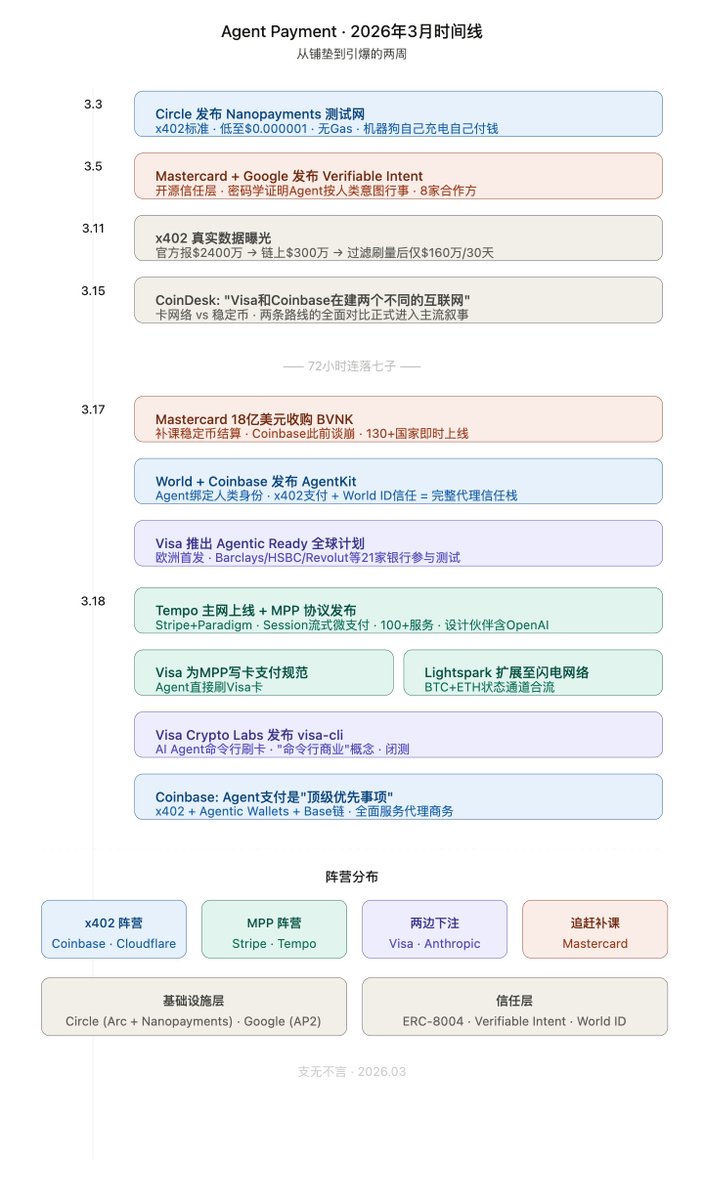
Four pieces on the same game board. A long-awaited battle for standards has officially begun.
The story starts with 402. Marc Andreessen once referred to the lack of native payment capability on the internet as "original sin." The HTTP protocol was inherently capable of transmitting text, images, and videos, but it could not transmit money. This flaw gave rise to the entire advertising economy; since users were unwilling to pay for content, advertisers stepped in to foot the bill. Thus, we ended up with a free but monitored internet.
402 could have changed all of that. Imagine this: your browser accesses a paywalled article, the server returns a 402 status code, the browser pops up a built-in micropayment interface, you click confirm, one cent is credited, and the article is unlocked. The entire process would be as natural as loading an image.
But the technology of the 1990s could not deliver on this vision. There were no mature digital cash solutions, no low-cost settlement channels, and SSL and TLS were just beginning. 402 became a placeholder ahead of its time.
Thirty years later, it was awakened by a Canadian.
Erik Reppel, a graduate of the Computer Science department at the University of Victoria, worked as an engineering lead at the Web3 social company Zora before joining Coinbase. Once he joined Coinbase's developer platform, he started a project he referred to as "Coinbase's exploration since 2015": designing a native payment standard for the internet.

One of his inspirations was the Bitcoin payment channel experiment conducted by former Coinbase CTO Balaji Srinivasan during his time at 21.co. The idea of that solution was correct, but it failed on cost. Back then, each on-chain transaction's gas fee was several dollars, making micropayments impossible. By 2024, Layer 2 networks had already reduced the cost of individual transactions to less than a tenth of a cent.
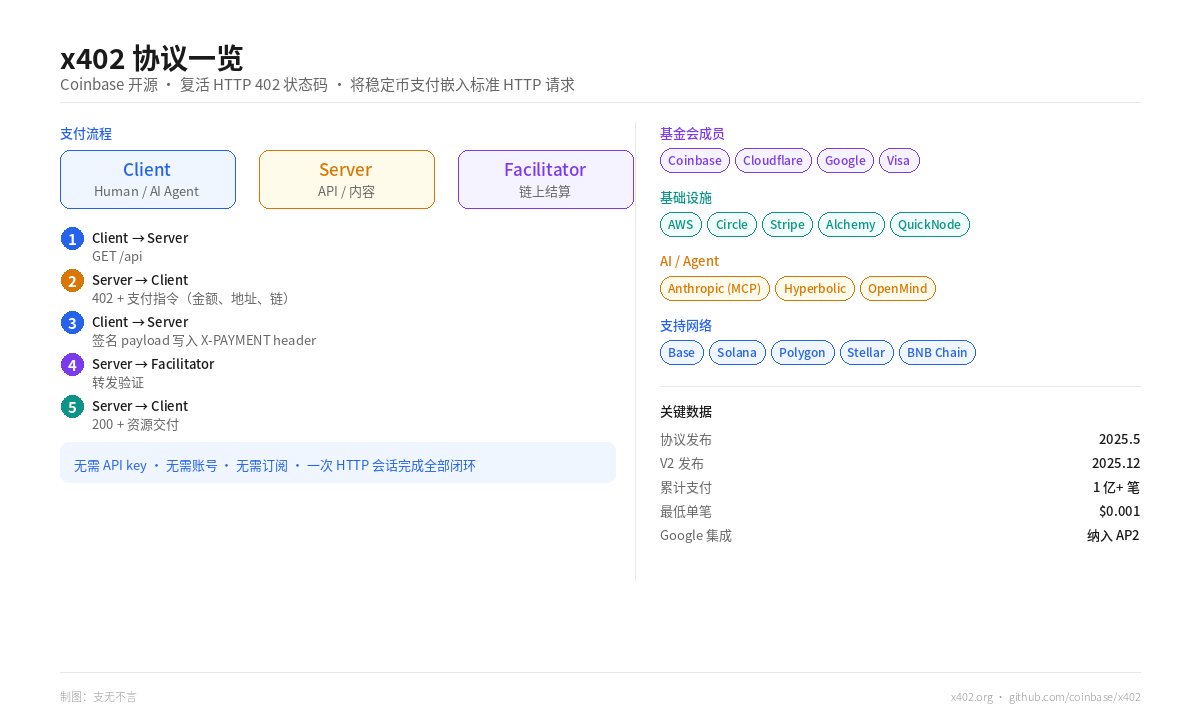
The timing was finally right. In May 2025, Reppel, along with colleagues Nemil Dalal and Dan Kim, jointly published a white paper announcing the official launch of the x402 protocol. Its logic is clean and direct: the client requests a resource, the server returns HTTP 402 and a JSON payload specifying the price, accepted tokens, and wallet address; the client signs the payment with a wallet, settles on-chain, and the server returns the resource. The entire process takes two seconds.
x402 chose the purest path: protocol-native, on-chain settlement, no intermediaries required. It directly integrates into the HTTP layer, like DNS and TLS, aiming to become infrastructure for the internet. Coinbase and Cloudflare subsequently co-founded the x402 Foundation, delegating protocol governance to a neutral foundation. What does Cloudflare's involvement mean? Approximately 20% of global web traffic passes through Cloudflare's 300+ data centers, integrating x402 into its Agents SDK and MCP server. This is a distribution advantage that competing protocols find hard to replicate.
But another Canadian has a different perspective.
Liam Horne, a graduate of the University of Waterloo, entered the Ethereum space in 2016 and was once a classmate of Vitalik Buterin (both received Thiel scholarships). His initial attraction to blockchain stemmed from a simple reason: software can transfer funds directly between each other, without needing banks.

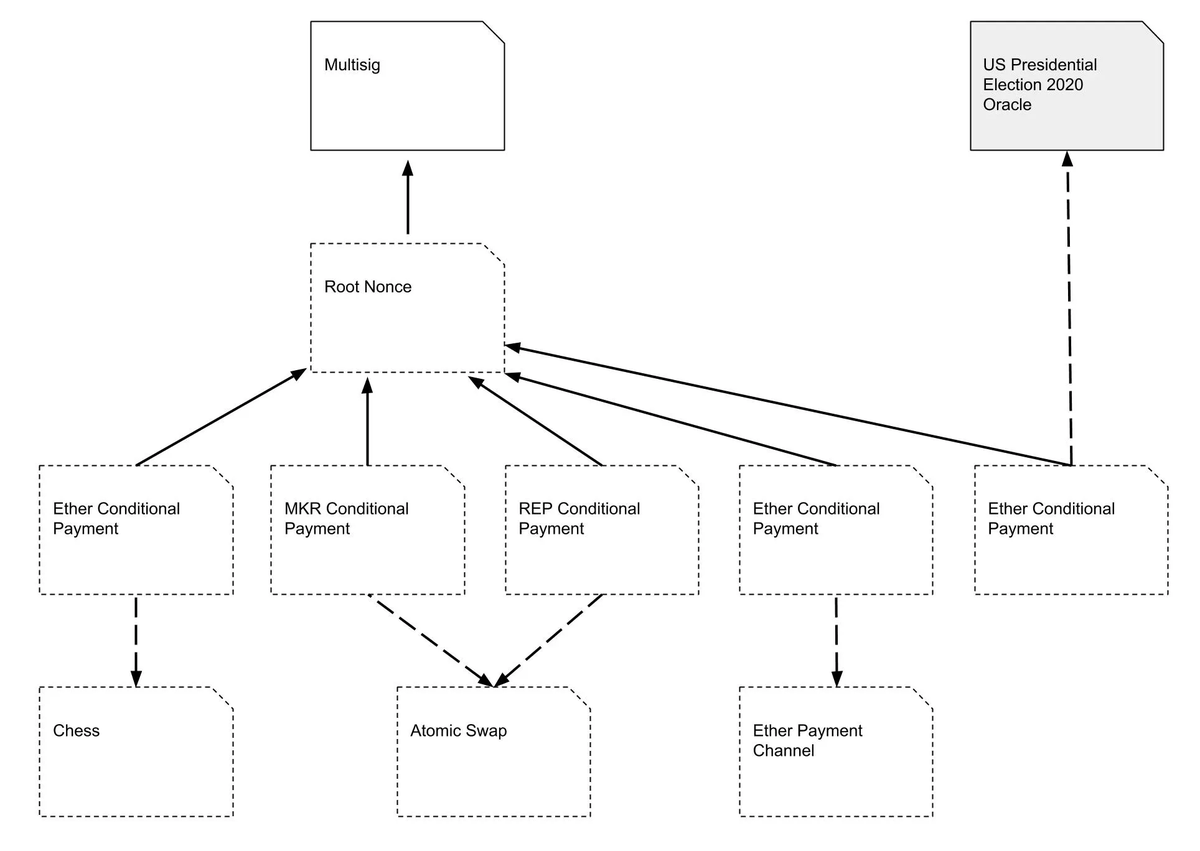
However, Ethereum was too slow and too expensive. In 2017, Horne and Jeff Coleman proposed the concept of "generalized state channels" at L4 Ventures. The two parties lock funds into a multi-signature contract, exchange signed transactions off-chain at any speed, and ultimately only settle the net results on-chain. Zero fees, instant settlement, theoretically allowing thousands of transactions per second.
They also invented a technique called "counterfactual instantiation," treating the contract as if it had been deployed for interaction when it had not interacted with the chain at all. This idea directly inspired Vitalik's proposal of EIP-1014, which later became widely used for account abstraction and cross-chain deployment with the CREATE2 opcode.
Horne's proudest demo is called Web3Torrent: a torrent downloading client where the downloader and uploader make micropayments for each piece downloaded. For every fragment of a file downloaded, a tiny amount is paid. Machines pay machines, with no human involvement.
But the problem is—no one needs this.
From 2017 to 2020, the main narrative of the Ethereum ecosystem was DeFi and trading, not payments. State channel technology was viable, but it found no users. It was like a completed toll station with no cars on the road. Horne admits that state channels became a "solution without a problem." Rollups emerged as a more universal scaling answer, and he turned to Optimism.
At Optimism, Horne's resume skyrocketed: engineering lead, CEO, expanding the team from 8 to nearly 70 people, leading the OP Stack development, and driving the collaboration between Superchain and Base. And Base is Coinbase's L2 chain. The two threads intersected here for the first time.
Later, Horne left OP Labs to become an advisor and participated in building World Chain. In the summer of 2024, he began to intensively study stablecoins. The success of Base made him realize one thing: the synergy between Coinbase, Circle, and Base almost replicated the expansion path of Tether, Tron, and Binance outside the US. Stablecoins were no longer a niche narrative; they accounted for 70% of all blockchain transaction volume.
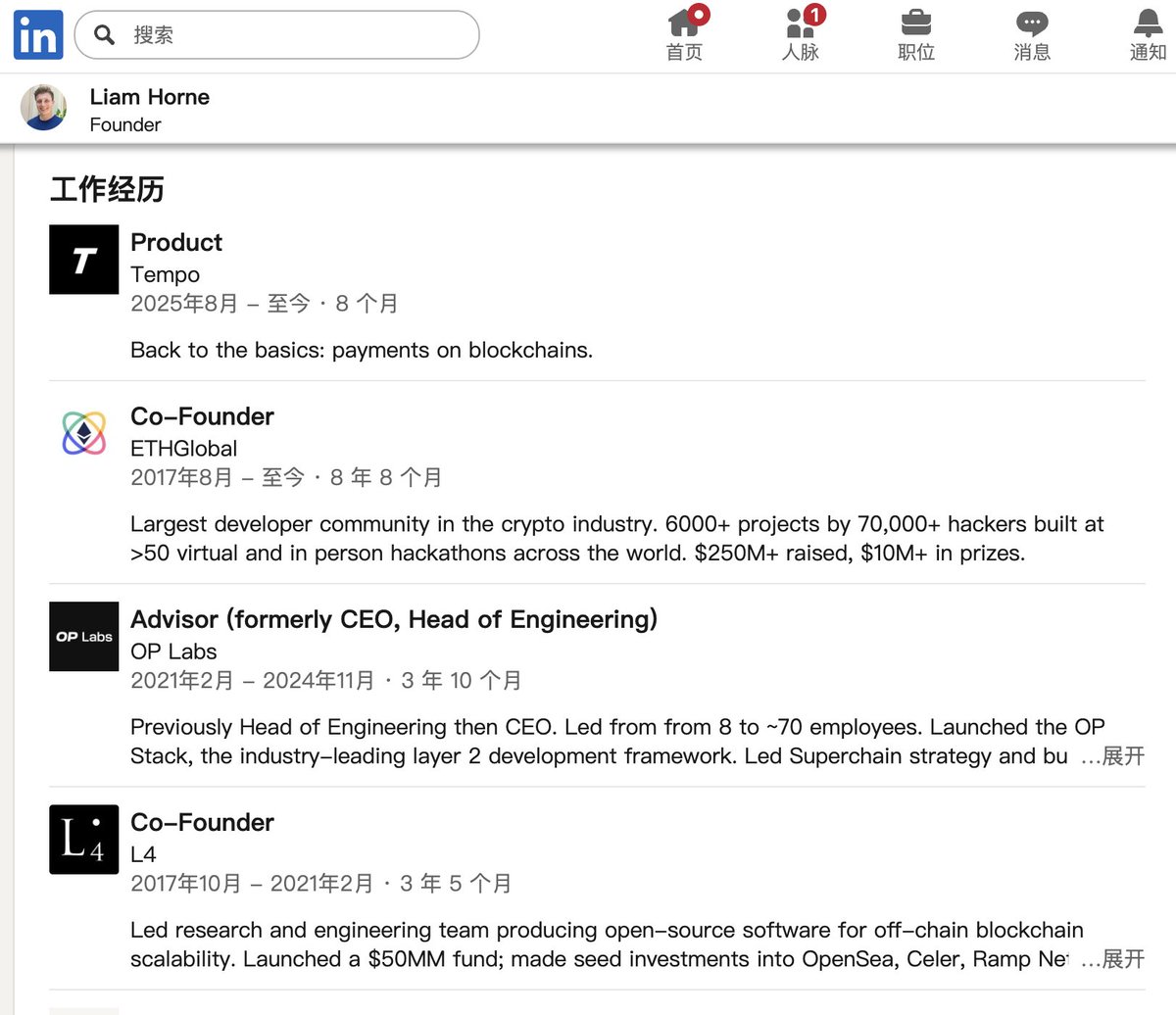
In September 2025, Tempo completed $500 million in Series A funding at a valuation of $5 billion, co-incubated by Stripe and Paradigm. Horne serves as engineering lead. Paradigm's CTO Georgios Konstantopoulos and co-founder Matt Huang are also deeply involved.
Horne spent six years helping scale Ethereum, first through state channels and then Optimism. Then he left to create a corporate-backed, not decentralized L1. In the same week Tempo's mainnet launched, OP Labs announced a 20% layoff, and Vitalik had previously publicly dismissed the L2 route. His classmate and scholarship peer seemed to have made his choice earlier.
This is not the only intriguing instance of personnel movement.
In February 2026, two co-founders of the decentralized social application Farcaster, Dan Romero and Varun Srinivasan, supported by Vitalik, announced their joining of Tempo. Before founding Farcaster, Romero was Coinbase's 20th employee, starting in 2014 and eventually becoming VP, overseeing international and consumer businesses. Srinivasan also came from Coinbase, having worked on engineering and product.
Their departure from Farcaster was also quite dramatic. After Neynar acquired the Farcaster protocol, the founding team collectively exited, with Romero announcing that he would return all $180 million raised to investors. He then wrote on X: "Stablecoins are an opportunity for a generation."
And that's not all. Tempo also poached Dankrad Feist, one of the key architects of Ethereum's L1 scaling route from the Ethereum Foundation, meaning that Tempo's core team now has at least two former Coinbase executives, a former CEO of Ethereum L2, and a former researcher from the Ethereum Foundation. Meanwhile, on the other side, Coinbase is pushing forward with x402. In a sense, this battle for standards is not only a showdown between Coinbase alumni but also a quiet schism within the Ethereum ecosystem.
So, what exactly is Tempo's MPP doing? How does it differ from x402?
The MPP protocol designed by Horne for Tempo can be summarized in one sentence: the session mode of state channels is moved to the application layer.
In the x402 world, every time an Agent calls an API, it must complete an on-chain transaction. This is manageable in low-frequency scenarios, but when an AI Agent needs to call thousands of interfaces within a few minutes, going on-chain every time means huge friction and delay.
The solution of MPP is Sessions: the Agent undergoes a handshake authentication, sets a spending limit, and then can freely call hundreds or thousands of APIs within this Session, with all expenditures packaged and settled at the end of the Session. Formally, this is very similar to the state channels Horne created on Ethereum nine years ago: locking funds, off-chain interactions, one settlement.
Another key difference is the payment method. x402 is purely on-chain stablecoin settlement, naturally decentralized but also inherently excludes fiat currency. MPP, however, follows the "payment agnostic" route, supporting stablecoins, credit cards, and even Bitcoin's Lightning Network. The integration of the Lightning Network is achieved through Lightspark, which itself is a "state channel" for Bitcoin. Notable is that the founder of Lightspark is David Marcus, former President of PayPal and one of the core creators of Libra.
Within the architecture of x402, there is also an important role called Facilitator, which is neither buyer nor seller but a third-party verifier caught in between. After the Agent signs the payment, the money does not go directly to the merchant but first passes through the Facilitator to verify the signature, confirm the balance, and execute on-chain settlement before releasing the resource. It adds an extra step, but this extra jump bears all the dirty work: anti-fraud, compliance checks, and settlement execution. Merchants do not have to worry about anything; they just need to know "the Facilitator said okay, the money is there."
MPP cuts out this role. Horne's logic is: since both Agents and merchants will become increasingly intelligent, why do we need an intermediary? Verification, encryption, settlement, all handled by the merchant's server. The chain is shorter, the delay is lower, and there are no middlemen making a profit off the spread.
But the cost is direct. The logic of encrypting and decrypting card payments falls on the merchant, along with the responsibility for PCI compliance. For large merchants like Shopify and DoorDash, who have already integrated the complete Stripe system, this is not an issue. But what if the future merchant is an AI Agent—"a zero-human company" with no compliance team or legal department—how will it handle these? MPP currently has no answer to this question.
Visa has also written card payment specifications for MPP. For merchants, integrating MPP equates to plugging into the existing Stripe system. Tax calculations, fraud protection, refund processing—it's all ready out of the box. The cold-start advantage of millions of global merchants using Stripe is something x402 cannot compete with in the short term.
Since the launch of x402 in May 2025, it has officially claimed to handle over 100 million payments. Bloomberg cited data from x402.org reporting that Agents completed $24 million in payments within 30 days. However, original data from blockchain analysis platform Allium Labs shows the actual on-chain flow was approximately $3 million during the same period. Analysts at Artemis Analytics further applied a wash trading filter to cleanse the data, marking wallets that frequently traded among themselves or cycled funds between addresses, ultimately arriving at a final figure of $1.6 million.
This discrepancy may not necessarily signify a failure for x402, but it certainly indicates how early the entire Agent payment sector is. What are the Agents really buying? Almost entirely developer tools on a pay-per-use basis. Firecrawl charges one cent for each query on web scraping, Browserbase sells browser sessions, Freepik sells AI image generation. Users are not coming for cryptocurrency; they are attracted by "no need to register, no need to subscribe, just use with one wallet signature." The author of the data analysis article at the end calculated that it cost him $0.47 in total to write the full piece using x402 to query data from Allium.
$1.6 million is not a huge number. But none of Stripe, Cloudflare, or Google are betting on a market of just $1.6 million per month. They are betting on the number after Agents become the default buyers. And McKinsey predicts that by 2030, the scale of Agent payments will reach $3 trillion to $5 trillion.
Interestingly, the market has not chosen to take sides.
Almost all top players have chosen to hedge their bets on both sides. Stripe is both a draft author of MPP and an early adopter of x402. Anthropic is simultaneously compatible with both protocols through MCP. OpenAI has demos on MPP and also appears in the ecosystem of x402. Google has not engaged directly in building a settlement protocol but has created an authorization framework AP2, subsequently embedding x402 directly within it. This illustrates that the complexity of this war goes beyond just "two protocols fighting."
It is a rational hedge. Just as early internet companies simultaneously supported HTTP and HTTPS, not because they couldn't distinguish the two but because no one wants to make a wrong bet during the migration period.
However, the underlying philosophical divide is real.
x402 believes in "protocol as infrastructure." It aims to become the TCP/IP of the payment field. Permissionless, chain-agnostic, anyone can connect, not dependent on any commercial entity. Currently, the ecosystems of Ethereum, Base, and Solana are fully integrating x402, and it is becoming the core payment channel for the Agent to Agent economy.
MPP believes in "infrastructure as protocol." It is backed by the commercial empires of Stripe and Visa, first capturing the Agent demands of the traditional payment world and then gradually expanding on-chain. Merchants are already receiving payments through Stripe; adding a layer of MPP allows them to accept automatic payments from Agents.
Some liken them to TCP/IP and AOL in the early days of the internet. But this analogy is not entirely accurate; MPP is also open-source and claims to be an open standard. However, as multiple developers have pointed out, MPP's documentation clearly recommends Tempo as the settlement layer, and its SDK currently only supports TypeScript, while x402 already has multi-language support in TS, Python, Go, and more. Some evaluations have been quite precise—MPP is seen as "a vertically integrated, non-neutral x402."
But regardless of which protocol wins, they both need to operate on-chain, while the real foundational supply of stablecoins is not on any new chain.
Ethereum's mainnet plus its Rollups (Arbitrum, Base, Optimism) holds over $170 billion in stablecoin supply, with a monthly turnover of approximately $2.8 trillion. x402 currently runs mainly on Base and Solana, which is where micro payments from Agents are occurring. Looking further down, Tron processes over $600 billion in stablecoin transfers each month, mostly small cross-border remittances under $1000. It may not be in Silicon Valley's narrative, but it is the network with the largest stablecoin usage globally.
Building upon this existing landscape, two new chains "born for stablecoins" are simultaneously entering the scene. Stripe has Tempo, and Circle has Arc; both chains are targeting sub-second confirmations, predictable fees, and compliance privacy, each claiming to build the next generation of payment infrastructure. However, they are either just launching mainnets (Tempo launched on March 18) or still in testnets (Arc plans to launch its mainnet in 2026), with none having been validated through large-scale real transactions.
Two new chains are challenging three established chains and their second layers, two sets of protocols are competing for standards, and several payment giants are positioning themselves. The table is becoming increasingly crowded.
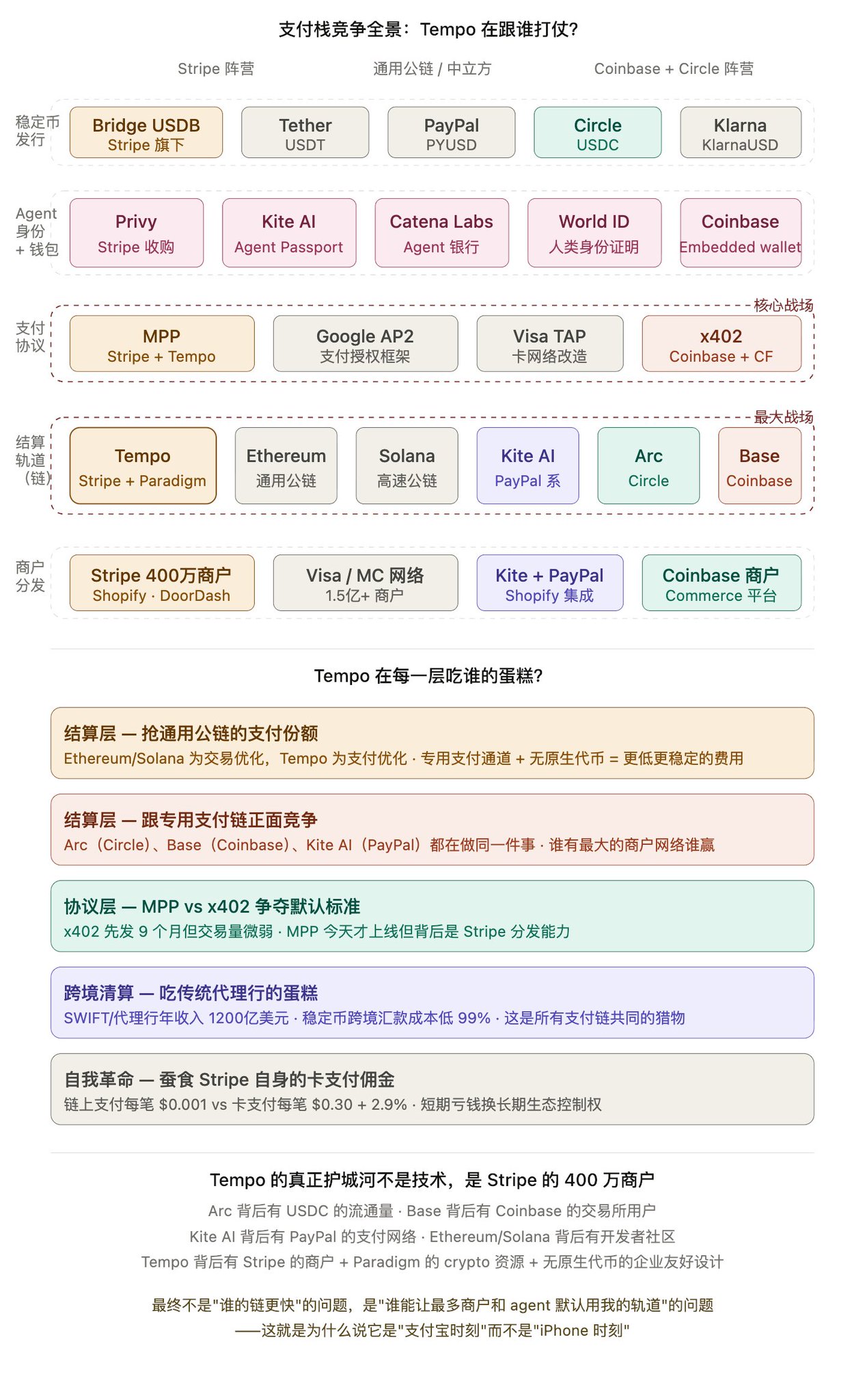
But at least, Agent Payments are bringing formidable challengers into the mix. Ethereum and Solana were designed for general computation, and stablecoin payments can run on top, but they are not optimal; gas fees fluctuate with network congestion, and settlement certainty depends on the overall load of the chain, while compliance privacy requires additional construction. What Agents need is precisely certainty: predictable fees down to the cent, millisecond finality, out-of-the-box compliance frameworks. The three new chains have designed from the very first line of code for these requirements, betting that the incremental market for Agent payments is sufficiently large to bypass the established advantages of the old chains and directly establish a foothold in the new field.
The logic of this bet is simple: the number of Agents is likely to far exceed that of humans. A human swipes a card a few times a day; an Agent could call APIs hundreds of times in a second, with each call being a micropayment. Coinbase's Brian Armstrong has said that soon the number of online Agents will surpass human users. But today's Agents hardly own any wealth; they do not have their own wallets or budgets, and every cent spent must be approved by a human. The battlefield for standards is about capturing that critical point where Agents transition from "running errands for people" to "spending autonomously." Whichever protocol has laid out the pipeline at that moment will catch this wave of traffic.
Tim Berners-Lee in 1996 could not have predicted the current situation. He left an interface in the HTTP protocol for payments, like leaving a window on a white wall. For thirty years, this window remained shut, until the AI Agents peeked in from outside and said: I need to spend money.
Thus, multiple teams rushed to install window frames for this window. One team believes in open protocols, another is backed by a commercial empire, and some are trying to build trust layers between the two. Many of those standing in between have overlapping names, coming from the same office, walking toward opposing directions.
This standard battle has only just begun. Who wins and who loses may not depend on the technology itself, but on who makes that window indispensable first. After all, in the history of the internet, it has never been the most elegant protocol that won, but the one most widely used.
But one thing is certain: that dormant 402 status code, long asleep for thirty years, has finally awakened. And this time, it is not a human knocking at the door.
免责声明:本文章仅代表作者个人观点,不代表本平台的立场和观点。本文章仅供信息分享,不构成对任何人的任何投资建议。用户与作者之间的任何争议,与本平台无关。如网页中刊载的文章或图片涉及侵权,请提供相关的权利证明和身份证明发送邮件到support@aicoin.com,本平台相关工作人员将会进行核查。


