Written by: @Merkle3sCapital
Introduction | The Overlooked Technological Foundation
When people saw Zhao Changpeng (CZ) rise to the top of the Chinese rich list in 2021 with a fortune of $90 billion, the mainstream narrative boiled it down to being a "lucky winner in the ICO boom." But this narrative overlooks a key fact:
Binance was able to reach the top of global trading volume in 165 days, underpinned by a high-frequency trading system engineer with 20 years of experience, who forcibly injected Wall Street-level technical logic into the nascent and chaotic cryptocurrency industry.
Unlike many idealistically driven blockchain evangelists, CZ is a pure, rigorously trained trading system architect. His career did not start at Binance, but began with the matching engine at the Tokyo Stock Exchange, the futures system at Bloomberg Tradebook, and microsecond-level high-frequency trading at Shanghai Fuxin Information.
This article aims to discuss that part of CZ that is overlooked by the public narrative: a trading system engineer’s decade-long dormancy, and how he achieved a comeback with a technological foundation.
Chapter One | Bloomberg Tradebook: Engineering Training in Futures Systems (2001-2005)
In 2001, CZ joined Bloomberg in New York, responsible for the development of the Tradebook futures trading platform.
In the financial environment at the time, the demands on real-time performance and stability for futures trading systems were far greater than for the spot market. Futures contracts involve leverage, real-time margin settlements, and complex exercise rules, which required the underlying matching engine to have extremely high transaction processing power.
During his four years at Bloomberg, CZ rose from a junior developer to the Head of Tradebook Futures Development.
His core technical contribution was the optimization of the "order execution system"—ensuring that buy and sell orders were executed at optimal prices in a volatile market environment while minimizing slippage.
This experience allowed CZ to deeply understand three core capabilities:
Redundant Design: Financial systems cannot go down
Data Synchronization Across Locations: Real-time consistency in global trading
System Resilience Under Massive Concurrent Load: Stability in extreme market conditions
These capabilities later became the foundational genes of Binance’s matching engine.
Many people do not know that CZ's last position at Bloomberg was "Head of Futures Development." This was not purely a management role, but a technical leadership position that required writing code and tuning systems personally.
Chapter Two | Shanghai Fuxin Information: Microsecond-Level Racing Logic (2005-2013)
In 2005, CZ resigned and returned to Shanghai to found Fuxin Information (Fusion Systems).
This is the most underestimated phase of CZ's technical career and the true origin of Binance’s technology.
Fuxin Information's client list includes top investment banks such as Goldman Sachs, Deutsche Bank, and Credit Suisse, with its core business providing ultra-fast automated high-frequency trading platforms for these institutions. In the realm of high-frequency trading, latency is the only metric to measure system performance.
CZ led three key technological innovations:
1. In-Memory Processing. To avoid the latency associated with traditional hard disk data reads, CZ designed an architecture where the entire order book resides in memory. This design places extremely high demands on hardware costs and system stability, but can improve data access speed by several orders of magnitude.
2. Streamlined Risk Checks. Traditional banking systems have elaborate compliance checks before placing orders; CZ optimized algorithms to simplify the risk verification process without sacrificing safety, significantly reducing the "round-trip time" of orders.
3. Server Colocation. In the market contest between Shanghai and Tokyo, CZ took the lead in promoting the strategy of physically placing trading servers next to exchange servers to shorten fiber optic transmission distances.
Through these means, Fuxin Information pursued latency optimization at the 20 microsecond level. In the HFT industry standards from 2005 to 2013, the breakthrough in technology was marked by reducing tick-to-trade latency from the 100-microsecond level to the 20-microsecond level.
This obsession with speed made it possible for CZ to develop an engine capable of processing 1.4 million transactions per second when he re-entered the cryptocurrency market in 2017. Meanwhile, the systems of most competitors frequently crashed under peak loads.
Binance’s technological moat did not appear out of thin air in 2017; it was honed microsecond by microsecond over the eight years at Fuxin Information.
Chapter Three | OKCoin: Clash of Character and Principles (2014-2015)
In 2014, CZ was invited by He Yi to join OKCoin as CTO.
This collaboration lasted less than a year but ended in a fierce public feud.
Yet this split shaped CZ's later management style at Binance.
The conflict between CZ and OKCoin (now OKX) founder Xu Mingxing essentially involved the clash between "transparent values" and "traditional gray market thinking":
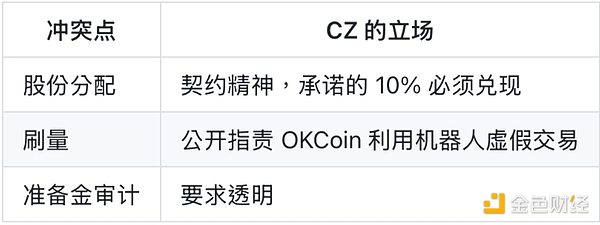
The "contract forgery case" that broke out in 2015 was the trigger for their complete rupture. CZ, representing OKCoin, reached an agreement with Roger Ver to manage the Bitcoin.com domain name, but Ver later accused OKCoin of refusing to make payments. CZ supported Ver’s claims and implied that OKCoin had forged a version of the contract that included termination clauses.
This feud cost CZ dearly—he found himself in a low point within the crypto sphere, but it also established his technical reputation of "not doing evil."
This invisible asset was successfully converted into investor trust during the 2017 ICO boom.
CZ's "directness and principle" are not mere social performances but a form of logic-based engineering thinking: pursuing fairness, efficiency, and absolute execution of contracts.
Chapter Four | Bijie Tech: Binance’s Invisible Laboratory (2015-2017)
Many people think that Binance was suddenly created in July 2017. In fact, Bijie Tech, founded by CZ after leaving OKCoin in 2015, was Binance’s true "laboratory."
Bijie Tech’s main business was providing cloud-based "white label" trading systems for various exchanges dealing with postal currency cards, collectibles, etc. Over two years of operation, CZ accomplished three key accumulations:
Technical Iteration. Simplified the originally costly high-frequency system designed for investment banks into a cloud-based architecture for large-scale deployment.
Talent Pool. The core development team during Binance’s early startup period was almost entirely inherited from Bijie Tech. This meant that Binance had a well-trained team proficient in matching engine optimization before the ICO even began.
Market Insight. While providing services to other exchanges, CZ saw the fragile points of the trading systems at that time—specifically, their inability to handle explosive user growth.
When the Chinese government began shutting down various informal exchanges in 2017, Bijie Tech’s business was hit hard. Still, this instead prompted CZ to shift all his energy toward cryptocurrencies and to directly convert the mature Bijie system into the underlying kernel of Binance.
This "plug-and-play" technological reserve enabled Binance to achieve performance leaps within just months of launching, which would typically take other exchanges years to achieve.
Chapter Five | Technological Deconstruction: Binance’s Core Competitiveness
Binance’s ability to dominate its peers in 2017 was not due to luck; it was the result of technological advantages.
Binance’s early system performance metrics
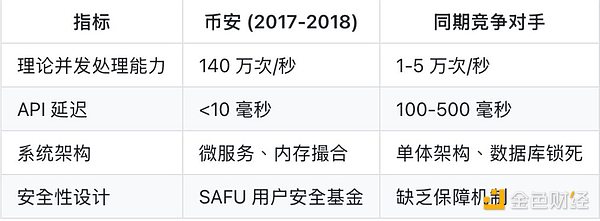
Where does Binance’s technological advantage come from?
Matching Engine: Direct inheritance of Fusion Systems' microsecond HFT architecture, memory state machine design, no MySQL select latency.
Data Center: Tokyo servers, minimizing physical distance for Asian users.
Architectural Design: Microservices, memory matching vs. competitors’ monolithic architecture and database locks.
CZ’s Criticism: Huobi/OKCoin’s early use of floating point matching and timers led to high latency and potential backdoors.
2024-2025 Technology Comparison
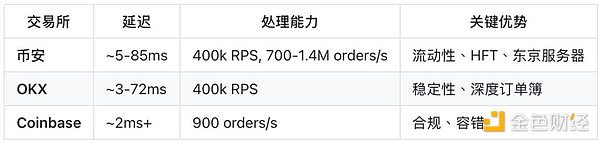
Binance's technological moat was honed by CZ over 20 years, microsecond by microsecond.
Chapter Six | He Yi: The Overlooked Growth Engine
CZ's technical abilities needed a partner who understood operations and the market to be fully unleashed. This person is He Yi.
Path from OKCoin to Binance
Joined OKCoin in 2014 as Co-Founder/Vice President, responsible for branding (once advertised in Times Square in New York)
Left with CZ in 2015
Joined Binance as CMO in August 2017
He Yi's Core Contributions
BNB Token Economic Model
Designed BNB as the exchange's "fuel," providing discounts when users pay fees with BNB, forming an ecosystem cycle.
Raised $15 million through ICO to support early expansion. Recommended a rebate system offering 20% commission rebates, enabling spontaneous spread and growth through the "Binance Angels" volunteer system.
Global Layout
Avoided China's "94 Regulation," quickly shifted to Japan, Malta, etc., supporting multilingual coverage across 180+ countries.
Key Data
Binance entered the global top ten within 42 days
Reached the top of trading volume in 165 days (about 180 days)
Over 280 million users, trading volume accounting for 41% of market share
In 2025, He Yi was promoted to Co-CEO of Binance.
The "technology + operations" dual-drive of CZ and He Yi is the core reason why Binance could outpace its peers in just half a year.
Chapter Seven | Early Capital: The Betting Nature of Chen Weixing and Zhang Liang
Binance's success is often described as the heroism of CZ alone, but without the capital backing from early key investors, it would have been hard for CZ to establish himself during the chaotic era of 2017 relying solely on technology.
Chen Weixing (Global Capital): Intuitive Investment from a KTV
Chen Weixing was one of Binance's earliest angel investors. In July-August 2017, just over a month after Binance was established, Chen Weixing quickly decided to invest after drinking in a KTV—an amount of about 25 million yuan for approximately 5% equity.
Interestingly, He Yi initially didn't believe this news until the funds were confirmed to have arrived.
His investment logic was based on three points:
Peer Recognition: Compared CZ to Wang Xing of Meituan, believing he had a "computer-like brain"
All-in Betting Belief: CZ’s action of selling his Shanghai property to "All In" on Bitcoin in 2014 made a deep impression on Chen Weixing
Resource Leveraging: Chen Weixing not only invested money but also used all social resources to endorse Binance
Subsequent Disputes: After Binance's valuation skyrocketed (reaching over $300 billion), Chen Weixing and CZ had disagreements over equity confirmation and repurchase valuation; he believed he was undervalued and even prepared to sue. But this did not affect him from becoming a legendary investor who "invested in two billionaires" (ByteDance's Zhang Yiming and Binance's Zhao Changpeng).
Zhang Liang (Black Hole Investment): The Cross-Industry Bet of a Real Estate Heir
Zhang Liang is the son of Zhang Li, co-founder of R&F Properties, and is one of the "Four Young Masters of Beijing." Black Hole Investment participated in Binance’s angel round in 2017, marking a typical real estate capital crossing into a new track.
By the way, the former CFO of Huobi, Chris Lee, later became the president of Zhang Liang's Black Hole Investment.
Common Characteristics of These Investors: They are not professional VCs but rather individuals/family capital, making quick decisions and willing to bet. They invest not in PPTs but in CZ as a person—a radical certainty of an "All In" mentality.
Conclusion | The Capital Miracle Under the Engineer's Reign
Zhao Changpeng’s career is not a simple wealth creation movement, but a classic case about "technological compounding" and "principle realization."
The technological foundation is the ballast of Binance. The rigor of Bloomberg and the extreme speed of Fuxin Information gave CZ the capability to strike dimensionally against the crypto market. He introduced microsecond-level racing logic into a nascent market that couldn't even guarantee a one-second delay.
"Direct and principled" character is the sharp blade of his capital game. Although the rupture during the OKCoin period left him in a low point, it also established his technical reputation of "not doing evil" in the industry.
The loyalty logic of capital and old teams. The entry of Chen Weixing, Zhang Liang, and others valued CZ’s extreme certainty as an "All In" person. Meanwhile, Bijie Tech's technological reserve ensured that after these capital inputs, they could quickly transform into highly competitive products.
Ultimately, CZ's logic lies in: In a highly volatile and trust-deficient industry, the most stable and transparent technical architecture is the best marketing tool.
This pursuit of "logic and computational power at the peak" constitutes the most overlooked yet core driving force in his career.
Note: Investment carries risks; market entry should be cautious. This information is not intended as investment advice.
免责声明:本文章仅代表作者个人观点,不代表本平台的立场和观点。本文章仅供信息分享,不构成对任何人的任何投资建议。用户与作者之间的任何争议,与本平台无关。如网页中刊载的文章或图片涉及侵权,请提供相关的权利证明和身份证明发送邮件到support@aicoin.com,本平台相关工作人员将会进行核查。