Author: FinTax
In March 2026, NYSE Arca and NYSE American, subsidiaries of the New York Stock Exchange, officially submitted a rule change application to the Securities and Exchange Commission (SEC) to eliminate the 25,000 contracts position and exercise limits for 11 spot Bitcoin and Ethereum ETF options. The SEC approved the aforementioned application and waived the 30-day waiting period for rule changes, allowing the changes to take effect immediately after submission. From the breakthrough approval of spot Bitcoin ETFs to the full alignment of the cryptocurrency derivatives market with traditional commodity ETF frameworks, this series of changes reflects a shift in U.S. cryptocurrency regulation from defensive control to actively promoting financial innovation, which may profoundly reshape the allocation landscape of institutional-grade crypto assets.
1. A Decade of Waiting: The Breakthrough Path of Bitcoin Spot ETFs
To understand the significance of this rule change, we first review the long journey of integrating cryptocurrency assets into the traditional financial system. As early as July 1, 2013, the Winklevoss Bitcoin Trust, promoted by Cameron and Tyler Winklevoss, submitted an S-1 registration statement to the SEC, regarded as one of the earliest attempts to file for a Bitcoin spot ETF in the United States, thus starting a more than ten-year regulatory chess game. In the decade that followed, the SEC disapproved over 20 applications, citing reasons such as market manipulation risks, lack of effective monitoring mechanisms, and insufficient market size for Bitcoin.
This deadlock was finally broken on January 10, 2024. On that day, the SEC approved the listing of 11 spot Bitcoin ETFs, including the BlackRock iShares Bitcoin Trust (IBIT), Fidelity WiseOrigin Bitcoin Fund (FBTC), ARK21Shares Bitcoin ETF (ARKB), and Grayscale Bitcoin Trust. The approval stated that complete disclosure obligations, exchange anti-fraud rules, and broker conduct codes would apply to these products on SEC-regulated exchanges, providing investors with the same institutional protection as traditional assets.
The launch of the spot Bitcoin ETF quickly created a rare record of product expansion in financial history. The BlackRock IBIT became the fastest ETF in history to reach an asset size of $50 billion, achieving what usually takes decades for traditional ETFs in less than a year. As of January 2026, the assets under management of Bitcoin spot ETFs surpassed $125 billion, with IBIT alone managing over $56 billion.
2. Establishing the Options Market: Testing the Waters under Strict Constraints
The successful listing of Bitcoin ETFs paved the way for derivatives trading. In October 2024, NYSE American obtained SEC rule authorization to begin listing Bitcoin ETF options, explicitly stating that each fund would have a position and exercise limit of 25,000 contracts. This restriction was not accidentally set, but rather had profound institutional logic.
According to the SEC's statements in the approval documents, the Exchange Act's requirement for position limits is to prevent investors from disrupting the underlying market by holding a disproportionate amount of contracts relative to the deliverable supply and average trading volume. At the beginning of the approval of Bitcoin ETF options, historical market liquidity data was still insufficient, and the limit of 25,000 contracts was a conservative balance struck by regulators between opening options and market stability. In contrast, the maximum position limit for traditional equity ETF options can reach 250,000 contracts, and the upper limit for large liquidity ETFs (such as the gold ETF GLD) is even higher.
On November 19, 2024, Nasdaq partnered with BlackRock to launch IBIT options, marking a landmark chapter for the crypto asset derivatives market. On the first day, there were 353,716 contracts traded, placing it in the top 1% of trading volume in the U.S. options market, making it the fifth most active ETF product of the day and the sixteenth most active options product. The nominal risk exposure on the first day was nearly $1.9 billion, with a ratio of call options to put options of about 4.4:1, showing extreme optimism in the market regarding Bitcoin's price movement. Bloomberg ETF analyst Eric Balchunas described it as "unprecedented," noting that this first-day performance far exceeded the $363 million record set by the ProShares Bitcoin Strategy ETF (BITO) on its first day in 2021.
Remarkably, the launch of IBIT options almost simultaneously triggered Bitcoin's price to break above $94,000 for a new high. Analysts believe that the large buying of call options generated a Gamma hedging demand among market makers, thereby pushing up Bitcoin's spot price. This market interconnection effect proves that the options market for crypto assets has attained price discovery functions comparable to traditional financial derivatives.
3. Institutional Evolution: Gradual Breakthrough from 25,000 to No Limits
Phase 1: Early to Mid-2025 First Adjustment
The specific limitation of 25,000 contracts quickly emerged as a constraint. In February 2025, NYSE Arca submitted a rule change to raise the position limit for BTC and BITB options from 25,000 to 250,000 contracts as per general rules, which was approved by the SEC in July 2025. The core threshold for this adjustment was that the underlying ETF must have traded at least 100 million shares in the past six months, or at least 75 million shares with at least 300 million shares issued in the past six months. GBTC also completed a similar adjustment through a separate rule change during the same period. Nasdaq ISE’s similar adjustment for IBIT entered the announcement process in early 2025, with formal approval on July 29, 2025.
Phase 2: Late 2025 to Early 2026 Exchanges Competing to Follow Suit
As demand continued to rise, various options exchanges began to update their rule frameworks competitively. In November 2025, Nasdaq ISE submitted a more aggressive proposal to the SEC, aiming to raise the IBIT options position limit from 250,000 to 1,000,000 contracts. ISE pointed out in its application documents that even if all 1 million contracts were exercised, it would only represent about 7.5% of IBIT’s outstanding shares and 0.284% of the global Bitcoin supply, which would not pose a market disruption risk.
Chronologically, major exchanges followed suit in succession, forming a clear roadmap of institutional change:
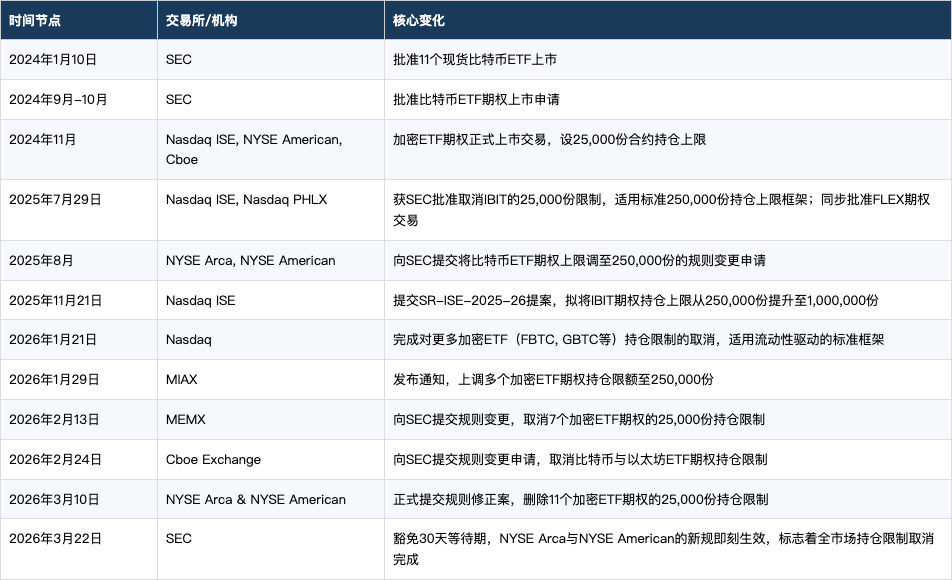
Table 1 Evolution Timeline of Crypto ETF Options Position Limits
Phase 3: March 2026 NYSE Completes the Final Piece
On March 10, 2026, NYSE Arca and NYSE American submitted rule change documents in the Federal Register aimed at removing the position limits and price discovery restrictions associated with Bitcoin and Ethereum ETF options contracts. On March 22, the SEC formally confirmed the above amendments and waived the standard 30-day waiting period for the two documents, effective immediately.
This rule change involves 11 crypto ETF products, including the BlackRock iShares Bitcoin Trust (IBIT), Fidelity Wise Origin Bitcoin Fund (FBTC), ARK21 Shares Bitcoin ETF (ARKB), Grayscale Bitcoin and Ethereum Trust, and Bitwise Bitcoin and Ethereum ETFs. After the removal of the limits, the position limits for these products will be dynamically calculated based on trading volumes and outstanding shares according to each exchange’s standard framework, allowing large liquidity ETFs to achieve limits of 250,000 or even higher. Furthermore, the rule change simultaneously opened up FLEX options trading, allowing institutions to customize strike prices, expiration dates, and exercise methods.
With this, all major U.S. options exchanges, including Nasdaq ISE, Nasdaq PHLX, MIAX, MEMX, Cboe, NYSE Arca, and NYSE American, have completed the removal of crypto ETF options restrictions.
4. Shift in Regulatory Paradigm: From Special Control to Equal Treatment
The most important regulatory implication of this change is that crypto ETF options officially gained the same status as other commodity ETF options. The limits for commodity ETF options, such as GLD, have always been anchored to liquidity and scale from the outset, never imposed with a fixed low limit of 25,000 contracts as was the case with crypto ETFs; whereas crypto ETF options had a firewall of 25,000 contracts specifically set up, implying suspicions by regulators regarding the maturity and stability of the crypto asset market. The removal of this firewall means that the SEC acknowledges that the Bitcoin and Ethereum ETF market possesses liquidity depth and market oversight mechanisms comparable to traditional commodities like gold.
At the same time, the SEC’s waiver of the 30-day waiting period for the application documents from NYSE Arca and NYSE American and their immediate effectiveness is a highly policy-driven signal. According to convention, the SEC only waives the waiting period when it believes that the proposed rule change presents no or only minor regulatory issues. This action may indicate that the current SEC no longer views the expansion of the crypto ETF scale as a potential risk requiring cautious observation.
Moreover, this transformation aligns closely with the current SEC leadership's policy orientation. In May 2025, newly appointed SEC Chairman Paul Atkins officially announced at a cryptocurrency working group roundtable that a “rational regulatory framework for the crypto asset market” would be developed, clearly stating the intention to incorporate blockchain and digital assets into the traditional financial market system. In July of the same year, Atkins further launched the "Project Crypto" initiative, systematically negating the previous regulatory approach that suppressed crypto innovation, committing to enhancing regulatory certainty through token classification regulations and revising the Howey contract determination framework. The previous era under Gary Gensler was characterized by the SEC's focus on enforcement lawsuits instead of rule-making, conveying negative signals to the crypto industry through extensive enforcement actions, starkly contrasting with the current policy direction.
Notably, the current round of rule changes was almost completed in a collaborative push within a few months, from Nasdaq ISE to Cboe and then to the two NYSE exchanges, rather than being the actions of a single exchange. This high degree of coordination indicates that there is a policy consensus between regulators and major exchanges behind the rule adjustments: aligning the institutional standards of the crypto derivatives market with traditional finance is a systematic goal of the current pro-crypto regulatory orientation, rather than an individual exemption.
5. Market Impact: Multifaceted Reshaping of the Crypto Derivatives Landscape
The removal of position limits directly impacts institutional investors by enabling large-scale hedging strategies. Previously, the limit of 25,000 contracts strictly limited any single entity's ability to hedge Bitcoin values through options, making it difficult for large hedge funds, asset management firms, and market makers to establish derivatives positions that matched their spot holdings. With the removal of limits, position sizes can reach 250,000 contracts or higher, allowing institutions to efficiently implement complex risk management tools such as covered call strategies, protective put strategies, and basis trading.
At the same time, covered call strategies have now become one of the fastest-growing application scenarios in the 2026 options market. In a volatile market environment, investors holding Bitcoin ETFs can earn 2% to 4% in monthly premiums by selling monthly call options, significantly higher than the yields from traditional fixed-income products. This provides a new allocation path for institutions focused on yield, balancing Bitcoin exposure and stable income, potentially attracting a group of institutional funds like insurance companies and pension funds that had previously been hesitant due to Bitcoin’s zero coupon characteristic.
Furthermore, the rule change simultaneously allows institutions to trade crypto ETFs as FLEX options, which is a deeply significant update that may be underestimated. FLEX options allow both trading parties to customize strike prices, expiration dates, and exercise methods and are core tools for structured products and large hedging positions, widely used in asset management and structured product design in traditional financial markets. Previously, the trading of crypto ETF options as FLEX was prohibited, severely limiting institutions' ability to construct customized risk management plans around Bitcoin ETFs. With this restriction lifted, more quantitative funds, structured product issuers, and market makers are expected to enter the crypto ETF derivatives market.
From a liquidity perspective, the removal of position limits will directly enhance the depth of the options market, promoting tighter bid-ask spreads. According to market microstructure theory, position limits artificially compress the trading scale of market participants, forcing market makers to raise quotations to manage risks when approaching their limits; with the removal of these limits, market makers will be able to manage Gamma and Vega risks more flexibly, thus providing more competitive quotations to the market.
From a price discovery perspective, the implied volatility surface of the options market, put/call ratio, and term structure are among the most forward-looking sentiment indicators in mature markets. The open interest of IBIT options currently stands at about 6 million contracts, exceeding its 52-week average (5.6 million contracts). As more institutional participants enter the market, the depth and breadth of the options market will further enhance, making Bitcoin's price discovery process more refined and closer to the standards of mature markets represented by gold and index options.
It is worth mentioning that Nasdaq ISE's proposal to raise the IBIT options position and exercise limits to 1,000,000 contracts is still under SEC review. According to current SEC disclosures, the comment deadline for this case is March 20, 2026, and the response comment deadline is April 3, 2026. If approved, IBIT will align with options for ETFs like EEM, FXI, and EFA at the same 1,000,000-contract level regarding position limits, which is expected to enhance IBIT options' market-making, hedging, and capacity for large trades, further strengthening its market functionality as a mainstream cryptocurrency ETF derivative tool.
6. Far-Reaching Impacts: The Structural Significance of Integrating Crypto Assets into Traditional Finance
From a broader perspective, the NYSE's removal of crypto ETF options restrictions is not an isolated technical rule adjustment, but the latest sign of the deep acceptance of crypto assets by the traditional financial system. In just two years, the market has completed several key institutional leaps. The approval of spot ETFs in January 2024 brought Bitcoin out of the regulatory gray area into a fully SEC-regulated investment product category, opening allocation channels for compliant-restricted institutions like pension plans and mutual funds. In November of the same year, the options market was subsequently established, introducing price discovery mechanisms and hedging tools, enabling Bitcoin to acquire a derivatives ecosystem comparable to stocks and commodities. Subsequently, from 2025 to 2026, the position limits were gradually lifted, aligning institutional standards with traditional commodity ETFs and removing the last institutional barriers to large-scale institutional participation; the simultaneous opening of FLEX options in March 2026 further allowed for customized contracts to meet deeper needs for structural products and complex risk management.
This evolutionary path highly parallels the historical trajectory of gold ETFs. After the listing of GLD in 2004, as the market matured and regulatory approvals were granted, the depth and breadth of the gold derivatives market gradually expanded, ultimately becoming an indispensable component of institutional portfolios. The current stage of the Bitcoin ETF market closely resembles the period from 2006 to 2008 post-GLD listing, which was a rapid construction phase for the derivatives ecosystem. At this time, infrastructure is becoming more robust, and mainstream institutional participation consistently rises.
Meanwhile, as top Wall Street institutions like Morgan Stanley, Goldman Sachs, and JPMorgan fully expand their crypto asset services, funds continue to flow into spot ETFs, and Bitcoin's annualized volatility has gradually decreased to levels comparable to some high-growth U.S. stocks, the label of alternative asset for crypto assets is being replaced by mainstream allocation assets. The NYSE’s rule changes represent a symbolically significant endorsement in this historic repricing process at the institutional level.
Conclusion
The NYSE's removal of the restrictions on crypto ETF options is the latest chapter in a systematic revolution that has been ten years in the making and has evolved rapidly over the past two years. From the SEC approving the first batch of Bitcoin spot ETFs to the record nominal exposure of $1.9 billion on the first day of IBIT options trading, to various exchanges collaboratively removing the 25,000 contracts cap, every step answers the same question: Are crypto assets an alternative fringe outside the traditional financial system, or are they a natural extension of it? With the immediate effectiveness of the new regulations from NYSE Arca and NYSE American, the answer to this question is no longer ambiguous. For market participants, constructing allocation strategies suited to their risk preferences and return objectives in a deeper liquidity and richer toolset crypto derivatives market will become the core proposition for institutional investors in the next phase. For global regulators and the asset management industry, the institutional evolution pathway of the U.S. market is providing a reference blueprint for integrating crypto assets in other jurisdictions.
免责声明:本文章仅代表作者个人观点,不代表本平台的立场和观点。本文章仅供信息分享,不构成对任何人的任何投资建议。用户与作者之间的任何争议,与本平台无关。如网页中刊载的文章或图片涉及侵权,请提供相关的权利证明和身份证明发送邮件到support@aicoin.com,本平台相关工作人员将会进行核查。