- A BitMEX research report found TradFi perpetual swap weekly volume climbed from $525.8 million to $30.7 billion in Q1 2026.
- According to BitMEX data, commodity perpetuals grew +65,463% after Binance launched gold and silver contracts in January 2026, with oil adding $6.9 billion weekly by March.
- BitMEX, the original inventor of the perpetual swap, posted +1,322.6% volume growth and plans to add forex pairs and new commodity listings in 2026.
According to the BitMEX analysis, the product category started in 2026 at near-zero market penetration. By late February, weekly volume peaked at $54.5 billion. The shift was structural. Exchanges adapted the same mechanism that BitMEX co-founders Arthur Hayes, Ben Delo, and Samuel Reed introduced on May 13, 2016, with the XBTUSD contract, to cover gold, silver, crude oil, and U.S. equities.
BitMEX data shows Binance posted the sharpest individual gain, growing volume by +74,536.6% after launching gold and silver perpetuals in January 2026. The exchange now holds 62.7% of the total TradFi perp market share, according to the report. Hyperliquid grew +953.4% and currently holds 29.7%. BitMEX itself posted +1,322.6% volume growth, the second-best rate among all tracked platforms, ahead of both Hyperliquid and Aster.
The BitMEX report identified two distinct phases in Q1 growth. Precious metals drove January and February volume. Crude oil entered in March.
Iran-related geopolitical tensions in March sent crude oil perpetual volume from zero to $6.9 billion weekly, according to BitMEX. The Wall Street Journal covered the development, focusing on the availability of 24/7 oil trading through crypto derivatives platforms. That coverage drew attention from traders who had no prior exposure to the product category.
BitMEX data shows commodity perpetuals overall grew +65,463%, reaching $25.0 billion in weekly volume. By the week of March 15, XAG (silver) held 34.8% of the commodity market share, crude oil held 27.7%, and XAU ( gold) held 27.5%. Smaller allocations went to copper, platinum, and palladium, the researchers noted.
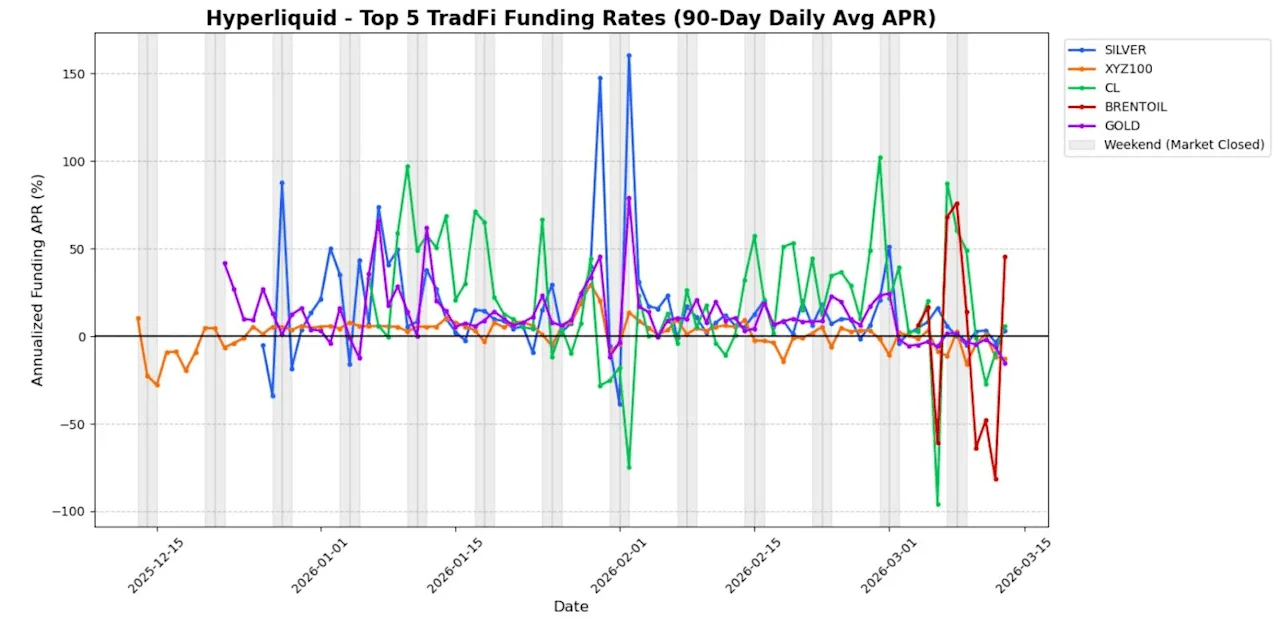
Hyperliquid top 5 TradFi funding rates (90-day). Image source: BitMEX.
Equity perpetuals grew +908%, reaching $4.9 billion weekly with a peak of $5.7 billion during the week of March 8, per BitMEX. The top contract by volume was Hyperliquid’s XYZ100 NASDAQ 100 index product at 42.2% of equity volume. Nvidia, Strategy, Tesla, and Circle followed. Robinhood stock ranked among the top ten most traded equity perpetuals.
In the report, BitMEX researchers explain the mechanism underneath these products as a funding rate system. When a perpetual contract trades above its spot index, long position holders pay short holders at regular intervals, typically every eight hours. When it trades below, shorts pay longs. The rate self-corrects without an expiration date, which eliminates quarterly rollover friction.
Applying that mechanism to traditional assets introduces a complication that BitMEX details at length in the report. Commodity and equity markets close on weekends. Exchanges handle the offline period differently. Binance freezes its price index at Friday’s close and applies a smoothed exponential weighted moving average with a plus or minus 3% deviation constraint. Hyperliquid uses a similar approach, with crude oil capped at plus or minus 5%.
BitMEX said it allows its internal order book to move freely within a rolling 2% hourly limit, letting price discovery continue through the full weekend without a hard ceiling. That difference generated arbitrage opportunities during the March oil events, according to the BitMEX report. When crude oil gapped higher on geopolitical news over a weekend, Hyperliquid’s WTIOIL contract hit its 5% ceiling and stopped reflecting the move.
BitMEX’s WTIUSDT continued trading. The analysts note that the spread between the two contracts became actionable until Monday’s open forced Hyperliquid to catch up to spot. A separate opportunity emerged from funding rate differentials, BitMEX noted. The exchange’s SPY contract ran at a negative 119.22% annualized funding rate on weekdays, meaning long holders received payment.
The Coinbase stock contract ran at a negative 105.23% on BitMEX versus a positive 1.04% on Hyperliquid. BitMEX calculates that a long-short position across the two venues produced a net annualized spread of roughly 106% with limited directional exposure. The MicroStrategy spread offered 52.92%, and Apple offered 37.33%, according to BitMEX’s 30-day average funding rate analysis.
Bitget enabled weekend trading for TradFi pairs in February 2026, the BitMEX report explains, after previously halting all activity on Saturdays and Sundays. Lighter, which held 30.7% of TradFi perp volume in late 2025, lost that share and posted a 30.4% volume contraction through Q1. Its December 2025 token generation event did not reverse the decline, per BitMEX data.
Looking ahead, BitMEX said it plans to add Brent crude, natural gas, copper, and platinum perpetuals to its platform. Forex pairs including EURUSD, GBPUSD, AUDUSD, and USDJPY are also in development. The report flags that Hyperliquid’s index partnership with S&P Global is drawing regulatory scrutiny from the U.S. Commodity Futures Trading Commission (CFTC), which requires platforms offering leveraged derivatives to U.S. users to register as a designated contract market or swap execution facility.
BitMEX places total weekly TradFi perp volume at $30.7 billion as of the report’s publication and identifies bonds, agricultural commodities, and interest rate products as the next potential additions to the perpetual swap ecosystem.
免责声明:本文章仅代表作者个人观点,不代表本平台的立场和观点。本文章仅供信息分享,不构成对任何人的任何投资建议。用户与作者之间的任何争议,与本平台无关。如网页中刊载的文章或图片涉及侵权,请提供相关的权利证明和身份证明发送邮件到support@aicoin.com,本平台相关工作人员将会进行核查。


