Author: Curry, Deep Tide TechFlow
Using AI to mass-produce success books is becoming the most popular side business on Amazon.
From May to October last year, an author named Noah Felix Bennett published 74 books on Amazon. These were printed books, priced at $11.99 each, that could be ordered and delivered to your home.
This person's books cover a wide range of topics, from self-help for porn addiction, to guides for single mothers, to manuals for dealing with workplace bullying... He writes about any topic that has search volume. For example, he first released a book called "How to Play with Your Wife's Mind," followed by another titled "How to Play with Your Husband's Mind," appealing to both genders.
Then he released another book called "Toxic Love: How to Break Free from an Emotionally Abusive Relationship," which first teaches you how to manipulate a partner and then how to escape a controlling marriage, completing the product line...
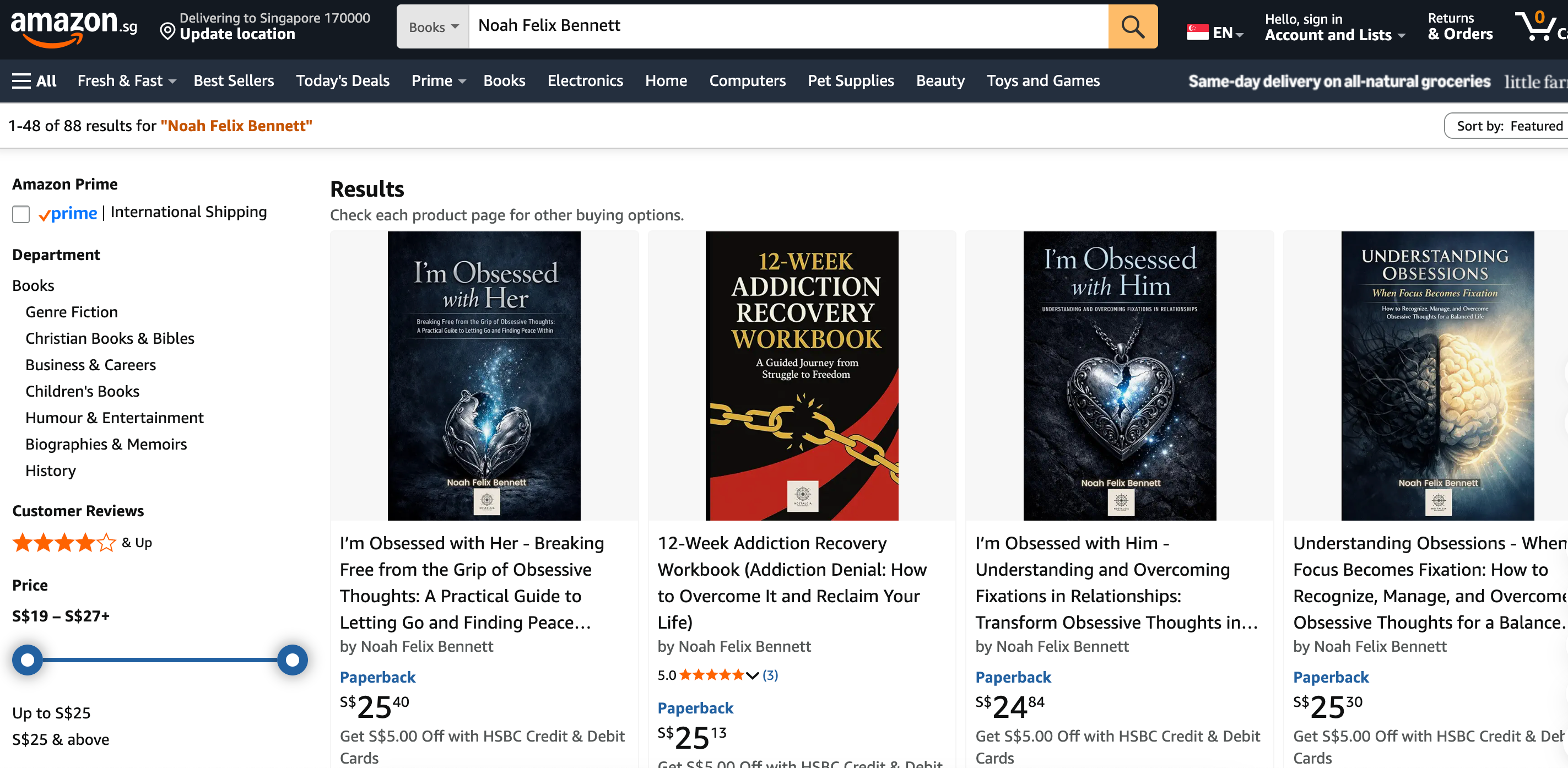
From September 29 to October 1 last year, Bennett released a series titled "New Year, True You," consisting of five books.
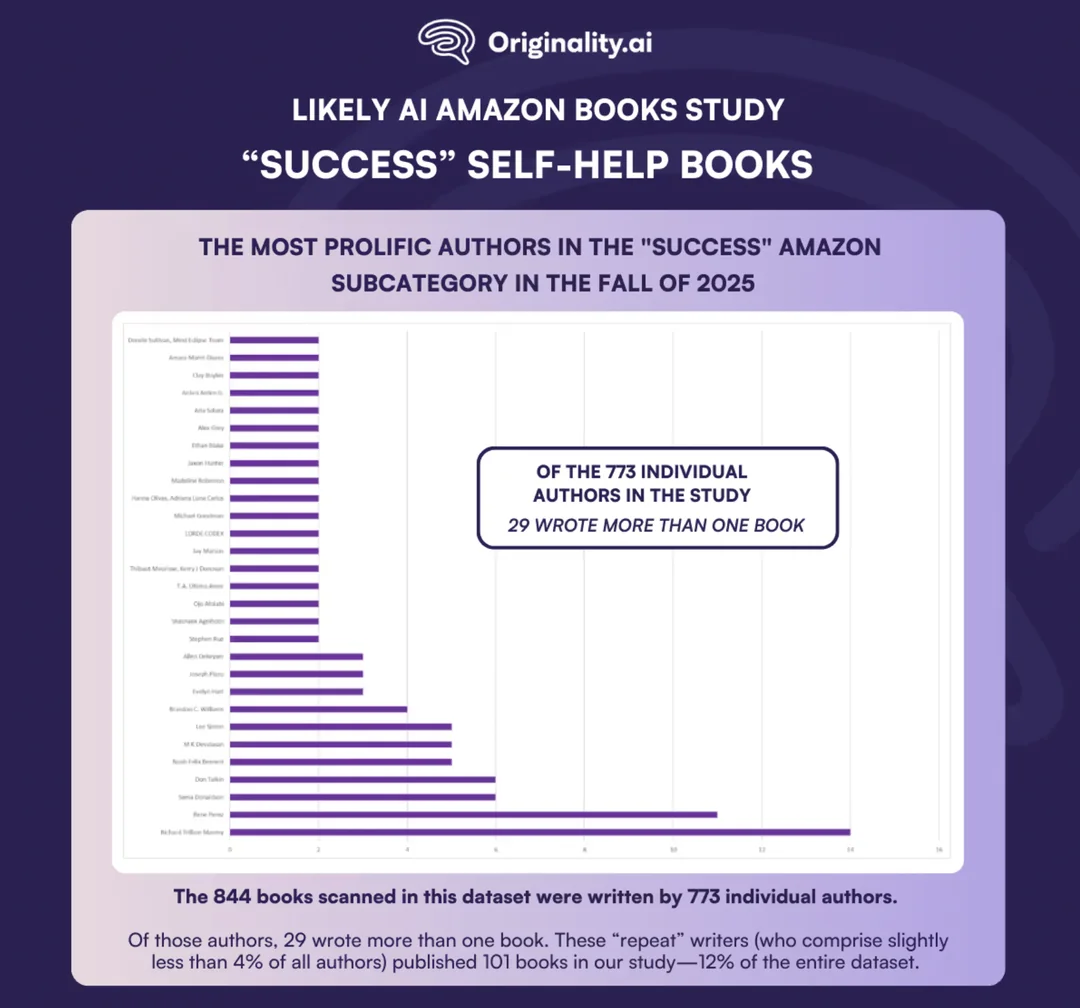
He is not the most prolific.
The author with the highest output in the same category is Richard Trillion Mantey, where "Trillion" means "trillion." In three months, he released 14 books, and by early December last year, he had a total of 397 books listed on Amazon. This person appears in podcasts using his real name and photo, presenting himself as running a legitimate business.
Bennett’s books mostly have only one or two reviews, so they can’t be considered bestsellers.
But at $11.99 each, the writing costs are almost zero, and the printing via Amazon’s print-on-demand service is nearly costless as well. As long as someone occasionally searches, clicks through, and places an order, it’s pure profit.
My name is AI, and I excel in mass success generation
This is not an isolated phenomenon.
On January 28 this year, the AI content detection company Originality.ai released a research report. They scanned 844 new books that were listed in the success category on Amazon last autumn, checking three sections of each book: product descriptions, author bios, and sample pages from the main text.
The result was that 77% of the books' main text was likely generated by AI.
If the criteria are loosened to "at least one section is AI-written," this proportion rises to 90%. Even product descriptions have 79% probability of being written by AI, meaning not only the books are written by AI, but the marketing copy is also generated by AI.
The author bios are even more interesting. 63% of authors did not write a bio at all, or their bios contained fewer than 100 words. Among the remaining authors who had bios, nearly one-third were generated by AI.
There are clear differences in style and wording between books written by AI and those written by humans. AI titles tend to favor cold functional words like Blueprint, Strategies, Master, Mindset, and Habits, resembling outputs from the same template. Human authors prefer more emotional words like Purpose, Journey, Life, and Love.
The differences are even more exaggerated in product descriptions. The phrase "Step into" was used 67 times by AI and only once by human authors. AI also particularly loves to use emojis in descriptions, such as check marks, books, and sparkles. 87 AI authors did this, but only 5 human authors.
There’s a detail in the report that could be called dark humor.
Among the 844 books tested, there was one titled "How to Write for Real People in the AI Era." The author wrote that we produce more content today than in any other era, but the feeling of "one real person talking to another" is disappearing. He said that today’s writing is "grammatically perfect but emotionally hollow, smooth but soulless."
This book was itself detected by Originality.ai as likely AI-generated.
If earlier success books contained unique experiences of successful people, today’s success literature can be produced on an assembly line by AI, where almost anyone can come up with a book to say a few words.
No one reads the books, but the business is thriving
Readers are not fools; they can still tell which content is written by AI.
According to the same report, AI-generated books have an average of only 26 reviews, while books written by humans average 129 reviews, nearly a 5-fold difference. Even if we exclude the dozen or so classic reprints with the highest review counts, human authors still have more than double the reviews compared to AI authors.
More reviews mean that someone has genuinely read the book and is willing to share their thoughts afterward. Fewer reviews suggest that the book was likely bought, flipped through a few pages, and then discarded, or that no one bought it at all.
Readers have a keen sense, but Amazon’s shelves do not help filter.
Amazon’s self-publishing platform Kindle Direct Publishing requires authors to disclose AI-generated content, but content "aided by AI" does not need to be disclosed. This means you can have AI write a whole book and just change a few sentences yourself, and that's considered "aided," with no need to inform anyone. The platform also has a limit of 3 self-published books per person per day, but with 365 days a year, that amounts to over a thousand books in a year.
Amazon has no motivation to clear out these books. Each book listed contributes to the platform's traffic and transaction fees; unsold books don’t take up warehouse space since they are printed on demand. To the platform, these books look identical on the shelves.
The most ironic part is that these AI authors might be the only ones who have truly "succeeded" in the entire success book category.
The principles taught in success literature—finding blue ocean markets, low-cost trial and error, mass production, and creating passive income—are essentially embodied by the two highly productive AI authors mentioned earlier. The 74 books cover every anxiety keyword with search volume, production costs are nearly zero, and there’s no need for readers to learn anything meaningful from the books; they just need to click purchase during a moment of anxiety late at night.
The content of the books is likely garbage, but the act of selling books itself perfectly executes everything that’s taught within them.
Friends in the domestic market should find this logic familiar. During the peak of the knowledge payment trend a couple of years ago, figures like Li Yizhou still needed to appear on screen to record courses and manage their personas, even pretending to be "mentors."
Now even that step is unnecessary; AI writes, Amazon sells, and authors don’t even need to understand what their books are about.
The success book category has a unique aspect: it may be the publication type least sensitive to content quality worldwide.
No one buys success literature to acquire specific skills. People buy it because one evening, they feel the need to change their lives, and spending $11.99 on a book is the least resistant action available. Purchasing is already a ritual of "change," while whether or not to read it is another matter.
AI has not changed the essence of success literature; it has only driven the cost of producing that sense of ritual to zero.
A couple of years ago, when the knowledge payment trend was at its peak, a saying circulated in the industry: selling shovels makes more money than digging for gold. Now, we don’t even need to sell shovels; AI builds both the shovels and the mine; all you have to do is put them on the shelves.
Originality.ai's report ended with a question: since AI can generate this content for free, why are people still willing to pay for a book? The answer could be simple: the form of "books" carries its own sense of authority and ritual, even though you could get the same information by asking ChatGPT.
Consumption driven by anxiety has never cared whether the purchased items are useful. The moment of purchase itself is the painkiller.
免责声明:本文章仅代表作者个人观点,不代表本平台的立场和观点。本文章仅供信息分享,不构成对任何人的任何投资建议。用户与作者之间的任何争议,与本平台无关。如网页中刊载的文章或图片涉及侵权,请提供相关的权利证明和身份证明发送邮件到support@aicoin.com,本平台相关工作人员将会进行核查。


