Author: RDA Research Institute
The International Monetary Fund (IMF) released a report titled "Tokenized Finance" in April 2026, placing tokenization within the framework of "structural changes in financial architecture," focusing on underlying financial operation aspects such as settlement, liquidity, and systemic risk. The report also notes that the most significant changes are happening within the regulated financial system, including banks, asset management institutions, and financial market infrastructures. The importance of this report lies in its elevation of the discussion around tokenization—from on-chain asset representation and product innovation to the underlying reconstruction of financial market settlements, liquidity organization, compliance, and risk management.
Why is the IMF emphasizing "market architecture changes" at this time?
The most noteworthy aspect of the report is that it adjusts the analytical framework of tokenization.
Previous discussions were more focused on digital asset representation, improvements in issuance efficiency, and changes in circulation methods; this time, the IMF discussed tokenization within the context of financial market operational mechanisms.
Such changes in expression often affect how the market understands trends.
As the discussion framework shifts from "asset class innovation" to "market architecture changes," the focus of industry observation will also change. What deserves attention next is not just which assets continue to go on-chain and which products continue to expand, but rather which foundational elements within the financial system will first undergo restructuring.
The three key capabilities pointed out by the IMF also form the technical basis for this positioning: permissioned shared ledgers, programmable financial assets, and risk management based on smart contracts.
After these capabilities combine, assets, funds, rules, and certain risk control logic have the opportunity to be processed within the same system. Financial processes that were originally completed across multiple institutions, systems, and timelines begin to have the conditions for re-integration.
The most crucial aspect of this statement is that the level of discussion around tokenization has been elevated.
Why does tokenization exceed the "asset on-chain" framework?
"Asset on-chain" is still the most intuitive manifestation of tokenization, but this expression is no longer sufficient to encompass the changes at this stage.
The IMF defines tokenization as a change in financial architecture because its impact has extended to settlement, liquidity, compliance, and risk management.
First, let’s look at settlement
In traditional finance, a single transaction typically goes through multiple stages, including trading, confirmation, clearing, settlement, custody, and reconciliation, which often leads to natural friction between different institutions, systems, and timing arrangements. Under a tokenization system, assets and funds can complete settlement in a more unified ledger environment, with settlement logic approaching atomicity, synchronization, and programmability. The IMF placing settlement at the core indicates that changes in settlement are an important starting point for tokenization to enter the infrastructure layer.
Next, let’s look at liquidity
Once the settlement logic changes, the ways funds are held, allocated, and utilized within the system will also change. Actions such as collateralization, margin calls, asset conversion, and fund allocation have the potential to become more continuous and automated in the future. For institutions, this will affect settlement management, capital efficiency, and market operating rhythm. The IMF’s discussion of liquidity alongside settlement reflects this relationship.
Further, changes have reached compliance and risk management
As long as rules can be embedded in asset and transaction processes, compliance checks, triggering conditions, and execution logic will no longer rely entirely on post-transaction manual processing. The boundaries between code, rules, and processes will become tighter. At this stage, tokenization is approaching the programmability of financial processes.
Tokenization has progressed to the point where what has been truly rewritten is not just the method of asset expression but the operational logic of financial markets.
What key signals has the IMF released this time?
Tokenization is entering the mainstream financial system
The IMF particularly emphasizes that the most influential changes are occurring within the regulated financial system.
Banks, asset management institutions, and financial market infrastructures have become key players in this round of tokenization advancement. This judgment indicates that tokenization is now entering the discussions surrounding the institution and infrastructure of the mainstream financial system.
In this regard, the more significant competition will increasingly focus on "who can enter the regulated system" and "who can accommodate institutional-level funds and processes." Tokenization is emerging from the early product competition phase and entering the stage of competition in institutions and system capabilities.
The focus of industry competition is shifting from asset issuance to infrastructure control
If the changes in tokenization have already penetrated the layers of settlement, liquidity, and system operations, then the more important competitive focal points in the future will naturally change.
Asset issuance remains important but it can no longer cover all core capabilities. The capabilities related to settlement, ledger, compliance interfaces, rules embedding capabilities, and integration with existing financial systems will increasingly emerge as new barriers.
This is particularly crucial for the RWA and digital asset industries.
Simply turning assets into tokens is becoming increasingly difficult to constitute a long-term advantage. Whoever can integrate assets, funds, rules, and settlements into a single operational structure will be closer to the next stage of initiative. The innovative value at the asset level still exists, but the control capabilities at the system level are rising.
The focus of risk governance is shifting from technical issues to system issues
The IMF highlighted three risk areas worth paying attention to in the report: speed, concentration, and fragmentation.
This assessment indicates that the governance of tokenization risks has entered a more systematic level. Whether the financial system will exhibit faster risk transmission and more complex system coupling within more efficient infrastructures is becoming a core issue.
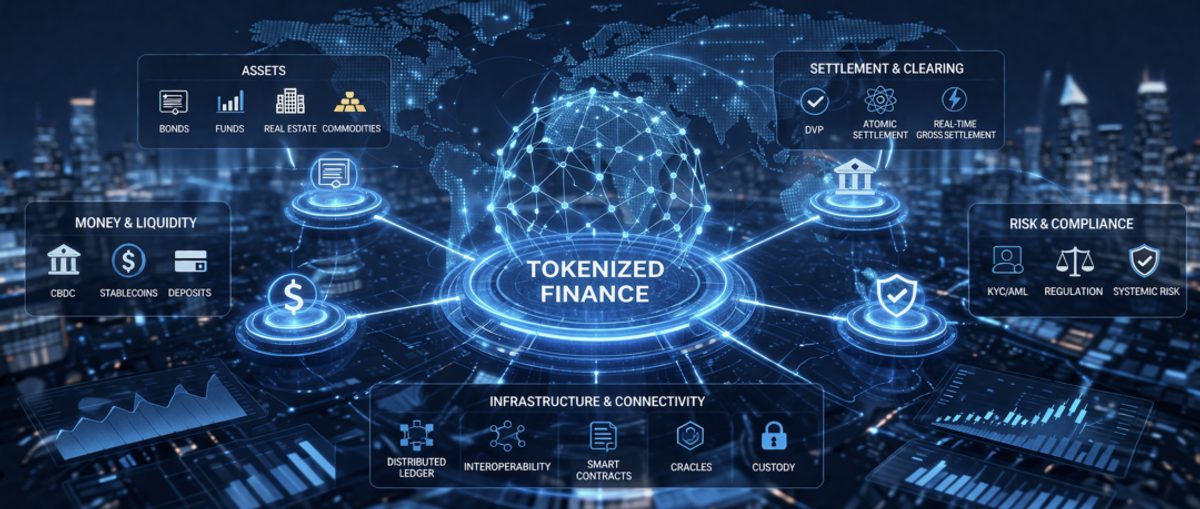
In traditional finance, issues such as settlement delays, business hours, manual reviews, and layered intermediaries, while causing efficiency losses, also play a role in buffering. The tokenization system, while compressing these buffers, will also enhance the system's sensitivity to speed, rule design, and interconnected structures. Automated clearing, continuous settlement, rule triggering, and cross-platform interaction, once placed under high-frequency environments, will significantly increase the risk propagation speed. The challenges brought by tokenization not only arise from new risks but also from how the system can regain stability after the old buffer mechanisms are compressed.
Why is industry competition shifting toward the infrastructure layer?
From the perspective of industry evolution, after tokenization has entered this stage, the competition logic has already started to change.
Previously, it was easier to amplify asset-side capabilities, issuance capabilities, and circulation narratives; however, the more significant capabilities going forward will increasingly fall on settlement, compliance interfaces, system connections, and institutional compatibility.
This change will directly impact the capability models of financial institutions, platform providers, and startups.
In the future, banks, brokerages, asset managers, custodians, trading platforms, and technology infrastructure providers will reorganize around new system boundaries. Some traditional intermediary functions will be compressed while some infrastructure capabilities will be amplified. Functions such as ownership records, compliance checks, settlement execution, risk triggering, and process coordination may undergo migration. Typically, the first changes occur in functional structures, while changes at the organizational level often lag slightly behind.
The core differentiation in the next stage may not only arise from who possesses more asset resources but rather from who can organize assets, funds, compliance, and settlements into a coherent system capability.
Whoever can master the settlement layer, the compliance interfaces, and integrate assets, funds, and rules more smoothly into the same operational system will have a better chance of gaining influence in the next stage. For the industry, this represents a clear upgrade in competitive dimensions. The focus of industry competition is shifting from asset class innovation to infrastructure capability and institutional coordination capability.
Why does tokenization ultimately return to institutional trust?
At the end of the report, the IMF presented several key anchors: clear policy frameworks, secure settlement assets, robust code governance, legal certainty, and international coordination.
When viewed together, these ultimately lead back to the same question: can this new structure be trusted, enforced, and held accountable?
The mainstream financial system's acceptance of a new architecture is concerned not only with whether it is faster but also whether it is clearer, more executable, and can maintain stability under pressure.
Clear legal ownership, secure settlement assets, robust code governance, and cross-border coordination mechanisms will determine whether tokenized finance can transition from experimental arrangements to mainstream processes. As tokenization enters deeper infrastructure competition, the importance of rule, legal, and institutional credibility will continue to rise.
Whether tokenization can enter the mainstream financial system ultimately rests on institutional trust.
The real change has already been in the discussion level
The most significant aspect of the IMF's positioning on tokenized finance is the change in discussion level.
Tokenization is shifting from "asset class innovation" to "financial architecture restructuring," and the market's focus moving forward should not only be on how quickly the scale of tokenized assets grows. How will the settlement logic change? How will liquidity be reorganized? How will intermediary functions migrate? How will systemic risks be redefined? Which participants can first establish infrastructure models that are acceptable to the market, can be adhered to by regulators, and integrated into the mainstream financial system? These questions will be closer to the core of the next stage.
The signals released by the IMF this time are not limited to the emergence of a new trend; they are more akin to the beginning of a reconstruction of financial infrastructure entering the mainstream process.
免责声明:本文章仅代表作者个人观点,不代表本平台的立场和观点。本文章仅供信息分享,不构成对任何人的任何投资建议。用户与作者之间的任何争议,与本平台无关。如网页中刊载的文章或图片涉及侵权,请提供相关的权利证明和身份证明发送邮件到support@aicoin.com,本平台相关工作人员将会进行核查。


