Written by: Prathik Desai
Translated by: Block unicorn
The clock is not a good remedy for hiding delays. For decades, financial markets have been built around the speed of existing information transmission. They introduced closing bells, batch settlements, and regional exchanges, which made sense in an era of slow information transmission. But all of that has changed. Capital will not wait. Just as water always finds cracks, capital will too. Financial gravity will pull it toward the fastest path to price information. That is the law of the market. Market participants will not tolerate inefficiency forever.
That is what I have seen from a macro perspective while observing the developments in the financial markets over the past few weeks.
In today’s article, I will help you understand what has broken the outdated bundled structure of financial markets, transforming it into a more efficient, unbundled structure that spans different venues, packaging, and time.
Changing Jobs
I have been studying finance for over a decade. In the early stages of my studies, I viewed traditional stock exchanges as synonymous with the market. For most of their development, stock exchanges have been the gathering place for everyone and everything: buyers, sellers, regulators, and the technologies that drive the market. They had indices that tracked component stocks and clocks that indicated trading times, telling everyone when they could trade and when they could not.
But that situation has changed over the past few years. In fact, just in the past few weeks, we have seen several developments that confirm this shift.
On March 18, S&P Dow Jones Indices authorized the S&P 500 index for Trade[XYZ], allowing the HIP-3 market deployer to launch the first and only perpetual derivative contract for the S&P 500 index on the Hyperliquid exchange. The S&P 500 index is the most widely followed large-cap index in the U.S., tracking 500 leading companies in the U.S. and covering about 80% of the total market capitalization, which exceeds $61 trillion. The index covers at least half of the global stock market capitalization.
This is an index that has been around for nearly 70 years yet listed on a market that has only been established for 6 months.
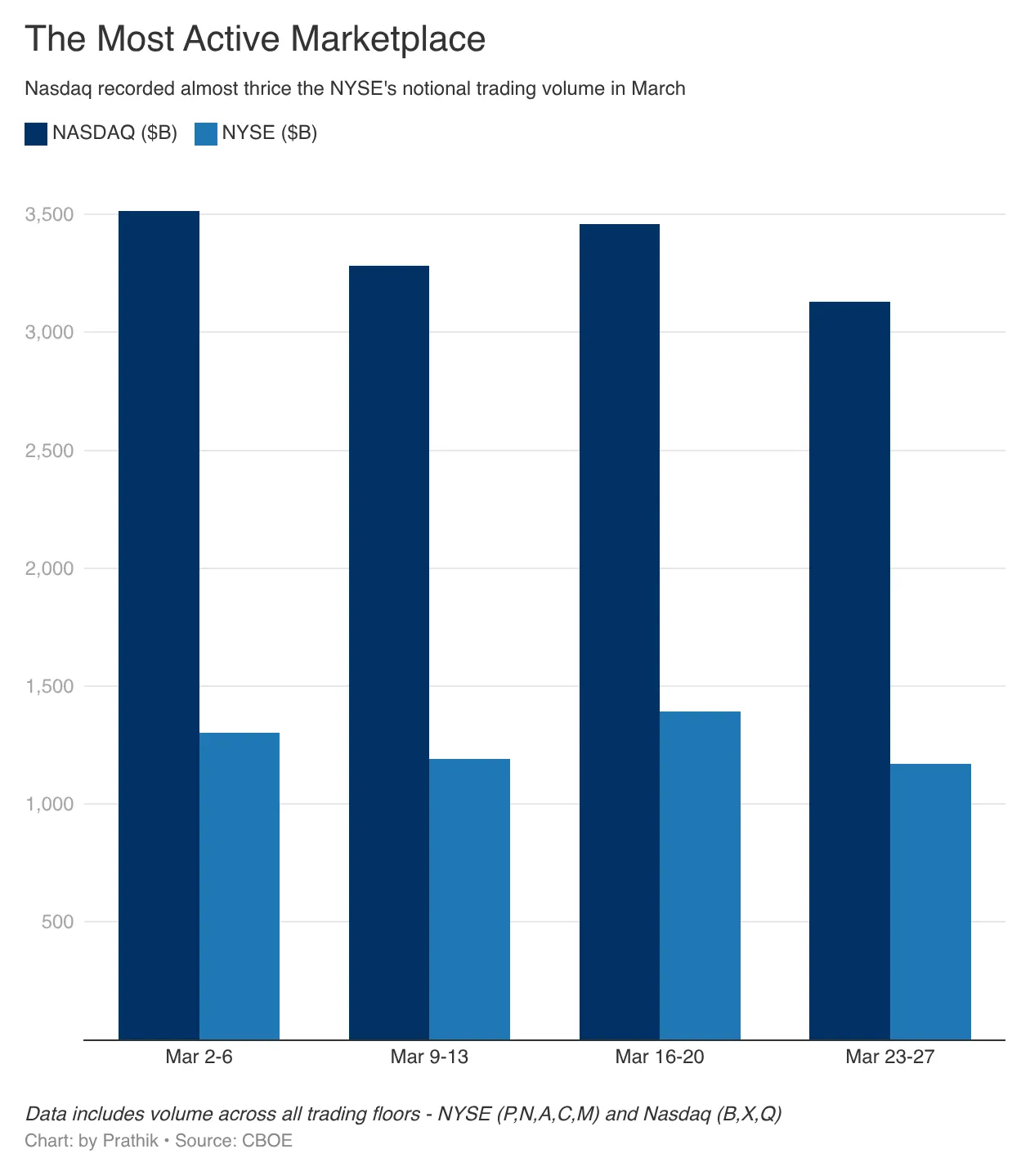
The day after S&P announced this news, the U.S. Securities and Exchange Commission (SEC) approved Nasdaq's application to trade and settle some stocks in token form. Nasdaq is one of the most active trading venues globally, with nominal trading volumes that often exceed those of the New York Stock Exchange (NYSE), the largest exchange by market capitalization in the world.
On March 16, Cboe Global Markets submitted a proposal to the SEC to launch "almost all-day (24x5) trading of U.S. stocks." The largest operating entity behind this U.S. financial exchange stated that it is ready to provide all-day stock trading services as early as December 2026.
But why? There is an increasing demand for extended trading hours for U.S. stocks.
These three initiatives target the outdated bundled trading structure. The S&P 500 futures trading market launched by Hyperliquid challenges the decades-old practice where investors could only trade traditional indices through traditional markets. It also makes it possible to trade one of the most tracked large-cap indices globally 24/7.
Nasdaq's tokenized stock trading initiative focuses on infrastructure. It introduces a new form of wrapping that allows the same stock to be traded in different ways. Previous attempts at tokenized stocks had faced criticism from the industry.
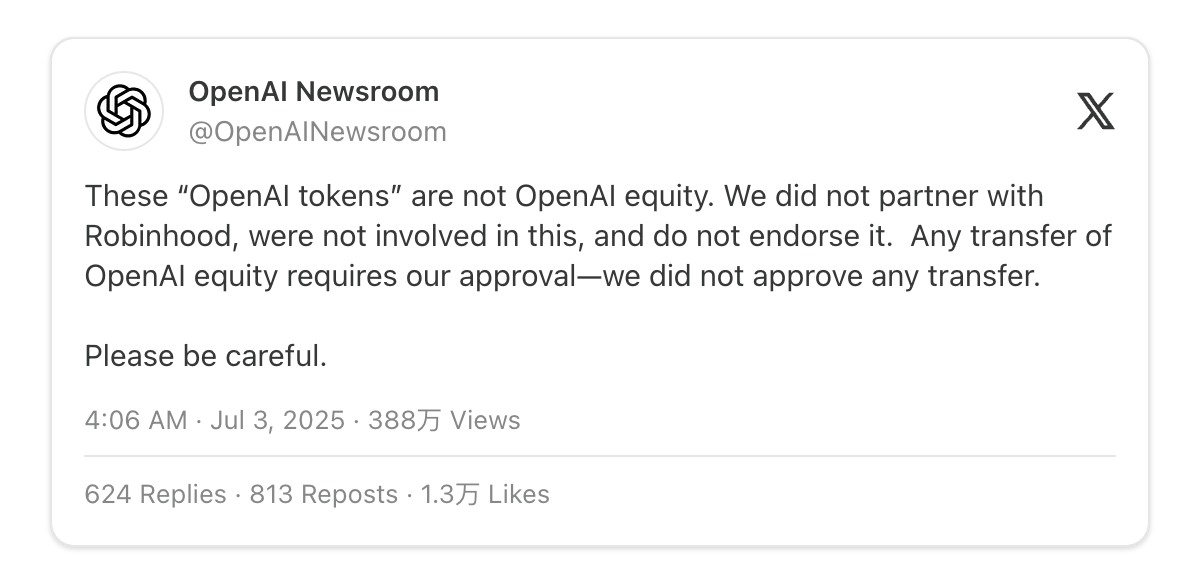
Investors question whether these tokens grant the same rights as the original shares.
But if I offer the same equity exposure via a token on the blockchain, while not losing the voting rights and legal protections that come with the original dematerialized shares, wouldn't you accept it?
Why would you want to do that? What benefit does it bring you?
So, if you are an investor outside the U.S. wanting easier access to the stock market of the world's largest economy, what then? What if this tokenized stock allows you to more easily integrate it with collateral and lending systems?
When you consider all-day trading, these advantages multiply.
That is what Cboe is attacking. Its nearly all-day (5 days a week, 24 hours a day) trading proposal aims to acknowledge that capital will not wait for office hours. Traders always want to express their views immediately after obtaining information. If Cboe doesn't provide them with a market to express their views, traders will flock to other platforms that offer such markets.
What I am saying is not a hypothesis or something that "might happen in the near future." It is happening right now, as we speak.
A Split Future
In the HIP-3 market of Hyperliquid, the adoption of the split of financial products is most evident, with the market set to officially launch in late October 2025.
In just the past month, the cumulative trading volume of the HIP-3 market has increased by $72 billion. The cumulative trading volume for the previous four months was $78 billion.
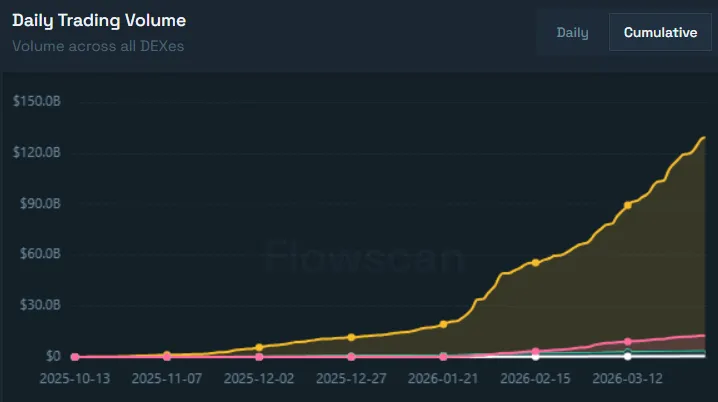
In March, Trade[XYZ] maintained 90% of the daily trading volume in the perpetual market for traditional financial products and stocks on HIP-3. But that is not the most interesting part.
More than half of Trade[XYZ]'s trading volume comes from the perpetual contract market for silver, crude oil, Brent oil, and gold.
Hyperliquid provides a unified trading platform for trading spot cryptocurrencies and perpetual contracts for cryptocurrencies and traditional assets. This not only streamlines the trading process on a unified platform but also brings higher liquidity, a unified user interface, and smaller bid-ask spreads.
Traders still want to trade some of the largest and hottest assets, covering commodities, publicly listed companies, large private companies, and indices. You might want to trade silver, gold, crude oil, Tesla, Apple, Amazon, Google, indices tracking the top 100 non-financial companies in the U.S. and the S&P 500 index—all of which can be done on the Hyperliquid platform.
HIP-3 separates the function of investing in these assets from the existing exchange infrastructure while still tracking the underlying asset with its original benchmark. Therefore, when you go long on silver futures contracts on HIP-3, the underlying asset it tracks is still linked to the value of one ounce of silver in the Pyth data source.
The reason traders choose to move from previous platforms to trade silver on HIP-3 is that HIP-3 does not differentiate between U.S. and non-U.S. traders and does not adhere to any specific time. Whenever an event occurs where a trader wants to express a view through asset pricing, HIP-3 provides a market for them, regardless of the trader's geographic location or time zone.
In the past few weeks, the open interest (OI) on the Hyperliquid platform has grown significantly, reflecting the aforementioned results. OI measures the total value of outstanding derivative positions. Unlike trading volume, which reflects trading activity, OI reflects trading commitments.
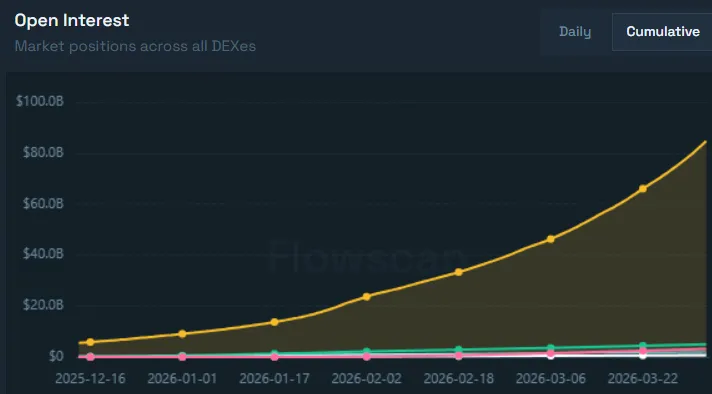
On March 1, the OI was $1.13 billion, doubling to $2.2 billion by April 1. This indicates that traders are confident in Hyperliquid's perpetual contracts and are locking up capital.
These metrics demonstrate that when market access is more convenient and friction is lower, traders will not remain loyal to any one platform or asset class. They will choose any platform that can provide volatility, convenience, and liquidity.
That is why traditional institutions like S&P, Nasdaq, and Cboe are taking measures to acknowledge this behavior.
At least two recent events have confirmed the importance of all-day trading and market volatility for traders.
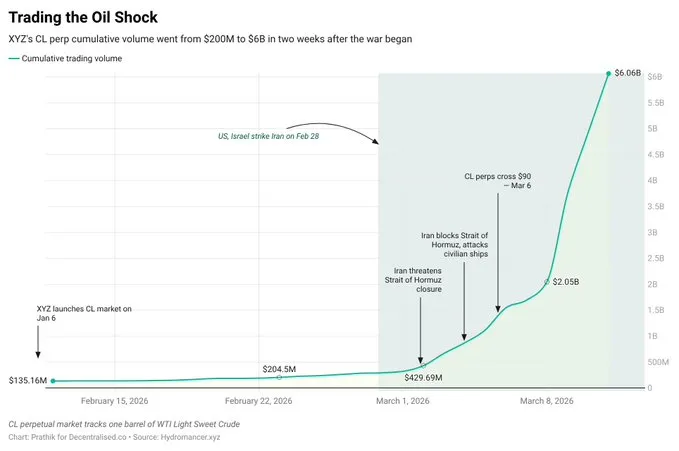
Saurabh wrote in a tweet from Decentralised.Co: "On February 28, the U.S. and Israel attacked Iran during traditional market hours. Within hours, the price of oil-linked perpetual contracts on the Hyperliquid platform soared 5% as traders absorbed the impact in real-time."
Within just two weeks of the outbreak of war, the trading volume of oil-linked perpetual contracts surged from $200 million to a cumulative $6 billion.
A significant risk of emerging platforms is liquidity. If liquidity is insufficient, the bid-ask spread can widen, leading to traders facing a more severe pricing disadvantage than on other platforms.
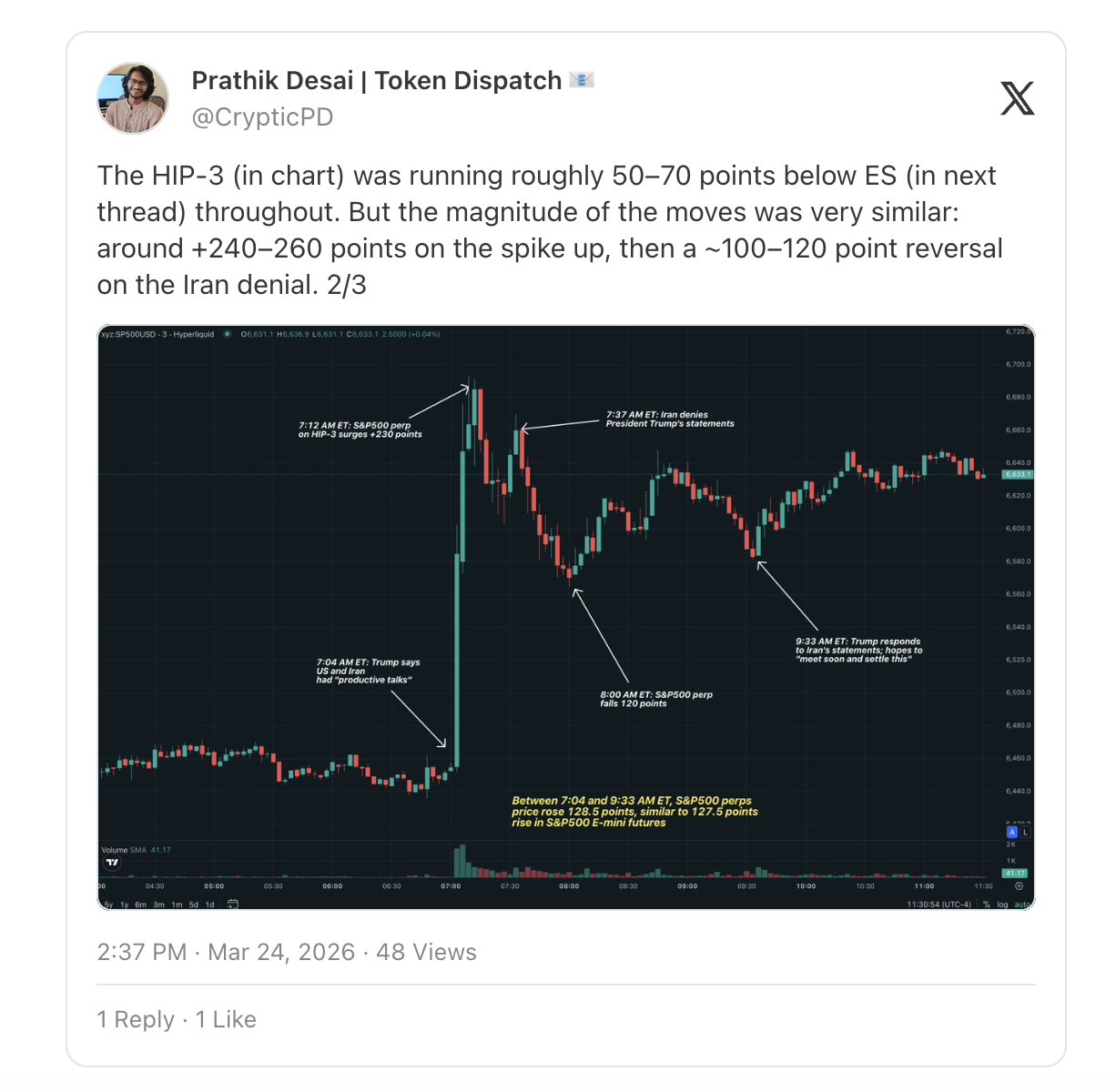
The week before last, as U.S. President Trump was negotiating "productive talks" with Iranian officials, the Hyperliquid platform displayed its strong liquidity. The newly launched S&P 500 futures based on the HIP-3 platform were able to track the movements of the CME E-mini S&P 500 futures accurately, down to the minute.
Although the on-chain perpetual contracts were about 50-70 points lower than ES, the price movements were quite similar.
What This Means
For decades, traditional markets have been bundled together and controlled places (exchanges), times (trading hours), and products (indices/contracts).
They maintain the status quo because they have failed to establish corresponding mechanisms to address inefficiencies such as latency, trading time restrictions, and regulatory constraints on non-U.S. investors. Instead, they have concealed these inefficiencies and packaged them as procedural systems designed to build trustable institutions to attract investors.
People will still trade and invest. It is not because they are stupid or naïve enough to believe the various claims made by traditional financial markets. They do it because they have no choice. This began to change with the advent of blockchain, which provided the world with on-chain markets, making trading and investing unprecedentedly convenient.
People see this option and seize it.
They did not care in the past, and they will not care in the future about changes in market structure. They are indifferent to whether the new structure is bundled or unbundled. Regardless of whether existing institutions are willing, as long as traders and investors can express opinions more conveniently through financial instruments, they will accept the new market structure. As for whether this structure comes from traditional giants like Nasdaq, Cboe, or the S&P 500, or from permissionless platforms running on blockchain, it does not matter.
The financial industry continues to evolve, as always, and will adopt any structure that can narrow the gap between the occurrence of events and the expression of opinions through prices.
Important events happen around the world every moment. So why should prices wait until the clock in some glass-fronted building in New York starts ticking on Monday morning to be determined?
免责声明:本文章仅代表作者个人观点,不代表本平台的立场和观点。本文章仅供信息分享,不构成对任何人的任何投资建议。用户与作者之间的任何争议,与本平台无关。如网页中刊载的文章或图片涉及侵权,请提供相关的权利证明和身份证明发送邮件到support@aicoin.com,本平台相关工作人员将会进行核查。


