Author: RWA Research Institute
The era of global data governance has entered a new phase of multilateral co-governance. Is the globalization of RWA really coming?
March 30, 2026, National Convention Center, Beijing.
In the morning, the World Data Organization held its first general meeting, reviewing and approving the organization’s charter and electing its first board and supervisors. Ding Xuexiang, a member of the Standing Committee of the Political Bureau of the Communist Party of China and Vice Premier of the State Council, attended the founding conference, read a congratulatory letter from President Xi Jinping, and delivered a keynote speech.
At around four-thirty in the afternoon, Zhou Yu, General Manager of Hangzhou Data Group, walked out of the venue, and the voice on the other end of the phone was clearly excited: "We are one of the founding member units of WDO."
Almost simultaneously, a Xinhua News Agency reporter got through to the phone of Yang Jie, Secretary General of the World Data Organization. This former chairman of China Mobile, who has just assumed the role of the first secretary-general, revealed the core mission of this new organization in an exclusive interview: to systematically connect the fragmented aspects of data governance and form an effective complement to existing mechanisms, rather than a replacement.
That evening, dozens of mainstream domestic media outlets simultaneously published this news— the world's first professional international organization aimed at promoting data development and governance practices officially commenced operations in Beijing.
The World Data Organization has arrived.
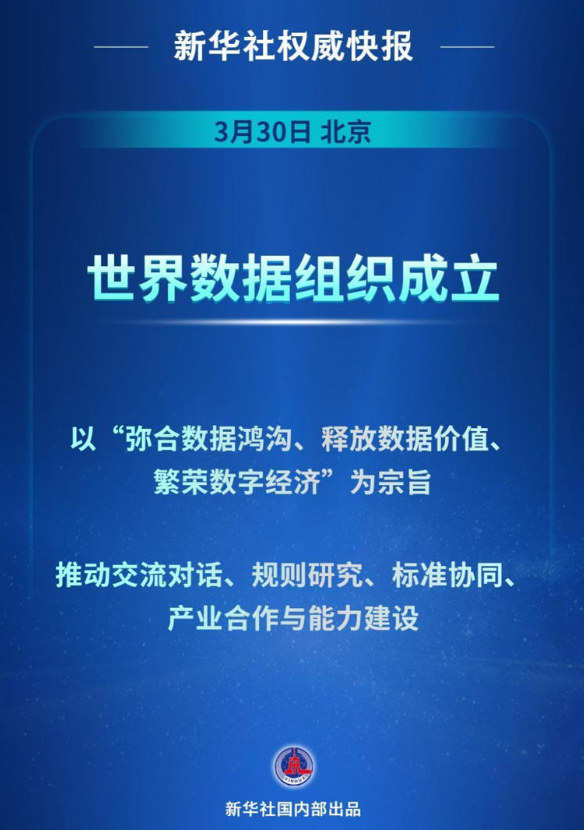
It has been exactly three days since then. Reports on this news from mainstream domestic media mostly remained at the factual level of "the global first international organization for data governance has been established." But few have asked a more critical question: what exactly has changed with this organization?
A common saying is: "It's just another international forum, without any enforcement power, just words."
We do not agree with this assessment.
This is not a simple expansion of international organizations; this is the "Geneva Convention" of the data colonial era. For the past thirty years, developed countries have shouted for "free flow of data," but in reality, it has been "free plunder." Today, the rules have changed. Data sovereignty is recognized as equal, and the data assets of developing countries have, for the first time, obtained protection at the level of international law. For the RWA (Real World Assets) industry, this is not a distant diplomatic news item but a fundamental institutional benefit.
Let us break down the underlying logic of this matter from three dimensions.
1. New Pattern: From "Free Plunder" to "Sovereign Equality"
To understand the significance of the World Data Organization, we need to return to a specific scene.
In 2018, an Indian agricultural entrepreneur said something thought-provoking in an interview with The Hindustan Times: "The land data, planting data, and harvest data of our farmers are all stored on the servers of American companies. Those companies take our data to develop precise agricultural credit models and then lend us money at higher interest rates. The data we create, in turn, becomes a tool to harvest us."
This is not an isolated case.
For the past thirty years, the so-called "global free flow of data" has presented an almost constant one-way structure in reality. User data from developing countries—ranging from consumption habits to biometric features, from geographic locations to social networks—flows at extremely low costs towards large technology platforms in developed countries. These platforms leverage data to train algorithms, optimize products, establish pricing strategies, and then sell services back to the data-producing nations. Data flows out, profits flow back in.
According to the Digital Economy Report published by the United Nations Conference on Trade and Development in 2021, over 70% of global data storage and processing capabilities are concentrated in a few countries in North America, Europe, and East Asia. Meanwhile, most countries in Africa, Latin America, and South Asia, despite contributing vast amounts of raw data, have virtually no bargaining power.
This pattern has been termed "data colonialism" by scholars.
The first historic breakthrough of the World Data Organization is its formal termination of this unipolar rule. According to official information released by Zhejiang Economic Digital Industry, the organization’s charter explicitly incorporates the principles of "multilateral co-governance and sovereign equality." This means that any member state has indisputable sovereign rights over the data generated within its borders. The cross-border flow, storage, and trading of data can no longer be unilaterally determined by the domestic laws of a few countries.
China has played a key role in this process. According to a report from Zhejiang Economic Digital on March 31, 2026, China transformed from a "rule participant" to a "core leader" in this instance, leveraging its most comprehensive digital industry system and rich practices in building a domestic data factor market. This is not a simple diplomatic victory, but an output of a governance paradigm—China has provided a reference template for the world with its experiences in domestic data factor market reforms.
You can understand it this way: the past data world was like a sea without maritime boundaries—whoever has the bigger ship calls the shots. Now, countries are beginning to delineate their territorial waters and have a commonly recognized arbitration body.
This is not the endpoint, but it is the starting point for all endpoints.
2. New Phase: The Three-Partition of Industry Digitization Defines the Future of Data Governance
The establishment of an international organization, if merely a result of political games, will not last long. What gives the World Data Organization lasting vitality is that it happens to step on a critical juncture of industrial evolution.
We can divide industrial digitization into three stages.
The first stage is called "Everything Can Be Counted." This stage addresses the issue of "from nothing to something." Enterprises convert paper documents into electronic spreadsheets, move offline stores to online e-commerce, and replace human customer service with chatbots. The core task of this stage is digital infrastructure. In this stage, data is a cost—you spend money to build systems, buy servers, and make digital transformations, with no direct returns in the short term.
The second stage is called "Everything Can Be Measured." This stage addresses the issue of "from having to being good." Data scattered around cannot be used; it needs uniform formats, unified interfaces, and uniform security standards. Thus, there has been international discussion on data standardization, and technologies like privacy computing, federated learning have emerged, alongside countries gradually rolling out data security laws and personal information protection laws. In this stage, data becomes assets—it is recorded on balance sheets, valued, audited, and managed.
The third stage is called "Everything Can Be Traded." This stage addresses the issue of "from being good to being valuable." If data assets can only be held in one’s hands, their value is locked. Only by allowing data to flow, trade, and price it can it truly become capital. What is needed in this stage is very specific: rights confirmation rules, valuation models, trading mechanisms, and cross-border compliance channels.
The establishment of the World Data Organization is fundamentally a global confirmation of the "third stage." It releases a clear signal to the world: data assetization is not an experiment of a few countries but a global consensus. According to official releases from Zhejiang Economic Digital, one of the key focuses of the organization in the future is to promote the establishment of a standard framework for mutual recognition and trading of cross-border data assets.

Here is a detail that is easily overlooked. In the past, if a Chinese data exchange confirmed the ownership of data assets, when they arrived in Southeast Asia or Europe, no one would recognize it. Due to the lack of a global mutual recognition rule framework, each country was speaking for itself. The core value of the World Data Organization is to build this "mutual recognition bridge." It is not meant to replace the regulatory sovereignty of countries but to establish a convertible universal language above sovereignty.
If we liken global data governance to a transportation system, in the past, each country was building its road, with varying widths and directions. What the World Data Organization aims to do is not to require everyone to drive the same kind of vehicle but to standardize the traffic lights and road signs.
What does this mean for the RWA industry? Very simply: the core premise of data RWA (tokenizing real-world data assets) is that the property rights and value of data assets can be universally recognized across borders. Without this premise, data RWA can only operate in an "internal circulation," with its scale locked within a country's borders. With the mutual recognition framework built by the World Data Organization, this ceiling has been lifted.
3. Clarification of Rules, Legalization of Advantages
After discussing the macro pattern, let’s zoom back in to the things that RWA practitioners truly care about.
The first direct benefit is the shift of data asset rights confirmation from "local food coupons" to "international hard currencies."
A real scenario: Suppose you complete the rights confirmation of a set of supply chain accounts receivable at the Shenzhen Data Exchange, turning it into an RWA token, intending to sell it to institutional investors in Singapore. In the past, this transaction faced significant compliance uncertainties. Regulatory authorities in Singapore would ask: What is the basis for your rights confirmation? Was it done according to China's "Data Security Law," or according to some international standard? Is there any legal conflict between the two?
Now, the framework of the World Data Organization provides a "middle layer." According to the information released by Zhejiang Economic Digital on March 31, 2026, the organization is promoting member states to sign mutual recognition agreements for data assets. While the details are still being negotiated, the direction is clear: in the future, data asset rights confirmations that meet the organization’s standards will gain mutual recognition among member states.
This is not something that will happen overnight, but the foundation has been laid.
The second benefit is that the principle of "sovereign equality" provides an umbrella of protection for data assets in emerging markets.
Data from Indonesia’s palm oil plantations, Nigeria’s mineral reserves, and Brazil’s agricultural remote sensing—these were previously the "free lunch" of international giants. Platforms could capture, analyze, and monetize at will, while the people and enterprises of data-producing countries received not a penny. The "sovereign equality" clause of the World Data Organization, for the first time at the level of international law, grants developing countries the right to refuse such "free extraction."
This means that the legitimacy of capturing value from RWA assets based on the genuine industrial data of these countries has fundamentally been secured. You are not "stealing" data but are financializing data assets within a framework authorized and recognized by a sovereign country. This distinction is the dividing line between legal and illegal.
The third benefit is the rules for cross-border flow transitioning from "vague" to "clear."
Vagueness is the enemy of innovation, clarity is its friend. In recent years, numerous data RWA projects have died in the gray area of compliance—uncertain whether data can be exported, whether revenue distributions might trigger regulatory red lines, or whether assets post-tokenization are considered securities. Many project parties didn’t want to avoid compliance; they simply had no clear rules to follow.
The establishment of the World Data Organization itself is a signal: rules are being written. According to the organization’s published "Work Roadmap for 2026-2028" (as quoted by Zhejiang Economic Digital), classification and grading standards for cross-border data assets, conditions for trading platform access, and mechanisms for dispute resolution will all be rolled out over the next 18 months.
For RWA practitioners, this is the best window period. Those who establish compliant pathways first will gain a first-mover advantage.
Conclusion
Returning to the scene at the beginning of the article.
The founding conference at the National Convention Center in Beijing was, in fact, a ceremony that was thirty years overdue. As early as the initial commercialization of the internet in the 1990s, some predicted that data would become the oil of the 21st century. However, what the prophets did not foresee was that the rights to extract, price, and distribute this barrel of "oil" have been monopolized by a few countries for nearly thirty years.
Three hundred years ago, the Treaty of Westphalia established the territorial sovereignty of states, ending thirty years of religious wars in Europe. Today, the World Data Organization aims to establish data sovereignty. This time, China is no longer a recipient of rules but a creator.
For the RWA industry, this ship has already set sail. The tide has turned, and those flowing with it will move faster.
But remember: the greatest opportunities are always hidden in the most genuine industrial demands.
The rules are set, and it's the right time to raise the sails.
Information source for this article: Official release from Zhejiang Economic Digital (March 31, 2026), UN Conference on Trade and Development's "2021 Digital Economy Report," related reports from The Hindustan Times in 2018. Some cases are based on publicly reported compilations.
免责声明:本文章仅代表作者个人观点,不代表本平台的立场和观点。本文章仅供信息分享,不构成对任何人的任何投资建议。用户与作者之间的任何争议,与本平台无关。如网页中刊载的文章或图片涉及侵权,请提供相关的权利证明和身份证明发送邮件到support@aicoin.com,本平台相关工作人员将会进行核查。


