Original Title: "Interpreting Aave V4: A Transition from Product to 'Bank'"
Original Author: Eric, Foresight News
On the evening of March 30, Beijing time, the Aave V4 version, which was officially launched for the mainnet and initiated in 2024, brought the first good news since the Aave DAO governance debate.
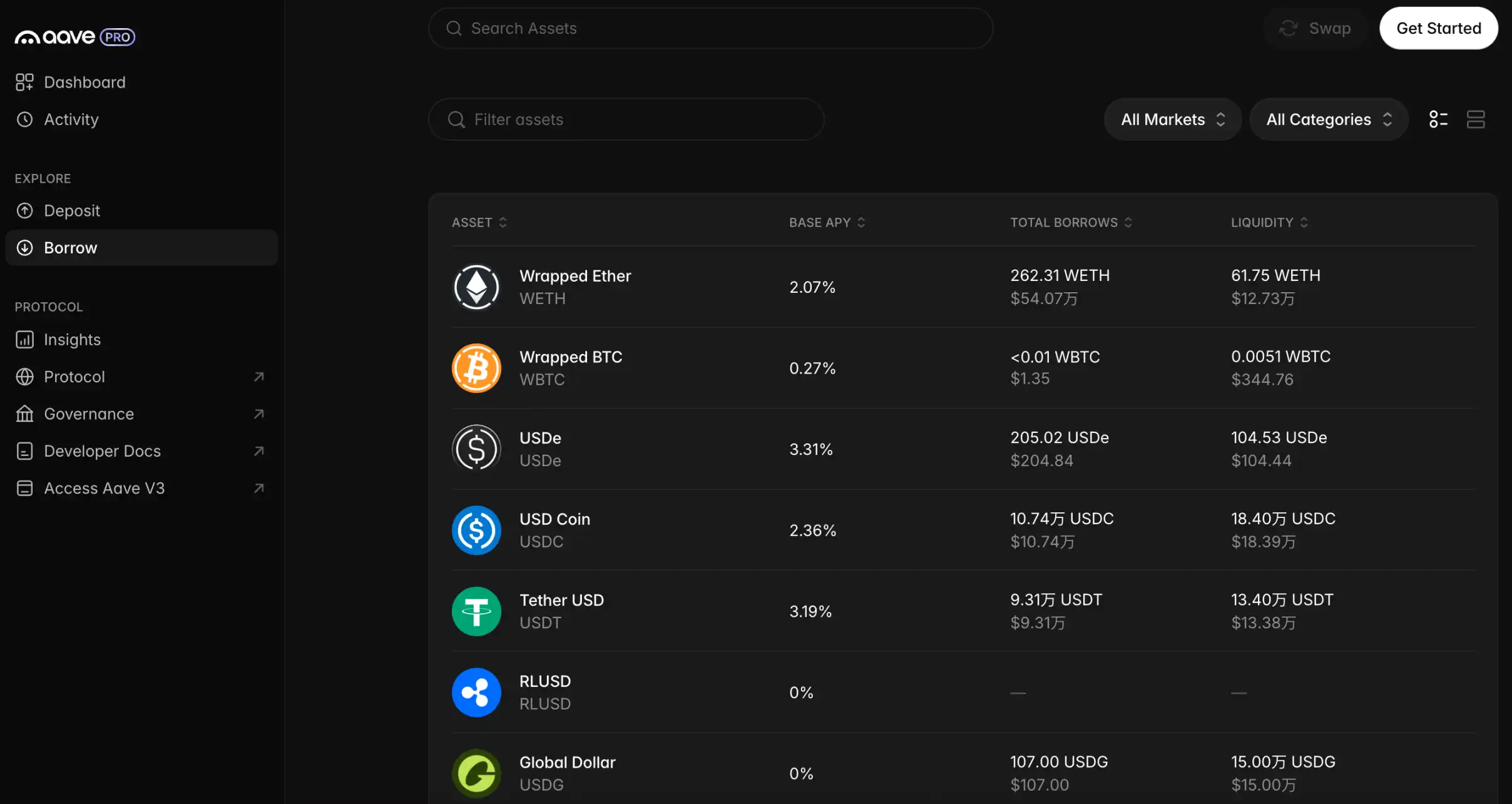
The V4 version can be described as a complete overhaul of Aave, with the core change being the integration of the originally independent lending markets into a unified liquidity pool structure: Hub and Spoke.
In the V4 version, there is a unified liquidity center (i.e., Hub) on each chain or L2, where all user-deposited assets for lending will be stored in a single liquidity pool. The Hub is responsible for global coordination, credit limit control, system-level constraints (such as "Total Borrowing Amount ≤ Total Supply Amount"), and emergency pauses. The Hub does not directly face users but manages liquidity in the background.
It is worth noting that there is not just one Hub on each chain, but rather different Hubs designed based on different needs, which essentially serves as a form of risk isolation. For example, V4 has currently launched Core Hub, Prime Hub, and Plus Hub. Core Hub includes major assets and is open to all users, while Prime Hub is designed for suppliers seeking more "controllable" collateral. Plus Hub is designed for strategy-based stablecoins, with its parameters needing to consider the project's scale.
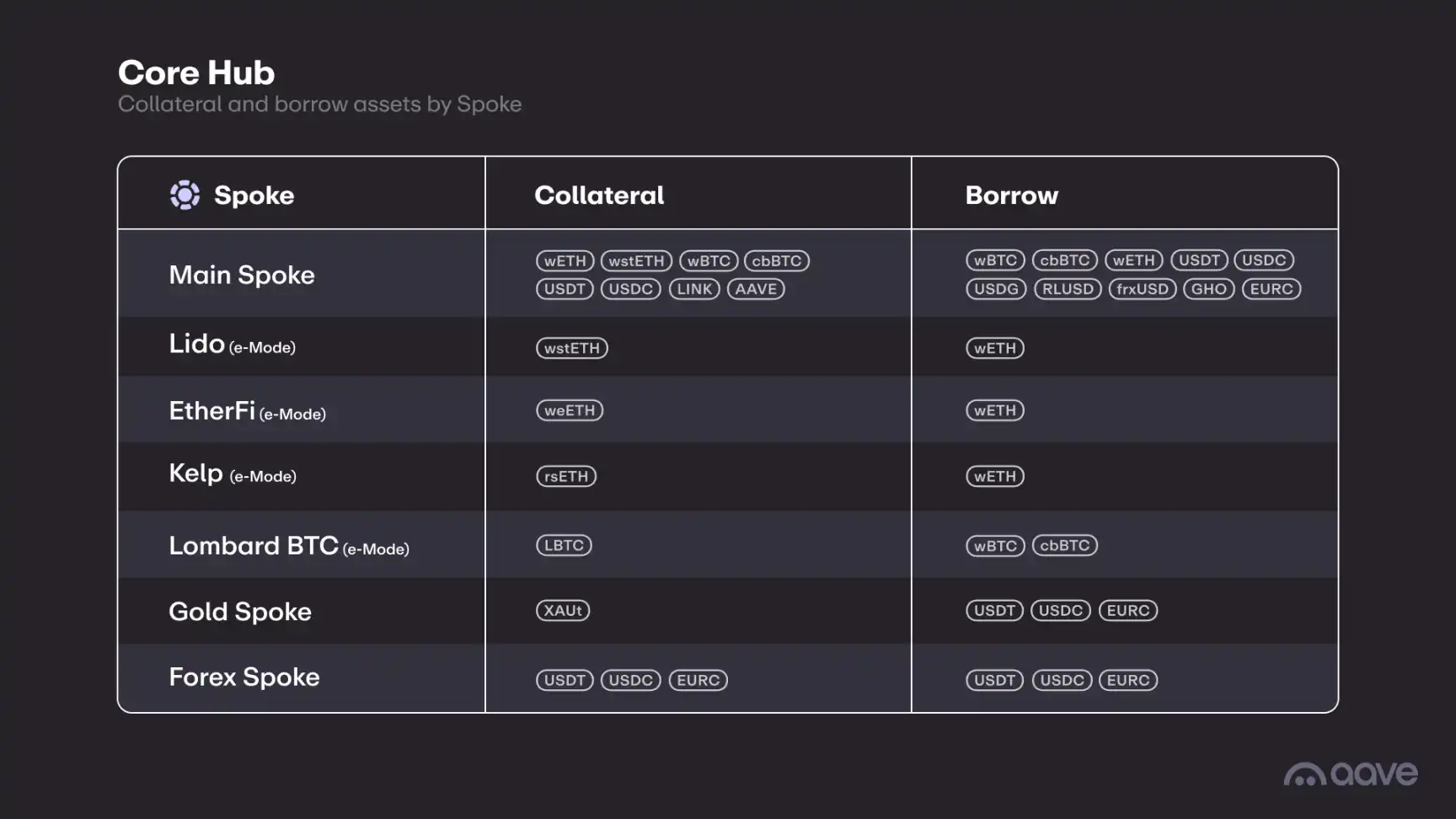
As for Spoke, you can understand it as independent markets, each with its own lending functionalities, risk parameters, and collateral rules. In a Hub, user assets are in the same liquidity pool, and borrowers need to select different Spokes according to their needs. For example, as shown in the above image, users can deposit WETH as lendable assets, and borrowers can borrow WETH in the first four Spokes, but only the EtherFi Spoke can collateralize weETH.
Although the official statement is that it can integrate fragmented liquidity, in practice, users borrowing against quality collateral do not see much difference. For instance, if you want to collateralize ETH to borrow assets, the operations in V3 and V4 are not different, as long as you ensure the health factor does not fall too low.
Thus, in terms of liquidity integration, V4 is indeed more refined than managing independent markets, but it cannot be said to represent a qualitative leap; the real differences stem from the customized parameters of Spokes and the new liquidation engine.
In V4, the borrower's interest rate depends on the base rate and risk premium. The base rate still utilizes the utilization curve as in V3, meaning it rises slowly below the optimal utilization rate and steeply rises once exceeded. The risk premium depends on the nature of the collateral; if the collateral is more stable assets like USDT, ETH, WBTC, the risk premium will be small or even zero, while high-risk altcoins will have high risk premiums, avoiding the situation where "good assets subsidize bad assets."
For a simple example, in V3, the interest rate is entirely dependent on supply and demand. Borrowing USDT, although there may be differences in borrowing limits (LTV) and liquidation thresholds, the interest rates for collateralizing ETH and LINK are the same under the same supply and demand, but LINK is clearly more volatile than ETH. If rates are the same, if borrowers collateralizing LINK raise the utilization rate, it can lead to the issue where users collateralizing ETH experience higher borrowing costs.
V4 optimizes this flaw; users borrowing against high-risk assets need to incur higher costs, while users providing funds can also obtain higher returns. At the same time, the higher interest rates restrict borrowing demand, making the cost advantages for users who collateralize quality assets more evident.
Regarding the liquidation mechanism, liquidators will only restore the health factor to the pre-set target value of the Spoke, and the lower the health factor, the higher the liquidation bonus. This design not only gives borrowers greater operational space but also reduces the overall bad debt risk of the platform. Additionally, the new liquidation engine has added a "dust prevention mechanism," whereby if remaining debt or collateral falls below a threshold (e.g., $1,000), the liquidator must fully liquidate the position to prevent small amounts from accumulating and reducing capital efficiency.
Finally, idle liquidity in the Hub can be automatically invested in low-risk yield strategies approved by governance (such as short-term government bonds, stablecoin LPs, money market instruments, etc.), which not only enhances the income of the capital providers but also increases the DAO's income, potentially one of the few advantages of "unified liquidity."
Overall, the advantages brought by Aave V4's unified liquidity in lending are not significant, and the so-called composability, that borrowing users can manage positions across different Spokes, is not much more convenient than V3. But as the author stated in the title, V4 has transformed Aave from a product into a financial infrastructure similar to a "bank."
Setting aside various complex businesses, the most core business of a bank is absorbing deposits, leaving a portion for user daily payment needs, transfers, and other reserves, and then earning the interest differential through lending. As for idle funds, banks can also allocate different investments within their risk tolerance limits.

Headquarters of St. George's Bank in St. George's Palace
Founded in 1407 in Genoa, Italy, St. George's Bank is often considered the world's earliest bank. The bank not only provided deposit and loan services but also handled government debt management, currency exchange, and fund transfers, meeting the commercial demands of Genoa as an important trade center in Europe at the time.
From the launch of ETHLend in 2017 to the launch of Aave V4 in 2026, in less than 10 years, Aave has become reminiscent of the original bank. Of course, Aave and banks differ significantly; this is merely an analogy. Compared to P2P, the banking model, which has endured countless black swan events over hundreds of years, is undoubtedly a better choice, just as V4 is to V3.
If you observe closely, you will find that many "innovations" in the DeFi track have almost turned into the dust of history, such as the hot DeFi 2.0 in the second half of 2021, while Aave, with its simple business logic honed over hundreds of years in traditional finance, has thrived and flourished. After years of exploration, many DeFi projects have likely realized this issue: The ceiling of DeFi is very high, but not a single step on the path tread by traditional finance can be omitted.
Aave V4 has centralized liquidity, and there are many things that can be done in the future, such as investing idle assets that have been unutilized for a certain period (for example, over a year) into higher-risk investments, such as engaging in ETH/USDT LP on Uniswap, operating completely in a commercial bank model, and gradually expanding into other banking activities, such as credit cards (referencing Ethfi's model of using collateralized stablecoins for consumption).
Furthermore, Aave could also expand into "investment banking." For instance, by launching an ICO platform that allows users depositing assets to earn interest while also being able to borrow USDT or USDC to participate in investments, without needing to withdraw and sell their assets to obtain stablecoins to participate in an ICO, thus charging fees from projects on one side while earning interest on the other.
Although the Hub & Spoke mechanism does not introduce any significant innovations in lending itself, it prepares the most important groundwork for the next steps.
免责声明:本文章仅代表作者个人观点,不代表本平台的立场和观点。本文章仅供信息分享,不构成对任何人的任何投资建议。用户与作者之间的任何争议,与本平台无关。如网页中刊载的文章或图片涉及侵权,请提供相关的权利证明和身份证明发送邮件到support@aicoin.com,本平台相关工作人员将会进行核查。


