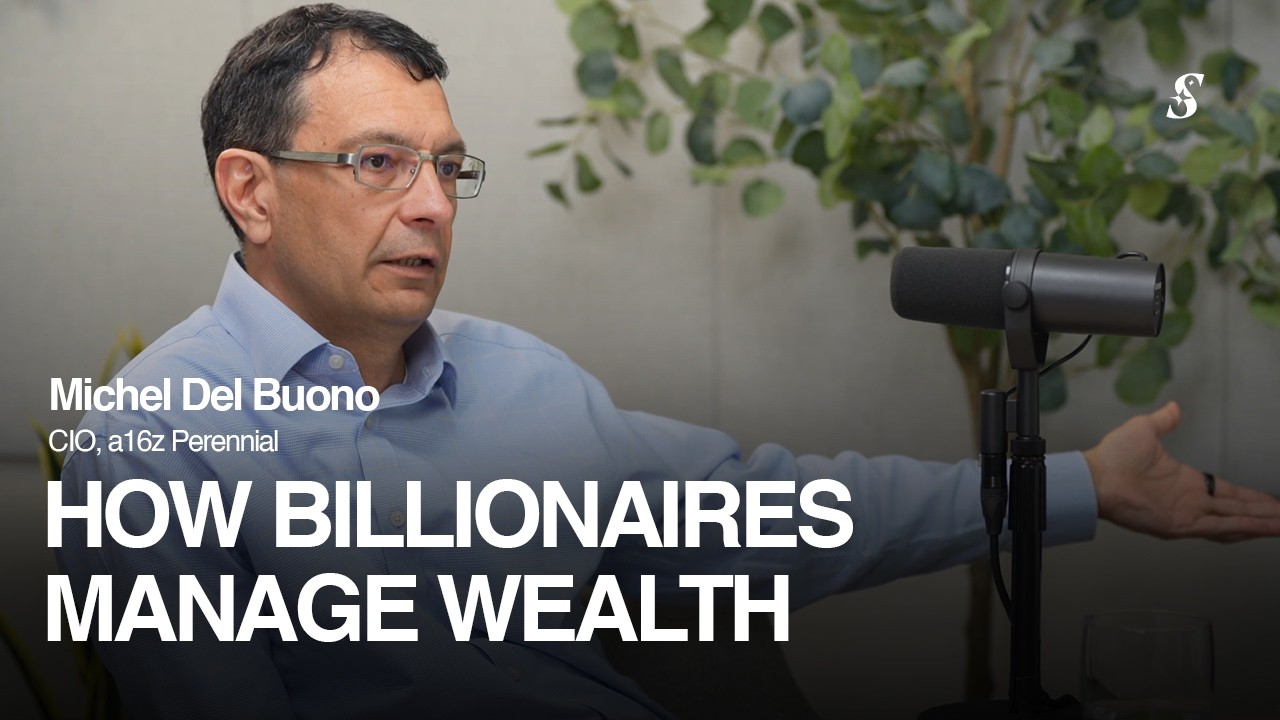
Source: Sourcery Podcast
Compiled by: Felix, PANews
The Chief Investment Officer Michel Del Buono of Perennial, a multi-family office under a16z (which provides investment services specifically for entrepreneurs, leaders, and institutions within the a16z ecosystem), recently shared insights on the Sourcery podcast about how top founders and investors in Silicon Valley manage their "first pot of gold" and prepare for potential major events like the SpaceX IPO. PANews has compiled highlights from the conversation.
Host: You are the Chief Investment Officer of a16z Perennial. Is this Marc and Ben's (the founders of a16z) family office or a multi-family office?
Michel: Perennial is essentially a multi-family office that serves entrepreneurs or investors who have established a partnership with Perennial; they do not necessarily all receive investments from our company, but many are actually supported by a16z.
Host: What is the structure of Perennial?
Michel: The reason we established Perennial (about four years ago) was to reflect on the current state of the wealth management industry. Marc, Ben, and other partners had previously used traditional wealth management companies. They observed that a16z’s LPs (limited partners), such as large sovereign wealth funds and major pension funds, have very high-end and professional investment teams, but the quality of personal wealth management services, particularly in terms of investment advice and investment acumen, is disappointing. This is not a comment on the overall service but specifically regarding investment matters.
Another purpose of establishing Perennial was to build a community around a16z, because community is at the core of a16z. This helps founders in another dimension of their personal lives; if you can lift the burden from their shoulders, they can focus more on their business. This makes our relationship with founders more long-term. Typically, you start building a relationship with them in their early startup phase and after they reach their "first pot of gold," that relationship doesn't hit an artificial endpoint; you can continue to help them plan for life post-"first pot of gold" events, such as philanthropy, asset management, succession planning, and so on.
Host: I would like to dive deeper into the strategy and structure of Perennial, but before that, it would be great to explore the current state of wealth management. What is the biggest issue right now? What structural problems have you identified in wealth management approaches?
Michel: If you are a wealthy individual, there are basically two ways to manage your wealth: one is through traditional RIAs (registered investment advisors) or wealth management channels; the other is through traditional asset management firms, such as hedge funds, PE (private equity) firms, etc. Of course, both approaches have their own issues when an individual possesses institutional-level wealth and needs to pay taxes.
Firstly, most traditional wealth management firms have spun off from banks, and the banks themselves do not train employees to become professional investors; these individuals are trained to be responsive and helpful service providers. As a wealth manager, your compensation depends on the growth of your business. So essentially, you have never been trained to be an investment expert, which means when you branch out and establish your own large independent firm, investment is still not a focus; therefore, I classify these products or services mainly as retail products, merely donning a very high-end service facade when it comes to investments, alongside all ancillary services like household staff, finding dog walkers, and babysitters. However, in general, they fall far short of the level deserved by individuals with institutional-level balance sheets.
Moreover, there’s a misalignment in the fee structure. Most firms rely on a “fixed fee” (charging the same amount regardless of what you do). Human nature being what it is, if you’re compensated the same for simple tasks as for difficult ones, you will choose to do the simple ones. We see many portfolios that are exceedingly simple, focusing merely on standard market stocks and bonds, with almost no attention to alternative investments. To provide alternative investments, one must hire high-paid, ambitious professional investors, and fitting them into an organization that is not investment-focused is very challenging. Thus, this uniform fixed fee structure leads them to be unwilling to invest the effort to build alternative investment teams, as buying stocks and bonds is much simpler.
The other route is through traditional institutional asset management companies. Their largest clients are non-profit organizations (pension funds, endowment funds, sovereign wealth funds, etc.), which do not pay taxes. Therefore, institutions do not consider tax factors at all. In California, individuals may need to pay over 50% tax. For individuals, the easiest way to achieve “Alpha (excess returns)” is through “tax Alpha,” but these institutions are even not allowed to optimize after-tax returns due to their fiduciary responsibilities, as the vast majority of their clients are only concerned with pre-tax returns. Thus, structurally, they cannot serve individuals.
This creates an awkward “no man’s land”: those taxable individuals who should be getting institutional-level asset allocations cannot find satisfaction through either of these standard channels.
Host: Dave, who facilitated our meeting, wants to hear what you've observed in different generations of wealth. From long-cycle accumulated industrial wealth to the rapidly created billionaires through AI and innovation cycles that a16z excels at. With this change, what has occurred in wealth management?
Michel: There are clear differences in wealth management approaches across different wealth generations. When I meet with a family, I can often guess which region they come from. The industrial wave in old industrial areas (Midwest), if I encounter a family from Chicago, they typically sold their business one or two generations ago, and the family’s current “business” is managing family assets. They are very familiar with all terminologies and asset classes and focused on performance.
In contrast, when you come to the West Coast, you are dealing with individuals who have just created wealth. They are very business-savvy, but they do not study wealth management as a full-time job like multi-generational families do. They typically face two choices: start a single-family office (which is extremely challenging) or join a multi-family office. When they join a multi-family office, they face many questions that I believe are not so easily answered: What am I paying for? What do I get? What do I want? Because they do not necessarily understand this industry, they will revert back to what they can comprehend. For example, how quickly do others respond to my emails? How much help can they provide when I have difficulties? These are important questions but not the only ones. Evaluating investment performance is crucial because even a few hundred basis points of additional performance over an individual’s lifetime can mean hundreds of millions of dollars, which could be used for philanthropy or other pursuits. However, this point is often overlooked in communication.
Host: I remember you mentioning that there is a significant difference between those wealth management companies that attract you with various customer services and cause you to overlook the actual performance of the portfolio. What have you observed in this regard?
Michel: This again returns to the fixed fee arrangement based on AUM (Assets Under Management). If I am selling you a pile of services, why should I charge you based on your total asset size? Imagine if you took your car to the mechanic, and they said, “Fixing this car will cost you 10 basis points of your balance sheet.” We would all find that absurd, right? It should be an hourly rate. But for them, it is evidently more profitable to charge based on AUM than on services. They view investment management as a cost center, merely going through the motions and focusing on service. This is why these portfolios often end up being very simple. Establishing a VC portfolio requires 10 years to see results, and many firms lack that patience. If you do not build an internal specialized investment team, you can only invest in others' funds, transforming into a FoF (fund of funds) model, leading to double charges. This is a massive burden for clients. If we hire professional investors solely compensated by investment performance, we can do the underwriting or direct investment ourselves, saving substantial hidden fees. Even saving half translates to hundreds of basis points of Alpha. Therefore, I believe the correct structural setup is very important.
Host: Family offices are very popular now. But you mentioned that single family offices are difficult to manage; why should people avoid creating a family office as a first step?
Michel: Having your own family office sounds cool, but you need to clearly define what your goals are. If it’s just to find someone to help with financial reports, you can call it a family office. But if you want to build a global multi-asset class portfolio, you need to hire at least 5 to 7 different specialized investors (fixed income, equities, venture capital, private equity, real estate, etc.). If your balance sheet does not reach the billion dollars level, paying these teams' salaries will consume all your profits.
Another challenge is retaining talent. These professionals are very ambitious, while the family head is effectively registering as a manager for an asset management company, and many founders do not wish to meet weekly to manage this team. Thus, retaining talent in a vacuum is difficult. Moreover, many people set up single family offices to consolidate the family, but statistics show that when family patriarchs pass away, family offices often disintegrate, and assets are hurriedly liquidated (sometimes we are the buyers picking up the pieces), or heirs take the money and go their separate ways. Therefore, single family offices face multiple challenges.
Host: At what wealth level should people consider choosing a wealth management direction rather than a family office?
Michel: For wealth management companies (like Perennial) that provide a wealth of investment expertise, the minimum threshold is approximately $25 million to $50 million, but in reality, it is better suited for clients with over one hundred million or billions, who have a perspective that spans multiple generations. Thus, they resemble endowment funds more than simple individuals.
Host: How many families are you currently serving?
Michel: We currently deliberately keep a small scale, working with only a few dozen families within a comprehensive framework, because we desire a high degree of customization. Many firms in the industry operate on a “template” basis, categorizing you based on your risk tolerance and liquidity, and then applying standard procedures. We do not do this. We believe those we work with are individuals with multi-generational wealth. Therefore, they should have tailored asset allocations and investment projects. We have done significant work concentrated on their holdings and have established a dedicated team for this purpose.
Host: Is this the main distinction between Perennial and companies like Iconiq that are Silicon Valley-oriented?
Michel: I believe most other Silicon Valley-oriented firms attempt to provide a full-stack product with all services. However, at a certain revenue level, what you can build internally is limited, so many of these companies do not even have professional investors. I often ask others, do you know how many professional investors are at such-and-such investment advisory firm? People guess 20% or 30%, but in reality, it is often zero, one, or two. This is a massive difference between us and them.
Host: There will be many significant wealth creation events coming up. It is rumored that SpaceX is about to have a $2 trillion IPO. What are your thoughts on this? How can early employees and founders prepare for such liquidity events?
Michel: If this comes true, it will be the largest IPO in history, and whether the market can absorb it will be a very interesting test. In terms of preparation, before an IPO, it is vital to construct tax, estate, and trust structures appropriately; after the IPO, the key is how to gradually diversify investments. I would not claim to know more about the company than someone who has worked at SpaceX for 20 years; I would not advise them to sell 100% of their stock to buy equity and debt immediately. Part of the strategy is diversification, while another part is long-term holding and thinking about how to profit from stock volatility (such as the options strategies we have established) without needing to sell stocks.
Host: This is really interesting. I have spoken with several people in Los Angeles about this IPO. I have talked to Shawn Maguire from Sequoia Capital, who has invested billions in SpaceX and Musk's companies. I have also spoken with engineers and people who have worked at SpaceX. I found that not only is there a shortage of wealth managers, but there is also a lack of wealth managers with such family office expertise, leading to a service vacuum. I know SpaceX is not only located in Los Angeles but also in Texas, where there must certainly be differences. What are your thoughts on this? Who should they seek out?
Michel: Many engineers and other professionals there are not in the wealth management circle, and they lack the ability to assess various options, so the result is often that they go to places that I think they should not. So the challenge they face is that even if this is not your area of interest, please invest enough time to understand this field.
I always recommend that people look at the background, education, and employment history of the people you hire. If they have never truly worked in professional investing, do not expect to get professional investment advice from that company. I believe putting in some effort to do homework in the industry is an extremely important first step, as people often say they got a recommendation from a familiar person, “Oh, my friend uses so-and-so; he's a good person, so I chose him.” I always like to use medicine as an analogy because it highlights how absurd this decision-making process can be. Suppose you have advanced cancer and need major surgery. You would not go ask your neighbor, “Hey, do you know a good neurosurgeon?” Of course not. You would read hospital reports to find out which surgeons perform this type of surgery most often; the same principle applies here. Your wealth is the culmination of your life's work. This is no trivial matter; it's incredibly important. So please invest the time to understand what you are buying, because I often find myself on the receiving end of such outcomes. I see people who go somewhere and then come to us saying they do not like that service; when you ask, “Why did you choose them initially?” the answer is almost always, “This was recommended by my neighbor, friend, or colleague.”
Host: How easy or difficult is it to switch wealth management firms?
Michel: Super difficult. This industry is designed to “trap you.” They have control over all your accounting numbers, wire instructions, trustee information, etc. Even in large custodial firms, while you can do many operations yourself as an individual client, once you switch to an RIA platform, those self-service functions are disabled, locking you into their ecosystem. This is why there is such fierce competition in the industry for clients who have just gained liquidity; because once a choice is made, the probability of clients switching is extremely low.
Host: When actually collaborating, what products do you show them? Do you guide them into the art sector? For typical portfolios, how did you set them up initially? You mentioned it's a gradual process, but how do you balance all types of services?
Michel: In century collaborations, asset allocation is a gradual process. We are very candid and tell clients that they do not need to place all their assets with us (while most firms in the industry will require you to hand everything over to them). We tend to collaborate with people in a more linear way. We acknowledge that their portfolios will change over time. Thus, we do not require clients to exit a position entirely on day one. We offer forecasting tools.
Yes, strange and unusual alternative assets may also be included, such as when some clients express interest in art; although I am not an expert, I know experts who can assist. More importantly, we provide advice. Many companies merely list options for you to choose from because they fear taking responsibility. We clearly communicate that if you wish to invest in a substantial amount of art, you will need to balance the entire portfolio with other assets. Returning to the medical analogy, you want a doctor to specifically tell you, “You need surgery; drinking herbal tea will not help,” rather than leaving you to choose between surgery and herbal tea. We take pride in this.
Host: What are your thoughts on the current market volatility (AI, geopolitics, wars, etc.)? How do you help clients navigate through these?
Michel: My favorite saying is: “Volatility is not the enemy.” Many people fear volatility, but if your balance sheet is deep enough and maintains certain liquidity, volatility is a huge opportunity. The stock market experiences a 40% pullback every four to five years; this is what “fire sale” means. You should maintain flexibility, so when the advisor calls you and says, “Everything is 60% off, it’s time to load the truck,” you can seize the opportunity.
Host: What kind of allocation do you prefer in cash, real estate, etc.?
Michel: Real estate is a very cool asset class for taxable individuals. It has low correlation (if you have a lot of tech stock risk). Many wealthy Americans (including a certain president) made their fortunes through real estate. Tax laws were made in the 1920s and 1930s when only physical assets existed, making tax law extremely favorable for physical assets (can obtain stable returns through depreciation deductions). If you can tolerate poor liquidity, your portfolio should hold a lot of real estate.
As for cash or highly liquid bonds, people dislike the 3-4% returns of bonds. But I tell them, you hold bonds not for that 3-4%, but for the flexibility and option value to cash out at any time to buy other assets. During the global financial crisis, the only thing that could be liquidated was U.S. Treasuries. Treasuries are safe-haven assets, and in times of war or crisis, their prices often rise even higher. You take this cash and go buy distressed assets.
Host: What is the most important lesson you have learned from Marc and Ben?
Michel: It’s about how to build a team. When I first arrived, they told me: “We hire people not because they lack flaws, but because they have skills.” I previously worked at large management consulting firms where performance evaluations were all about discussing how to correct my flaws; they didn’t even mention what I did well, which is incredibly frustrating. Here, the situation is entirely the opposite. If you excel at something, we celebrate it; we are all human and will have flaws, but we can learn to coexist with those flaws. The result is that every person I meet in this department is extraordinarily capable; the talent pool here is shocking.
Host: What do people commonly do wrong regarding wealth?
Michel: For founders of startups, because they have grown up in the venture capital circle, when they achieve that extremely valuable “first pot of gold,” they do not hold back a bit of money for emergencies but instead turn around and invest that money into a bunch of early-stage startups recommended by friends. Listen, if you want to do venture capital, at least systematize it and do not throw 80% of the cash you just received at your three friends. This almost always ends in tragedy. Since they themselves are survivors of bias success, they have difficulty seeing the overall statistics of the industry, always believing that investing in three will yield at least one success, but usually, none will succeed. Putting hard-earned liquidity back into highly uncertain and illiquid things is the biggest mistake I have observed.
Host: Has the IPO window opened? Who will go first, SpaceX or OpenAI?
Michel: I think SpaceX will go public first. OpenAI and Anthropic are currently in fierce competition. At present, companies can still raise huge amounts of money in the private market (like OpenAI and large VC fund raising), so as long as they can still secure tens of billions in private market funds, the pressure to IPO is low. Ironically, when the economy slows down and private capital becomes less accessible, they may be forced to IPO instead.
Related reading: Dialogue with a16z co-founder Marc Andreessen: Founders are better off not being introspective; humanity always approaches new things with panic
免责声明:本文章仅代表作者个人观点,不代表本平台的立场和观点。本文章仅供信息分享,不构成对任何人的任何投资建议。用户与作者之间的任何争议,与本平台无关。如网页中刊载的文章或图片涉及侵权,请提供相关的权利证明和身份证明发送邮件到support@aicoin.com,本平台相关工作人员将会进行核查。


