Written by: Charlie Little Sun
Last week, a latest draft concerning the CLARITY Act leaked, Circle recorded a drop of about 20% in a single day, and Coinbase dropped nearly 10%.
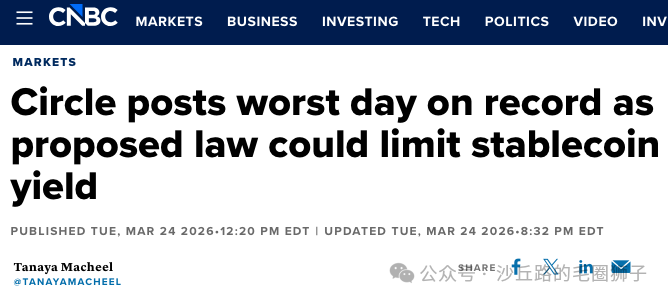
A few weeks ago they were the hot stocks of agentic commerce, the future payment infrastructure, and now they have become a reflection of Washington policy risk.
Following my last article on the first act of the CLARITY Act——The CLARITY Act is hindered, the Crypto camp is diverging, the battle of interests between DeFi and TradFi—— last week's events seemed more like the second act: what really matters to the U.S. decision is not the revenue terms, but who the dollar account belongs to.
In the past few days, many news outlets and media have analyzed the impact of the events, but what I find more worth writing about is why a term that seems very technical regarding stablecoin rewards could deeply affect Circle, Coinbase, banks, and Wall Street.
And why the essence of this matter is not whether a platform will still be able to offer some rewards to users in the future, but whether the U.S. is really willing to allow stablecoins to grow into a kind of on-chain savings account.
This is not a battle over revenue terms, it's a battle over "dollar accounts"
Section 404 of the Senate draft is the core of the whole news: digital asset service providers cannot pay any form of interest or returns simply because users hold payment stablecoins.
Moreover, from the structural text, 404 is primarily targeting the platform/distribution layer, which does not automatically mean it is a blanket ban on all issuers.
However, if rewards are linked to payments, transfers, exchanges, settlements, platform use, membership programs, merchant cashback, providing liquidity or collateral, governance and staking, these actions would still be allowed.
At the same time, the bill also explicitly prohibits packaging such compensation as "deposits," "FDIC-insured," "zero-risk," or "equivalent to bank deposit rates," and requires the SEC and CFTC to jointly formulate related disclosure rules within 360 days after the bill is enacted.
In other words, Washington is not saying "stablecoins cannot incentivize users," but rather "you can incentivize behavior, but you cannot package stablecoins as on-chain demand deposit accounts."
If we only look at the discussions within the crypto circle, it would seem to be a product design issue, but once we include the banking aspect, the nature of the problem changes immediately.
The ABA and other banking organizations' joint letter in January was quite straightforward: they requested Congress to ban inducements, whether paid directly by issuers or indirectly by affiliates, platforms, or partners, aiming to prevent payment stablecoins from becoming an alternative to investment and deposits.
Moreover, in the past month, the White House has attempted to bring banks and the crypto camp together multiple times, but this issue has always been a point of contention.
The logic of the banks is very straightforward——if fully-reserved stablecoins can provide yields close to risk-free rates on the platform, some deposits will naturally flow out, which would undermine the banks' liability costs, loan capabilities, and the narrative of financial stability.
The estimate given by Standard Chartered Bank of about 500 billion USD potential deposit outflows may not be the most accurate number, but it is enough to serve as a political weapon at the legislative level.
Some may find this merely a detail of incentive marketing, an inconsequential wordplay, not worthy of being escalated to a grand proposition about "dollar accounts".
But if it truly were just awordplay, the banks wouldn't have sent several letters pressuring publicly in January, and the White House wouldn't have invited banks and the crypto industry to the same table twice at the end of January and the beginning of February.
What truly turned this matter into a core contradiction has never been the incentive itself, but rather the potential of "moving the dollar onto the chain, and letting it attract like a savings account".
As I mentioned in my previous article: behind the battle of incentives, what truly decides is whether stablecoins in the U.S. will only be a payment/transaction medium or will become a vehicle for savings. The latest round of drafts actually aims to write this sentence into law.
Circle is more like an AI stock, Coinbase is more like a policy stock
Circle and Coinbase have both taken hits this time, but the ways they have suffered are different.
Circle's stock price in these weeks has been like a litmus test of emotions.
At the end of February, the market first cheered the earnings report because its data was indeed beautiful: USDC circulated 75.3 billion USD by the end of the year, a year-on-year increase of 72%; Q4 total revenue was 770 million USD, a year-on-year increase of 77%; reserve income was 733 million USD.
By early March, the story of agentic commerce pushed it up a bit more. Media hyped up that Circle and Stripe were building a path for a "yet nonexistent" future——a world where autonomous AI agents settle using stablecoins at high frequencies.
This story is certainly enticing because it makes Circle appear not just as a stablecoin issuer benefiting from interest rate cycles, but as a payment infrastructure for the AI era.
But once the draft leaked on March 24, the market turned around and treated it as the biggest beta of the CLARITY risk.
In a matter of weeks, the same company was labeled in three different valuation languages: earnings stock, AI infrastructure stock, policy victim stock.
The most magical aspect here is that the actions Circle has taken during this period have not changed fundamentally; it is just the labels Wall Street has affixed to it that have transformed.
Coinbase, on the other hand, is not so "story-driven;" it is more like the market sees it as the first-level victim in this chain.
The reason is simple: its stablecoin economics have long ceased to be a peripheral role.
Coinbase disclosed that Q4 stablecoin revenue was 364.1 million USD, and the USDC held in Coinbase's product line reached a historic peak of 17.8 billion USD, with a USDC market capitalization of 76.2 billion USD.
The company also clearly included all of this in its narrative of "Everything Exchange is working" in its investor disclosures.
In other words, Coinbase is not fighting over a small product feature, but an entire set of growth flywheels: balance retention, user retention, subscription rights, platform stickiness, teamwork of dollar balances and on-chain services.
On March 24, when the market made Coinbase drop by 9.8%, it was actually making a very blunt yet very direct pricing: if the yield based on balance in stablecoins is suppressed, this flywheel will slow down.
But I feel this is also where many people mistakenly mix Circle and Coinbase together.
The hit Circle took is more like indirect conduction because the draft directly targets digital asset service providers paying interest or returns to holders, meaning the platform distribution and user interface layers take the hit first; while Circle, as the issuer, primarily derives its income from reserve revenue in the short term.
Coinbase, however, is different; its user relationships, platform distribution, USDC incentives, and Coinbase One rewards are already on this line. Thus, for both to fall, Circle resembles "policy uncertainty compressing growth expectations," whereas Coinbase resembles "some growth engine possibly being dismantled directly."
On this level of differentiation, the market has already given some intuitive signals through the extent of its decline, but many reports still haven't articulated it fully.
Both Chinese and American media got half of it right but missed three layers
In the past week, I have seen that most mainstream American media have framed this incident in two directions.
One direction focuses on stock prices: Circle crashing, Coinbase jumping, crypto-related stocks being more sensitive to news from Washington than many people think.
The other direction is the legislative window: banks and the crypto camp have yet to reach an agreement; the White House has coordinated in the past, and the time before the midterm elections is narrowing, putting the question mark on whether the bill can be enacted by 2026.
This narrative is certainly not wrong, but it remains at "what happened."
Chinese media and self-media outlets, on the other hand, often quickly pivot to trading aspects.
On one side, there is the question of whether Circle has been wrongfully punished, whether Coinbase has been hurt the most, and whether Tether's auditing actions will take the opportunity to strike.
On the other hand, there is the question of whether a final compromise text will be unveiled this week and whether activity-based rewards will ultimately be interpreted too narrowly.
This perspective is closer to the market and is more sensitive, but many discussions still linger on "which company benefits and which one suffers."
I believe both sides have collectively missed three layers.
The first layer is political economy.
Many write it as "banks vs crypto," but fail to articulate it as "whether the U.S. allows stablecoins to become substitutes for savings accounts."
Section 404, the public statements from the ABA, the White House's multiple coordinations, and media reports together make it quite clear: Washington does not want to eliminate stablecoins, but rather wants to lock them into the route of payment tools first.
It is willing to accept stablecoins growing to resemble more efficient Visa, SWIFT, or B2B settlement layers, but is not eager to let them resemble high-yield demand deposit accounts.
The second layer is the distinction between issuance and distribution.
Circle will certainly be affected because once the platform layer can hardly rely on "holding to earn" to boost USDC balances, the growth speed and valuation expectations of USDC will also be impacted.
However, the most direct impact is not on Circle, but rather on the platform and distribution layer.
Coinbase’s drop resembles its growth engine being directly discounted by the market, whereas Circle feels more like a potential downgrade in future growth slope.
To lump these two together and write them as "negative for stablecoins" is a bit too vague.
The third layer, which I find profound and essential, is that the demand for yields will not disappear but will only migrate.
Restraining the imagination of saving through payment stablecoins does not mean that the market's demand for cash-like yield suddenly evaporates.
It is more likely to migrate to tokenized MMFs, on-chain securities, or other structures that more explicitly fall under the regulation of securities.
And this corresponds with another easily overlooked language in the CLARITY draft: Section 505 clearly states that a financial product that is already a security will not cease to be a security because of tokenization; and a real-world asset that is not asecurity will not simply become one because of tokenization; more crucially, the tokenization itself cannot serve as an exemption from existing registration requirements.
In layman's terms: Washington is willing to leave a path for tokenization, but does not intend to throw open the door and is not rewriting existing securities regulatory logic just because of being on-chain, and Section 505 specifically prevents the market from marketing tokenized RWA or tokenized financial assets as things that are “naturally equivalent” to underlying assets.
Once the demand for yield migrates away from stablecoin balances, the most likely beneficiaries may not be those who tell the best crypto stories, but rather TradFi institutions more skilled in on-chain securities and compliant distribution.
Banks, Coinbase, and Wall Street are not competing for the same thing
The most interesting aspect of this matter is that on the surface, it appears to be a dispute over a piece of legislation, but underneath, it is actually three entirely different business models vying for a future ticket.
Banks are fighting over the liability side.
They are not afraid of "crypto becoming cooler," but of "the dollar moving from deposit accounts to the chain, and retaining an appealing yield close to risk-free rates once there."
Once this happens, the core part of the bank's moat—low-cost deposits—will be pried open.
That is why banks keep redefining this matter as financial stability rather than policy competition.
Coinbase is fighting for entry and distribution rights.
In my last article, I mentioned its "everything exchange" strategy: all assets on-chain, all transactions completed in one account, while making the dollar balances on the platform competitive.
It is not merely about retaining a 3.5% USDC reward but about preserving a broader platform vision——users putting dollars, crypto, future on-chain securities, derivatives, and subscription rights into the same interface.
Coinbase's strong stance this time is not only because of short-term losses but because it believes these terms will determine the space for the next decade rather than a compromise over a single quarter.
The narrative of current investors has also publicly stated that: Everything Exchange is its direction, with USDC on the platform being a key component of that.
Wall Street is disputing whether tokenization will still occur in the channels it is familiar with.
The language of Section 505 has already given an answer: once securities are on-chain, they still remainsecurities, and tokenization does not automatically lower registration requirements.
In other words, "U.S. stocks on-chain" can certainly happen, but Washington does not intend to hand over the roles of gatekeepers of existing securities exchanges, broker-dealers, custody, and clearing systems to crypto-native platforms.
In my previous article, I mentioned that "the key is not whether tokenization is possible, but who can legally dominate this path," and it now appears to be even more valid.
As for DeFi, this time it is overshadowed by stablecoin yields.
Many believe CLARITY recently has only Section 404 left to look at, but the draft's languages regarding software developers, front ends, wallets, messaging systems, safe harbor, and rule-of-construction are also worth examining.
On one hand, the bill states that simply compiling, verifying, providing nodes, and developing wallets and software should not subject individuals to the Act; on the other hand, it clearly states that this does not automatically alter the applicability of laws like money transmitter, AML, and CFT for actions beyond the scope.
In other words, the U.S. is not completely denying DeFi a road to survival, but is attempting to differentiate between "the person writing the code" and "those who actually control user funds, execute user transactions, and provide regulated access."
But how this line will be drawn in the future relies heavily on regulatory interpretation.
In the short term, it's negative, but in the long term, it may not be a bad direction
Therefore, my current judgment is not entirely aligned with the market's initial reaction during the trading day.
In the short term, banks have indeed gained a small step forward.
Coinbase is hurting the most, and Circle will also inevitably be affected.
Over the past few years, the easiest data story to tell about user growth for stablecoins in the U.S. market has been "turning on-chain dollars into a more attractive dollar balance."
Once this path is blocked, the product strength of the platform, distribution efficiency, and growth multiples provided by the capital markets will all be repriced.
However, in the long term, I do not see this necessarily being a bad thing for the entire stablecoin industry.
It feels more like a forced pivot. If U.S. regulation ultimately nails stablecoins on the payment tool line, the industry will be compelled to talk a little less about APY and a little more about real payment scenarios.
Whoever can integrate stablecoins into B2B settlements, cross-border payments, merchant acceptance, corporate treasury, and e-commerce payments will hold more long-term value.
The same goes for Circle.
The market has recently dressed it up as an AI payment stock one moment and a policy victim stock the next, but the more likely future is that it is compelled to shift more quickly from being a “company benefiting from interest rate cycles” to a “company building payment networks and B2B infrastructures.”
This path is harder than issuing rewards, and the growth may not be as smooth, but once it's worked through, the quality of the valuation may actually be higher.
The market has finally realized that a technical clause regarding stablecoin yields underlies three larger wars——banks defending the liability side, Coinbase fighting for entry rights, and Wall Street competing for the legitimate dominance of tokenization.
Many historical turning points are not found in grand speeches, but in seemingly inconspicuous legal sentences.
免责声明:本文章仅代表作者个人观点,不代表本平台的立场和观点。本文章仅供信息分享,不构成对任何人的任何投资建议。用户与作者之间的任何争议,与本平台无关。如网页中刊载的文章或图片涉及侵权,请提供相关的权利证明和身份证明发送邮件到support@aicoin.com,本平台相关工作人员将会进行核查。


