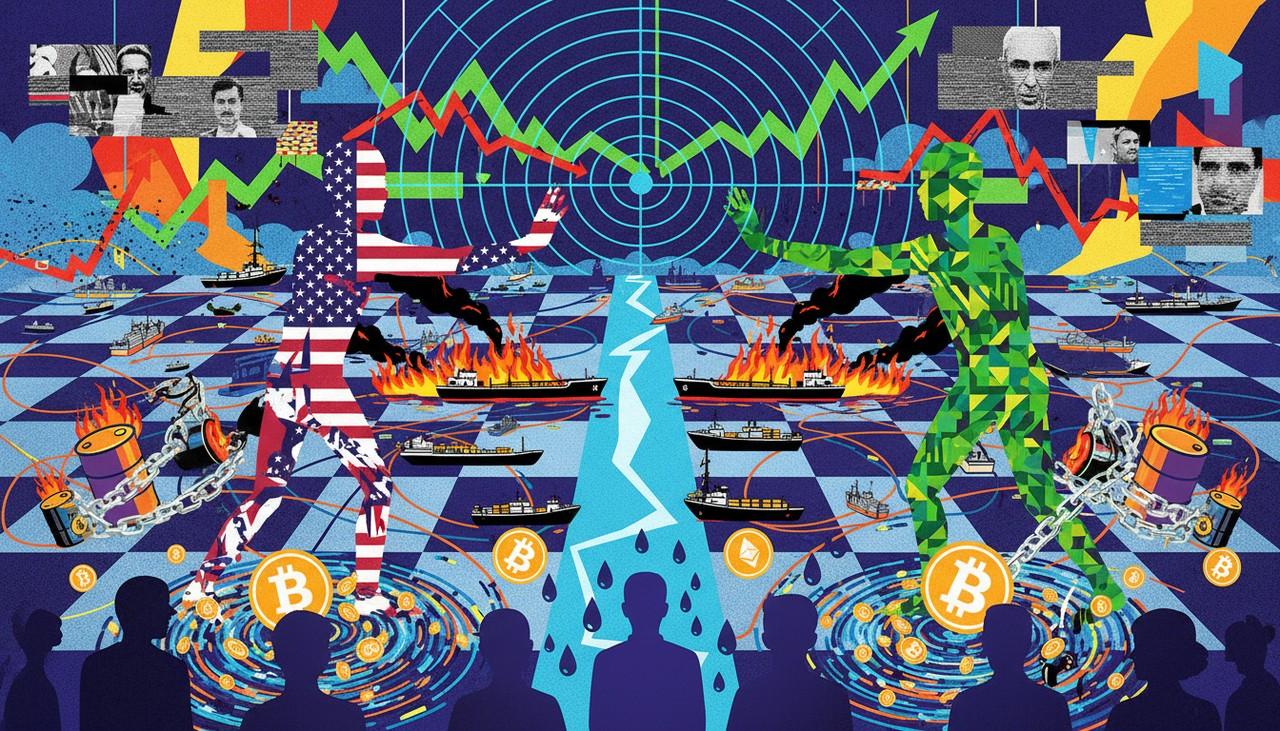
On March 30, 2026, in East Eight Time, Federal Reserve Chairman Powell provided the latest policy signals: in the context of high inflation and no obvious slowdown in growth, the choice was made to maintain the current stance, emphasizing that "monetary policy is in a favorable position and can wait to observe the situation's development." On one hand, he defined the price shocks from the new round of tariffs as "one-time price increases" and downplayed their persistence; on the other hand, against the backdrop of rising energy costs due to the situation in the Middle East and Brent crude oil at $113.7 per barrel, the Federal Reserve still chose to wait and see. This downplaying of supply shocks stands in sharp contrast to the market's concerns about "the resurgence of inflation stickiness," and directly affects inflation expectations repricing and the risk appetite for global risk assets, including cryptocurrencies such as Bitcoin, which are being repositioned in the macro narrative's coordinates.
Tariffs and Oil Price Surge: The Handling of Inflation Sparks
In this round of statements, Powell once again described the new round of tariff shocks as "inflation caused by tariffs is a one-time price increase," and cited internal assessments to limit its upward effect on inflation to the range of 0.5-1 percentage points (according to a single source from Rhythm and Planet Daily). This implies that within the framework of the Federal Reserve, tariffs are more akin to a one-time elevation of price levels rather than a continuous inflation process, thus there is no need to respond with significantly tighter monetary policy. This qualitative assessment represents a deliberate distinction between demand-side driven inflation and supply-side tax shocks, and is also a logical extension of continuing to focus policy on "observing subsequent data" rather than "preemptive action."
Alongside tariffs, energy prices have tightened again. Influenced by the geopolitical situation in the Middle East and expectations of G7 energy market interventions, the latest quotation for Brent crude oil is $113.7 per barrel (according to a single source), which is viewed by the market as an intuitive signal of supply-side tension. Since the briefing explicitly prohibits estimating the quantitative transmission of the Middle East situation to oil prices, this article will not model specific point estimates, but it is certain that the rise in energy costs will be transmitted through transportation, chemicals, manufacturing, and other links, increasing the risk of a resurgence in core inflation. At this time, the Federal Reserve chooses to continue treating these supply shocks as "transitory external events," which is in obvious misalignment with the market's concerns about high oil prices potentially solidifying inflation expectations.
The core of this misalignment lies in the fact that the Federal Reserve emphasizes the "limited nature of tools against supply shocks," thus tending to avoid making aggressive responses to every fluctuation in oil prices or tariffs; while the market fears that after already experiencing a cycle of high inflation, any new supply-driven increases are more likely to become solidified as long-term stickiness through expectation channels. This divergence in expectations is becoming an important variable in traders' pricing curves and the premiums of inflation-protective assets.
Is Policy in a Favorable Position? The Assumptions Behind Inaction
When Powell claims that "current monetary policy is in a favorable position and can wait to observe the situation's development," the underlying premise is: under the existing interest rate range, demand has been sufficiently suppressed, financial conditions are generally tight, and the economy can still withstand a prolonged high interest rate environment. This means that the Federal Reserve judges that the current monetary environment is sufficient to suppress second-round inflation shocks without immediately stifling growth or triggering systemic financial pressure. This confidence in the policy position directly supports the strategic choice of "waiting rather than ramping up."
However, the Federal Reserve also acknowledges that traditional interest rate tools have limited direct response capabilities to supply shocks like tariffs and oil prices. Under such a premise, continuing to bet on "time exchanging for space," relying more on a gradual decline in inflation expectations and the self-repair of supply chains, rather than forcibly suppressing prices through tighter monetary policy. The tension of this strategy lies in the fact that if time does not bring about a decline in inflation, but instead results in more widespread price increases and growth slowdown, the policy will face a "stagflation-style" dilemma.
In a wait-and-see stance, the dual risks of inflation resurgence and economic slowdown will first be priced into risk assets. Firstly, if the market believes that the Federal Reserve's bet on "waiting it out" is correct, with nominal rates at high levels but real rates gently declining, equity assets and some high beta assets may receive valuation support. Secondly, if the market turns to worry about inflation rising again and the policy being forced to maintain high rates for a longer time, or remains unable to pivot in a timely manner when economic data weakens, the discount rate for high-risk assets including growth stocks and cryptocurrencies will be raised again, with volatility consequently magnified. Waiting does not mean inaction; rather, it hands over the pricing power of volatility more to the market.
The Claim of QE Not Causing Inflation: Historical Memory and Controversy Resurfaces
In this statement, Powell reiterated that "there are no signs that QE has inflationary characteristics," a statement that itself carries a high degree of controversy. Looking back at the post-pandemic phase, quantitative easing combined with fiscal stimulus once propelled global asset prices to soar, while consumer prices saw a relatively delayed response, constituting a structural divergence of "asset leading, consumer lagging," which is central to the debate around the inflation effects of QE. Now, when the chair separates QE from high inflation, it equates to a discursive absolution for past rounds of QE, also reserving political and public opinion space for the potential future need to employ such tools again.
The transmission from asset prices to consumer prices cannot be explained by a single dimension. In the market's memory, the successive surges of US stocks, real estate, and commodities after the pandemic were highly synchronized with ultra-loose liquidity, while the delayed reaction of the CPI provided ample material for the narrative of "QE pushes assets first, then consumption." The briefing explicitly prohibits the fabrication of specific quantified data and model calculations regarding the inflation effects of QE, therefore it can only be pointed out: there remain significant differences in academia and the market surrounding the proposition "Does QE inherently have inflationary characteristics?" The chair's statement of "no signs" is more of a policy discourse than a consensus conclusion.
It is equally important to emphasize that the market's concerns about the long-term inflation effects of QE and the systemic underestimation of supply shock risks are still in a "to be verified" state. Some traders believe that the ultra-loose cycle of the past decade may have already sown the seeds of inflation deep within balance sheets, which could erupt only during the overlap of supply shocks and fiscal deficits; while others believe that high leverage, changes in demographic structure, and technological advancements have rather suppressed inflation potential in the medium to long term. These differences have not been thoroughly adjudicated by data, yet they have profoundly affected the current pricing logic of interest rate curves, nominal yields, and inflation-protective assets.
Tech Unicorns and Crypto Legislation: A Liquidity Battle
As the macro interest rate environment remains high while waiting, traditional capital markets and crypto markets are competing for the limited incremental liquidity in the same arena. On one hand, the rule adjustments for the Nasdaq 100 index have reserved weight space for more large tech companies and potential unicorns, combined with expectations of a technology unicorn IPO wave, indicating that in the near future, global equity capital is more likely to concentrate on these growth stories. This "quality equity asset"吸金效应 will pull some risk preferences away from crypto assets, especially during stages when funding costs remain high, liquidity is more willing to choose sectors with more mature regulatory and valuation systems.
On the other hand, the regulatory legislative process surrounding fiat-pegged assets like USDT and USDC is noticeably accelerating, with the Clarity Act widely expected to be announced this week (the specific terms are currently unclear; speculation on structure and force is prohibited). Once such legislation is enacted, it will directly reshape the channels for crypto funds to enter and exit: on one hand, it is expected to provide clearer frameworks for compliant funds to enter; on the other hand, it may also constrain existing arbitrage, cross-border, and gray areas. This "pipeline reconstruction" will change the distribution pattern of liquidity between the traditional financial system and the on-chain world.
Under the same macro interest rate environment, Wall Street and the crypto market are actually competing for the same pool of funds: when Nasdaq tech giants and newly listed unicorns offer a combination of high growth + high certainty, institutions are more inclined to use their limited risk budget to allocate assets that can be portrayed by traditional valuation methods; while the crypto market must attract or retain liquidity through more aggressive yield structures, clearer regulatory expectations, and grand narratives. This cross-market liquidity tug-of-war is reinforcing the sensitivity of cryptocurrency prices to regulatory news and policy trends.
Whale Holding Silence: Bitcoin's New Position in the Macro Narrative
In this round of heightened macro uncertainty, the "silence" of large on-chain holdings has become another important clue. According to a single source of data, Strategy currently holds about 762,099 BTC, valued at approximately $51.5 billion at current valuations. It should be noted that this number comes from a single channel, and readers should maintain a cautious attitude toward its accuracy, but it is sufficient to indicate that large institutions and whale-level entities have formed a deep, long-term capital lock-up on Bitcoin.
This long-term holding structure, on one hand, reduces the freely circulating chips in the spot market, magnifying the marginal buy-and-sell impact on prices; on the other hand, it also significantly enhances the magnifying effect of Bitcoin prices against changes in macro policy expectations—when expected interest rate paths, inflation trajectories, and regulatory progress experience slight adjustments, leveraged funds in the futures and derivatives markets will layer reflections on relatively thin spot liquidity, leading to a multiplying effect on price sensitivity to "every word from the Federal Reserve."
In the current environment dominated by wait-and-see monetary policy, Bitcoin is being pulled in two directions. On one hand, there is its narrative as an "inflation hedging asset": with recurring supply shocks from tariffs and oil prices and the Federal Reserve insisting on viewing them as one-time events, some funds prefer to use Bitcoin to hedge against the tail risks of "policy underestimating inflation." On the other hand, it also faces the reality of being a high-volatility risk asset: in an environment of high interest rates, rising discount rates, and ongoing regulatory uncertainties, Bitcoin will be prioritized for reduction alongside growth stocks and tech stocks as risk aversion sentiment heats up. This "dual attribute" pull makes Bitcoin simultaneously resemble gold in the macro narrative and a high beta shadow of Nasdaq.
A Patient Bet: Waiting on the Federal Reserve and Self-Proving Crypto Market
In summary, the Federal Reserve continues to view tariffs, oil prices, and other supply shocks as one-time events that can be "waited out," rather than as persistent threats that require proactive tightening. The premise of this core position is that inflation expectations will not spiral out of control due to short-term supply-side surges, and existing interest rate levels are sufficient to maintain the medium-term downward trend of prices. The Federal Reserve chooses to place its bets on time and expectation management rather than on more aggressive policy actions.
However, before the key variables of oil prices and tariffs become clear, market pricing of uncertainties regarding inflation and future interest rate cuts will continue to be magnified. The briefing has already explicitly prohibited predicting the specific rhythm of interest rate hikes or cuts, so it can only be emphasized here: the volatility of the curve, whether this round of inflation is "persistent," and whether policy will be forced to choose sides between growth and prices will gradually manifest in high-frequency data and policy language over the next few months, and asset prices will react in advance.
For crypto assets, the road ahead is a narrow path parallel to clear regulation and macro swings: on one hand, advancing legislation related to USDT, USDC, and the Clarity Act will provide clearer institutional coordinates for compliant fund inflow and outflow, possibly triggering a sentiment inflection point of "regulatory boots hitting the ground" at some moment; on the other hand, the Federal Reserve's wait-and-see stance combined with the variables of oil prices and tariffs destined the macro environment not to swiftly return to the old era of "zero rates + unconditional easing." For the crypto market to welcome a new funding inflection point in such a framework, it must await the resonance moment of regulation and macro, while also providing a sufficiently convincing self-proving process in on-chain innovation, yield structures, and risk management.
Join our community to discuss and become stronger together!
Official Telegram Community: https://t.me/aicoincn
AiCoin Chinese Twitter: https://x.com/AiCoinzh
OKX Welfare Group: https://aicoin.com/link/chat?cid=l61eM4owQ
Binance Welfare Group: https://aicoin.com/link/chat?cid=ynr7d1P6Z
免责声明:本文章仅代表作者个人观点,不代表本平台的立场和观点。本文章仅供信息分享,不构成对任何人的任何投资建议。用户与作者之间的任何争议,与本平台无关。如网页中刊载的文章或图片涉及侵权,请提供相关的权利证明和身份证明发送邮件到support@aicoin.com,本平台相关工作人员将会进行核查。