Author: Changan I Biteye Content Team
When you open the Polymarket leaderboard, the first reaction might be: This address made $200,000, is buying with him guaranteed profit?
Not necessarily.
Behind the huge profits could be a series of 50 consecutive correct bets, or it could just be a single heavy bet that happened to be right.
The former is a replicable systematic profit, while the latter is an unsustainable survivor bias.
This article will help you solve two core issues:
- How to penetrate data noise and identify true "smart money"?
- After finding the address, how to practically operate with different strategies?
1. Finding Smart Money: The Essence of Prediction Markets is Information Competition
Prediction markets are fundamentally different from cryptocurrency trading in secondary markets: it is an extremely segmented information competition.
Every market subject is backed by a concrete professional issue:
- Will a certain movie break 100 million in its first week? (theater scheduling, pre-sale data)
- Will the highest temperature in a certain city exceed 35 degrees tomorrow? (meteorological models, historical averages)
- Will Iran launch an attack on Israel this month? (geopolitics, intelligence monitoring)
There are very high information barriers in these fields.Following smart money is essentially about finding people with a higher understanding than yourself in a specific vertical.
Where can we find these people?
The previous article on Biteye"Mastering Polymarket: 7 Tools Are All You Need" introduced 7 tools for Polymarket. Taking Polymarket Analytics as an example, we must be wary of the following three pitfalls during filtering:
1. The false prosperity of PNL (profit and loss) data The data structure of Polymarket is extremely complex, involving various on-chain operations like buying, splitting, merging, and redeeming. Many tools (even official websites) can yield multiplied deviations in PNL if the calculation dimension is chosen incorrectly. True smart money should penetrate calculation based on event dimensions, integrating inflows and outflows as well as current market value.
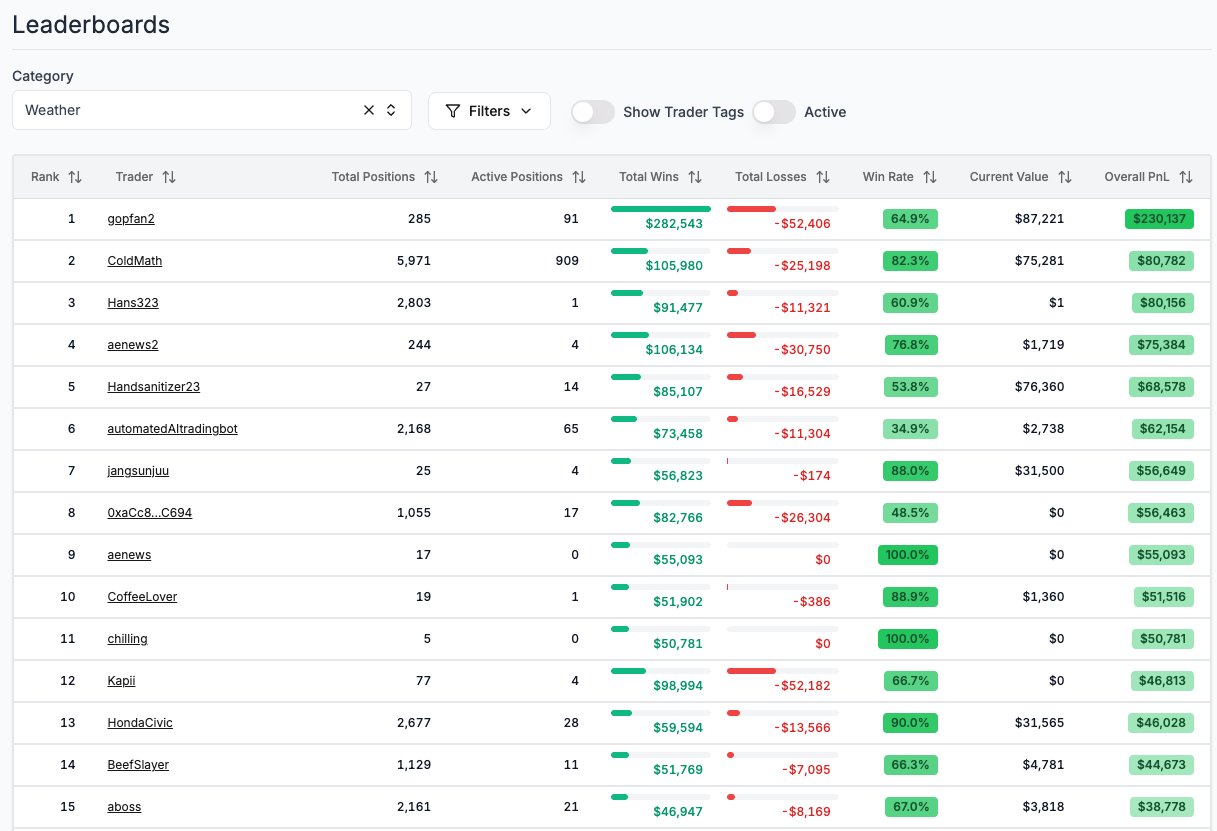
2. Interference from arbitrage bots For example, automatedAltradingbot frequently appears on the leaderboard. These addresses profit through cross-market arbitrage or providing liquidity. Although their win rates are impressive, each trade has a hedged position. If you only follow one "leg," the risk will be entirely asymmetric.
3. A high win rate does not mean high expectations Some addresses specifically target markets with win rates above 98% and just before settlement, earning the last $0.02 spread. While this strategy has a win rate close to 100%, it offers no profit margin for followers and could even lead to losses due to fees.
2. Four Dimensions to Filter Smart Money
After finding the leaderboard, the next step is filtering. Smart money has two bottom-line conditions:
- Profits must align with the logic of the Kelly criterion
- At the same time, there must not be excessive single losses.
The core idea of the Kelly criterion is: the bet size must match the win rate and odds; you cannot just go all-in because a particular bet feels safe. A trader who truly understands risk control has calculated every position and will not experience a situation where one loss wipes out all previous profits.
Thus, before looking at specific data, first eliminate two types of addresses: those with unusually large total losses and those with records of single large losses. Even if the total PNL for such addresses is positive, their risk control logic is problematic.
The remaining addresses can then be judged using four dimensions:
1. Win Rate
Win rate is the core indicator for assessing whether an address is profitably stable, but it must be considered alongside PNL.
- High win rate but low PNL: often indicates endgame operations where wins yield minimal profit;
- Low win rate but high PNL: may result from a few heavy bets being fortuitously correct.
2. Number of Markets
A sample size that is too small lacks reference value. The probability of winning 5 consecutive coin flips is not low, but no one would think it indicates anything.
Betting on 10 markets with an 80% win rate is not as valuable as betting on 300 markets with a 70% win rate; the latter holds much more weight. The more markets involved, the less profit can be attributed to luck.
However, if the number of markets is excessively high, it may indicate that the address belongs to a bot strategy, making it unnecessary to follow.
3.Holding Period
Addresses with short holding periods, entering and exiting within a few hours, may have their buys reflected in the market price by the time you discover them, making your entry merely a chase for highs and becoming exit liquidity.
Addresses with longer holding periods are more likely demonstrating a prior judgment, often leaving enough time for you to follow up when you discover them, making them the most favorable type for ordinary followers.
4.Profit Structure: Is it diversified profit or reliant on a single trade?
A good total PNL does not mean every market is profitable. Some addresses are propped up by one or two substantial bets, while most others are losing. This structure is difficult to replicate—you do not know where the next hefty bet will be placed, and whether it is based on judgment or luck.
Stable smart money should have profits distributed across multiple markets rather than concentrated in a few excessively large trades.
What does a healthy address look like?
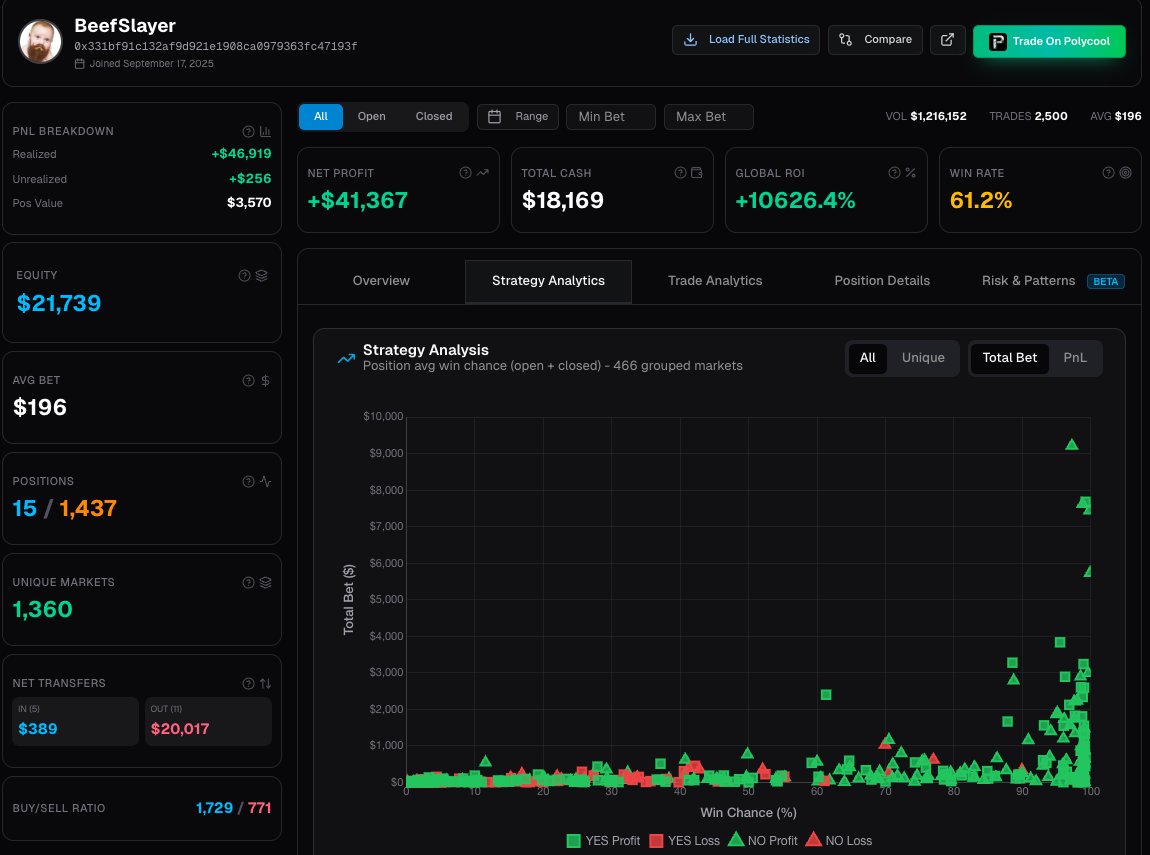
Taking the address BeefSlayer on the weather leaderboard as an example.
At a glance, the data shows: participated in 1,360 independent markets, totaling 2,500 transactions, with a net profit of $41,367, a win rate of 61.2%, and an average bet of $196.
From the scatter plot on the right, we can see profits distributed across various win rate ranges, not concentrated in a few excessively large trades. Large positions are concentrated in the 60%-90% win rate range, aligning with the logic of the Kelly criterion, where higher confidence markets receive heavier bets, while uncertain markets control position size.
Fund management: averaging only $196 per bet, there has not been a single heavy bet that wiped out the account across 2,500 trades, indicating stable risk control.
3. Practical Follow-up: Automated Tools vs. Subjective Judgment
After finding an address worth following, how should you operate? There are generally two paths: one is to directly use bots for automated following, which is straightforward but limited; the other is to treat the positions of smart money as reference signals, making your own judgment before deciding whether to follow. Both methods have applicable scenarios, which will be discussed below.
Strategy One: Follow Bots
There are ready-made follow-bot tools available on the market that, once you set the target address, can follow automatically. Some common options include:
Polygun : A Telegram follow bot that recently acquired Polymarket Analytics. The latter is a data analysis platform, and the merger allows for analysis and direct execution of follow trades.
Kreo (XHunt Ranking #194239): A Telegram bot that monitors on-chain smart money actions in real-time and follows trades automatically, supporting settings for daily loss limits and stop-loss rules, covering both Polymarket and Kalshi platforms.
PolyHub (Hubble) (XHunt Ranking #49220): A tool under Hubble that helps users identify smart money addresses on Polymarket, currently offering follow trade tools.
However, following bots is not as simple as it seems; after trying to follow, I encountered three issues:
Issue One: The disparity in fund sizes.
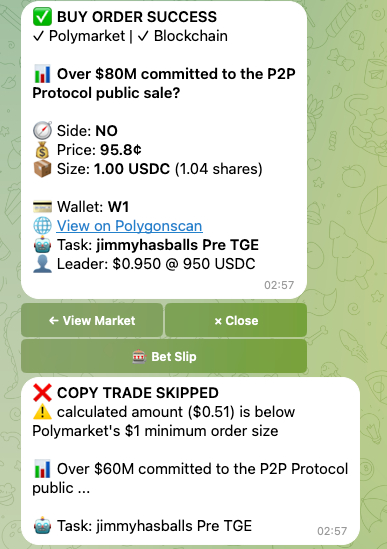
Suppose the address you are tracking has $100,000 in funds, and they bet $500 in a market, which is 0.5% of their total fund. If your follow wallet only has $100, and you follow proportionally, that means you are spending $0.5, but the minimum trade amount on Polymarket is $1, so your follow may not be executed.
Issue Two: Market liquidity constraints.
Smart money has large funds, and a single buy may consume a significant portion of the order book's liquidity. By the time your follow triggers, there may not be enough remaining order book, leaving you unable to buy at the same price or unable to acquire sufficient volume.
Issue Three: Order execution mechanism
Most Polymarket traders rarely use market orders; the majority place limit orders at their ideal prices as takers, making small orders more likely to execute one after another.
This creates challenges for following:
If you choose to follow according to portfolio proportions, then small executed limit orders can easily cause your order to fall below the minimum trade amount of $1;
If you choose a fixed amount per trade, it is easy to have multiple trades executed for the same option, causing severe deviations in your position, and subsequent hedge selections by the trader will lead to insufficient funds to buy the hedging position.
These issues are not apparent when the fund size is small, but they become increasingly severe as the follow capital increases.
Strategy Two: Subjective Following
Use smart money positions as signals, then decide whether to follow based on your own judgment.
Step One: Monitor Target Addresses
After finding addresses worth following, you cannot rely on manual refreshing to discover their new actions. The actual operation involves using tools to monitor their on-chain transactions, receiving notifications immediately when they have new buys or sells.
You can use Kreo's Tg monitoring bot, which will notify you at the first moment when the monitored wallet address makes a transaction.
Step Two: Determine Why the Wallet Bought
After receiving the transaction record notification, we need to determine why this address made a purchase.
Look at the timing of their position: Was it right after a major news item? If it was a news-driven trade, by the time you receive a notification and follow up, the market price may already have digested that news, making your follow a chase for highs.
If they positioned ahead of time, with their entry before the news, it indicates they are making trades based on their judgment, which is a more valuable signal, and you would still have time to follow.
If their entry price is near 100, it indicates that the address is engaging in "endgame trading," as the market result is basically determined, and they are taking the last part of the profit. Whether to follow this position depends on if the remaining space is worth it for you.
Step Three: Determine if It's Worth Following
After assessing the wallet's strategy, two more things need to be checked before following:
Price Spread: The larger the spread, the higher your entry cost in comparison to theirs, which compresses potential profits and amplifies risk.
Position Proportion: The higher this position's ratio of their total funds, the more confident they are, and this signal is worth paying attention to.
4. Pitfall Guide: Why Following Still Leads to Losses?
Following sounds simple, but there are many details in practice that can result in losses. Here are three common missteps I've encountered.
Misstep One: Incorrect Position Model for Follow Bots
Follow bots generally have four position models: fixed amount, precise replication, proportional, and based on portfolio weight.
Initially, I used proportional following, but if the other party's capital is 100 times mine and they bet 1%, while I also follow 1%, the absolute amount might only be a few cents, making it impossible to execute. Smart money often bets on low-probability markets with small positions to gain large odds; this portion of profit cannot keep up.
So, I switched to fixed amount following, buying $1 each time. However, I encountered another issue: low-probability markets are generally higher-risk. If smart money wins once after 100 bets, following to buy a few times a day quickly depletes funds without reaching that major win.
The conclusion is: Before using a follow bot, clarify the other party's profit structure. If their gains mainly come from low-probability markets, replicating their strategy with a follow bot is challenging.
Misstep Two: Discovering Too Late and Still Following
It's impossible to stare at the screen all the time. When you see a monitoring push and check the market, you may find that the price has risen from $0.35 to $0.72.
At that point, following in may double your cost, leaving less than $0.28 for remaining profit space, but if the judgment is wrong, the downside risk is still there at $0.72, creating a complete misalignment in risk and rewards.
Misstep Three: Holding When Smart Money Clears Out
Monitoring shows smart money starting to reduce positions, and you think "The direction is still right; just wait a bit longer," only to find they have entirely cleared while you remain fully committed.
The underlying logic of following is to leverage their information and judgment. When they exit due to losses, continuing to hold onto hope to maintain a position is often where I incurred the most losses in following trades.
This is very similar to being a liquidity provider on Polymarket: when limit orders accidentally execute and the spread is large, there is typically a reluctance to cut losses, thinking the price will rebound, only for it to fall continuously.
These three missteps share a common issue: following can easily lead to relinquishing critical thinking.
The bot helps you execute, smart money helps you judge, and it seems you don’t have to worry about anything. However, when something goes wrong, you have no idea what went wrong or how to adjust.
5. In Conclusion: Following is Entry-Level, Understanding is Upgrading
Following is a crutch that can help you enter the deep waters of prediction markets but cannot replace your walking.
What is truly valuable is not what smart money "bought," but "why they bought." When you can start to deduce the logic behind their actions, following will no longer be a lifeline but a tool to enhance efficiency.
This is the necessary path from being a "retail trader" to evolving into "smart money."
免责声明:本文章仅代表作者个人观点,不代表本平台的立场和观点。本文章仅供信息分享,不构成对任何人的任何投资建议。用户与作者之间的任何争议,与本平台无关。如网页中刊载的文章或图片涉及侵权,请提供相关的权利证明和身份证明发送邮件到support@aicoin.com,本平台相关工作人员将会进行核查。


