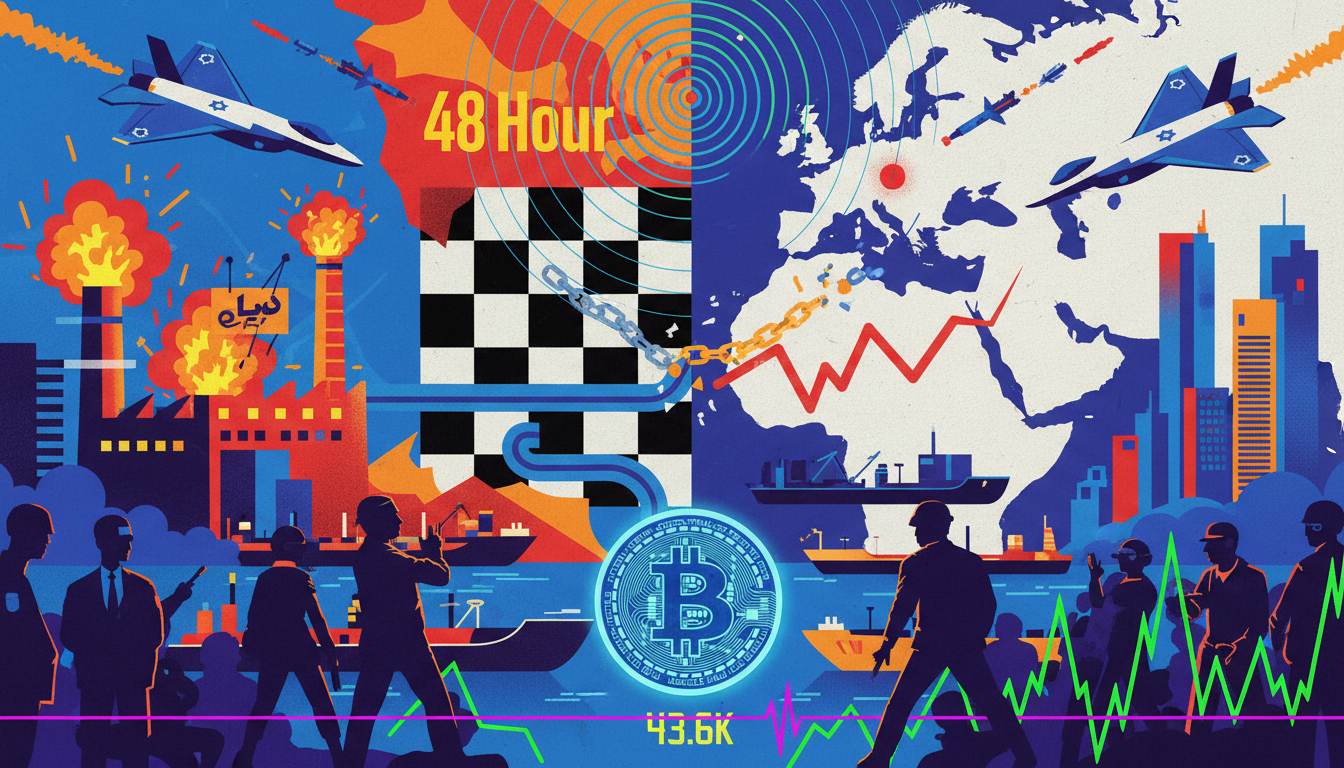
On March 25, 2026, Tehran publicly rejected the 15-point ceasefire proposal put forth by the United States, reaffirming that the decision on when to end the war would be made by Iran itself, and further escalating tensions in the Middle East. On the same day, however, the traditional finance and crypto industries were rapidly evolving on a different track: US crypto-related stocks saw a general rise, Interactive Brokers opened a cross-platform transfer channel for digital assets, Coinbase pushed for the blockchain integration of exchange data, while the UK slammed the brakes on political donations involving crypto. Amidst the stark contrast of war and institutional reshaping, a key question has emerged: why is funding still being increased in crypto-related assets and infrastructure when the shadows of war have not yet dissipated?
The Hard Stance of Iran's Rejection of the 15-Point Proposal
On March 25, Iran made a clear statement through its media, rejecting the 15-point ceasefire proposal from the United States and emphasizing that the timing for the end of the war would be determined by Iran itself, not dictated by external forces. This stance was repeatedly presented in reports by Iranian news channels and the Iranian Students' News Agency, showing that Tehran is not in a hurry to compromise under the current circumstances.
The chairman of Iran's government information committee, Hazrati, concretized this hard-line stance through his public remarks. He bluntly stated, "The enemy has listed their wishes that cannot be achieved through attack" and offered a response of "no need to consider" regarding the ceasefire proposal. This wording reflects not just tactical negotiating language, but also conveys Iran's confidence in its own bargaining power and regional influence, sending a clear signal that "it will not sign unequal agreements under pressure."
In a broader historical context, Iran has long insisted on an autonomous approach and a role in regional games regarding Middle Eastern issues, entangled with the United States and its allies over sanctions, nuclear issues, and regional proxy conflicts. Iran's rejection of the ceasefire proposal strengthens the market's perception that the "situation in the Middle East is difficult to quickly de-escalate." Within the global asset pricing logic, such prolonged and structural confrontation tends to amplify risk-averse sentiment, pushing capital to re-evaluate gold, energy, and assets highly correlated with geopolitics, while also supporting narratives of "de-sovereignty" and "anti-censorship," indirectly elevating the market's imaginative space regarding the safe-haven properties of crypto assets.
Against the Backdrop of War, Crypto-related Stocks Rise
At the same time, US crypto-related stocks exhibited a general rise. According to market data from msx.com, amid heightened geopolitical risks, publicly listed companies associated with the crypto supply chain collectively strengthened, contrasting sharply with the cautious reaction of traditional stock markets to conflict news. This counter-trend performance indicates that capital has not merely retreated from risk assets, but rather is undergoing a more nuanced reallocation among sectors.
Geopolitical tensions usually push some capital toward traditional safe-haven assets such as gold, government bonds, and certain commodities. However, during this round of heightened uncertainty in the Middle East, capital is simultaneously seeking a balance between "traditional safe havens" and "new narrative assets." Some investors do not wish to completely exit from risk but prefer to concentrate their exposure on assets that have growth stories, relatively clear regulatory frameworks, and high relevance to on-chain assets. This has made "crypto-related stocks" be seen as a more controllable risk exposure during times of risk aversion.
The market's willingness to bet capital on these companies largely stems from their perception as intermediate tools positioned between "pure crypto tokens" and "traditional entities":
● On one hand, the price fluctuations of on-chain assets and industry imagination can be indirectly reflected through these listed companies' performance expectations, balance sheets, and fundraising capabilities; on the other hand, these companies are subject to securities regulation, financial disclosure, and corporate governance rules, making them more easily incorporated into risk assessment frameworks by institutional investors compared to purely on-chain assets.
In an environment where the shadows of war and regulatory pressures coexist, the combination of "on-chain assets + publicly listed companies" is interpreted by some capital as a compromise that can enjoy the growth benefits of the crypto industry without being completely exposed to a fully unregulated environment. This structural preference helps explain why, on the same day Iran rejected the ceasefire and geopolitical risks heightened, US crypto-related stocks still managed to enter relatively independent rising markets.
The Intent Behind Interactive Brokers Opening Asset Migration Channels
Meanwhile, traditional brokerages are accelerating their interface construction with the crypto world. Research briefs indicate that Interactive Brokers has launched a cross-platform transfer feature for digital assets, allowing users to migrate their crypto portfolios between different platforms. The current coverage and details of this functionality are still limited in publicly available information, but it can be confirmed that it targets the demand for "managing crypto exposure within the traditional stock account system."
For users accustomed to trading stocks and ETFs, a long-standing pain point has been: when wanting to allocate crypto assets, one often needs to jump out of the familiar brokerage ecosystem, re-register trading accounts at exchanges, complete KYC, and learn new interfaces and fund transfer rules. This move by Interactive Brokers effectively builds a migration channel between traditional securities accounts and crypto assets, transforming "from 0 to 1" into "from 1 to 1.2": users can gradually increase their exposure to crypto assets within the existing compliance framework and fund custody system, rather than fully embracing a completely unfamiliar trading environment.
The lowering of thresholds is reflected not only in operational aspects but also in psychological costs and perceptions of compliance. When a user can view an overall investment portfolio through the familiar brokerage interface, which includes stocks, bonds, and crypto assets, crypto is no longer an isolated "island of another world," but rather part of a unified financial plan. This experiential integration greatly enhances the likelihood of traditional funds tentatively entering the crypto market.
From an industry structure perspective, traditional brokerages accessing crypto migration features will generate chain reactions affecting exchanges, compliance custodians, and licensing competition dynamics:
● From the exchange level, the "inbound entry" from brokerages may dilute some retail users' direct account-opening demand, forcing leading platforms to further widen the gap in deep liquidity, derivatives innovation, and global layout.
● In terms of compliance custody and licensing, whoever can provide underlying clearing, custody, and risk management services for these large brokerages holds the "backdoor key" to traditional capital access; it is less about competing for users and more about contesting the power of discourse over compliance infrastructure.
In the macro context of Iran rejecting the ceasefire and the rise of geopolitical uncertainty, the actions of Interactive Brokers strengthen a trend: even as the world becomes more dangerous, the institutional integration of traditional finance and crypto assets is becoming tighter.
Coinbase's Ambition to Move Market Depth on-chain
On the crypto-native infrastructure front, Coinbase is attempting to push exchange data on-chain through Chainlink. The briefs indicate that this plan currently covers data from two exchanges, but the specific names and technical parameters have not been fully disclosed across multiple sources, so it can only be confirmed that Coinbase is pushing parts of trading depth and price information into the on-chain public environment as an oracle.
For a long time, oracles primarily served as price feeding functions, providing aggregate pricing data for certain assets to DeFi protocols. However, if on-chain depth, order structure, and transaction data were moved to the blockchain, the oracle ecosystem and DeFi pricing mechanisms could undergo a transformational change. Protocols would no longer rely solely on the "last transaction price," but could dynamically adjust margin requirements, liquidation thresholds, and even market-making strategies based on the actual order book situation, thus shortening the information lag between on-chain and off-chain markets.
At a deeper level, this transparency has the potential to weaken the survival space of the "black box exchange" model. If mainstream exchanges and infrastructure providers begin habitually putting key market data on-chain, investors and institutions will be able to more easily compare different platforms’ depth and real transaction situations, rather than passively accepting API data from a single platform. For compliant platforms already operating under US regulation and gradually embracing public disclosure, this amplifies their inherent advantages.
Within this framework, Coinbase's move to put market depth data on-chain is not just a technical experiment, but also sends a signal to the market: future competition among exchanges will not only be about transaction fees and listing speed but also about the measurement of information transparency and compliance synergy capabilities. For those exchanges that still rely on opaque matching and disclose little true depth, failing to enhance transparency may erode their long-term valuation premium and institutional trust.
Political Anxiety Behind the UK's Suspension of Crypto Donations
Contrasting with the accelerated advancements in market infrastructure, there is an increasing vigilance in the political sphere over the influence of crypto. According to research briefs, the UK government has suspended political donations related to crypto, following a £9 million donation received by the UK Reform Party from a crypto billionaire. This figure has already sparked widespread discussion in the UK political arena and raised alarms for regulatory agencies.
The UK’s suspension of crypto political donations is not purely targeted at a specific party, but represents systemic concerns over the rapid amplification of crypto funds within the political ecosystem. Regulatory focus mainly centers on three dimensions: first, whether the transparency of the source of crypto funds is sufficient to support the credibility of democratic processes; second, whether the cross-border, rapid circulation characteristics will reinforce covert lobbying and interests transfer; third, whether the existing political donation regulatory framework still holds when political parties increasingly rely on difficult-to-trace funding sources.
Compared to the United States and some EU countries, this move by the UK appears relatively radical, revealing different path choices regarding the relationship between campaign financing and crypto assets. Previous election cycles in the US have seen candidates actively embrace crypto industry donations from voter clusters, with regulations emphasizing disclosure requirements and limits rather than outright bans. Meanwhile, within the EU, regulations like MiCA have pushed for greater emphasis on compliance and reporting obligations rather than directly blocking capital flows.
This difference implies that in the future, there may be significant divides in the compliance costs and feasible space for crypto funds to participate in political processes between major jurisdictions in the US and Europe:
● In relatively open jurisdictions, crypto businesses and holders may influence policy-making through more transparent and compliant pathways but will need to comply with stricter identity disclosure and auditing requirements;
● In regions where regulations are tightening or have even been temporarily suspended, it will become more difficult for the crypto industry to influence regulatory direction through political donations and must instead rely on more indirect methods such as industry associations and public opinion.
For the industry, this not only indicates rising compliance costs but also marking an essential stage of increased "institutional embedding depth": as crypto evolves from a marginal topic to a force that can fundamentally influence elections and policy agendas, regulatory responses will inevitably not be mild.
Crypto Pricing Against the Shadow of War and Institutional Dividends
Layering the above clues presents a clear multi-threaded narrative: on one end is Iran's rejection of the 15-point ceasefire proposal and its insistence on autonomously deciding the war's end, leading to long-term expectations of the Middle Eastern situation and heightened risk aversion; on the other end are a series of market and infrastructure upgrades such as the rise of US crypto-related stocks, Interactive Brokers opening digital asset migration channels, and Coinbase pushing market depth data on-chain; simultaneously, the UK's suspension of crypto political donations reminds us that the rise in crypto's discourse power at the institutional level will inevitably invite harsher regulatory countermeasures.
From an asset pricing perspective, short-term geopolitical risks are indeed driving some capital's imagination of crypto's "safe-haven attributes." When the uncertainties surrounding sovereign credit and regional order amplify, those digital assets seen as "de-sovereign" and "cross-border flow" will inherently garner increased attention and allocation weight. However, unlike in 2017 or 2020, today's prices do not merely respond immediately to emotions and narratives, but are also heavily constrained by "compliance levels and the embedding depth within the financial system."
Interactive Brokers' migration channel, Coinbase's on-chain data experiments, and the revaluation of US crypto-related stocks all point to the same trend: the factors that will determine the mid- to long-term pricing of crypto assets are no longer solely halving cycles or singular macro narratives, but rather how deeply they are embedded within traditional financial and institutional systems. The clearer the regulations, the more transparent the infrastructure, and the more stable the connections to mainstream brokerages and institutions are, the more likely their risk premiums will narrow, and the fluctuations in market value will resemble other mature asset classes.
In the coming months, it will be crucial to focus on three main lines: first, the evolution of the Middle Eastern situation, especially whether the game between Iran and the US over ceasefires and sanctions will intensify, defining the benchmark for risk aversion; second, the initiatives of more traditional institutions to engage, including whether brokerages, banks, and payment giants will replicate Interactive Brokers' asset migration model or increase investments in custody and clearing; third, the subsequent regulatory pathways for crypto political funding in major jurisdictions, whether the UK's suspension will trigger a chain reaction within the EU, and how the US will balance innovation with preventing political capital risks in the next major election cycle.
Amid the intersection of these three forces, crypto assets find themselves at a tension-filled crossroads: on one side is the shadow of war, geopolitical fissures, and unsteady sovereign credit; on the other side, the institutional benefits brought by compliance, institutionalization, and on-chain transparency. For participants, the real task is to grasp not just the short-term fluctuations in price amidst conflict news, but rather which types of assets and which infrastructure will establish a solid bidirectional embedding with the global financial system over the coming years.
Join our community to discuss and grow stronger together!
Official Telegram community: https://t.me/aicoincn
AiCoin's Chinese Twitter: https://x.com/AiCoinzh
OKX benefits group: https://aicoin.com/link/chat?cid=l61eM4owQ
Binance benefits group: https://aicoin.com/link/chat?cid=ynr7d1P6Z
免责声明:本文章仅代表作者个人观点,不代表本平台的立场和观点。本文章仅供信息分享,不构成对任何人的任何投资建议。用户与作者之间的任何争议,与本平台无关。如网页中刊载的文章或图片涉及侵权,请提供相关的权利证明和身份证明发送邮件到support@aicoin.com,本平台相关工作人员将会进行核查。