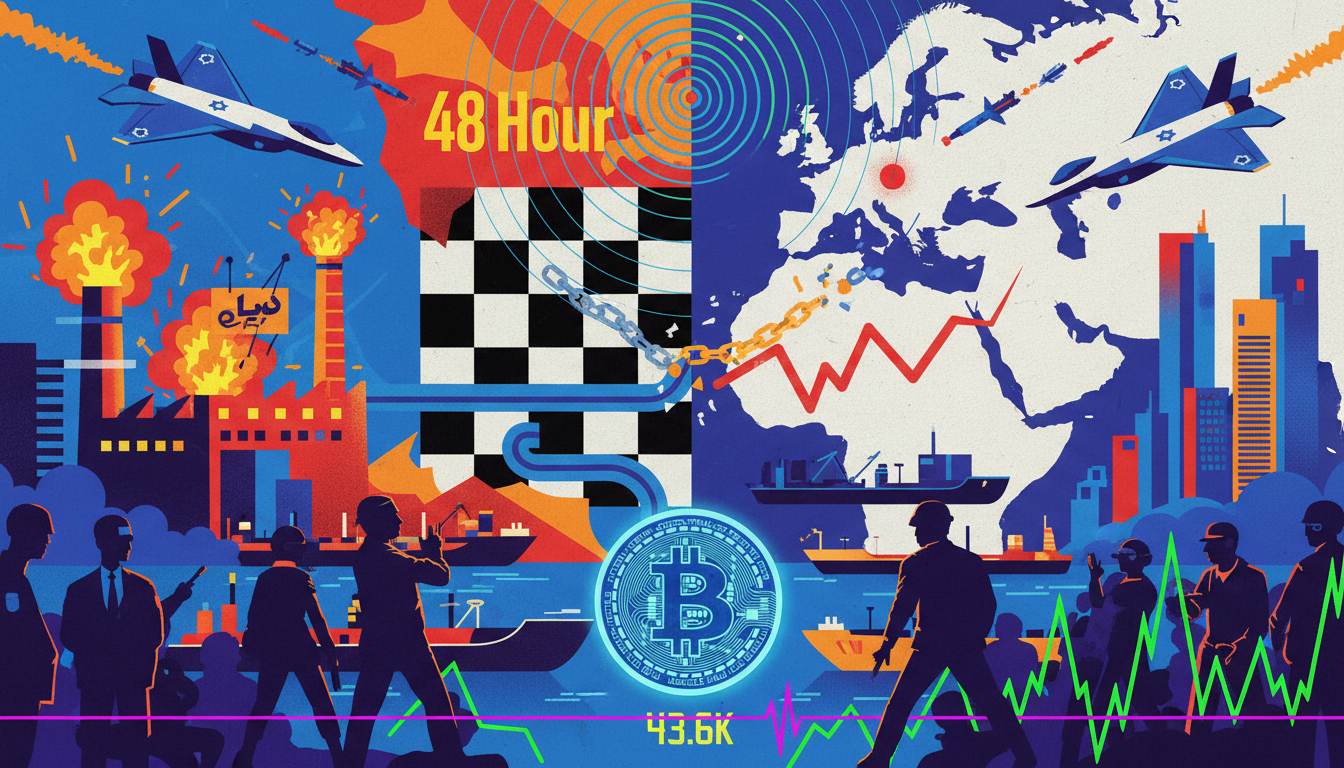
On March 25, 2026, Iran publicly rejected the so-called "15-point ceasefire proposal" put forward by the United States. The chairman of the Iranian government's Information Committee, Hazraty, responded directly, stating that it was a "lie" and adding "not to pay attention to it." Alongside this diplomatic hardline statement was a subtle tug-of-war in asset prices at high levels: Bitcoin continued to fluctuate between $60,000 and $75,000, while crypto concept stocks and the U.S. stock market maintained an upward trend overall. During the trading hours in the East Eight zone, the narrative of "will risk-averse funds bet on Bitcoin again amid escalating geopolitical tensions" resurfaced. However, this time it collided with the technical and cyclical perspective proposed by "K33 Research, stating that 'the market may be approaching a phase bottom'"—one side is the risk-off story under the shadow of war, and the other side is the debate over tops and bottoms amid high-level fluctuations.
Ceasefire Proposal Rejected as Lies: Sensitivity of Middle East Tensions and Asset Pricing
In the statement on March 25, Hazraty directly named the U.S.-proposed "15-point ceasefire agreement," using extremely restrained language but maintaining a firm attitude: he not only called this statement a "lie," but also declared "not to pay attention to it," effectively nullifying it from Iran's official perspective on the spot. This process itself reveals two layers of meaning: first, a fundamental questioning of the legitimacy and source of the proposal; second, it sends a signal in the international public opinion arena that "Iran will not back down under the current conditions," leaving space for the continuation of conflict escalation.
Currently, the only information that can be confirmed from the outside is that "there is a ceasefire concept referred to as the '15-point proposal,'" which completely lacks details of terms and cross-verification from multiple official channels. Among the available materials, there is no reliable text indicating which areas these "15 points" specifically involve, including what political or economic arrangements; similarly, claims about how this proposal was communicated and whether it included other conditions remain at the "to be verified" level. Based on this, making any speculative extensions regarding the proposal's content, negotiating directions, or behind-the-scenes transactions is both irresponsible and likely to mislead market judgments.
Under the premise of this highly incomplete information, the market instead turned to "vote" with prices. Currently, global risk asset valuations are already at relatively elevated levels. The strong overall performance of U.S. stocks and crypto concept stocks means that every escalation of tensions in the Middle East feels like a side wind suddenly blowing when walking a tightrope at a high altitude:
● The energy market will react first, as oil prices are extremely sensitive to expectations about navigation safety and supply disruptions;
● Foreign exchange and interest rates will transmit to broader asset pricing through the path of "risk-off currencies strengthening, emerging markets under pressure";
● At the end of this chain, crypto assets are often caught between the dual narratives of "high Beta risk assets" and "decentralized risk-off tools." Each increase in the Middle East's powder keg atmosphere pushes the market to reassess the effectiveness and boundaries of crypto as a hedge against geopolitical risks.
Bitcoin Fluctuates: Risk-Off Asset or High Beta Tech Proxy
In contrast to the tensions in the Middle East, Bitcoin's price did not "fit in" with a unilateral surge but maintained a period of fluctuation between $60,000 and $75,000. According to K33 Research, this repeated turnover within this range represents "the market may be approaching a phase bottom"—not a traditional "deep value buying," but more like a long/short rebalancing within the high-price area: selling pressure continues from above, but buying interest has not retreated from below.
Historically, during several typical geopolitical conflict points, the linkage between Bitcoin and real-world conflicts has shown different pictures: there were phases of "geopolitical risk escalation + Bitcoin rapid surge," while other periods showed almost no significant reaction, with prices driven more by internal cycles, liquidity, and macro rates. In this round of Middle Eastern tension narratives, Bitcoin clearly has not followed a strong trajectory of "one-sided upward attack + risk-off sentiment resonance," but has instead remained flat at high levels—closer to a state of "capital being cautious and waiting, yet not easily leaving the market."
This also brings the question of Bitcoin's role back to the table:
On one hand, against the backdrop of overall rising crypto concept stocks and U.S. stocks, Bitcoin continues to show significant correlation with other high-growth assets, exhibiting clear characteristics of "high Beta tech assets"—when liquidity improves and risk appetite warms up, it rises faster, and during pullbacks, it drops more steeply;
On the other hand, when keywords like "war," "sanctions," and "capital controls" surface, market sentiment will quickly rebond Bitcoin with the narrative of "digital risk-off tool," especially for investors in politically and financially unstable regions. The current fluctuation in the $60,000 to $75,000 range neither resembles the continued strength of traditional risk-off assets during crises nor exhibits the sharp selling that pure risk assets face amid rising geopolitical tensions, presenting an ambiguous stance "between the two."
Funds Circumventing the Dollar Anchor: Implicit Exploration of Non-Dollar Anchor Assets
Beyond the controversy surrounding Bitcoin's role, another more hidden but equally crucial flow of funds is taking shape. According to Visa and Dune reports, the current total supply of non-dollar anchor related assets is approximately $1.1 billion, and they are "increasingly being used for actual payments and settlements." This implies that, in the on-chain world, the traditionally "dollar-only anchor" structure is quietly being diluted, as some funds begin to actively seek out stable value carriers that circumvent the dollar system.
In politically and sanction-risk-rich areas, why does the market prefer these non-dollar anchor assets? The core consideration is not complex: once directly linked to the dollar, it inevitably falls within the reach of U.S. financial sanctions tools—including freezing, blocking, refusal of settlement, and a whole set of measures. For economies with fragile banking systems, limited foreign exchange reserves, or frequent threats of sanctions, choosing non-dollar anchor assets adds a layer of "not being easily shut off" survival insurance, even if this insurance itself remains full of volatility and technical risks.
From this perspective, Iran and its neighboring countries, which have long been under the shadow of sanctions, are naturally the potential soil for non-dollar anchor assets, on-chain payment tools, and cross-border settlement experiments. Every round of escalating regional tensions serves as a reminder to local businesses and individuals: reliance on a single currency or single settlement system means being more susceptible to "technical expulsion" from the global market during geopolitical conflicts. This memory will settle into a structural preference over time—whenever possible, leave several channels that do not go through New York or London for settlements.
This round of Iran publicly rejecting the "15-point proposal" brings sanctions, energy, and regional security to the forefront again. Although there is no direct evidence indicating an explosive increase in the use of non-dollar anchor assets within the region in the short term, with a formed scale of $1.1 billion and a primary purpose leaning towards "actual payments and settlements," it is reasonable to determine that: each political disturbance will strengthen the willingness to explore and adopt these assets within the region, though this change is more reflected in the details of on-chain transaction structures rather than in the immediate price volatility of leading currencies.
London's Ballots and Wallets: Crypto Donations Tear Open Regulatory Cracks
Far from the clouds of war in the Middle East, debates about "where the money comes from" are intensifying on the political stage in London. Current publicly available data indicates that the UK Reform Party has accepted approximately £9 million in crypto donations, a digital figure from a single source that still needs further cross-validation in subsequent disclosures and regulatory documents, but the magnitude itself is enough to draw attention: beyond traditional political fundraising channels, crypto assets are becoming a new battleground for certain parties to seek resources and exposure.
In stark contrast, the UK Labour Party plans to ban political donations in crypto form, taking a more conservative stance. On one side, the Reform Party is actively embracing on-chain funds to expand its fundraising pool, while on the other side, the mainstream party is concerned about the transparency and compliance of fund sources, advocating to "keep crypto out of politics." This divergence essentially points to the same focal point: in an era of information asymmetry and highly mobile cross-border capital, how does the political system define the boundaries of "qualified political funding"?
Amid the increasing differentiation of global crypto regulation, if the UK ultimately chooses to tighten or even prohibit crypto political donations, the consequences may extend beyond cash flows of one or two political parties:
● Industry lobbying will be forced to rely more on traditional lobbying channels and fiat currency donations, weakening the direct influence of "native crypto funds" on policy-making processes;
● Regulatory agencies may be more inclined to evaluate crypto assets from the perspective of "systemic risk, anti-money laundering, and preventing election interference," rather than "innovation and competitiveness";
● Other jurisdictions may also take this route, binding "political funding compliance" with "crypto regulation," resulting in another layer of non-technical access threshold.
In this context, the political debate in London and the geopolitical conflict in Tehran may appear unrelated on the surface but actually point to a deeper question: is the crypto network fundamentally a "new source of capital," or a "potential source of political risk"? Different answers will directly reshape how funds flow between the on-chain and offline worlds.
Washington and Wall Street Game: Tokenization Rules and Geopolitical Chess
Alongside the debates in London regarding political donations, U.S. regulators have turned their gaze toward more "underlying structural" issues—a securities tokenization hearing is about to be held, and the core discussion will center on which assets can be issued and traded on-chain, thus delineating a new round of regulatory boundaries. The outcome of the hearing will not only relate to the future fate of on-chain bonds, fund shares, stocks, and other "on-chain securities" but also determine to what extent large financial institutions can "move traditional assets on-chain."
If this hearing is only viewed as a "technological regulatory update," it underestimates its geopolitical implications. For a long time, the U.S. has regarded financial infrastructure as a strategic asset when dealing with the situation in the Middle East, designing financial sanctions tools, and evaluating the control of crypto networks: SWIFT, the dollar clearing system, and cross-border payment networks are all key levers in geopolitical games. When the discussion extends to "which securities can circulate on-chain," the issue is no longer merely "how to protect investors," but rather "how to guide more financial activities onto a regulated on-chain track without losing control."
If this hearing ultimately promotes the establishment of a clearer, executable compliance framework, traditional institutions may embrace tokenization and crypto assets more boldly on at least three levels:
● Asset Level: More bonds, funds, and even some alternative assets will be packaged as "on-chain securities," and traded on a global basis within regulatory bounds;
● Infrastructure Level: Wall Street-level custody, settlement, and clearing institutions will enter, creating a tighter "dual bridge of data and funds" between on-chain trading and traditional financial systems;
● Geopolitical Level: The U.S. has the opportunity to continue solidifying its dominant position in global capital flows through compliant on-chain assets and infrastructure, using a "regulatable on-chain network" to hedge against the "uncontrollable decentralized network."
Under this framework, the tokenization hearing is no longer an isolated compliance discussion but rather a collective deployment by Washington and Wall Street on "how to master both innovation and control". When the conflicts in the Middle East, financial sanctions, and crypto infrastructure are placed on the same table, Iran’s rejection of the "15-point proposal," London's crypto donation debate, and Bitcoin’s price plateau become all coordinates in this larger chess game.
From Tehran to London: Seeking Crypto's Role amid Uncertainty
Connecting Tehran, London, and Washington, several seemingly disparate clues are beginning to intertwine: Iran publicly angrily rejected the "15-point ceasefire proposal", reinforcing the uncertainty and sanctions risks of the Middle Eastern situation; Bitcoin fluctuates at a high level between $60,000 and $75,000, oscillating between the roles of "risk-off tool" and "high Beta risk asset"; the supply of non-dollar anchor assets expands to about $1.1 billion, increasingly used for actual payments and settlements, providing a new financial escape valve for sanctioned and high-risk areas; and the sharp divergence over crypto political donations in the UK exposes the collective anxiety of Western democratic systems regarding "on-chain fund interventions in politics."
These fragments collectively point to a trend: in an environment of escalating geopolitical conflicts and great power competition, the crypto world is gradually being pushed from a mere "speculative asset pool" towards a more structural role—part of political and financial infrastructure. The value carriers on-chain are no longer just tools for "betting on trends"; they also embody multiple functions, such as circumventing sanctions, reconstructing payment channels, influencing political fund distribution, and being reintegrated into and tamed by regulatory systems. Yet, how prices reflect this shift still heavily relies on two traditional variables: liquidity and regulatory signals. As long as the global liquidity environment remains accommodative and regulatory expectations do not deteriorate sharply, even the most intense political narratives may be treated by the market as "noise"; conversely, a negative hearing conclusion or sudden regulatory statement could instantly offset the risk premium brought by geopolitical risk-off stories.
In the short term, the market needs to remain vigilant against two types of sudden volatility sources: one is sudden events related to the Middle East situation—whether military escalations or new sanction plans will quickly transmit to crypto assets via energy, exchange rates, and sentiment channels; and the other stems from regulatory statements from places like Washington and London, especially key nodes involving securities tokenization, political fund compliance, and cross-border payment controls. In the long run, what truly deserves attention are those slow-moving variables that are less dramatic: the formation of compliant tokenization frameworks, the reflection of a multipolar currency system in the on-chain world, and the transition of non-dollar anchor assets from exploration to scaled usage. Under these trends, crypto assets may be redefined—not merely as "digital gold" or just as "high-volatility tech stock proxies," but as a new type of financial infrastructure caught between sovereignty, markets, and technology.
Join our community to discuss and grow stronger together!
Official Telegram community: https://t.me/aicoincn
AiCoin Chinese Twitter: https://x.com/AiCoinzh
OKX Rewards group: https://aicoin.com/link/chat?cid=l61eM4owQ
Binance Rewards group: https://aicoin.com/link/chat?cid=ynr7d1P6Z
免责声明:本文章仅代表作者个人观点,不代表本平台的立场和观点。本文章仅供信息分享,不构成对任何人的任何投资建议。用户与作者之间的任何争议,与本平台无关。如网页中刊载的文章或图片涉及侵权,请提供相关的权利证明和身份证明发送邮件到support@aicoin.com,本平台相关工作人员将会进行核查。