Author: David, Shenchao TechFlow
Last Thursday, the New York Stock Exchange had a new stock, code VCX.
It is actually a fund. The fund contains shares of companies like Anthropic, OpenAI, and SpaceX. Among them, Anthropic accounts for 21%, and OpenAI for 10%.
These companies have a common point: none of them are publicly traded, and ordinary people cannot buy their stocks.
VCX is currently one of the few things on the market that allows ordinary investors to indirectly hold shares of Anthropic.
Its net asset value is $19 per share. On the first day of listing, the opening price was 42, it surged to 125 during the day, and closed at 76. On the fourth trading day, it peaked at $315, triggering trading halts twice due to its volatility.
In just four days, the price rose from 19 to 315.
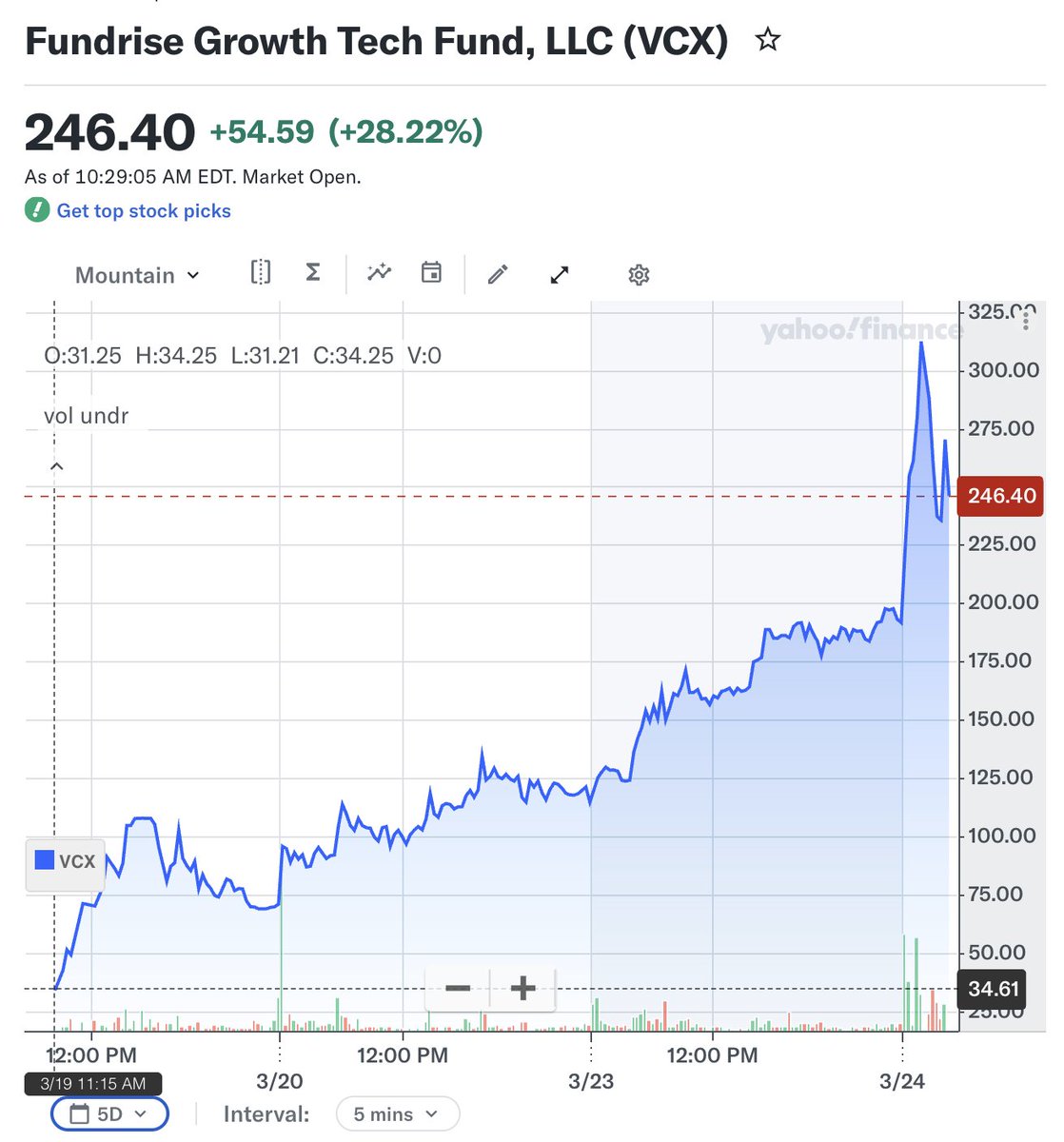
Investors are essentially buying this fund at a price 16 times its actual asset value. It's not because the fund manager is so great; it's because it contains Anthropic.
A month ago, Anthropic raised $30 billion at a valuation of $380 billion, making it the second-largest financing globally this year. Its annual revenue is $14 billion. However, it is not publicly traded and has no stock code; you won't find it in any brokerage's search box.
If you can't buy the real thing, go for the shadow. VCX is currently the shadow of Anthropic, or more accurately, the shadow of AI FOMO.
Why is it so expensive?
VCX is not a traditional fund.
With regular funds, you can wait for the price to drop if you think it's too high because fund managers can issue more shares, so the supply is elastic. VCX is a closed-end fund, and when it lists, the shares are locked in and will not increase.
More importantly, the vast majority of shares cannot be sold at all. Investors who bought in before February 20 have their shares locked for six months and won't be able to trade until September. VCX has over 100,000 investors, but only a small portion of shares are actually circulating on the market.
What does this mean? Many people want to buy, but there are very few shares available. A small amount of buying pressure can distort the price.
So that 16 times premium is actually pricing in "how many people want to touch Anthropic, and how narrow the door is." It's just that this thirst is not something VCX manufactured itself.
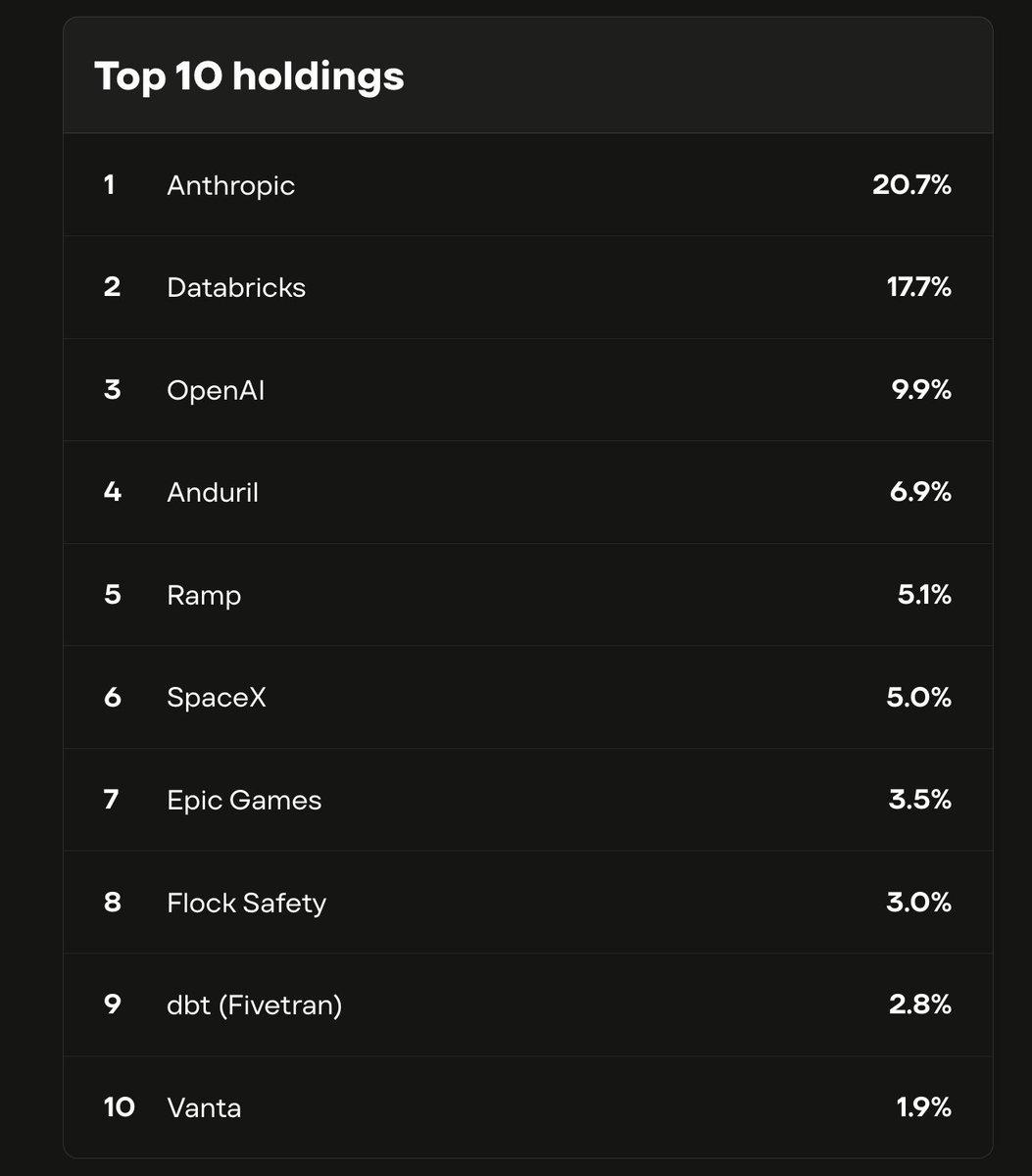
Image: Fundrise's VCX fund top 10 holdings
Over the past decade, a structural change has occurred in the tech industry: the best companies are going public later and later, or may not go public at all.
When Facebook went public in 2012, its valuation was $104 billion, which was already astronomical at the time. Today, Anthropic's private valuation is more than three times that of Facebook's IPO; however, it didn't even have a clear plan for going public;
OpenAI is valued at $500 billion and is not publicly traded. SpaceX has been rumored to be preparing for an IPO for over a year, but still has no definitive date.
Ten years ago, a company of this size would have already rung the bell on the New York Stock Exchange. Now, they don’t need to. The private market can provide almost unlimited funding, without having to face the pressure of quarterly reports or deal with retail investors and short-sellers.
For founders, this is a rational choice. For ordinary investors, it means that the fastest-growing companies in history are only available to watch through glass.
VCX was originally set to go public on March 9, but was delayed by ten days due to the Iran war. In those ten days, nothing changed—Anthropic did not increase or decrease in value, and the fund's holdings did not change a single share. But the delay itself brewed ten more days of expectation.
When it finally listed, all the pent-up demand from those ten days squeezed into a very narrow channel.
Not all shadows are valuable
If you want to access shares of unlisted companies, VCX is not the only path.
But before discussing these routes, there is a more fundamental question: Anthropic is not public; how did a publicly traded fund obtain its shares?
The answer is a backdoor.
Large private companies engage in rounds of financing every few months, from Series A to G, with each round allowing new investors to enter. Anthropic just closed a $30 billion Series G round last month, with participating organizations from GIC to Sequoia to Goldman Sachs lined up. These rounds are typically only open to institutional investors, with a minimum threshold often starting at ten million dollars.
But there is a second route.
Just because a company is not publicly traded does not mean its shares cannot be privately traded. Early employees and angel investors hold shares, some of whom want to cash out early. Thus, a secondary market for private companies emerged—non-public, opaque, but real transactions occur.
Fundrise began buying on these two routes in 2022, when the valuations of private tech companies had just gone through a downturn, making prices cheaper. Over four years, they accumulated a portfolio containing Anthropic, OpenAI, and SpaceX. Then they packaged it into VCX, listed it on the New York Stock Exchange, and ordinary people can buy it like a stock now.
In the same month, at least three similar funds also traded on the New York Stock Exchange, all selling the same concept:
Buying things acquired through the backdoor and selling them to you through the front door.
Robinhood launched a fund called RVI, which went public on March 6 at an offering price of $25. Its holdings include Databricks, Revolut, and Ramp, are all good private companies. It dropped 11% on its first day, closing at $21.
Destiny Tech100, code DXYZ, went public in 2024 and is considered a pioneer in this track. It has a heavy position in SpaceX, accounting for 16% of its holdings. It just added a little exposure to Anthropic in February through an indirect method. Now its stock price is around $24.
Another fund, XOVR, is the first ETF approved to directly hold shares of private companies, with about 21% allocated to SpaceX.
Four funds, with similar structures and concepts, all trade on the same exchange. But their fates are completely different.
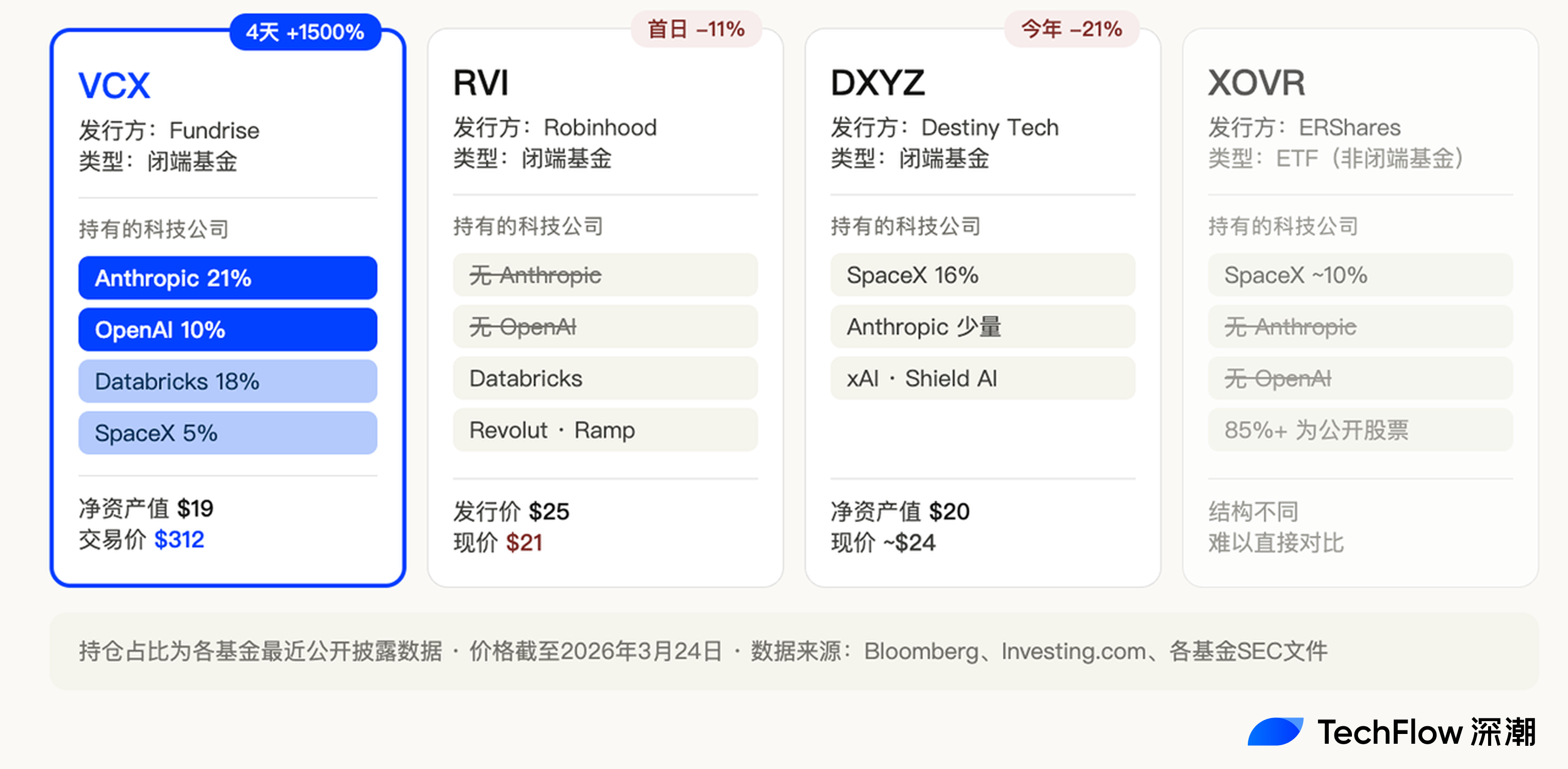
VCX rose 1500% over four days. RVI broke below its issue price on the first day. DXYZ is lukewarm.
VCX holds 21% of Anthropic and 10% of OpenAI. RVI's holdings do not include either Anthropic or OpenAI. DXYZ just recently added a small exposure to Anthropic.
This indicates that, at least at this moment, the market is not rushing for "shares of private companies." The market is rushing for Anthropic.
Whoever is closest to them is valuable.
Robinhood's RVI loses here. Databricks and Revolut are certainly good companies, but evidently, at this moment, they are not the names people are willing to pay a 16 times premium for.
Shadows also have an expiration date
What are those who bought VCX at $312 betting on?
They are betting that before the door opens, others will still be willing to pay a higher price to get what they cannot obtain from Anthropic.
However, this door will not stay closed forever.
VCX has over 100,000 investors, most of whom have their shares locked for six months. The lock-up period ends on September 19. By then, a large number of shares will flood into the market, and supply will dramatically shift from extremely scarce to abundant overnight.
The reason VCX can be sold at a 16 times premium is partly due to Anthropic being inside; the other part may be because the tradable shares are too few. Once the lock-up period ends, the second condition will disappear.
There is one more significant variable.
Anthropic, OpenAI, and SpaceX are all rumored to be planning to go public between the second half of 2026 and 2027. Anthropic just raised $30 billion last month at a valuation of $380 billion and has hired the Silicon Valley law firm Wilson Sonsini to prepare for its IPO. SpaceX's CFO has been communicating with investors about an IPO since the end of last year, aiming for mid-year.
Once the real deal goes public, the shadow will no longer be valuable.
If you can directly type Anthropic's stock code in your brokerage's search box, why would you pay a 16 times premium for a fund that indirectly holds it?
For instance, as mentioned earlier, DXYZ also skyrocketed slightly when it went public in 2024, but later, as SpaceX delayed going public, the hype faded, and its stock price dropped by more than half from its peak.
Thus, VCX investors are experiencing a classic countdown.
What they bought at a 16 times price is not shares of Anthropic, but a time-limited ticket. When the door opens depends on when Anthropic decides to go public.
Before that, the premium is maintained by scarcity; afterward, the premium will go to zero.
But the existence of shadow stocks is not incidental.
Every wave of technological innovation creates the same anxiety: the most important companies are not accessible to you. In the 2000s, before Google's IPO, Goldman employees fought hard for allocation internally. In 2020, it was SpaceX, and intermediaries in Silicon Valley's secondary market suddenly became the most sought-after networks.
Now it's AI's turn.
Moreover, this time the anxiety runs deeper; Anthropic and OpenAI may not be profitable now, but they are rewriting the rules. Because of the impact of AI, SaaS stocks have crashed, security stocks have collapsed, and IBM lost $31 billion in a single day.
Investors see not just "this company is very profitable," but "if I don't stand on its side, I might end up on the side that's crushed by it."
The 16 times premium on VCX is pricing not just a fund, but the anxiety itself.
Tickets will expire, and premiums will dissipate. But as long as AI continues to accelerate and the most valuable companies keep their doors closed, there will always be people willing to pay irrational prices for shadows.
Not because the shadow is worth this money, but because the feeling of being locked out is too expensive.
免责声明:本文章仅代表作者个人观点,不代表本平台的立场和观点。本文章仅供信息分享,不构成对任何人的任何投资建议。用户与作者之间的任何争议,与本平台无关。如网页中刊载的文章或图片涉及侵权,请提供相关的权利证明和身份证明发送邮件到support@aicoin.com,本平台相关工作人员将会进行核查。


