Author: FinTax
1 Introduction
On March 5, 2026, local time, the U.S. Securities and Exchange Commission (SEC) released Litigation Announcement No. 26496, submitting a proposed final judgment document regarding the lawsuit against Justin Sun, TRON Foundation, BitTorrent Foundation, and Rainberry, Inc., which was approved for filing by the Federal District Court for the Southern District of New York on March 9. This nearly three-year regulatory dispute surrounding the TRX token has reached a resolution point. According to the proposed final judgment submitted by the SEC on March 5, 2026, Rainberry accepted a permanent injunction and a civil penalty of $10 million for violations under section 17(a)(3) of the Securities Act; the SEC also proposed to dismiss all other charges against Rainberry, Justin Sun, TRON, and BitTorrent.
Thus, a three-year-long regulatory game of chess has finally reached a settlement. Behind this case, we can further glimpse potential adjustments in the U.S. cryptocurrency regulatory landscape: why did the SEC only pursue accountability for wash trading and withdraw other charges? What changes occurred in the SEC's cryptocurrency regulatory approach since Trump took office? What compliance red lines will this settlement reveal for project parties, trading platforms, and investors in the cryptocurrency industry? This article will analyze the underlying logic and signals, referencing the SEC's official announcements and case background.
2 Root Cause: How Did the Lawsuit Arise?
To understand the deep logic behind the SEC's settlement with Justin Sun and related entities, it is necessary to return to the beginning of the dispute and clarify the core basis and statutory allegations under which the SEC initiated the lawsuit. Backtracking to 2023, on March 22, the SEC formally filed a lawsuit in the United States District Court for the Southern District of New York (Case No. 1:23-cv-02433), targeting Justin Sun and his affiliated entities TRON, BitTorrent, and Rainberry, and completed a revision of the complaint the following April. The SEC’s core allegations against the relevant parties centered around multiple violations related to the issuance, trading, and promotion of the TRX token, directly accusing the parties of violating various provisions of the U.S. Securities Act of 1933 and the Securities Exchange Act of 1934, including unregistered issuance, market manipulation, and undisclosed celebrity endorsements. This case was initiated during the tenure of SEC Chair Gary Gensler under the Biden administration, a period marked by widespread opposition within the industry due to his strict regulatory stance on cryptocurrencies. Specifically, the SEC's three core allegations are as follows:
2.1 Unregistered Issuance Allegation
The SEC accused Justin Sun of distributing billions of TRX and BTT tokens to global investors, including those in the U.S., since August 2017, and engaging in token sales through bounty programs, airdrops, and secondary market sales without completing the corresponding securities registration process, thus violating sections 5(a) and 5(c) of the Securities Act of 1933 regarding securities issuance registration.
2.2 Wash Trading Allegation
This is also the core controversy of the dispute. The SEC pointed out in its amended complaint that between 2018 and 2019, Justin Sun profited over $31.9 million through the illegal issuance and sale of TRX tokens; at the same time, the SEC believed he directed employees to conduct over 600,000 wash trades of TRX between accounts under his control to maintain TRX prices and create a false appearance of trading activity. Ultimately, the SEC accused Rainberry of facilitating these actions, artificially inflating TRX trading volumes by creating transactions that did not involve actual ownership changes.
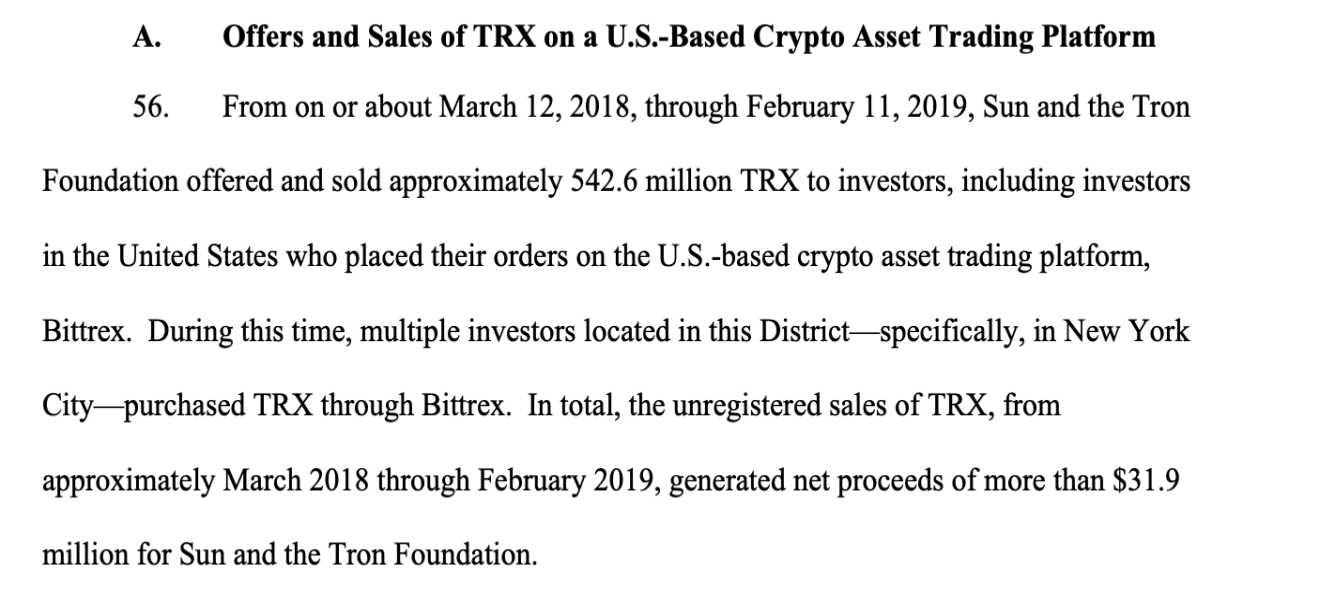
Image: SEC accused Justin Sun of profiting over $31.9 million from illegal sales of TRX
2.3 Celebrity Endorsement Allegation
In its complaint, the SEC also accused Justin Sun of orchestrating celebrity promotional activities for TRX and BTT tokens, inviting eight prominent figures, including Lindsay Lohan, Jake Paul, Akon, and Ne-Yo, to promote the tokens on social media without disclosing to ordinary investors the core fact that these celebrities received promotional fees. Of these, six celebrities have paid a total of over $400,000 to the SEC in disgorgement, interest, and civil penalties, reaching a settlement without admitting or denying the SEC's determination; later, Austin Mahone settled on August 4, 2023, through a consent judgment; and on March 5, 2026, the SEC submitted a voluntary dismissal notice for pending charges against DeAndre Cortez Way.
3 Motivation Analysis: How Did the Dispute Lead to Settlement?
This nearly three-year-long regulatory lawsuit ultimately leading to a settlement results from multiple factors, including shifts in the SEC's regulatory approach, the business and legal needs of the parties involved, and changing political orientations following elections in the U.S.
3.1 SEC Regulatory Adjustments
Since Trump took office, there has been a significant change in the SEC's regulatory approach and enforcement strategies regarding the cryptocurrency industry. On January 21, 2025, SEC Acting Chair Mark Uyeda announced the establishment of a Crypto Task Force, clearly stating a commitment to establishing a comprehensive and clear regulatory framework for crypto assets. Subsequently, on February 27, 2025, the SEC announced the withdrawal of its civil enforcement action against Coinbase; on May 29 of the same year, the SEC reached a joint dismissal agreement with Binance and its former CEO Zhao Changpeng. From a series of SEC dismissal actions, it is evident that the Justin Sun case is not an isolated incident but rather a byproduct of the SEC's shift from high-intensity confrontations to regulatory restructuring since 2025.
3.2 Business Considerations of the Parties Involved
From the defendants’ perspective, accepting the settlement also holds practical benefits. This settlement, involving only Rainberry paying the fine, releases all defendants from litigation charges, helping to eliminate current legal risks and clear away obstacles for the future overseas development of the TRON ecosystem, representing a realistic choice based on business growth.
3.3 Litigation Progress Promotion
After Trump returned to the White House in February 2025, the SEC, together with Justin Sun's lawyers, jointly requested the court to suspend litigation proceedings, allowing ample time and space for settlement negotiations between both parties. After nearly a year of communication and negotiation, the parties ultimately reached a targeted settlement regarding the core dispute of wash trading.
3.4 Potential Relevant Background
Many within the industry believe that the SEC's settlement with Justin Sun is inextricably linked to his significant financial support for cryptocurrency projects associated with the Trump family. Reports indicate that Justin Sun spent at least $75 million to purchase WLFI tokens from World Liberty Financial, related to the Trump family. Three Democratic members of the U.S. House of Representatives pointed out that cryptocurrency companies donated at least $85 million to support Trump’s re-election campaign, suggesting that the SEC's retreat in enforcement actions in the crypto space may be related to this.
4 Regulatory Signals and Market Implications
4.1 New Trends in SEC Regulation
This settlement clearly illustrates four key trends in SEC cryptocurrency regulation under the Trump administration: first, the regulatory approach has shifted from high-pressure crackdowns to flexible regulation; second, settlements have become an important enforcement tool for the SEC; third, the alignment of regulatory policies with governmental industrial orientations has significantly increased; and finally, the SEC now places greater emphasis on advancing the refinement of regulatory frameworks through public roundtables, written comment requests, and interpretative guidance.
4.2 Guidance for Market Participants
For project parties, areas involving inflated trading activity, undisclosed interests in promotional activities, and other potentially misleading market behaviors remain the most likely to trigger regulatory scrutiny.
For cryptocurrency trading platforms, this case also highlights the importance of trade monitoring and identification of abnormal behaviors. Platforms need to establish more robust mechanisms for detecting abnormal transactions to promptly identify and prevent wash trading and other similar behaviors.
For ordinary cryptocurrency investors, the false trading volumes created by wash trading are common investment traps, easily misleading investors' judgments of cryptocurrency liquidity and market demand.
5 Conclusion
The settlement of the three-year regulatory dispute between the SEC and Justin Sun, along with the TRON entities, is a noteworthy point in the development process of U.S. cryptocurrency regulation. From a high-pressure indictment to a precise settlement, the SEC's regulatory approach regarding cryptocurrencies has undergone significant adjustments with the change in the political landscape in the U.S. For the cryptocurrency industry, the practical value of this case lies not in providing ultimate answers to all issues, but in reiterating the need to reduce manipulation risks, enhance disclosure quality, and strengthen trading monitoring and compliance governance, which remains the safest direction for development before the regulatory framework stabilizes completely.
免责声明:本文章仅代表作者个人观点,不代表本平台的立场和观点。本文章仅供信息分享,不构成对任何人的任何投资建议。用户与作者之间的任何争议,与本平台无关。如网页中刊载的文章或图片涉及侵权,请提供相关的权利证明和身份证明发送邮件到support@aicoin.com,本平台相关工作人员将会进行核查。


