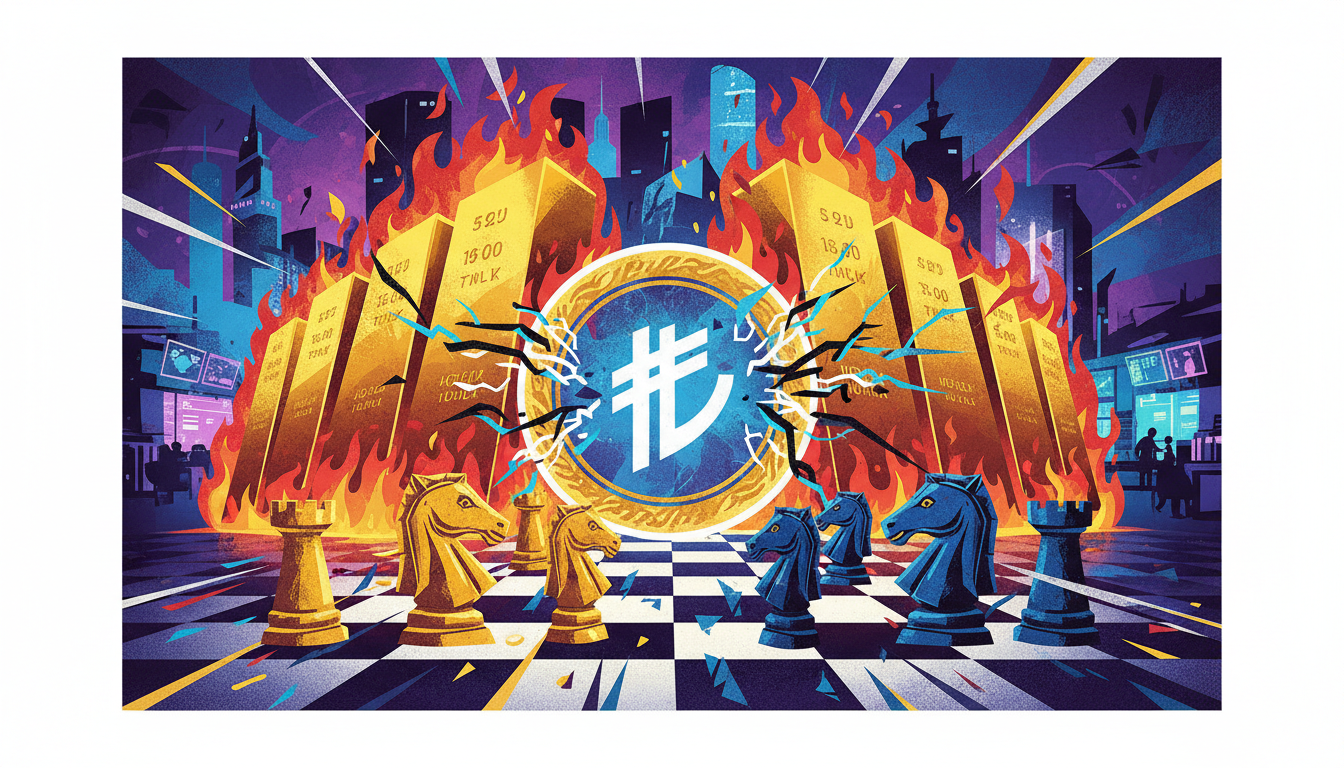
On March 23, 2026, East Eight Time, a faint gesture of "easing" appeared on the Middle Eastern battlefield: the United States announced that it would delay its planned military strike against Iranian energy facilities by five days, while Iran threw out a package of ceasefire conditions through high-level officials on the same day. However, the limited tactical pause contrasted sharply with the nearly impossible high threshold requirements to fulfill in the short term. At the same time, Macquarie's global strategist provided a scenario forecast for crude oil prices, locking Brent crude oil in the range of $85–90 per barrel under the path of "de-escalation" and up to $150 at maximum under the scenario of "continued closure of the Hormuz Strait until April." The market was forced to price between these two ranges: one side held unrealized peace expectations, while the other posed a risk channel leading to extreme supply shocks. The core judgment is becoming increasingly clear — the probability of a short-term peace agreement being born is relatively high, and geopolitical risks are pushing energy prices and global risk assets into a higher volatility range.
Ceasefire negotiations tug-of-war: Iran sets almost unacceptable conditions
On March 23, Mohsin Rezaei publicly stated the ceasefire conditions, which are almost equivalent to setting a very high threshold for a ceasefire. He emphasized that Iran would only stop the war after receiving all compensations, the lifting of all economic sanctions, and international legal guarantees from the United States not to interfere in Iranian affairs. These three demands correspond to the economic settlement of war losses, the overall dismantlement of the long-term sanctions system, and institutional protection of future sovereignty space, resembling a "total settlement" of decades of confrontation rather than technical terms for a tactical ceasefire.
To understand why Iran has chosen to raise the stakes instead of seizing any opportunity to swiftly end the war, one must return to the long narrative of confrontation with the United States since 1979. Since the Islamic Revolution, the two countries' relationship has rapidly fallen into long-standing hostility: sanctions, diplomatic isolation, and regional proxy conflicts have intertwined to form a deep rift over 47 years. For Tehran, this military escalation is not an isolated event but a new segment extending from this long curve. Therefore, Iran is more inclined to regard the current crisis at the negotiating table as a window for structural re-negotiation, hoping to bring years of accumulated dissatisfaction, the sanctions system, and security anxieties to the table by proposing conditions close to "extreme limits" rather than simply addressing the ceasefire arrangements around the recent rounds of strikes.
From the perspective of U.S. domestic politics and diplomatic constraints, these conditions are almost impractical in the foreseeable future. Comprehensive compensation means acknowledging responsibility and deploying substantial financial and political capital; lifting all economic sanctions touches upon the complex mechanisms coordinated by the U.S. Congress, Treasury, and allies; and guaranteeing, in the form of international law, the "non-interference in Iranian affairs" directly challenges the fundamental logic of maintaining U.S. influence in the Middle East. This is also why Macquarie's strategists pointed out that it is still too early to hold high hopes for a "peace agreement" in the Middle East in the coming days: the gap between the chips Iran has put forth and the constraints on the U.S. in domestic politics, alliances, and strategic layout is difficult to bridge in the short term. Even if negotiation channels are in operation and ceasefire terms are appearing frequently, the timeline for a meaningful substantial ceasefire and regional order reshaping will certainly extend far beyond the "next few days" trading period, closer to months or even longer games.
Trump presses pause for five days: tactical respite rather than strategic shift
In contrast to Iran's high-profile raising of stakes, is the "limited restraint" released by the United States on March 23. According to available information, Trump decided to delay military strikes targeting Iranian energy facilities by five days, and this decision clearly only covers energy targets and does not equate to a comprehensive pause of all military actions. In other words, this is a delay in actions against the "heart of energy," not a declaration of ceasefire on the overall battlefield.
From both military and political dual dimensions, these five days bear a highly tactical function. On one hand, they provide maneuvering space for ongoing or brewing negotiations, allowing allies and neutral parties time to exert mediation pressure, while also enabling the U.S. to further assess the comprehensive impact of strikes on energy supply, ally security, and domestic public opinion. On the other hand, the pause limited to energy facilities retains a high-pressure stance against Iran: the U.S. can claim it has "given diplomacy a chance" while not loosening its grip on other fronts, maintaining deterrence and uncertainty towards its opponent.
It is important to emphasize that other military actions unrelated to energy targets have not completely stopped. This means that what is currently occurring resembles a "tactical respite" rather than a "strategic shift." The tempo of firepower on the battlefield may slightly slow down, but the structural hostile relationship and deterrence framework have not weakened. Domestic and allied public opinion pressures in the United States make this five-day pause not only a demonstration of "moderate restraint" but also reserves more options for potential escalation or downgrading in the future: if negotiations yield no results, the U.S. can publicly claim it has provided ample time; if there is a slight easing of the situation, it can package this pause as a rational choice of a "responsible power," thus taking the initiative in narrative terms.
Oil prices stuck in the Hormuz Strait: extreme pricing of two scenarios
In this game, the crude oil market is being forced to price back and forth between two extreme scenarios. According to Macquarie's scenario analysis, if the situation eases to a certain extent, Brent crude oil prices can run in the range of $85–90 per barrel; if the Hormuz Strait remains closed until April, Brent could potentially be pushed to the extreme level of $150 per barrel. For energy traders, this is not a simple choice of "bull market/bear market," but a matter of life and death concerning the boundaries of supply security.
The Hormuz Strait is one of the most sensitive chokepoints for global oil transportation, connecting oil-producing countries in the Persian Gulf with international markets. A large amount of Middle Eastern crude oil and related liquefied energy products need to pass through this narrow waterway; once a continuous blockade or high-risk status occurs, the transmission chain will rapidly extend from physical supply to freight costs, insurance costs, and then overall risk premiums. Even if actual flow is not completely interrupted in the short term, as long as the market views the blockade risk as a "permanent option," deviations, increased insurance rates, and added security costs can support a higher price center.
In pricing logic, "easing situation but still tense" and "key routes remain closed" are two completely different paths. Under the former path, futures prices reflect more of a rebalancing of supply and demand after a risk premium decline, with implied volatility maintaining high levels but trending towards convergence; under the latter path, the market is forced to price in tail risks, and implied volatility in options will visibly elevate, with increased trading activity in deeply out-of-the-money call options, making the entire volatility structure display "heavy tails." The futures curve may shift rapidly from mild backwardation to a steeper curve, amplifying the spot premium or discount, reflecting concerns about recent supply shortages, while valuations of energy-related stocks often reprice concurrently in this process, with high cash flow and high-reserve companies becoming "winners" in a defensive style, while high-cost and highly indebted targets are more susceptible to magnified bearish outcomes.
Amid these two scenarios, oil prices are stuck by the Hormuz Strait: one end connects to the relatively controllable bandwidth of $85–90, while the other end leads to the extreme high of $150. Any news related to the Strait's passage, security incidents, or negotiation wording could become the source of violent fluctuations in futures, options, and energy stock prices.
From oil prices to stocks and bonds: a chain reaction under geopolitical clouds
The escalation of tensions in the Middle East brings not only the shock of oil prices itself but more importantly, its secondary effects on global macro expectations. When rising energy prices are perceived as sustainable risks, inflation expectations will be repriced, thereby affecting the market consensus on interest rate paths. Higher and more persistent inflation expectations imply a longer environment of high rates, forcing the Federal Reserve and other major central banks to rethink their balance between "anti-inflation" and "stabilizing growth," leading to potential chain reactions in U.S. stock valuations, credit spreads, and emerging market capital flows.
During the phase of rising risk aversion sentiment, capital often flows out of high-beta growth stocks, high-leverage assets, and targets with relatively weak liquidity, shifting towards traditional safe-haven assets such as dollars, U.S. Treasury bonds, and gold. Highly valued sectors that are extremely sensitive to interest rates (such as high-growth tech, some high-leverage real estate, and high-yield bonds) may experience valuation compression, while defensive sectors with stable cash flows benefiting from bulk prices tend to be more resilient or even receive net cash inflows. For emerging markets, once the dollar strengthens and risk aversion sentiment rises simultaneously, the pressure will rapidly compound on local currency assets and foreign currency debts, increasing the pressure for capital to flow back to the U.S. and core markets.
In this context, the judgment of "don't hold too high expectations for a peace agreement within a few days" is not just a reminder of the rhythm of news, but also an implicit warning about market pricing behavior: short-term traders may cyclically overestimate the probability of "good news suddenly occurring," tending to bet on swift easing, thus building overly optimistic positions in energy prices and risk assets; they may also underestimate tail risks at certain extreme emotional moments, viewing scenarios like blocking the Hormuz Strait as "low probability, not necessary to price in." Both types of mismatches can lead to violent repricing when real news lands, amplifying volatility and liquidity pressure.
For investors, a more rational structural approach is to search for hedging targets within energy and defense-related sectors, such as high-quality upstream resource companies, defense enterprises, and supply chain segments, while cautiously assessing position leverage and liquidity to avoid passive losses or forced liquidations in the midst of severe volatility. On the portfolio level, managing dual risks of "intellectual stop-loss" and "technical stop-loss" through options, assets with low correlations, and moderate cash ratios may be more aligned with the current risk-return ratio than purely betting on a "sudden great peace."
The current game board of a 47-year feud
The current negotiations between Iran and the United States are not an isolated diplomatic confrontation, but are deeply rooted in the long history of confrontation since 1979. Multiple rounds of economic sanctions, diplomatic blockades, and proxy conflicts in Iraq, Syria, and Lebanon have allowed both sides to form a set of familiar game scripts: high-profile threats, limited actions, indirect confrontations, and cycles of phased easing. Therefore, any seemingly "turning point" ceasefire signals must be interpreted within this long narrative and not simply understood as the endpoint of a crisis.
In the current game board, Iran's strategy of seeking chips through high conditions and regional influence is quite clear: by raising the ceasefire threshold, Tehran has effectively transformed negotiations into a re-negotiation of the entire sanctions and security framework, using its position in the Hormuz Strait, regional proxy networks, and energy supply to try to force concessions from its adversary in mid- to long-term commitments. The U.S., on the other hand, maintains the upper hand at the negotiating table through military deterrence and sanctions tools, both demonstrating the capability and resolve to continue escalating while controlling the intensity of the conflict with limited pauses and precise strikes to avoid sliding into total chaos.
Between these two forces, institutions like Macquarie play a notably modern role: they amplify risk narratives — through scenario analyses and price range forecasts, putting numbers like $85–90 and $150 into the sight of the public and professional investors; they are also shapers of market expectations, as the wording and judgments in their reports are continuously cited and circulated, woven into the psychological price systems of traders, asset managers, and corporate decision-makers. In a sense, the missiles on the battlefield and the range forecasts in reports are jointly reshaping the realities of energy and financial markets on different levels.
More covert yet equally crucial is that "delaying" has already become a part of the negotiations game. Both sides are likely leveraging the negotiation window to adjust military deployments, revise intelligence assessments, test each other's red lines, and gauge international public opinion reactions. Each softening of language, every "positive signal," could be aimed at securing space for the next round of plays rather than true preparations for an endgame. Under such a structure, time is weaponized: the longer it drags on, the more resources are consumed from the other side and the clearer the opponent's red line becomes, while the market finds itself locked in a high-volatility, low-certainty range from which it cannot escape.
Peace is unlikely to land soon: prepare for fluctuations rather than betting on miracles
Overall, in light of Iran imposing near "impossible immediate conditions" and the U.S. implementing only a limited pause in strikes against energy facilities, the likelihood of reaching a comprehensive peace agreement in the short term is low. The discussions of ceasefire and the existence of negotiations do not mean that the war machine is about to stop; rather, they resemble an adjustment of posture and tempo within an established confrontation framework.
The core trigger points around oil prices have become relatively clear: under the path of easing, Brent crude is being channeled into the $85–90 "stressed normal range"; however, if the conditions in the Hormuz Strait deteriorate and continue to stay closed until April, prices could potentially be driven toward the $150 extreme scenario. The vast discrepancy between the two makes any information related to Strait passage, regional military escalation, or negotiation breakdown a potential detonator for significant fluctuations in the futures and spot markets.
For investors, a more rational strategy is to manage positions and hedging around geo-risk premiums and liquidity fluctuations rather than betting on a miraculously "sudden great peace." By constructing a structural allocation among energy, defense, and some defensive assets, supplemented by options and cross-asset hedging tools, actively managing the profit-and-loss curve under extreme scenarios may prove to be more sustainable than chasing ephemeral optimistic sentiments in the news flow.
Looking ahead to the next few weeks, three key informational lines should be closely monitored: first, the subtle changes in negotiation wording — whether it moves from "ceasing hostilities" towards "structural arrangements" or repeatedly circulates within verbal commitments; second, the rhythm of military operations — whether the scope, target selection, and intensity show a trend of convergence or re-escalation; third, actual shipping data — the tanker throughput in the Hormuz Strait, quotes for insurance and freight, and the utilization of detour routes. These three lines will jointly determine how Middle Eastern risks reflect within global asset prices and provide essential coordinates for investors to dynamically update their judgments on risk assets and energy exposures.
Join our community, let's discuss, and become stronger together!
The official Telegram community: https://t.me/aicoincn
AiCoin Chinese Twitter: https://x.com/AiCoinzh
OKX Welfare Group: https://aicoin.com/link/chat?cid=l61eM4owQ
Binance Welfare Group: https://aicoin.com/link/chat?cid=ynr7d1P6Z
免责声明:本文章仅代表作者个人观点,不代表本平台的立场和观点。本文章仅供信息分享,不构成对任何人的任何投资建议。用户与作者之间的任何争议,与本平台无关。如网页中刊载的文章或图片涉及侵权,请提供相关的权利证明和身份证明发送邮件到support@aicoin.com,本平台相关工作人员将会进行核查。