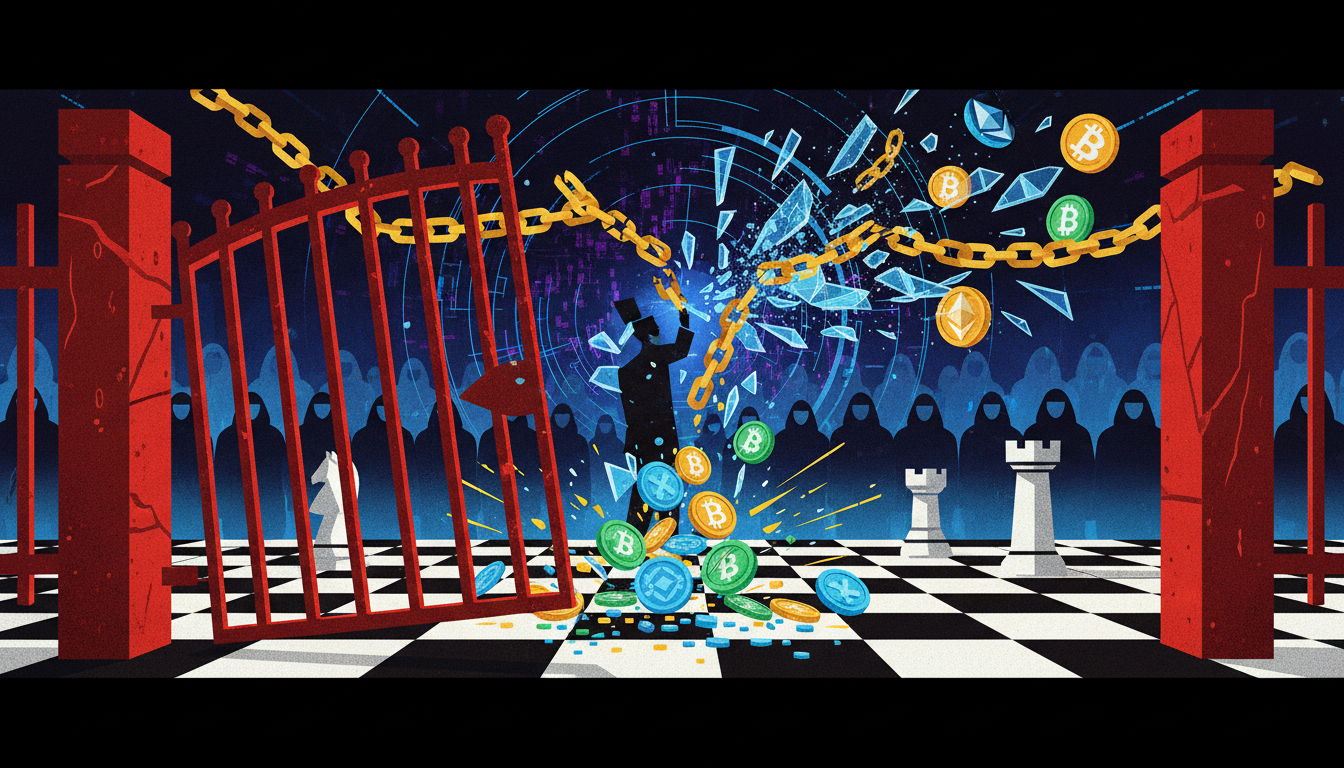
On March 24, 2026, East Eight Time, the controversy surrounding the witch hunt (Sybil) of the Backpack executed before and after TGE was completely ignited. The early large-scale determinations and bans excluded a large number of users who participated in points tasks and anticipated TGE from the distribution list on the eve of the opening, drastically tightening the timeline within just a few days. As public opinion continued to ferment, Backpack announced on March 24 the opening of a manual appeal channel and officially launched the "Rule No. 3", a set of rules that quickly became the key turning point of the event, marking the shift of the project from unilateral cleansing to negotiating with the community. The core of the controversy lies in the systemic conflict between "one person, one account in a compliant context" and the long-standing habit of Chinese users to "participate in airdrops with multiple accounts". In this context, the official proposal of "≥50% point refund" and "secondary market token buyback compensation plan" was seen as a key attempt to rebuild trust and restore relationships with early supporters, transforming this witch hunt from a simple blacklist dispute into a comprehensive battlefield of compliance, interests, and narrative game.
Witch Hunt Upgrade: Collective Wall Collision of Multi-Accounts Among Chinese Users
The "hunt" against witches by Backpack did not come suddenly, but was pushed to a climax according to the established risk control rhythm around the TGE. As the points period approached the end, the project began to conduct mass cleansings targeting suspected Sybil behaviors, with many users discovering that their accounts were marked, points reset to zero, or excluded from the final distribution list just as TGE was about to commence. Due to the overlap of cleansing actions and TGE timing, it was difficult for outsiders to view it as routine risk control; instead, it resembled a concentrated "execution" at the last moment, directly triggering massive community dissatisfaction and public opinion explosion.
The contradictions were particularly concentrated among Chinese user groups. For a long time, participating in tasks and airdrops with multiple accounts was seen as the "default gameplay" in many Chinese communities, from multiple devices within a family to bulk account creation, which already walked on the gray edges. Backpack's one-size-fits-all cleansing categorized these habitual operations as witchcraft, instantly turning some users from "faithful participants" into "systematic cheaters," sharply defining the limits of "fairness" in practical terms. Many users who considered themselves not professional witches, merely switching a few accounts on the same device, were unified into high-risk groups, creating huge cognitive dissonance.
The official repeatedly emphasized that "one person, one account is the compliance bottom line", locking the focus on rigid requirements for regulation and compliance instead of negotiating around "community gameplay." This stance had strong persuasiveness in the Western context but directly clashed with the reality of multiple accounts in Chinese circles. More subtly, the boundary between "real witches" and "wronged users" was not clear in specific execution; algorithmic judgments, mass bans, and lack of prior warnings compounded, amplifying the feeling of being wrongly hit. Increasingly, users began to see this round of cleansing as an opaque, unappealable violent judgment, with emotions escalating from dissatisfaction with the results to questioning the legitimacy of the rules themselves.
Rule No. 3 Goes Live: From Zero Tolerance to Negotiable Bottom Line
As the controversy continued to escalate, Backpack officially launched the so-called "Rule No. 3" on March 24, 2026, becoming a watershed in the entire event. According to official explanation, if the number of accounts involved does not exceed three under the same device, users can use the manual appeal channel to request a review; once the appeal is approved, they will receive more than 50% of points refunded. This means that within the previously regarded framework of "multiple accounts as witches", the project provided a path for "overturning" for the first time and also returned some of the previously cleared points to a compensable circulatory track.
From a compliance perspective, this shift was not merely an "admission of error," but a transition from "absolute zero tolerance" to "limited compromise above the regulatory bottom line". Backpack still insisted that one person, one account is the compliance bottom line, but through Rule No. 3, it made a technical distinction between "family shared devices" and "multiple accounts in daily scenarios" versus professional witches, changing some edge cases from total eradication to "discount compensation". Under the premise of unrelenting regulatory pressure and the need to stabilize early users, such a plan of "refunds ≥50% points" sought a middle ground acceptable to the market between risk and reputation.
The manual appeal channel expanded this set of rules from cold, hard algorithms to a level of dialogue between people. Theoretically, manual reviews could more intricately recognize the differences between real users and mass witches, but they also significantly increased the executing costs for the project parties and slowed down the decision-making pace. In an environment where trust had already been damaged, users hoped that the manual review could correct "machine misfires," while also fearing that the appeal process would lack transparency and standards, leading to a "black box" effect again, thus placing their hopes on a mechanism that lacked detailed explanation. Particularly, the official only provided a percentage bottom line of "at least half of the points refunded", without revealing the overall compensation amount or approval rate, leaving many participants oscillating between expectation and uncertainty—while the negotiating door had cracked open, how much could be recovered and how many could succeed remained shrouded in fog.
Compensation and Buyback: Paying for Past Decisions with Future Cash Flow
Apart from the point refund, Backpack also simultaneously introduced another strategy, the secondary market token buyback plan, forming a two-tier compensation framework that interacts with the appeal mechanism. The upper level is the account dimension point recovery: through Rule No. 3 and manual appeals, some points that were originally reset to zero re-enter the cashable queue. The lower level is the market dimension price support: after TGE, absorbing the sell pressure through buyback, using the project's future cash flow and reserve funds to cover the psychological and actual losses of early supporters.
From the perspective of token economics and secondary market game, the impact of buybacks on supply and demand expectations is direct. Even if the specific scale and pace are not currently disclosed, just the statement that "the official will buy back some tokens in the secondary market" is enough to draw an imaginary "bottom line" for prices in the short term. For holders, this means that during extreme pessimism and surging sell-offs, there might be an "invisible hand" ready to take over, thereby psychologically buffering the panic and anger triggered by the cleansing, at least softening the narrative of being "completely abandoned".
However, as pointed out in the research brief, the scale and timeline of the buybacks are currently completely missing, and the project has not provided any hard data on total amounts or percentage levels. This makes the market's dependence on buybacks more based on trust expectations rather than quantifiable cash flow discount models: some view it as "responsible action with real money," while others worry that this is just a one-off emotional management tool, unlikely to form a long-term mechanism. Backpack emphasized in its statement that "one person, one account is the compliance bottom line, but we will reduce losses for early supporters through compensation mechanisms". This phrase logically completes a cycle from "we must cleanse" to "we are willing to compensate," but the actual penetrative power of compensation ultimately depends on the details of point refunds and the real manifestation of buybacks on the market.
Chinese Community Pressure Field: Public Opinion Swirl and Power Dynamics Exploration
As news of the witch cleansing spread across major social platforms, the Chinese community quickly formed a highly concentrated "pressure field". On social media, discussions about being wrongly affected, algorithmic unfairness, and sudden tight rules rapidly occupied the timeline, with many communities spontaneously organizing cases of accused witches, collecting evidence, writing long articles, creating tables, and packaging feedback to submit to the project. Coordination within groups, cross-platform forwarding, and multilingual translations transformed originally scattered complaints into a rhythmically organized feedback, continuously striking at the official narrative.
In the absence of verifiable data, the judgment that "the strong response from the Chinese community has pushed policy adjustments" seemed more like a collective intuition than a strictly causal proof. However, in the actual public opinion space, this interpretation gradually gained widespread consensus: many participants viewed the implementation of Rule No. 3 and the opening of the appeal channel as the result of community pressure and viewed this incident as an important example of Chinese users effectively "voicing" within the international project compliance framework. Emotionally, this feeling of "we are not completely passive" itself has a re-mobilization effect.
Meanwhile, Backpack officials still maintain compliance rhetoric in external statements: emphasizing regulatory requirements, KYC risks, and the prudence of global business expansion, while in actual policy they chose to partially withdraw from "complete ban" to "partial compensation". This operation of "not loosening our mouths, but slightly adjusting the rules" appears to observers as a portrayal of power dynamics—attempting to provide limited concessions without shaking the compliance narrative to avoid setting a strong "first complaint wins" precedent for future similar events. For Backpack, finding a new balance between global compliance requirements and regional community operation realities will no longer be a one-time crisis response but a long-term issue to face in the coming years.
Under Global Regulatory Shadows: Industry Cycle of Compliance Cleansing
Pushing the timeline further out, Backpack's witch cleansing and compensation are not isolated events but are entwined within a larger regulatory and macro background. The research brief mentions that the upcoming stablecoin yield service ban draft being formulated in the U.S. directly tightens the space around earnings and derivative services at the legislative level, and such signals would be viewed as risk warnings by global project parties, prompting them to excessively benchmark compliance in advance. Under such external pressure, "one person, one account" and "strict control of witches" are no longer just the project’s own preference but are part of preventive compliance: once characterized by regulatory agencies as condoning money laundering and abuse of rewards, projects will face costs far exceeding public opinion storms.
At the same time, global acceptance of crypto payments is accelerating. A single source cited in the research brief shows that Binance Pay has covered tens of millions of merchants, and Binance CEO Richard Teng publicly stated, "Cryptocurrency is becoming the global business standard." On the other hand, major Asian stock indices have seen clear rises within the same time frame, with increasingly tight interconnections between traditional finance and crypto assets. This dual line of "one side is the infiltration of crypto payments, the other side the advancement of regulatory pressures" forces project parties to be more cautious during expansion, preferring to sacrifice some "airdrop bonus narratives" in order to leave enough safety margins for compliance reviews.
The Backpack witch incident coincides perfectly with this macro turning point. For project parties, Sybil cleansing is not only a technical purification of TGE results but also a preemptive self-verification for future license applications, fiat on-ramps, and payment business layouts— the more one aims for mainstream compliance, the harder it becomes to balance "benefit-oriented airdrops" and "compliance-oriented account management." For the industry, this turmoil is merely a localized sample in the larger cycle of Sybil cleansing and compliance tightening, reminding all participants that the old gameplay of "more accounts mean more earnings" is gradually being eroded under the trilateral game among regulation—projects—markets, and every controversy will tear open a new gap between the old and new order.
After the Cleansing: Trust Repair and Rewrite of Airdrop Rules
The path from rigorous cleansing to establishing appeal and compensation mechanisms encapsulates a typical crisis script for Backpack: first completing a high-pressure cleanup in the name of compliance, then opening limited room for maneuver under community backlash and public opinion pressure. This path has earned the project a cleaner account structure and a publicly presentable "regulatory friendly" image but has also traded one trust overdraft for compliance chips—compensation mechanisms and buyback commitments are essentially a stop-loss operation where the project pays for prior decisions with the future value of tokens.
For the entire industry, future airdrop designs are unlikely to sustain the previous model of "broad entry and exit + post-cleansing." How to reconstruct participation rules amid compliance, anti-Sybil measures, and the reality of multiple accounts may become the core proposition of the next round of airdrop competitions: clearer multi-device identification standards, more upfront risk control explanations, and more transparent appeal plans will all be viewed as important indicators of project seriousness. Meanwhile, Backpack's path of "strictness first, then compensation" may very well be copied by other projects: first locking in compliance bottom lines through rigorous cleansing, then releasing tiered compensation and buyback plans based on community response and market performance, forming an adjustable crisis management template.
This model's long-term impact on user behavior may manifest in two directions: on one hand, professional witches will be forced to constantly upgrade tools and strategies to bypass increasingly finely tuned risk controls; on the other hand, ordinary participants will pay more attention to rules and information collection, no longer seeing "multi-accounting for profit" as a zero-cost game. Ultimately, transparency in information and expectation management will become the scarcest chips in the next round of airdrop games—those projects that clearly articulate cleansing standards, appeal paths, and compensation boundaries will manage to win more lasting user trust in the tightening time of compliance.
Join our community, let's discuss and become stronger together!
Official Telegram community: https://t.me/aicoincn
AiCoin Chinese Twitter: https://x.com/AiCoinzh
OKX benefit group: https://aicoin.com/link/chat?cid=l61eM4owQ
Binance benefit group: https://aicoin.com/link/chat?cid=ynr7d1P6Z
免责声明:本文章仅代表作者个人观点,不代表本平台的立场和观点。本文章仅供信息分享,不构成对任何人的任何投资建议。用户与作者之间的任何争议,与本平台无关。如网页中刊载的文章或图片涉及侵权,请提供相关的权利证明和身份证明发送邮件到support@aicoin.com,本平台相关工作人员将会进行核查。