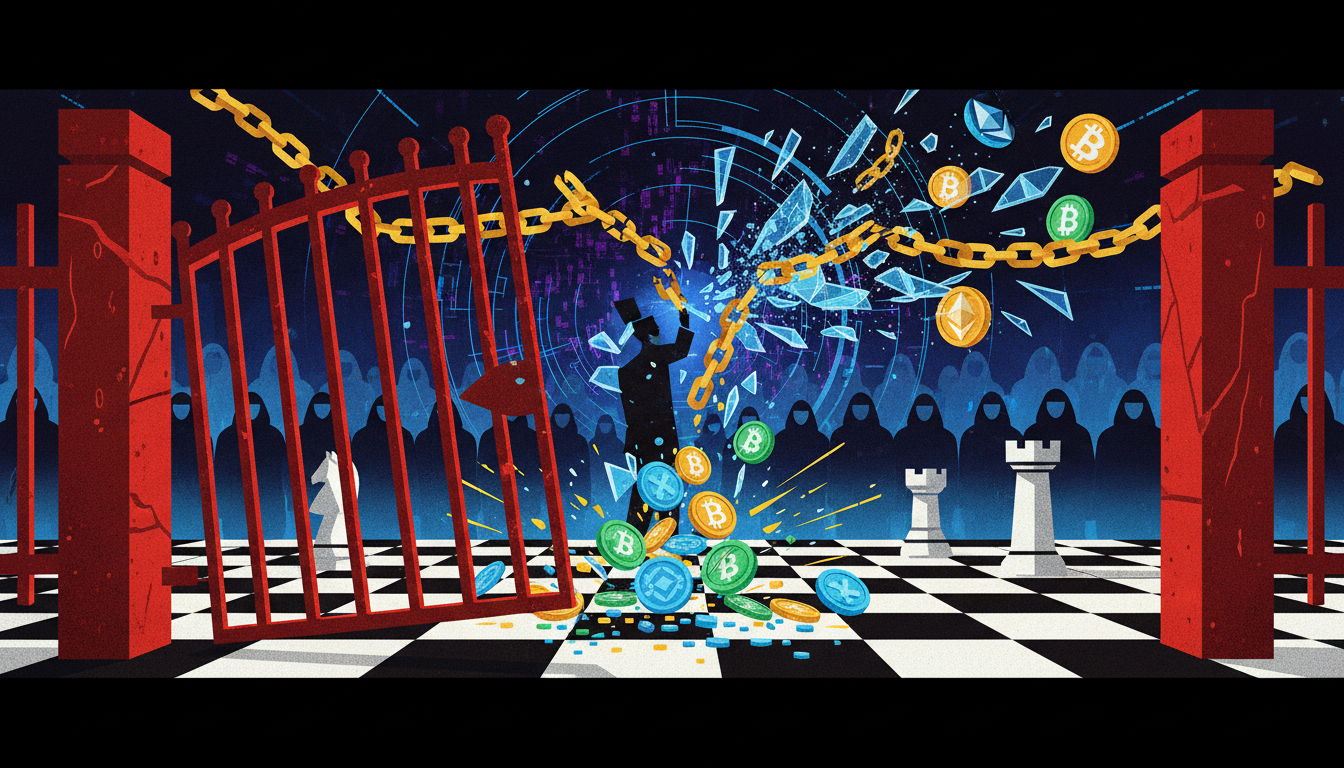
On March 24, 2026, Backpack brought the compliance issue originally focused on technology into the spotlight, revolving around the account cleanup triggered by "witch judgments". The platform centralized the handling of multiple accounts suspected of being controlled by the same entity based on existing anti-witch logic, directly colliding with the long-standing habit of multiple account operations among Chinese-speaking users. As the controversy intensified, Backpack launched two key initiatives on the same day—initiating a manual appeal channel and providing the "Rule No. 3" based on device dimensions, becoming the first clear turning point in the event. Meanwhile, the official signal of compensation through secondary market token repurchases extended the impact of the turmoil from platform governance to token prices and market expectations. The collision between Western compliance bottom lines and local play culture was fully exposed this time.
From Account Bans to Opening Appeals: How Backpack Hit the Brakes
After Backpack launched the witch judgment mechanism, a large number of addresses with multiple account behavior were identified by the system and brought under scrutiny, leading many users to find their account rights restricted, points reset to zero, or significantly reduced. Although the official did not disclose the specific scale of affected users, feedback from the Chinese community indicated that the impact was not limited to traditional "studios" but extended to a considerable number of ordinary participants who habitually engaged with multiple accounts.
On March 24, when reactions became concentrated, the Backpack team chose to quickly adjust their pace, announcing the opening of a manual appeal channel, shifting part of the process that originally relied entirely on automated identification to one that could be manually reviewed, explained, and corrected. The motivation was not simply a "concession" but resembled a search for an operational compromise between the risk control bottom line insisted upon by the anti-witch teams in Europe and America and the reality of the user structure—both maintaining the overall direction of anti-witch measures while allowing space for individuals with blurred boundaries to appeal.
Specifically regarding "Rule No. 3," Backpack stated that: using a single device as a measurement unit, as long as there are no more than 3 accounts under the same device, users are eligible to initiate an appeal; upon approval, they can recover more than 50% of the deducted points and have the opportunity to receive additional point incentives. This clause essentially lowered the original ideal model of “one person, one account” rule to a more realistic execution level of "single device ≤ 3 accounts can be exempted."
On the discourse front, the co-founder team and the Chinese window also spoke out simultaneously. The Chinese head Claire and the Backpack Chinese team publicly stated through media that they had engaged in in-depth communication with the European and American teams, repeatedly emphasizing that "they did not want the interests of users supporting Backpack to be harmed." This proactive acknowledgment of the execution controversy and quick correction became another key pivot in calming the storm.
One Account per Person vs. Multiple Accounts: Value Conflicts Brought to the Fore
The "one person, one account" standard long insisted upon by the anti-witch teams in Europe and America was not essentially a moral requirement but stemmed from dual considerations of compliance and risk control. On one hand, facing various regulatory reviews and anti-money laundering pressure, the platform needs to be able to clearly answer the basic question of "one real natural person corresponds to one accountable account"; on the other hand, in operational activities such as airdrops, incentives, and trading mining, one person, one account can maximize the reduction of volume manipulation, arbitrage, and collective exploiting of resources, thus providing protection for both project parties and ordinary users.
In stark contrast, multiple account operations among Chinese-speaking users have long become a "normalized tool." From early trading mining and transaction fee rebates to later airdrop activities and point systems, multiple account arrangements were often seen as a way of "reasonably utilizing rules" for arbitrage rather than a guilty presumption. Historical experience has taught these users that as long as they do not touch obvious cheating models, opening multiple accounts and participating in different activities is a conventional means of increasing returns and hedging against uncertainties.
The peculiarity of this incident lies in: this is the first time the official has clearly acknowledged the strategic divergence between the Eastern and Western execution teams. The European and American anti-witch teams preferred to continue using mature compliance templates, steadfastly promoting the one person, one account; while the Chinese team had to confront a community reality where multiple account operations were already commonplace. This internal standard inconsistency, once lacking transparent prior communication, can easily be magnified into a trust crisis characterized by “selective strikes” and “temporary rule tightening” at the execution level.
What the community saw was not just points deducted and accounts limited but rather where platform governance stood on which set of value coordinates: is it the abstract global compliance framework or the real usage habits and historical path dependencies? When the answer manifests itself only in the form of "results" on the day of execution, the originally controllable internal strategic divergence naturally evolves into open community contradictions and trust tests.
The Step Back of Rule No. 3: Who Can Get Points Back and Who is Labeled a Witch
Rule No. 3 uses devices as a measurement dimension, writing into clear rules that up to 3 accounts per device can appeal. This seems simple but is, in essence, a handshake between technology and compliance in the middle ground. For most users who only use a small number of accounts on one phone or computer, this rule provides an understandable and executable boundary, and the platform can distinguish more clearly through device fingerprints and system environments, reducing collateral damage caused by pure IP dimensions.
On the compensation front, returning more than 50% of points after the appeal is approved, combined with additional point incentives, formed a signal of compromise: "acknowledging the existence of collateral damage but still emphasizing risk control priority." For those who already opened only a few accounts mainly for daily transactions and limited activity participation, this level can psychologically cover expected losses; for heavy participants, even if they cannot return to the point scale before the incident entirely, at least it is no longer a zero-sum settlement.
The ones truly targeted were large-scale witch clusters relying on multiple devices and environments. From a rule structure perspective, the single device exemption line of Rule No. 3 means that operations which log in to a large number of accounts repeatedly on one device, or batch-fabricate device environments through cloud hosts, will be easier to lock down by the system and manual review. However, there remains a grey area that is difficult to draw a clear line—such as family members sharing devices, habits of logging in from multiple locations, and switching between multiple platforms, which may display characteristics similar to multiple entity control on technical fingerprints.
From the perspective of balancing compliance and community sentiment, this compromise solution is clearly closer to "reopening a door for edge cases without abandoning principles." The platform maintained the basic stance against witches while giving ordinary users an opportunity for correction through Rule No. 3. The true test will lie in whether subsequent executions are transparent, whether appeals are efficient, and whether these standards will be publicly disclosed in advance in future operations rather than re-establishing trust through remedial measures afterward.
Token Repurchase Compensation: Comforting Users or Supporting Prices
Aside from the rule adjustments, Backpack also launched another market-oriented proposal—compensation through secondary market token repurchase. According to currently available public information, the team has only provided a general framework of "compensating the affected group through repurchase" without disclosing specific details such as the scale of repurchase, execution rhythm, price range, etc., and has not provided a clear formula directly linked to the appeal results.
Combining with past cases in the industry, when trading platforms initiate secondary market repurchase, it often has two layers of goals: one is to support prices and increase order book depth through real buying, reducing sell pressure during emotionally pressured phases; the other is to release signals of long-term value alignment by destroying or locking up repurchased tokens, thus aligning the interests of the platform and token holders. For Backpack, this repurchase serves both to indirectly compensate the affected group economically and to repair the cracks of trust in tokens and the platform at a reputational level.
However, unlike the direct refund of points, for users labeled as witches, the repurchase only provides an indirect compensation path: the platform releases buy orders to the market, which theoretically can provide some support for the price, but whether it truly benefits the affected users depends on whether they still hold the tokens and whether they choose to continue holding under the expectation of repurchase. For those who are already feeling doubtful and choose to reduce holdings or even exit, this type of compensation is markedly limited.
In the absence of a specific scale and timeline, the market can currently only price the directional fact that "the platform is willing to repurchase" and cannot accurately measure its strength and sustainability. This means that the expectations of repurchase may be viewed as a positive signal in the short term, stimulating some funds to attempt speculation, while simultaneously facing the reverse risk of "fulfillment not meeting expectations." The actual effectiveness of the repurchase will depend on the disclosed execution details and the intensity of funding投入, rather than the vague commitment itself at present.
The Sandwich Role of the Chinese Team: A Pressure Test for Communication and Localization
In this witch incident, the role of Backpack's Chinese team has been unprecedentedly magnified. According to public reports, they have repeatedly emphasized having engaged in "in-depth communication" with anti-witch teams from Europe and America, hoping to advocate for more explanation and correction space for affected Chinese-speaking users without rocking the overall direction. This action of actively bringing internal communication to the forefront itself sends a signal: the Chinese team is not merely a one-way "megaphone" but is attempting to become a buffer between rule-making and local feedback.
“We do not want the interests of users supporting Backpack to be harmed” — this statement, though not aggressive in tone, precisely highlights the positioning of the Chinese team—on one hand, they must maintain the overall image of the platform and compliance bottom line to avoid leaving loopholes in the global regulatory context; on the other hand, they must prove to local users that they are not unconditionally upholding existing decisions but are actively pushing for corrections. The overlapping of these two demands places the Chinese team in a naturally high-pressure position.
This public communication also brought to light a more long-term question: on a global platform serving multilingual and multicultural users, at which stage should the localization perspective enter into rule-making? Is it like this time, after the implementation of rules and the outbreak of disputes, that the local team's remediation and compromise come into play to smooth out conflicts, or should it be that when designing anti-witch standards and point distribution mechanisms, local usage habits and arbitrage culture research and modeling are introduced in advance?
If this wave can ultimately drive Backpack to more quickly and systematically incorporate input from local teams into future decision-making processes, then the Chinese team's "sandwich" role might partially transform into a "pre-participation" institutional position; conversely, if localization primarily bears the task of post-event communication and emotional management, similar governance friction will only replay during the next tightening of rules.
The Lessons Backpack Needs to Learn After This Witch Incident
Looking back on the entire event, from the rigorous witch judgments executed with the ideal model of one person, one account on March 24, to the rapid initiation of manual appeals under pressure, and finally introducing the "Rule No. 3" stipulating that a single device can be exempted for up to 3 accounts; along with the combination of point refunds and token repurchase compensation to mend the rift, Backpack completed a swift turnaround from "technology-driven" to "governance compromise" in a short time.
The core gap exposed by this path is the lack of transparency in rule announcements and localization participation on cross-cultural platforms. The rules themselves can be tightened, but if there is a lack of clear communication and scenario-based examples beforehand, it is difficult for users to discern what behaviors constitute a red line and which fall into grey areas; while placing the perspective of local teams mainly on post-event appeasement and explanation also means that the compliance models lost an important real-world calibrator at the design stage.
Looking ahead, Backpack and other trading platforms strengthening anti-witch governance are likely to form a new industry consensus on two points: first, to maintain a high-pressure stance against large-scale, multi-device, multi-environment witch clusters, upholding compliance and fairness bottom lines; second, when tightening rules that involve incentives such as points, airdrops, and rebates, to introduce clearer advance announcements, more detailed boundary explanations, and higher frequency of localized communication to reduce the necessity for "post-event compensatory governance."
For users, what truly deserves ongoing attention is the repurchase scale, rhythm, and execution data that Backpack will publish later, as well as the actual results regarding the appeal approval rate and points refund rate. These quantifiable indicators will better demonstrate whether the platform is willing to bear the costs of this incident and whether it takes cross-cultural governance's trust deficit seriously. Only when rules are transparent, execution is predictable, and correction pathways are clear, can true gaps for long-term coexistence be found between the "compliance iron wall" and the habit of multiple accounts.
Join our community, let's discuss and grow stronger together!
Official Telegram community: https://t.me/aicoincn
AiCoin Chinese Twitter: https://x.com/AiCoinzh
OKX benefits group: https://aicoin.com/link/chat?cid=l61eM4owQ
Binance benefits group: https://aicoin.com/link/chat?cid=ynr7d1P6Z
免责声明:本文章仅代表作者个人观点,不代表本平台的立场和观点。本文章仅供信息分享,不构成对任何人的任何投资建议。用户与作者之间的任何争议,与本平台无关。如网页中刊载的文章或图片涉及侵权,请提供相关的权利证明和身份证明发送邮件到support@aicoin.com,本平台相关工作人员将会进行核查。