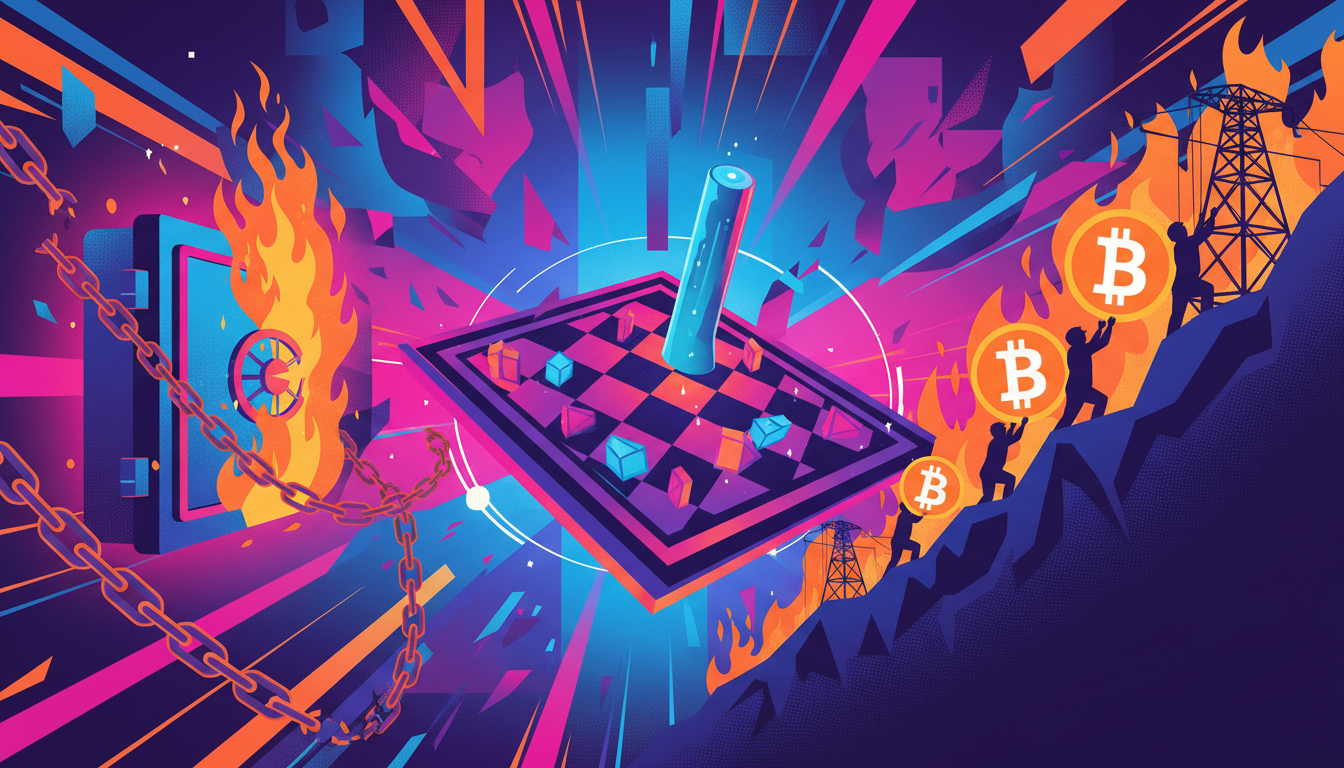
The TERAFAB plan proposed by Elon Musk targets a direct goal of 1 terawatt-level computing capacity and publicly states that "most of the project's capacity must be directed towards space applications," while aiming to "avoid constraints from terrestrial energy." This statement shifts the narrative of computing power from traditional data centers and mining operations directly to orbits and deep space. The reality is that, according to publicly available data, the current total power generation capacity in the United States is only about 0.5 terawatts, making the TERAFAB goal nearly equivalent to recreating two US power systems, creating a strong sense of impact. While this grand computing utopia is being discussed, high-leverage players in the crypto world and on-chain whales are experiencing cycles of liquidation, margin calls, and re-leveraging amidst significant fluctuations. One depicts the extreme blueprint of energy and computing power in space, while the other bets on future prices in exchanges, both pointing towards the same mainline: the computing power revolution and high-leverage gambles are collectively amplifying the risks and imagination of this world.
One Terawatt Computing Bet: Musk Is...
TERAFAB is described as a project that aims for 1 terawatt-level computing capacity; in Musk's narrative, this is not merely an expansion of super data centers but requires that "most of the project's capacity must be directed towards space applications" and unlocks the limit of computing power by "avoiding constraints from terrestrial energy." This means he is trying to move the physical carrying capacity of computing power from densely populated areas on the surface to space or near-space scenarios with fewer traditional constraints, thereby circumventing the bottlenecks of existing urban power grids and land costs.
In contrast, the current overall power generation capacity in the US is about 0.5 terawatts; what TERAFAB aims to achieve is to add an even larger computing power consumption volume on top of a national-level power system. The comparison of 1 terawatt to 0.5 terawatts is not just a doubling of figures but conveys a palpable feeling of the tension this blueprint represents on the real energy map: if realized, it will mean either reshaping the power generation landscape or transferring a large amount of demand "off the surface."
The so-called "avoiding constraints from terrestrial energy" logically points to two layers of meaning: first, it means jumping out of the existing power grid and fuel supply framework, no longer being tightly locked by local electricity prices, transmission bottlenecks, and environmental indicators; second, it is about redistributing the spatial distribution of computing power and energy, projecting the computing demand originally concentrated in a few countries and few areas to overflow or map into space or extreme regions, pushing the old paradigm of "wherever there is cheap energy, there is computing power" to the extreme. This conception naturally resonates with crypto mining, AI training, and high-performance computing, and has quickly been adopted by the crypto circle, mining companies, and venture capital as a new narrative trump card—whether genuinely researching future space-grade facilities or just attaching the "space computing power" label in funding presentations, all are utilizing this highly charged story to seek reasons for the next round of capital and hardware cycles.
Surface Electricity Crunch: Space Computing Will...
Looking back from the 1 terawatt-level target, what first comes to mind is the potential impact on global power and infrastructure demand. Even if this volume does not appear instantly but is deployed in phases and regions, it equates to adding an entirely new "load structure" centered on computing power atop the existing power generation and distribution network. This will force countries to rethink their electricity generation structure, cross-border transmission, and energy storage, and any projects oriented towards AI, crypto, or cloud services will struggle to avoid the subsequent price and supply chain reactions.
Once the mainstream narrative pushes the future competition for computing power towards space or extremely remote areas, the logic of "suburban hydropower," "desert photovoltaics," and "border thermal power" where traditional mines are located may face a repricing of electricity costs. On one hand, if high-energy-consuming projects are increasingly directed towards orbits or new power generation domains, the marginal electricity demand in certain regions on the surface may ease, providing local mines with breathing space; on the other hand, if space-level projects lock in substantial power generation and hardware capacity upstream, the resources available to traditional mining and local high-energy-consuming computing may actually diminish, raising their long-term marginal costs, particularly disadvantageous for small and medium-sized mining operations.
In such an expectation, mining companies and large mining pools have to reassess between energy prices, geographic layout, and scaling expansion. On one end, they continue to delve deeper into cheap hydropower, wind and solar energy, and cool climates for more extreme surface cost optimization; on the other, they bet on the future emergence of orbital or near-space computing infrastructure, positioning themselves as potential partners or upstream clients. Larger players are more motivated to layout along both paths simultaneously to hedge against the uncertainties brought about by energy price fluctuations and tightening regulations.
As for crypto computing itself, whether it will be "squeezed out" by space-level projects or form synergies within a larger-scale energy system remains an open question. If space computing prioritizes serving AI, scientific research, and military needs, then crypto mining may be pushed to the edges, needing to survive within more fragmented and stricter surface quotas; if computing infrastructure is seen as "universal underpinning," the crypto network may have the opportunity to function as a programmable cash flow and incentive layer, in turn providing mechanisms to support financing and operations for that infrastructure. At this stage, there isn't enough data to reach a conclusion; the only certainty is that crypto mining will struggle to coexist with this narrative in a "small and scattered" manner.
Bloodbath and Backflow: Huang Licheng ETH...
Beyond the grand narrative of computing power, individual fates within the high-leverage market also vividly reflect risks and greed. According to a single source of information, crypto trader Huang Licheng chose to go long with high leverage during a severe ETH fluctuation, resulting in liquidation when the market plunged sharply, leading to the forced closure of his long position by the system. Such operations are not uncommon on-chain and in exchanges, but the combination of a personal label and high leverage made this event quickly amplify into a "celebrity-level bloodbath demonstration."
More dramatically, according to the same source, shortly after being liquidated, he did not choose to withdraw, but rather swiftly re-established a position, holding approximately 2,200 ETH at an estimated value of about 4.62 million dollars at the time. From an external perspective, this is a typical case of "rushing back into the race after being forced to exit": on one hand, it reflects continued confidence in the medium to long-term market; on the other, it also reflects the psychological path dependence of individuals in a high-volatility environment, unable to escape the belief of "need to earn back losses."
High-leverage trading, in times of amplified volatility, can easily create chain liquidations and emotional sell-offs. When prices fall rapidly and the margin for leveraged long positions becomes insufficient, the system will automatically liquidate, creating additional sell pressure that further drives prices down, triggering more positions to reach the liquidation line. This "pro-cyclical" mechanism essentially magnifies what could originally be digested through normal buying and selling into an avalanche-like price waterfall, while simultaneously stimulating extreme panic and brief despair in social media and public discourse.
The story of Huang Licheng aptly provides a window: in volatile markets, retail and celebrity players are often trapped in the same cycle of greed and fear. In times of rising prices, leverage is seen as a shortcut to amplify returns; in downturns, liquidations are interpreted as "bad luck" or "black swans." However, structurally, all of this stems from a systematic underestimation of risk—that is, compressing what should be slowly accumulated trend returns into a high-multiple, short-cycle gambling mechanism, ultimately leaving the side with the least bargaining power to foot the bill.
Whales Adding Margin for Self-Rescue: 120,000...
In contrast to the dramatic liquidations of celebrity accounts, the operations of on-chain whales appear colder and more scalable in effect. According to a single source revelation, a certain on-chain whale holds about 120,000 ETH in long positions, and due to recent severe fluctuations approaching the liquidation line, has been forced to add margin to the platform to avoid having their position forcibly closed by the system. This number of 120,000 far exceeds that of most institutions and individuals, and once it goes bankrupt, it will cause a significant shockwave through the market.
Large long positions inherently have a magnifying effect on market depth and liquidation waterfalls during severe fluctuations. On one hand, such a position is itself a "systemic risk point": once concentrated liquidations occur, it can throw massive sell orders onto the market in a short time, breaking through weak price ranges, causing prices to plummet; on the other hand, other traders monitoring on-chain data will see it as an important signal to short or withdraw liquidity in advance, further undermining the market's absorption capability. This represents a typical "the larger, the more fragile" paradox—if one point destabilizes, it can drag down the whole market.
However, the differences between whales and ordinary traders in risk management tools and psychological resilience cannot be overlooked. Large holders often have more sophisticated hedging tools and more flexible capital mobilization capabilities, creating multiple buffers through margin addition, reducing positions for hedging, or off-exchange financing; but they are not without fear. The market's scrutiny of liquidation lines and social media's anticipation of "whale liquidations" transforms into additional pressure and uncertainty. Anxiety flows across different sizes; the form and threshold may vary but the essence remains similar.
Drawing a timeline that includes Huang Licheng's individual story and the on-chain whale holding 120,000 ETH reveals that whether it is a celebrity account with thousands of ETH or institutions or large holders with hundreds of thousands, their behaviors operate within the same narrative resonating with high leverage and high volatility. Some re-enter after being liquidated, others throw another bundle of margin into the fire—what underlies all of this are different bets on the future price trajectory, jointly forming the most dramatically tense structure in this market cycle.
Regulation and Taxation Observation: External Rules...
Beyond the internal cycles of computing power and leverage, external rules also play a significant role in reshaping risk boundaries. According to a single source of information, Brazil has postponed its crypto tax policy until after the 2026 elections; this decision releases a clear signal of "policy observation": under the overlay of political cycles and economic uncertainty, lawmakers have chosen to delay crucial decisions on taxing crypto gains, pushing potential controversies onto the next government for resolution.
In contrast, the tightening rhythm of US regulation stands as a counterpoint. According to publicly available information, the joint regulatory document from the SEC and CFTC will take effect on March 23, bringing clearer compliance pressures to the US crypto market. From exchange licenses and derivatives compliance to KYC and anti-money laundering requirements, the thresholds and costs for leverage usage may rise. For high-leverage products, this could compress excessive speculation space or push some high-risk activities towards jurisdictions with laxer regulations.
The global markets delaying taxation versus the tightening in US regulation creates a two-way force acting on leverage and liquidity. On one end, countries like Brazil that defer "tax collection" allow local capital to participate relatively lightly in the short term, intensifying regional speculation and capital inflows; on the other end, compliance pressures represented by the US compel large-scale institutions and compliant capital to reduce leverage, optimize margin management, or even withdraw from certain high-risk products. In the highly fluid realm of crypto networks, capital will search for the "most comfortable" regulatory temperature between these two extremes, driving a rebalancing of cross-border flows and derivatives structures.
Regulatory uncertainty, alongside super narratives like that of Musk, jointly shape the current market's policy and emotional gaming arena. On one side are high concepts such as "1 terawatt computing," "space applications," and "avoiding surface constraints," which create technologically utopian imaginations; on the other are real constraints like timelines for tax implementation, rising compliance costs, and license red lines. The tension between the two can provide fuel for the next round of narratives or, at some point, may become the last straw that breaks the back of excessive leverage.
Computing Utopia or Leverage Fog:...
Returning to the starting point, the contradiction between space computing and surface energy is intertwined with the story of high-leverage trading, becoming one of the main threads of the current crypto market. On one hand, the 1 terawatt-level target of the TERAFAB shifts focus from mining machines and server rooms to planet-level energy distribution, prompting a reevaluation of the relationships between electricity, geopolitics, and computing power; on the other hand, stories like Huang Licheng holding 2,200 ETH after liquidation and whales adding margin for 120,000 ETH long positions serve as dramatically striking reminders to all participants: in such an environment, the cost of speculating on the future is often the margin and sleep of the present.
Musk's grand objective still lacks publicly available technical details and a clear timeline and should not be overly mythologized by the market. Whether it is the need to "point towards space applications" or "avoid constraints from terrestrial energy," it is more a long-term value declaration and agenda setting than a business plan that can be directly discounted into short-term profits. In the context of unclear technological routes and undisclosed cost structures, treating this narrative as a reliable anchor for the next valuation bubble is inherently a high-risk behavior.
The tragicomic acts of individuals and whales in leverage continue to unfold, reflecting the structural high volatility and high risk of reality. The decentralized market structure, 24/7 trading, and unrestricted global capital flow allow prices to complete price fluctuations that traditional markets might experience over several days or even weeks in extremely short timeframes; while widely accessible high-leverage tools and derivatives directly amplify such fluctuations into extreme ends of gains and losses. Regardless of position size, any participant who excessively bets their fate on leverage may ultimately become the centerpiece of the next "typical case."
Looking ahead, this round of game regarding computing infrastructure, energy patterns, and regulatory boundaries will largely determine how far the narrative can go. If space computing truly enters a feasible stage, the crypto network may emerge as an essential fund and incentive layer, thereby promoting infrastructure upgrades; if tightening regulation combines with rising energy costs, high leverage and high-energy consumption structures may become marginalized, replaced by more robust and efficient structures. Regardless of the direction, in an era where imagination and risk are both magnified, learning to maintain distance between narrative and leverage may be one of the few choices that participants can still control.
Join our community, let's discuss and become stronger together!
Official Telegram community: https://t.me/aicoincn
AiCoin Chinese Twitter: https://x.com/AiCoinzh
OKX Benefit Group: https://aicoin.com/link/chat?cid=l61eM4owQ
Binance Benefit Group: https://aicoin.com/link/chat?cid=ynr7d1P6Z
免责声明:本文章仅代表作者个人观点,不代表本平台的立场和观点。本文章仅供信息分享,不构成对任何人的任何投资建议。用户与作者之间的任何争议,与本平台无关。如网页中刊载的文章或图片涉及侵权,请提供相关的权利证明和身份证明发送邮件到support@aicoin.com,本平台相关工作人员将会进行核查。