🧐About the significance of Token forks and three identity changes: certificate → asset → computational unit!
Recently, many friends raised this question, which is a very interesting topic, so is Token invented by the cryptocurrency community or AI?
On this issue, I researched seriously for a whole morning:
When the term became popular in the cryptocurrency community more than a decade ago, it was probably the first time most people in our field heard this term, and at that time in Chinese, everyone called it token.
Now the meaning of Token has undergone tremendous changes, as if the whole world is using it.
So what is the history of Token development—
1️⃣In the context of computing and engineering, Token has long existed.
For example: identity authentication token: after logging in, the server sends you a token, which is equivalent to a "you are logged in" certificate; API token / access token: a key certificate used for calling interfaces; tokens in compilation principles: program code is broken down into the smallest semantic units after lexical analysis.
So from the source, Token is essentially not a currency, but "a type of marker or permission certificate that can be recognized by the system."
2️⃣Cryptocurrency and Token
Then, in recent years, the cryptocurrency community has "financialized" the term Token and magnified it.
After blockchain emerged, especially with smart contracts and the ICOs in 2017, everyone urgently needed something to represent various tokens in the market besides Bitcoin.
Early players in the cryptocurrency community were mostly computer geeks, familiar with computer terminology, so Token was given a particularly strong new meaning: a digital unit that can be issued, transferred, traded, and programmed on the chain.
At that time, it was only then significantly associated with these concepts: tokens, assets, incentive units, governance rights, usage rights, equity mapping imagination, community narratives, and so on.
In other words, the cryptocurrency community did not invent the term Token but promoted it from "a certificate/marker in the system" to "a container of value on the chain."
The Chinese translation "通证" actually has a very contemporary quality.
Why wasn't it simply translated as "token"? Because many people feel that it is not just a coin, not just money, but: a tradable rights certificate, translating to "通证" makes Token appear to be more advanced, while "coin" or "token" sounds like a scam, relatively low.
Therefore, the translation "通证" carries a clear ideological packaging to some extent: it aims to express not just a coin, but a circulating certificate that can carry usage rights, governance rights, income rights, identity, and incentive relationships.
This is also why the term "token economy" became popular back then.
3️⃣ AI Large Model Era
In the age of large models, Token has become popular again, but its meaning is almost no longer the one from the cryptocurrency community.
So many people feel that the term invented by the cryptocurrency community has been taken over by AI.
In AI, Token usually refers to: the basic segmentation unit used by the model when processing text.
For example, when you use AI, the platform says:
Input 10k tokens, output 3k tokens, token price, context window 128k tokens
Here, Token is essentially: a measurement unit / computational unit / context consumption unit for the model.
So AI has not inherited the asset meaning from the cryptocurrency community; it resembles a return to an earlier layer of Token's more ancient essence:
the smallest unit recognized and processed by the system.
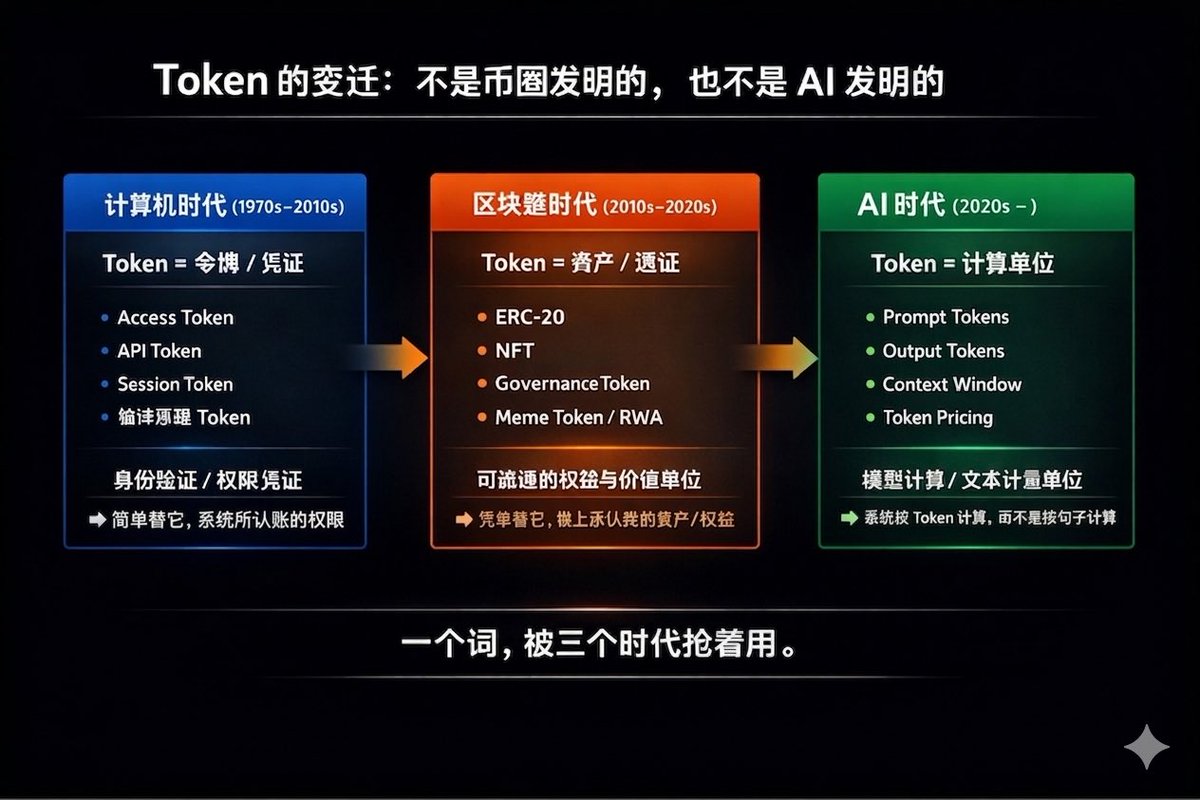
4️⃣ Soft Fork of Token
To summarize, today Token has at least three layers of meaning, and I give it an interesting perspective that it has completely forked, and it is a soft fork.
The first layer: certificate-type Token
For example: access token, refresh token, API token (token), session token means that I hold it, and the system recognizes my permissions.
The second layer: asset-type Token
For example: ERC-20 token, governance token, meme token, RWA token
The core meaning: it is the tokens and asset rights we are familiar with, which means that I hold it, and the chain recognizes my ownership / transferable rights / certain rights.
The third layer: computational-type Token
For example: LLM token usage, prompt token, output token, which means the system does not understand you by "sentences" but by segmenting and calculating you by tokens.
5️⃣Conclusion
So to whom should this term be applied, and how should it be used, I think there is no need for debate. Token is not invented by AI, nor is it invented by the cryptocurrency community; it has always been an old word.
You can understand it this way:
The word Token has not changed.
What has changed is that different waves of technology have taken notice of it, so it will exist with multiple meanings. Because it naturally fits to express: a basic unit that can be recognized, recorded, transmitted, and settled by a system.
The cryptocurrency community has assetized it,
AI has measured it.
And its original background has always been "a recognized marking unit by the system," even a slice of the era.
So its meaning has not been "replaced," but rather layered and forked.
免责声明:本文章仅代表作者个人观点,不代表本平台的立场和观点。本文章仅供信息分享,不构成对任何人的任何投资建议。用户与作者之间的任何争议,与本平台无关。如网页中刊载的文章或图片涉及侵权,请提供相关的权利证明和身份证明发送邮件到support@aicoin.com,本平台相关工作人员将会进行核查。


