The price move did not come from paper trading or speculative futures. It emerged from the real-world market for immediate-delivery barrels, where refiners compete for cargoes they need now, not next month. That distinction matters because it shows where the pressure actually sits.
Intraday pricing reached roughly $176.80 before settling near $170.79, marking a historic high for any crude benchmark. Analysts tracking the move said no prior oil market cycle had pushed physical crude above this level, including the 2008 peak near $147 for Brent.
“Cash Dubai crude (balance of the month) just broke above $170 per barrel,” oil researcher and founder of commoditycontext.com, Rory Johnston, stated. “To my knowledge, no crude has ever commanded more than $170/bbl before,” he added.
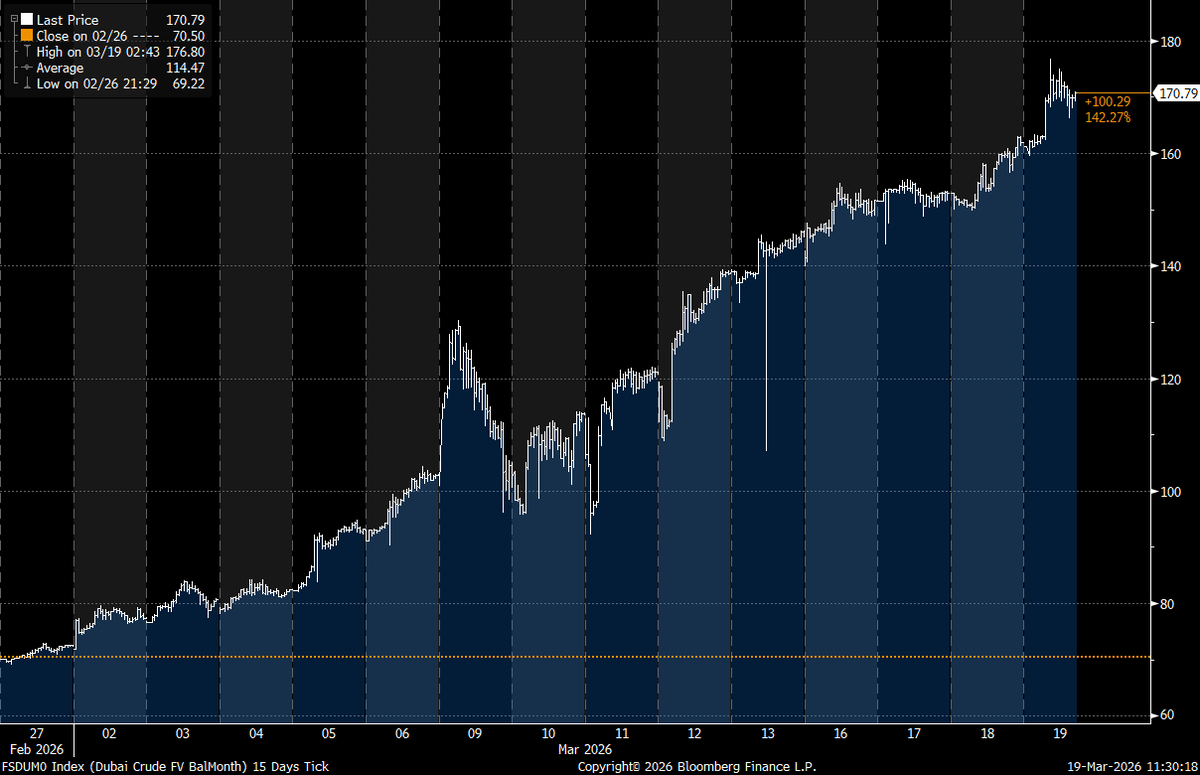
Cash Dubai crude chart via oil researcher Rory Johnston on X.
The jump follows a rapid sequence of gains earlier in the week. Platts assessments showed Dubai crude climbing from the low $150s to the mid-$160s before breaking higher, indicating tightening conditions were already building before the latest spike.
At the center of the disruption is the Strait of Hormuz, a narrow shipping lane that typically carries about one-fifth of global oil and liquefied natural gas flows. Traffic has dropped sharply as attacks, insurance withdrawals, and security risks have made transit increasingly difficult.
That bottleneck has forced Gulf producers to slow exports while storage fills and tankers sit idle. At the same time, Asian refiners—who rely heavily on Middle Eastern sour crude—are bidding aggressively for the limited cargoes that can still move.
The result is a wide divergence between physical and financial markets. While Dubai crude pushed past $170, Brent and West Texas Intermediate (WTI) have remained far lower, reflecting expectations that supply could eventually normalize. Still, both Brent and WTI have also been surging in value amid the Middle East escalation.
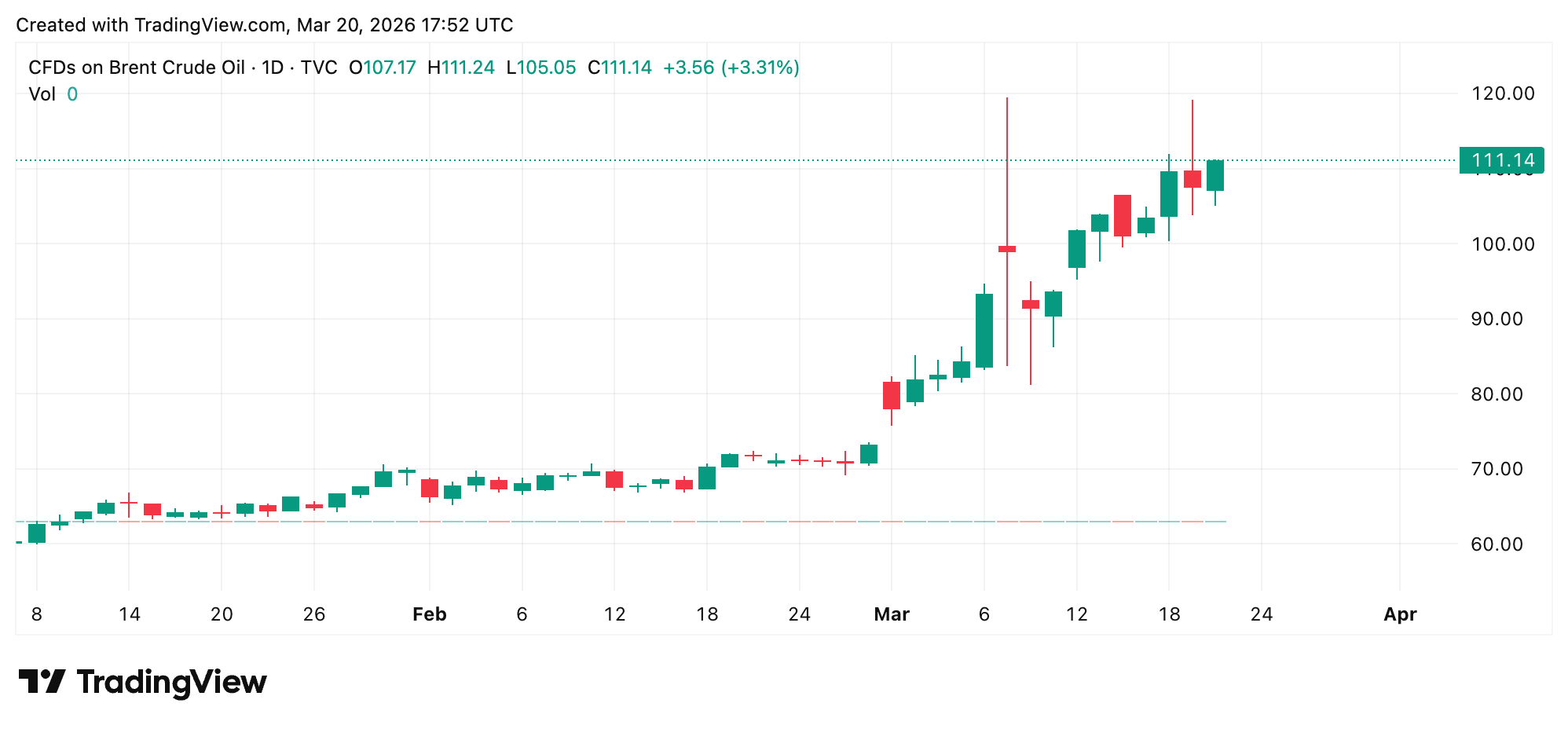
This gap is not subtle. The premium for physical Dubai barrels over futures-linked pricing has expanded to as much as $60 to $65 per barrel, far above typical spreads that hover near $1 in calmer conditions. That difference points to localized scarcity rather than a fully repriced global market.
Governments have attempted to ease the strain. The International Energy Agency released roughly 400 million barrels from emergency reserves, while the United States tapped more than 170 million barrels from its Strategic Petroleum Reserve. Those measures have helped stabilize Atlantic basin prices but have done little to resolve immediate shortages in the Gulf.
For consumers, the impact is still working its way through the system. Fuel prices do not instantly reflect spot crude spikes, but sustained tightness tends to filter into transportation, manufacturing, and food costs over time. The average price per gallon of regular gasoline in the U.S. is $3.91, while it was $2.92 per gallon a day before the war started on Feb. 27.
Energy producers outside the Gulf are positioned to benefit. U.S. shale operators, Canadian oil sands projects, and Brazilian offshore producers have gained attention as alternative supply sources. Energy equities have also responded as investors price in higher realized revenues.
The broader economic effect depends on how long the disruption lasts. A quick reopening of Hormuz would likely bring prices down sharply as stranded supply returns to the market. A prolonged conflict, however, could push global benchmarks higher as inventories draw down and replacement supply struggles to keep pace.
“A prolonged Middle East conflict could create new credit challenges for developed market sovereigns in Europe [and] Asia, primarily through higher energy and borrowing costs, rising inflation [and] weaker economic growth,” the credit agency Fitch Ratings wrote on Friday.
Market participants are watching several indicators closely, including daily price assessments, prediction markets, tanker tracking data, and official reserve updates. These signals help determine whether the current spike reflects a short-lived shock or the early stage of a longer adjustment.
For now, the message from the physical market is direct. When buyers pay record prices for immediate barrels, it reflects urgency, not theory. The futures market may be waiting for clarity, but the cargo market has already made its call.
- What is Cash Dubai crude?
It is a physical oil benchmark representing immediate-delivery Middle Eastern crude used mainly by Asian refiners. - Why did Dubai crude exceed $170?
Supply disruptions and limited tanker movement created intense competition for available cargoes. - Why are futures prices lower than physical prices?
Futures reflect expectations of future supply, while physical prices reflect current scarcity. - Will oil prices stay this high?
That depends on how quickly shipping routes normalize and supply flows return.
免责声明:本文章仅代表作者个人观点,不代表本平台的立场和观点。本文章仅供信息分享,不构成对任何人的任何投资建议。用户与作者之间的任何争议,与本平台无关。如网页中刊载的文章或图片涉及侵权,请提供相关的权利证明和身份证明发送邮件到support@aicoin.com,本平台相关工作人员将会进行核查。


