Your phone takes an hour to charge. Your EV takes all night. That trade-off—more capacity means more waiting—is so embedded in how batteries work that nobody really questions it anymore. A team of Australian scientists just built something that breaks that rule entirely.
Researchers at CSIRO, Australia's national science agency, together with teams from RMIT University and the University of Melbourne, have unveiled the world's first working quantum battery prototype.
This is an actual physical device that charges, stores energy, and discharges it—using the rules of quantum physics instead of chemistry. Their findings were published Wednesday in Nature Light: Science & Applications.
The prototype is a tiny, layered wafer of organic materials like a nanoscopic sandwich that gets charged wirelessly by a laser pulse. That pulse lasts femtoseconds. One femtosecond is a quadrillionth of a second. The device charges in that window, then holds its energy for nanoseconds—about six orders of magnitude longer than it took to fill up.
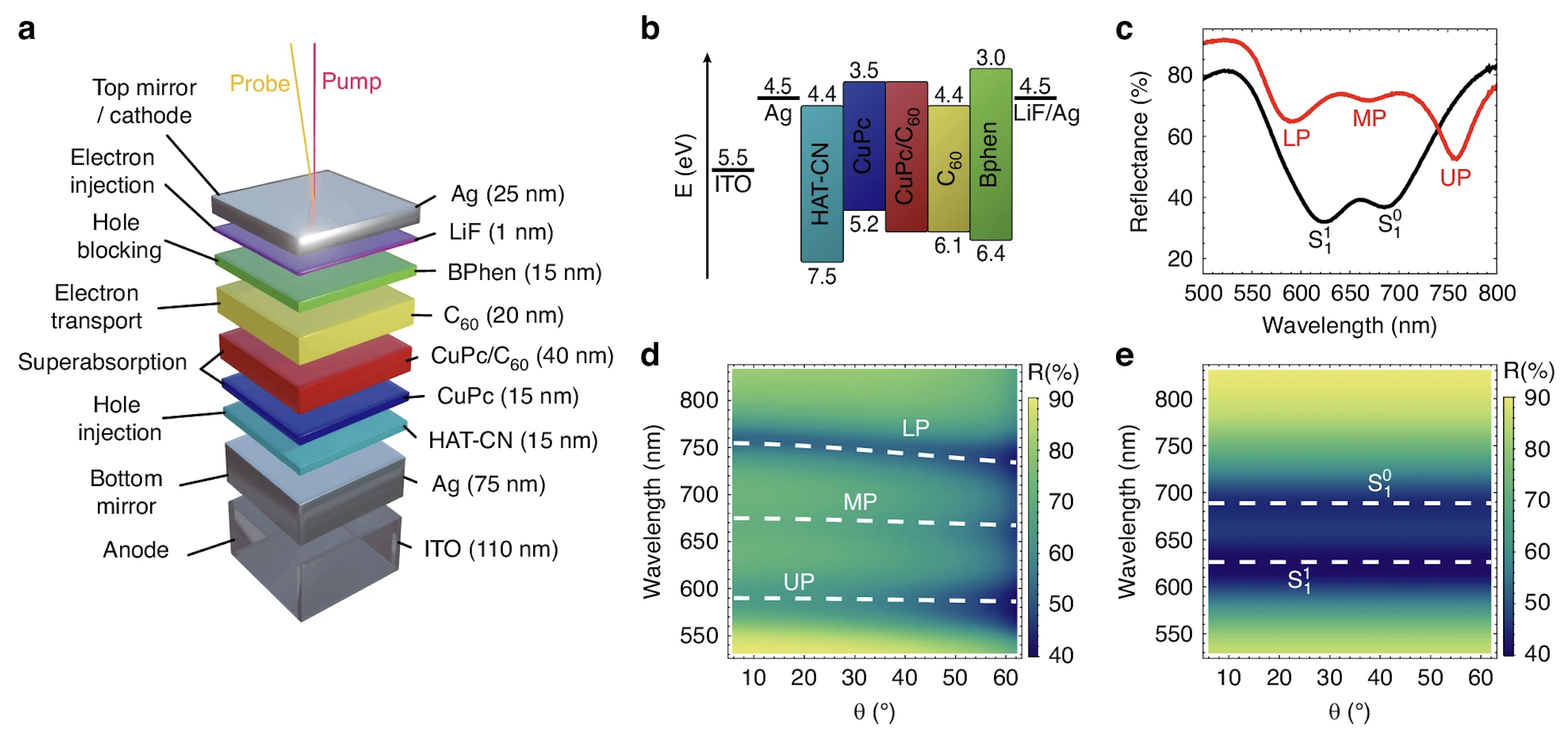
That gap sounds unimpressive until you scale it. "If we can charge a battery in one minute, it would stay charged for a couple of years," lead researcher James Quach explained. The physics already work. The challenge now is extending how long the stored energy can last in a real-world device.
The genuinely strange part isn't the speed but the scaling behavior.
Conventional batteries get slower to charge as they grow. More capacity means more time, but quantum batteries do the opposite. The more molecules packed into the device, the faster each one charges—because at the quantum level, they don't act individually. They behave collectively, sharing the incoming energy in a single coordinated burst the researchers call "superabsorption."
Technically speaking researchers say that the charging time drops as 1/√N, where N is the number of molecules. Double the battery, cut the charging time by nearly half, and so on.
"Our findings confirm a fundamental quantum effect that's completely counterintuitive: quantum batteries charge faster as they get larger," Quach told Melbourne University. "Today's batteries don't function like that."
This property had been predicted mathematically since 2013, and a partial version was demonstrated in 2022. What's new here is the complete cycle: The team figured out how to pull the stored energy back out as an electrical current, which no previous quantum battery experiment had managed. The device also runs at room temperature—a practical advantage over competing superconducting approaches from China and Spain that require cryogenic cooling.
The immediate application isn't your EV or something like that. The prototype's total capacity is measured in billionths of electron-volts—enough to power nothing in the real world yet. But quantum computers are a different story. Those systems are already advancing faster than most expected, and they have a specific energy problem: Their delicate quantum states demand power delivered coherently, without the noise that conventional electronics introduce. A quantum battery charges and discharges using the same quantum language those processors speak.
"Quantum batteries could provide energy coherently, with the minimum energy cost to the quantum computers," Professor Andrew White, who leads the quantum technology lab at the University of Queensland and was not involved in the research, told The News Digital.
CSIRO is already seeking development partners, including EV manufacturers and deep-tech investors, to push the research forward. The theory had a decade head start on the hardware. The hardware just caught up.
免责声明:本文章仅代表作者个人观点,不代表本平台的立场和观点。本文章仅供信息分享,不构成对任何人的任何投资建议。用户与作者之间的任何争议,与本平台无关。如网页中刊载的文章或图片涉及侵权,请提供相关的权利证明和身份证明发送邮件到support@aicoin.com,本平台相关工作人员将会进行核查。


