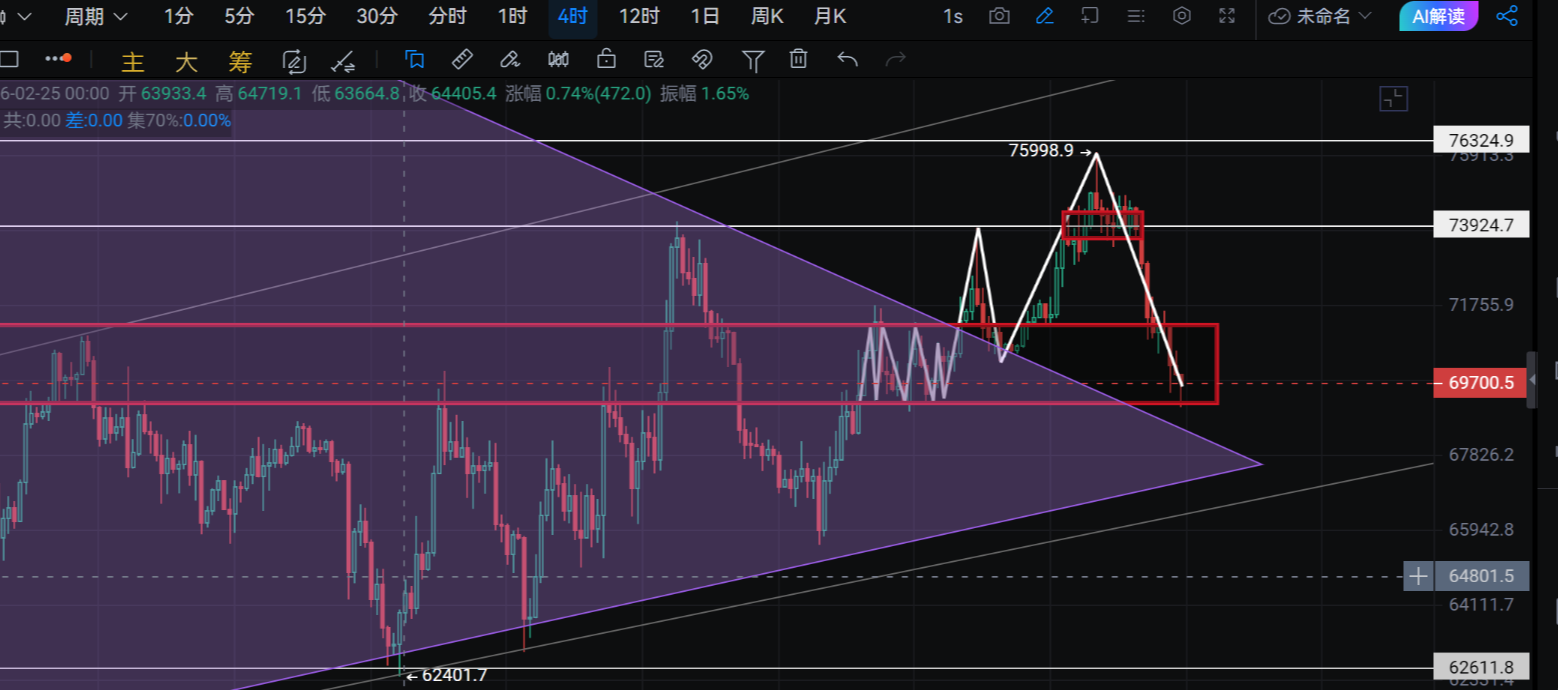
On March 19, the tensions surrounding Iran were once again tightened: on one hand, the United States openly threatened to expand the scale of its military strikes against Iran, while on the other hand, it internally weighed whether to partially relax restrictions on Iranian oil exports. At the same time, the UAE faced missile and drone attacks, further pushing the already fragile security landscape of the Middle East into the unknown. As geopolitical tensions heated up, traditional safe-haven assets exhibited "abnormal market behavior" — spot gold fell below $4,600 per ounce, dropping approximately 4.5% to 5.5% in a single day, while spot silver plummeted over 10% to $67 per ounce. Meanwhile, some crypto assets did not experience a simultaneous crash, indicating a clear diversion of market risk-averse funds. The repricing of oil price expectations, inflation trajectories, and high-interest rate cycles is fundamentally rewriting the old narrative of "safe haven": in this round of Middle Eastern shocks, how energy prices and interest rate expectations will reshape the safe-haven role of crypto assets has become a question that investors must address directly.
Missile Attacks and Easing Sanctions Tear Apart the Middle Eastern Chessboard
In the evolution of the situation following March 19, the U.S. attitude toward Iran exhibited a high degree of division: on the military dimension, Washington released signals through multiple channels indicating it "would expand its strikes against Iran," with the intention of curbing Iran's regional influence in the Middle East; but in terms of energy, discussions were underway within the U.S. on whether to consider relaxing some oil sanctions to release more elasticity on the global supply side. This contradictory posture of simultaneously increasing military pressure while weighing options for energy de-escalation turned Iran from a "security threat" into an "oil price variable."
The missile and drone attacks on the UAE made the market realize that this contest is no longer confined to the bilateral confrontation between the U.S. and Iran, but rather affects the entire security expectations of Gulf transport channels. As a regional financial and energy hub, the attacks on the UAE itself are highly symbolic: once ports, shipping lanes, and infrastructure are seen as potential risk points, the entire Middle East's risk premium will be rapidly transmitted into the global pricing system through shipping costs and supply stability. Although specific details of casualties and equipment losses have yet to be fully disclosed, the signal that the "illusion of safety" has been shattered is already strong enough.
Against this backdrop, approximately 130 million barrels of Iranian crude oil inventory sitting on the sea has become a crucial variable. According to Jin Shi data, if this floating inventory is exempted or partially lifted, it will create a significant impact on the supply side, creating a subtle hedge against the current tensions in the Middle East: either release Iranian oil to suppress oil prices and ease imported inflation, or continue to strengthen financial and political pressure on Iran through sanctions, tolerating higher oil prices and tighter inflation expectations. This back-and-forth energy tug-of-war has turned Middle Eastern geopolitical conflicts from mere war headlines into "system parameters" directly embedded in asset pricing logic.
Gold and Silver Plummet: Safe-Haven Liquidation Under High-Rate Shadows
Contrary to traditional textbook logic, amidst the heightened Middle Eastern situation, missile attacks, and military exercise threats, gold and silver did not experience a surge in "panic buying," but instead exhibited a rare plummet scenario. According to data from platforms like Bitget, spot gold once fell below $4,600 per ounce, with a single-day drop of about 4.5% to 5.5%, marking one of the more extreme daily volatility ranges in history; the trajectory of silver was even more tragic, with spot prices dropping more than 10% to $67 per ounce. Such a level of retracement far exceeds what can be explained by normal geopolitical news.
The driving force behind this round of precious metals' "reverse performance" is the sharp repricing of monetary policy expectations. The latest data shows that the number of initial unemployment claims in the U.S. dropped to 205,000, reaching a 13-month low, with the labor market's "resilience" interpreted by the market as a lack of urgent reason for the Federal Reserve to pivot to easing quickly. High employment and low unemployment in the current context have been directly translated into a policy path of "maintaining high rates for longer," with the interest rate curve pushing back bets on rate cuts significantly. In this environment, zero-interest assets — whether gold or silver — are competing directly with a "more than 5% risk-free rate of return," making the cost of holding them appear increasingly high.
Geopolitical tensions typically raise demand for safe havens, but when the "shadow of high rates" looms over global capital allocation, some institutions have chosen to take profits on precious metals or reduce positions passively to free up margin and position space. This has led to short-term pressures on both gold and silver from "interest rate pricing" and "leverage de-risking": on one hand, high rate expectations suppress forward prices; on the other hand, margin accounts are forced to liquidate under intensified volatility, accelerating the downward trend. As a result, amidst the rolling news of missiles and drones, traditional safe-haven tools have been sold off, with risk-averse funds beginning to seek other vehicles.
Oil Price and Inflation Chain: From Middle Eastern Warfare to Monetary Cycles
To understand the market's repricing, it is essential to return to the main chain of "Middle Eastern situation — oil prices — inflation — monetary policy." Missile attacks and concerns over the security of shipping lanes will first translate into risk premiums for oil prices through the stability of crude oil supply; rising oil prices will then transform over a period of months into input inflation pressures in transportation, manufacturing, and consumption sectors, pushing up future readings of CPI and PPI. Until inflation fully retreats to the target range of major central banks, each escalation in the Middle East is likely to be amplified by the market as "yet another disturbance delaying rate cuts."
The U.S. hesitation regarding whether to relax sanctions on Iranian oil essentially reflects a dilemma within this chain: if a portion of Iranian crude oil exports is allowed, the release probability of the 130 million barrels inventory sitting on the sea will increase, providing a certain buffer to the global supply and helping to suppress oil prices, mitigate input inflation, and leave more room for future monetary policy. However, from both geopolitical and domestic political angles, it is difficult for the U.S. to "let go" on energy while escalating accusations of Iran's security threat; otherwise, it risks being interpreted as indirect support for Iran. This oscillation creates a high degree of uncertainty in oil price expectations and leads to continuous adjustments in the market's assessment of the medium to long-term inflation trajectory.
Once inflation expectations rise, the pricing of the duration of high rates will extend, delaying marginal easing of global liquidity and discounting valuations for all risk assets. The stock market, growth stocks, and crypto assets will be repriced under a higher discount rate, with funds favoring assets with stable cash flow, strong dividend capacity, and relative insensitivity to interest rates. Meanwhile, some investors will seek assets that do not directly rely on central bank monetary policy, or that can maintain relative value amid currency devaluation, which is why cryptocurrencies are being placed back on the discussion table regarding safe havens when some traditional assets face dual pressures.
Bitcoin Brought to the Fore: The Narrative of "Ultimate Hedge" in Chaos
In the intertwined backdrop of this round of Middle Eastern shocks and high-rate repricing, Bitcoin has been repackaged into the core of the safe-haven narrative. MicroStrategy founder Michael Saylor publicly stated on social media that Bitcoin is the "ultimate hedge tool against chaos" (market perspective); such expressions provide a clear rhetoric for the narrative: when sovereign risks, inflation risks, and currency devaluation risks overlap, an asset that does not depend on the sovereignty of a single nation, has predictable total supply, and is verifiable on-chain inherently possesses the attributes of a "hedge asset" similar to gold, and in some dimensions, even has advantages.
Comparing this round's performance shows that while gold and silver faced collective sell-offs due to high rate expectations, crypto assets did not completely replicate their crash trajectory; the declines of some mainstream coins were noticeably lower than those of precious metals, and even exhibited signs of fund inflows during certain time frames. The behavior of market funds provides a clear clue: precious metals, suffering losses on the "interest rate — yield" dimension, are freeing up some capital space for on-chain assets that exhibit stronger narrative and growth dimensions. The safe-haven attributes among assets are not simply shifting, but being reconstructed under multiple risk coordinates.
The behavior of institutions and retail investors on-chain also confirms this point. On one hand, institutions allocate assets like Bitcoin through compliant channels and custody solutions, packaged as "composite insurance" against dual risks of geopolitics and currency; on the other hand, retail investors often use exchanges and self-custody wallets to convert some local currency and traditional asset positions into on-chain assets, to hedge against uncertainties from domestic inflation and capital controls. The discussions within the public discourse have gradually shifted from "Is Bitcoin a safe haven asset?" to "In what situations and relative to what risks does Bitcoin resemble a hedge tool?", which itself is a manifestation of the maturation of the safe-haven narrative.
Polymarket Bets and On-Chain Pricing of Long-Term Tensions in the Middle East
Alongside spot market prices, on-chain prediction markets are also assigning their own pricing to the situation in the Middle East. According to various media reports, on the decentralized prediction platform Polymarket, regarding bets on an end of the war in the short term, the probability of "peace landing" is only about 5%, suggesting that market participants generally believe this tense situation is unlikely to fully settle in the foreseeable future. Although this number is not an official forecast, it represents a collective judgment made with "real money" bets, holding unique signal value.
The significance of the prediction market lies in that it is not just a simple emotional vote, but integrates emotions, information, and capital constraints. The roughly 5% peace probability on Polymarket reflects investors' pessimistic expectations of the "long-term and structured" nature of the Middle Eastern tension: it is not a series of one-off attack occurrences, but a normative backdrop in the geopolitical landscape for the coming years. Under such expectations, the market will not expect that one diplomatic maneuver will eliminate risk premiums; rather, it will embed higher energy risks and greater supply uncertainties into the baseline scenarios of inflation and interest rate trajectories for the long term.
This on-chain pessimistic pricing will further reinforce the reassessment of long-term inflation and demand for safe-haven assets. When the probability of war ending is priced into on-chain contracts at only 5%, investors tend to allocate assets capable of "surviving the cycle" amidst high inflation, currency devaluation, and regional turbulence. For some, this means increasing allocations to gold, commodities, and energy equities; for others, it entails increasing holdings of on-chain assets like Bitcoin to hedge against the risks associated with sovereign currencies and financial sanctions. The prediction market does not determine reality, but it continuously feeds back: the market is using pessimistic expectations to drive a slow yet resolute reconstruction of safe haven categories and allocation proportions.
Redrawing the Safe Haven Map: How Much Weight Can Crypto Assets Bear?
Based on the developments since March 19, a clear logical chain can be observed: the escalation of the Middle Eastern situation involves key nodes like the UAE, combined with the U.S. oscillation between "military pressure on Iran" and "considering easing oil sanctions," making energy games the core variable; the 130 million barrels of Iranian crude oil and expectations over shipping safety jointly impact oil prices and inflation expectations; inflation and labor data (initial jobless claims at 205,000, hitting a 13-month low) further reinforce market bets on high rates lasting longer, leading to significant sell-offs in traditional precious metals throughout this process. Under the convergence of multiple forces, risk-averse funds are starting to migrate partially from gold and silver, attempting to find new risk-hedging vehicles in crypto assets.
As a result, crypto assets like Bitcoin have gained an opportunity to demonstrate their safe haven properties: on one hand, they possess inherent narrative advantages during times of escalating geopolitical conflicts and expectations of sovereign currency devaluation; on the other, their on-chain transparency, cross-border mobility, and non-dependence on a single sovereign also provide technical tools for hedging against sanctions and capital controls. However, the limitations are also clear: price volatility far exceeds that of precious metals, they are extremely sensitive to liquidity environments, and they face policy uncertainties in regions where regulatory frameworks have not yet been fully clarified. This means that crypto assets are more like "high-beta safe haven vehicles" — capable of accommodating part of the hedging demand against geopolitical and currency risks, but unable to fully replace traditional tools like gold.
Looking forward, several key variables warrant continuous tracking: first, the progress and scope of potential relaxation of Iranian oil sanctions — although specific timelines and quota arrangements have not yet been disclosed, any policy signals from the U.S. or international organizations will quickly reprice oil prices and inflation expectations; second, the Federal Reserve's public statements and dot plot updates — adjustments to the rate cut path amidst persistently strong initial jobless claims will sway the allocation of funds between safe-haven and risk assets; third, the performance of traditional safe-haven assets — how gold, silver, and government bonds perform in a high-rate environment will directly influence the "safe haven weight" of crypto assets in global asset allocation. Under the dual reflections of the Middle Eastern powder keg and high-rate shadows, crypto assets have been brought to the global safe haven map, but how much weight they can bear still requires time and cycles to provide an answer.
Join our community to discuss and become stronger together!
Official Telegram community: https://t.me/aicoincn
AiCoin Chinese Twitter: https://x.com/AiCoinzh
OKX benefits group: https://aicoin.com/link/chat?cid=l61eM4owQ
Binance benefits group: https://aicoin.com/link/chat?cid=ynr7d1P6Z
免责声明:本文章仅代表作者个人观点,不代表本平台的立场和观点。本文章仅供信息分享,不构成对任何人的任何投资建议。用户与作者之间的任何争议,与本平台无关。如网页中刊载的文章或图片涉及侵权,请提供相关的权利证明和身份证明发送邮件到support@aicoin.com,本平台相关工作人员将会进行核查。