Author: Glendon, Techub News
As global market attention towards cryptocurrencies gradually shifts, another key area in the crypto industry has experienced a significant change.
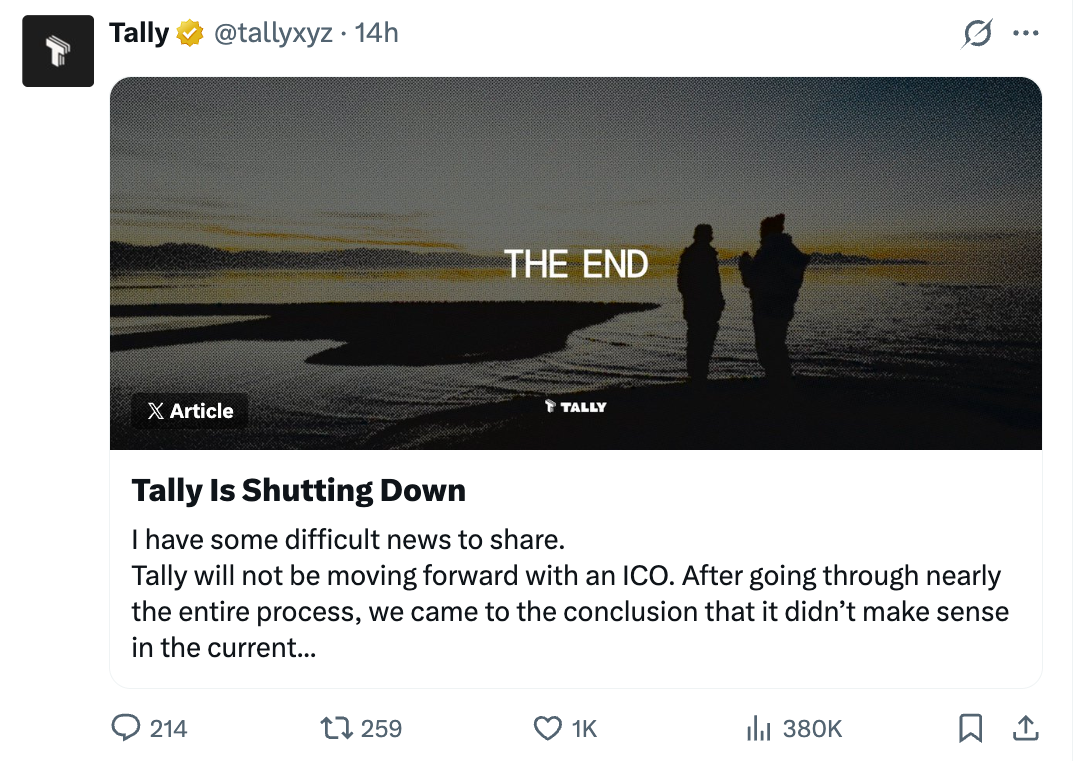
Last night, shocking news emerged in the DAO governance field: Tally, a platform providing on-chain voting and delegation as core governance infrastructure for more than 500 leading DAOs such as Uniswap, Arbitrum, and ENS, announced it would officially close after nearly six years of operation.
What was surprising is that just in early February, Tally had publicly declared its intention to launch an ICO, planning to publicly document the entire process over the next 60 days, and had built an ICO fundraising platform based on the Uniswap CCA mechanism to help teams of different sizes raise capital. However, in just one month, the sudden shift from preparing to "set sail" to "shipwrecked" caught many off-guard. What exactly happened behind the scenes that led to Tally's rapid change?
In the open letter released by Tally, CEO Dennison Bertram revealed the direct reason for Tally's conclusion. Simultaneously, this reason mirrors the deep-seated challenges currently facing the DAO governance sector. (Related reading: List of crypto projects ceasing operations, transforming, or going bankrupt in 2026)
Tally's Development History
Before analyzing the reasons for Tally's closure, let us quickly review the development history of Tally.
Tally was co-founded by Dennison Bertram (CEO) and Rafael Solari (CTO) as a leading platform providing on-chain governance infrastructure for decentralized autonomous organizations (DAOs). Its core mission was to lower the barriers to participation in DAOs, enhancing governance efficiency and transparency.
Starting in 2021, Tally gradually became a mainstream DAO governance tool, referred to by the community as the "DAO governance dashboard," providing users with intuitive and convenient features for on-chain voting, proposal creation, delegation management, and treasury monitoring. Subsequently, Tally continually expanded its business boundaries and evolved into a full-cycle on-chain organizational operating system encompassing token issuance, fundraising, scaling, and staking incentives. Its platform catered to over 500 well-known DAOs, including Arbitrum, Optimism, ENS, Uniswap, AAVE, ZKsync, and Wormhole, and became one of the most widely used governance tool stacks in the Web3 world.
Looking back on Tally's development history, several key milestones cannot be overlooked:
2021-2022: Tally's platform influence expanded, raising $7.5 million through two rounds of financing. During this period, it was praised by the community as the "DAO governance dashboard," supporting on-chain voting and delegation functions;
September 2023: Tally launched on the zkSync Era mainnet, allowing protocols, projects, and public goods on zkSync Era to create and run DAOs, expanding support for the zero-knowledge proof ecosystem;
April 2024: Tally established a multi-chain governance system called MultiGov in collaboration with Wormhole and ScopeLift, supporting DAOs on Solana, Ethereum mainnet, and EVM L2, breaking down barriers between different blockchains;
June 2024: Tally launched Tally Protocol, releasing the economic potential of governance tokens by providing a liquidity layer for governance staking and restaking, optimizing the distribution of voting power to bring economic security back to blockchain protocols, and offering innovative solutions for the economic governance of DAOs;
April 2025: Tally completed $8 million in Series A financing, led by Appworks and Blockchain Capital, with participation from BitGo, bringing total financing to $15.5 million;
February 2026: Tally planned to conduct an ICO and build an ICO fundraising platform based on the Uniswap CCA mechanism.
As of the time of writing, Tally's official website indicates that the platform has transferred a value of over $1 billion and generated more than 7,000 proposal records and over 270,000 token claiming records. In the open letter, Dennison Bertram emphasized that throughout the company's lifecycle, the systems it assisted in operating had protected protocol values exceeding $80 billion, with over a million users having used the site and tens of millions of token holder addresses participating in governance through the platform.
Based on the above data, Dennison Bertram believes Tally has proven that decentralized governance can operate on a large scale. However, it is puzzling why Tally still decided to cease operations.
"Infinite Garden" Dream Shattered, Business Model Unsustainable
Regarding the direct reason for Tally's cessation, Dennison Bertram succinctly summarized it in the open letter: Currently, there has yet to be a venture capital-supported decentralized protocol governance tool enterprise, and the product market fit in the crypto industry mainly focuses on payment and speculation.
This situation reflects the real predicament faced by the DAO industry, namely the collapse of the "Ethereum Infinite Garden" hypothesis.
Not long ago, the crypto industry optimistically believed that the Ethereum ecosystem would nurture countless innovative DAO projects, including thousands of decentralized protocols, millions of active participants, and robust governance systems operating at scale, thereby forming a flourishing "infinite garden" (a diversified ecosystem composed of protocols and communities requiring complex coordination and governance infrastructure as support). However, the reality is that industry resources are continuously concentrated in a few leading protocols, resulting in a Matthew effect where the rich get richer. Leading DAOs such as Uniswap, Aave, and Arbitrum account for the majority of governance demand, while medium and small DAOs suffer from a lack of funds and insufficient governance motivation, leading to very weak demand for professional governance tools.
In short, the crypto market is far from mature. Practitioners originally hoped to build a rich ecosystem made up of consumer applications, protocol communities, and governance organizations, but this vision has not materialized. In this scenario, Tally cannot create a viable business model around this idea, making its path to development arduous.
At the same time, it is worth noting that in the current complex and severe situation, Tally and the entire crypto industry are mired in a talent drain. In recent years, the explosive growth of the AI industry has attracted a large number of top technical talents. In contrast, the talent loss issue in the crypto industry is becoming increasingly severe. It is important to note that the crypto industry needs to continuously invest substantial human resources in product development and technological iteration to meet the ever-changing market demands. However, under the high salary allure of the AI industry, many core technical talents have switched careers, resulting in a significant impact on the innovation capability and business models within the crypto space.
Dennison Bertram unequivocally stated: "AI has become the new narrative of the future, and its narrative framework is grander than that of cryptocurrencies, covering a broader scope." Although he remains confident in the crypto industry, he no longer agrees with the notion that the industry is still in its early stages.
Regulatory Winds Shift, Governance Demand Transitions from "Essential" to "Optional"
In addition to the factors mentioned above, in a report by CoinDesk, Dennison Bertram emphasized that Tally's rise and fall is closely tied to the drastic fluctuations in U.S. cryptocurrency regulatory policies. He stated that during Gary Gensler's tenure, the U.S. Securities and Exchange Commission (SEC) adopted a stricter stance regarding the classification of crypto tokens as securities. To avoid legal risks, many projects have been decentralized through DAO structures to reduce the risk of tokens being considered securities. During this phase, DAO governance tools became an "essential" requirement for project compliance and survival, becoming indispensable. Tally quickly became an industry benchmark due to its stable on-chain voting system, delegation management functions, and deep integration with mainstream smart contracts like OpenZeppelin Governor, attracting top protocols such as Uniswap and Arbitrum.
However, as the U.S. government's regulatory stance gradually shifted towards a more lenient approach, the compliance pressure on the crypto industry was significantly alleviated. For example, in a recent document released by the SEC regarding regulatory safe harbors for crypto assets, four categories of crypto assets were explicitly stated not to be securities, namely digital commodities, digital collectibles, digital tools, and payment stablecoins defined under the GENIUS Act. Additionally, in explanatory documents, 16 examples of digital commodities such as SOL, HBAR, LINK, and ADA were explicitly listed as not falling under the category of securities.
The opening of regulatory policies led many projects to find that decentralized governance was no longer a necessary means to evade regulation; rather, due to issues like inefficient decision-making and high governance costs, it could become a burden on project development. This fundamental shift on the demand side directly led to a significant contraction in the market space for governance tools like Tally. Many teams, aiming to reduce costs, chose to stop paying for governance tools, thus contributing to Tally's "doom." As a result, Tally's cessation of operations seems inevitable.
What Impact Will Tally's Closure Have on the DAO Community?
Tally plans to gradually cease operations by the end of the month. Its closure will undoubtedly have a profound and multi-layered impact on the DAO community, exposing the current vulnerabilities of the decentralized governance ecosystem and accelerating the industry's reflection and restructuring process.
On one hand, Tally had provided over 500 DAOs with core functions such as on-chain voting, proposal management, delegation systems, and treasury monitoring, serving as the "operating system" for daily governance of leading protocols like Uniswap, Arbitrum, and ENS. Its sudden closure means these organizations face pressure to migrate their governance tools in the short term. Although on-chain data is immutable and proposal records still exist, the lack of a stable, user-friendly front-end interface will significantly raise the barrier for ordinary members to participate in governance, potentially leading to a further decline in voting participation rates and exacerbating the issue of "governance apathy."
It is important to note that DAO governance already suffers from low participation, slow decision-making, and a few active voters controlling systems worth billions of dollars. Following Tally's cessation, some DAOs will urgently need to find alternative solutions or rebuild processes, inevitably increasing operational costs and the likelihood of errors, resulting in "short-term pain."
On the other hand, this incident may provoke the community to question the sustainability of DAO governance tools. The end of Tally as an industry benchmark sends a strong signal to the entire Web3 community: even the most successful infrastructure projects may find it difficult to continue due to changes in the external environment. This undermines the DAO community's trust in third-party governance tools. Simultaneously, Tally's closure also reveals the fundamental dilemma of governance tools in terms of business models. Despite serving hundreds of protocols, Tally still failed to find a sustainable profitability path.
However, in the long run, crises often give birth to opportunities. Although Tally's closure casts a shadow over the DAO governance industry, it does not signify the end of DAO governance. This incident may serve as a catalyst for the DAO community to accelerate technological independence and ecosystem restructuring. It could prompt the community to pay more attention to the decentralized deployment of governance front-end or lead the industry to explore new forms of governance tools. For instance, governance assistants combining AI are emerging, capable of automatically summarizing proposals, analyzing voting trends, and reminding key time nodes, thus lowering the barriers for voters to participate.
Moreover, changes in the regulatory environment may also bring new hope for DAO governance. If future regulators can establish a clearer and more reasonable framework for crypto regulation, clarifying the legal status and governance boundaries of DAOs, it will help eliminate market uncertainty and promote the healthy development of the DAO industry. In due time, DAO governance tools may encounter new development opportunities.
Conclusion
The rise and fall of Tally reflects the full cycle of DAO governance from enthusiasm to sobriety. Its "curtain call" is also an important milestone in the development process of the DAO governance industry. It exposes the multiple challenges the industry faces in terms of regulation, market, and talent and prompts deeper reflections on the future of DAO governance.
Perhaps Tally's departure is not the end, but rather a starting point for DAO governance to evolve towards a more mature stage. In this era full of uncertainties, only through continuous innovation and adaptation to change can a new dawn be found amidst the winter, propelling DAO governance toward a more mature future.
免责声明:本文章仅代表作者个人观点,不代表本平台的立场和观点。本文章仅供信息分享,不构成对任何人的任何投资建议。用户与作者之间的任何争议,与本平台无关。如网页中刊载的文章或图片涉及侵权,请提供相关的权利证明和身份证明发送邮件到support@aicoin.com,本平台相关工作人员将会进行核查。


