Written by: Azuma(@azuma_eth)
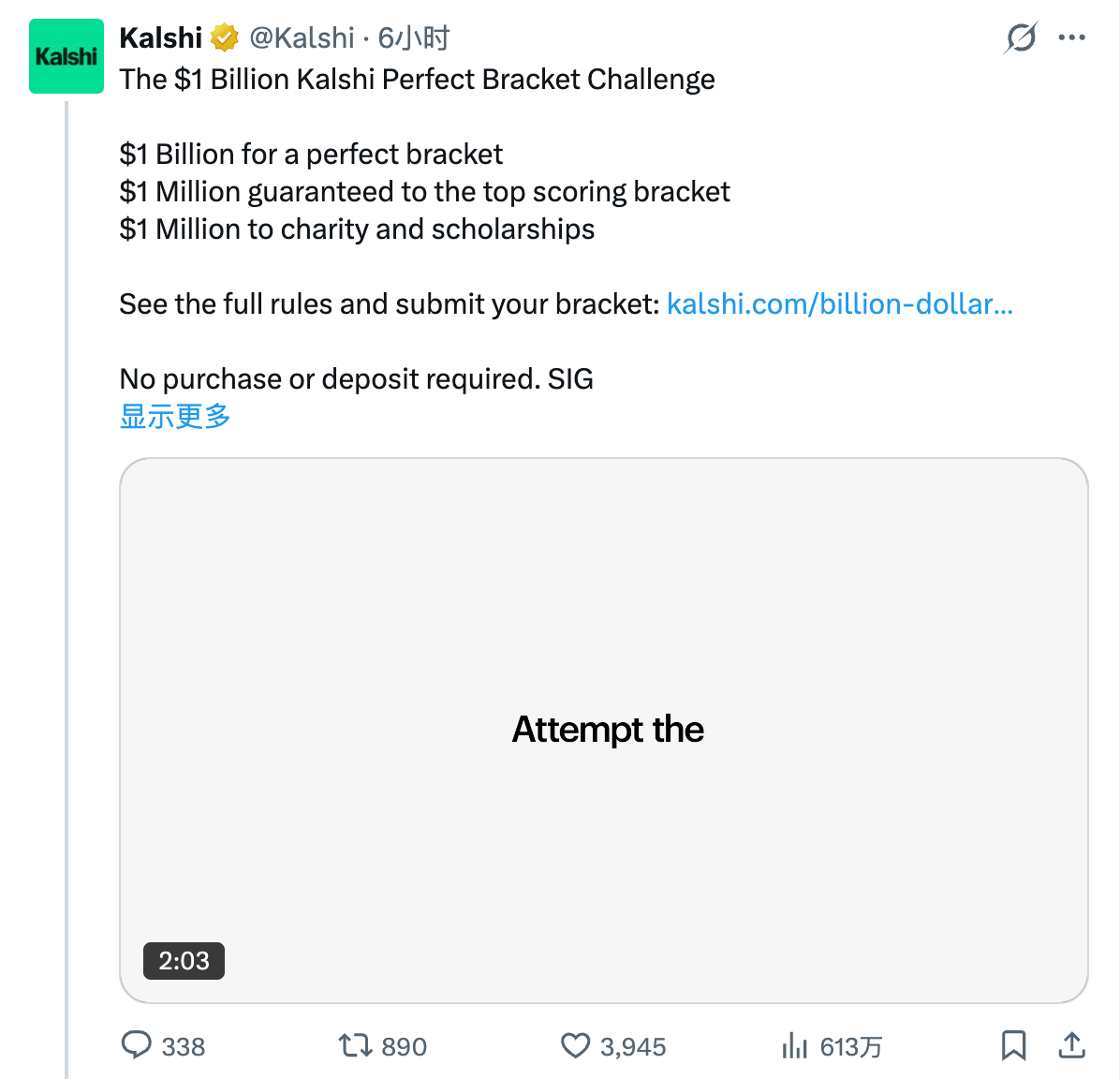
In the early hours of March 17, the prediction market Kalshi announced on X that it will emulate stock god Warren Buffett by launching the "Perfect Bracket Challenge" for the upcoming NCAA "March Madness" event—users who perfectly predict all match outcomes will take home a super prize of $1 billion.
"March Madness": America's Hottest Basketball Feast
So-called "March Madness" refers to the NCAA Men's Basketball Championship (NCAA Tournament) held every March by the National Collegiate Athletic Association (NCAA). The event is named as such because it usually starts every March, uses a single-elimination format, has a packed schedule, and fierce competition.
According to the schedule confirmed by the draw yesterday, "March Madness" in 2026 will officially start on March 18 (tomorrow) Beijing time. 68 college teams that have earned their spots in "March Madness" through months of regular-season battles will compete for the championship, starting with the First Four play-in games, where 8 teams will directly eliminate 4 others, and the remaining 64 teams will compete through five rounds of single-elimination matches (64 teams → 32 teams → Sweet 16 → Elite 8 → Final 4 → Championship game → National Champion).

As the most-watched college basketball event in the United States, compared to the NBA, which mainly consists of club teams, the NCAA, being college-based, often fosters a strong sense of "home team identity" among the public. During "March Madness," current students, alumni, and local communities spontaneously rally behind their alma mater. Therefore, the nationwide participation atmosphere of this event can, to some extent, even surpass the excitement of the NBA Finals.
From a competitive standpoint, although college players still struggle to compare with professional players in overall strength, the uniqueness of "March Madness" lies in the extremely limited stage window for most participants—typically only 1 to 4 years, and many of the top talents often enter the NBA after their freshman year. This "fleeting" opportunity makes each game iteration feel more urgent—once on the court, almost everyone competes with everything they have.
Meanwhile, 2026 is widely regarded as a significant year for the NBA draft, further amplifying the attention on this year's event. Kansas University's Darin Peterson, Brigham Young University's AJ Dibansa, and Duke University's Cameron Bouzel (son of Yao Ming's rival Carlos Boozer) are all seen as rare talents expected to compete for next year's NBA first overall pick. The direct matchups between these "future stars" also add a layer of foresight about the future NBA landscape beyond just the viewing pleasure of this "March Madness".
Unprecedented Traffic, Prediction Market Can't Miss Out
During "March Madness," predicting match outcomes by filling out a "bracket" through sports betting services has long been a major local tradition in the United States. How could a professional prediction market miss this opportunity?
Currently, prediction markets like Polymarket and Kalshi have already launched prediction events related to "March Madness," and Polymarket even included this in the first batch of paid trial sports events, indicating they are preparing to cash in on the upcoming excitement.
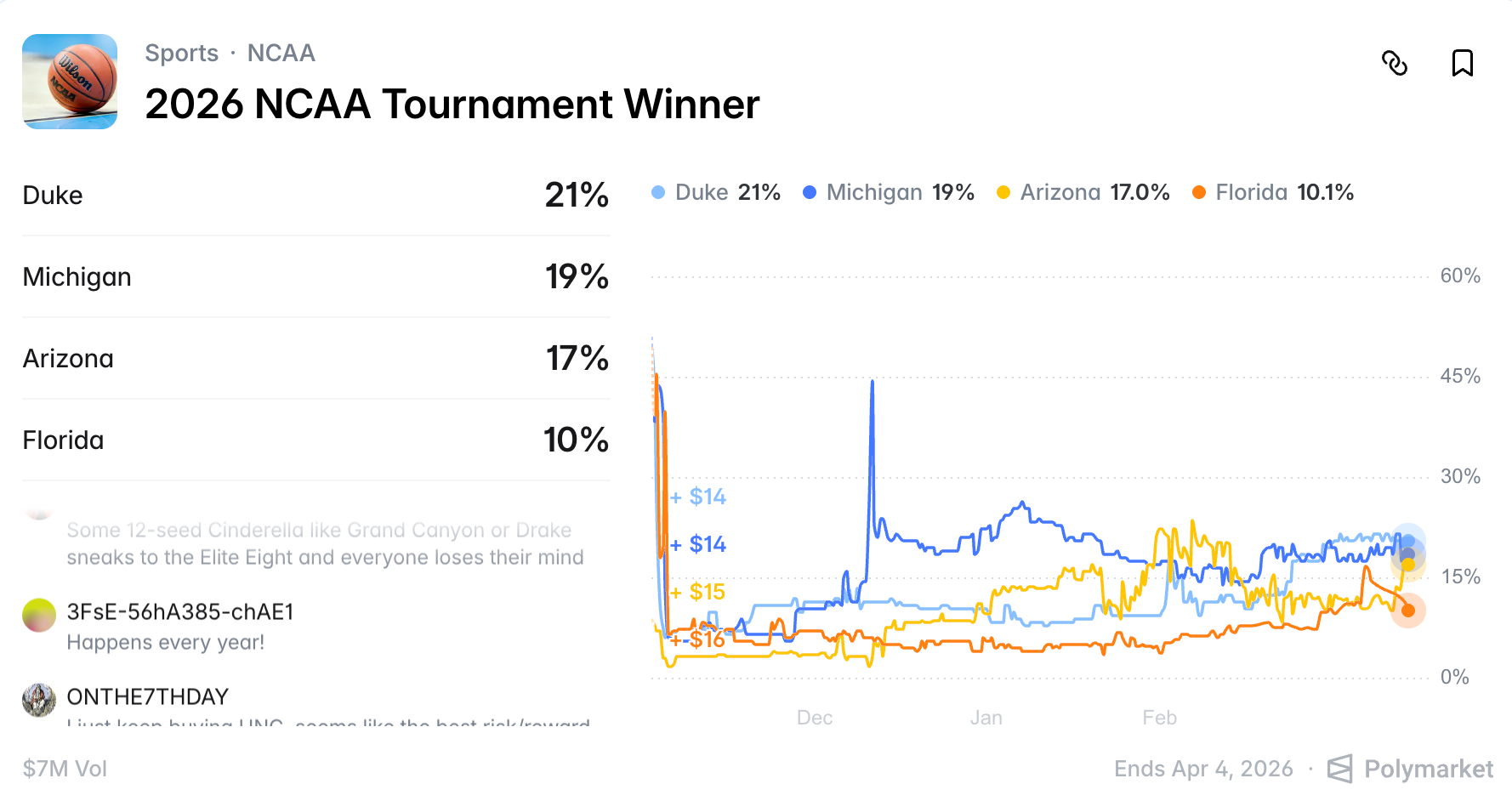
Polymarket's real-time odds show that the top four universities with the best odds of winning the "March Madness" championship are the number one seeds from the four major regions:
- Duke University, with the popular NBA first overall pick candidate Cameron Bouzel next season, ranks first with a current odds of 21%;
- University of Michigan ranks second with a current odds of 19%;
- University of Arizona ranks third with a current odds of 17%;
- Defending champion University of Florida ranks fourth with a current odds of 11%.
On the other hand, Kalshi sent out a bombshell "1 billion dollar prize" event this morning in imitation of Buffett. All users can submit a prediction ticket for free on Kalshi, and users who perfectly predict all match outcomes can take home 1 billion dollars. If no one succeeds, Kalshi will also award 1 million dollars to the user with the best prediction and allocate another 1 million dollars to support charities.
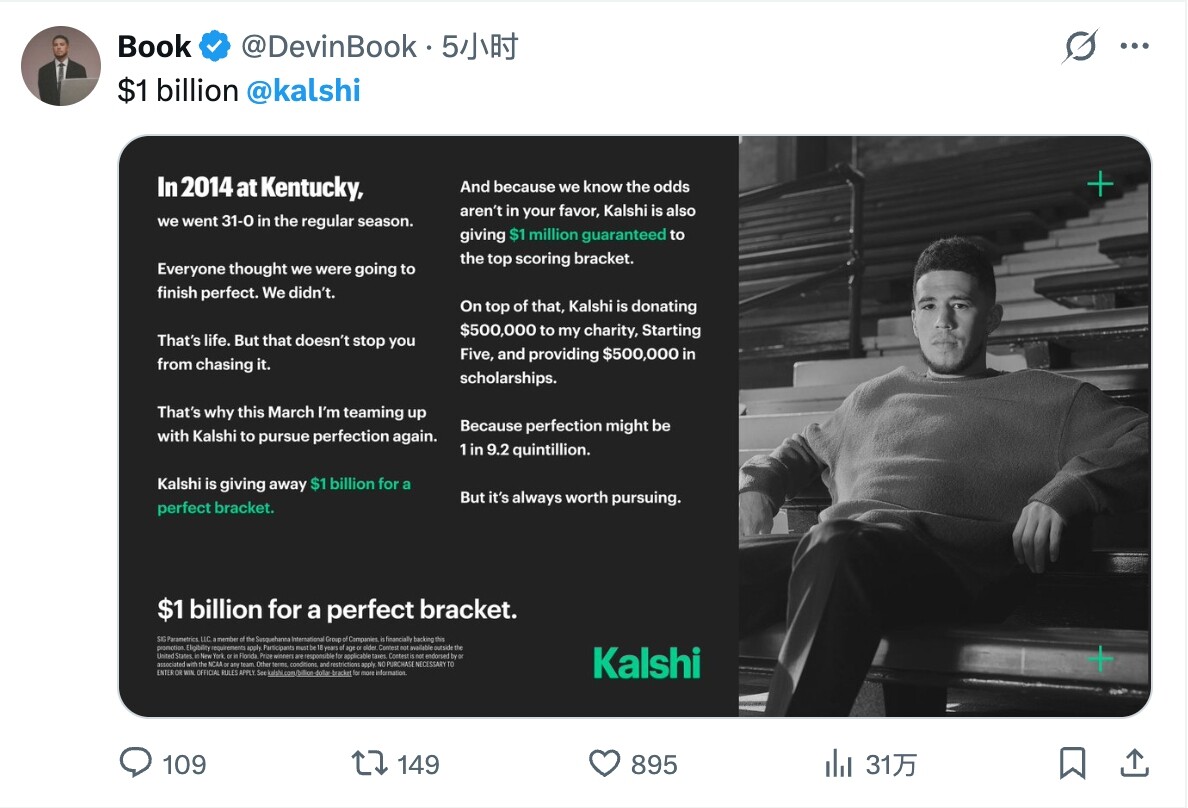
It is worth mentioning that Kalshi has also enlisted NBA star Devin Booker to boost the hype. In 2014, Booker's Kentucky University team had an undefeated record of 31 wins and 0 losses during the regular season and was once considered a favorite for the national championship that year, but lost to the University of Wisconsin in the semifinals with a score of 64 - 71. The following year, Booker entered the NBA, leaving him unable to make up for this regret.
Buffett Has Already Offered a Reward for 12 Years, but No One Has Taken the Grand Prize
The reason for mentioning Kalshi's grand prize as following Buffett's lead is that Buffett set up a similar grand prize back in 2014—employees of his Berkshire Hathaway company who can guess all match outcomes can receive a massive prize of 1 billion dollars, distributed by the company over 40 years (or opt for a one-time payment of 500 million dollars).
However, due to the immense difficulty of perfect predictions, the prize has remained unclaimed. Buffett subsequently reduced the guessing difficulty multiple times (the rewards were also adjusted accordingly), until last year when an anonymous employee from Berkshire Hathaway's subsidiary FlightSafety International managed to secure a million-dollar prize by correctly predicting 31 out of 32 first-round games after the difficulty and reward adjustments.
Just how difficult is perfect prediction? The most classic number circulated in the industry is "1 in 9.2 quintillion," which means "1 in 9.2 trillion trillion." This probability comes from the following mathematical calculation: assuming each game is 50% vs 50% (completely random), without considering seed strengths, odds, or historical patterns, there are a total of 63 games in "March Madness" (excluding the First Four), so the number of possible permutations is 2^63, which translates to 9223372036854775808... If all these result possibilities were written on paper, the paper would weigh 180 trillion tons, equivalent to 500 million Empire State Buildings...
Do you think it's impossible? No worries, I can help you significantly increase the odds!
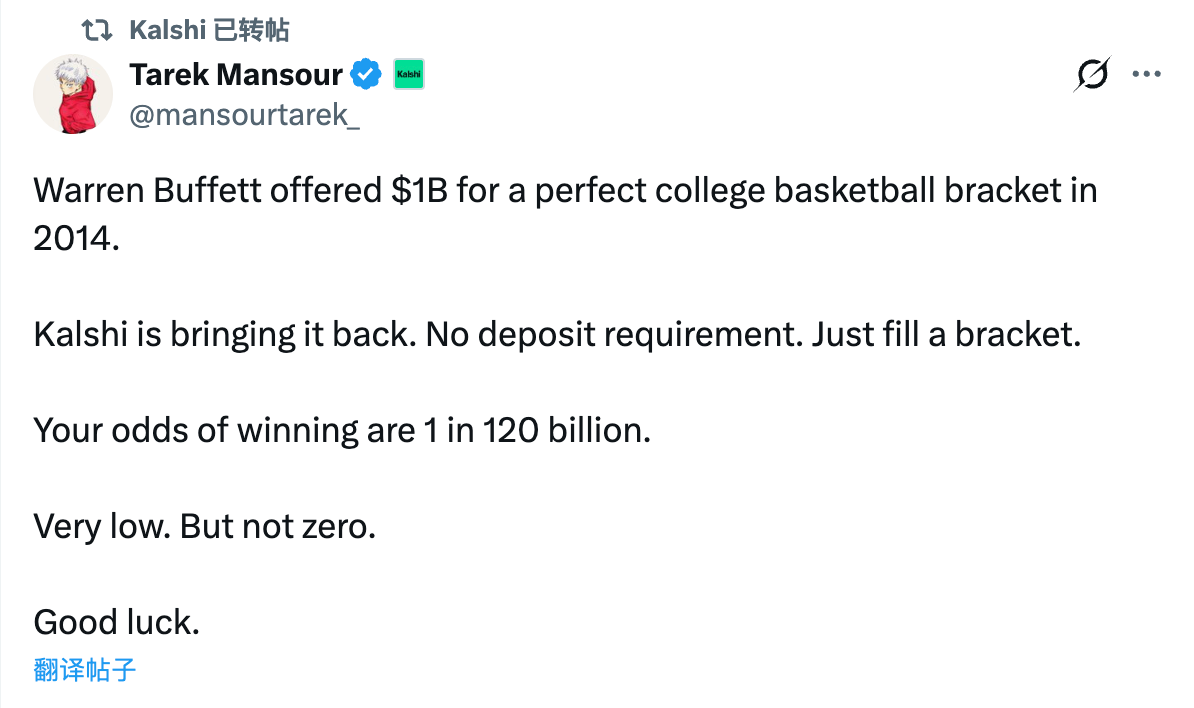
Kalshi's CEO Tarek Mansour stated this morning regarding this event that the probability of a perfect prediction is about "1 in 120 billion." The reason for the vast difference between the two probabilities is that the latter is based on a more realistic model of calculation—the outcomes of sports games are not 50-50; strong teams often have an easier time winning. After weighting historical win rates and related odds, academia and the statistical community generally estimate the probability of a perfect prediction for "March Madness" to be between "1 / 10^11 and 1 / 10^13," with "1 in 120 billion" falling within this range.
However, even at "1 in 120 billion," it still means the possibility is almost zero. It is evident that Kalshi is playing the same probability game as Buffett, believing that no one will take home this 1 billion dollars.
The Community is Ready, AI May Become the Key to Breaking Through
After Kalshi announced its grand prize event, a wide discussion erupted on social media—after all, predicting costs nothing, what if someone wins?
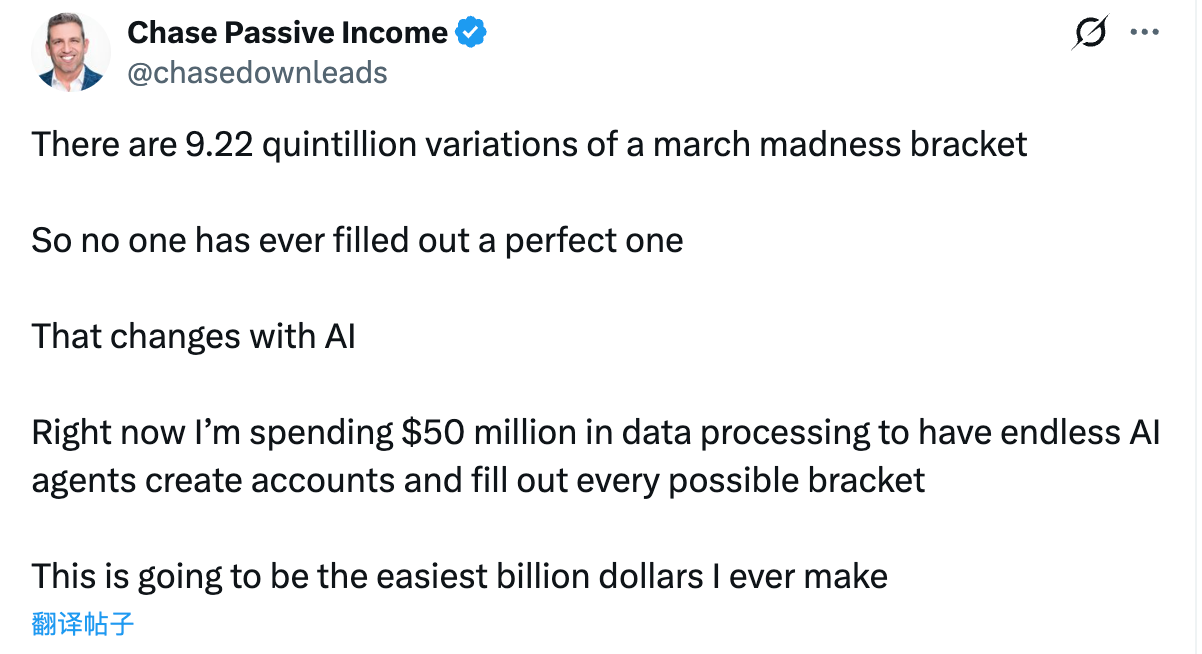
This time, many users are pinning their hopes for breaking through on this revolutionary AI technology. Overseas KOL Chase Passive Income expressed on X that he will spend 50 million dollars on data processing to allow countless AI agents to create accounts and fill out all possible groupings, and this will be "the easiest 1 billion dollars to earn."
Will the unsolvable probability problem continue? Can AI create miracles? Before the nationwide champion of "March Madness" is revealed, no one knows the answer.
As spectators, besides waiting to watch the games and enjoy the excitement, don't forget to go to Kalshi to fill out a wish ticket.
免责声明:本文章仅代表作者个人观点,不代表本平台的立场和观点。本文章仅供信息分享,不构成对任何人的任何投资建议。用户与作者之间的任何争议,与本平台无关。如网页中刊载的文章或图片涉及侵权,请提供相关的权利证明和身份证明发送邮件到support@aicoin.com,本平台相关工作人员将会进行核查。