A new research report by Ark Invest and bitcoin-focused financial services company Unchained, examining the intersection of quantum computing and bitcoin security, concluded that while quantum technology could eventually challenge the network’s cryptography, the threat remains far from imminent.
According to the study, current quantum systems operate in what researchers call the “Noisy Intermediate-Scale Quantum” (NISQ) era, where machines typically run with fewer than 100 logical qubits and limited computational depth. Breaking bitcoin’s elliptic curve cryptography would require at least 2,330 logical qubits and millions to billions of quantum operations, far beyond today’s capabilities.
Instead of a sudden “Q-day” where bitcoin security collapses, researchers argue that quantum progress will likely unfold through a series of gradual technological milestones. These stages range from early scientific applications, such as materials simulation and chemistry, to the eventual ability to attack weak cryptographic systems.
Only in later stages could quantum computers begin to threaten bitcoin’s elliptic curve digital signature algorithm (ECDSA), which secures private keys and transactions.
Even then, attacks would likely be slow and costly, requiring significant computational resources. The report estimates that electricity costs alone could reach around $100,000 to break a single bitcoin key in early quantum attack scenarios.
Vulnerable Bitcoin Supply
Researchers estimate that roughly 35% of the total Bitcoin supply could theoretically be exposed to future quantum risks. This includes about 1.7 million BTC stored in older address types believed to be lost and roughly 5.2 million BTC in reusable addresses that could be migrated to safer formats.
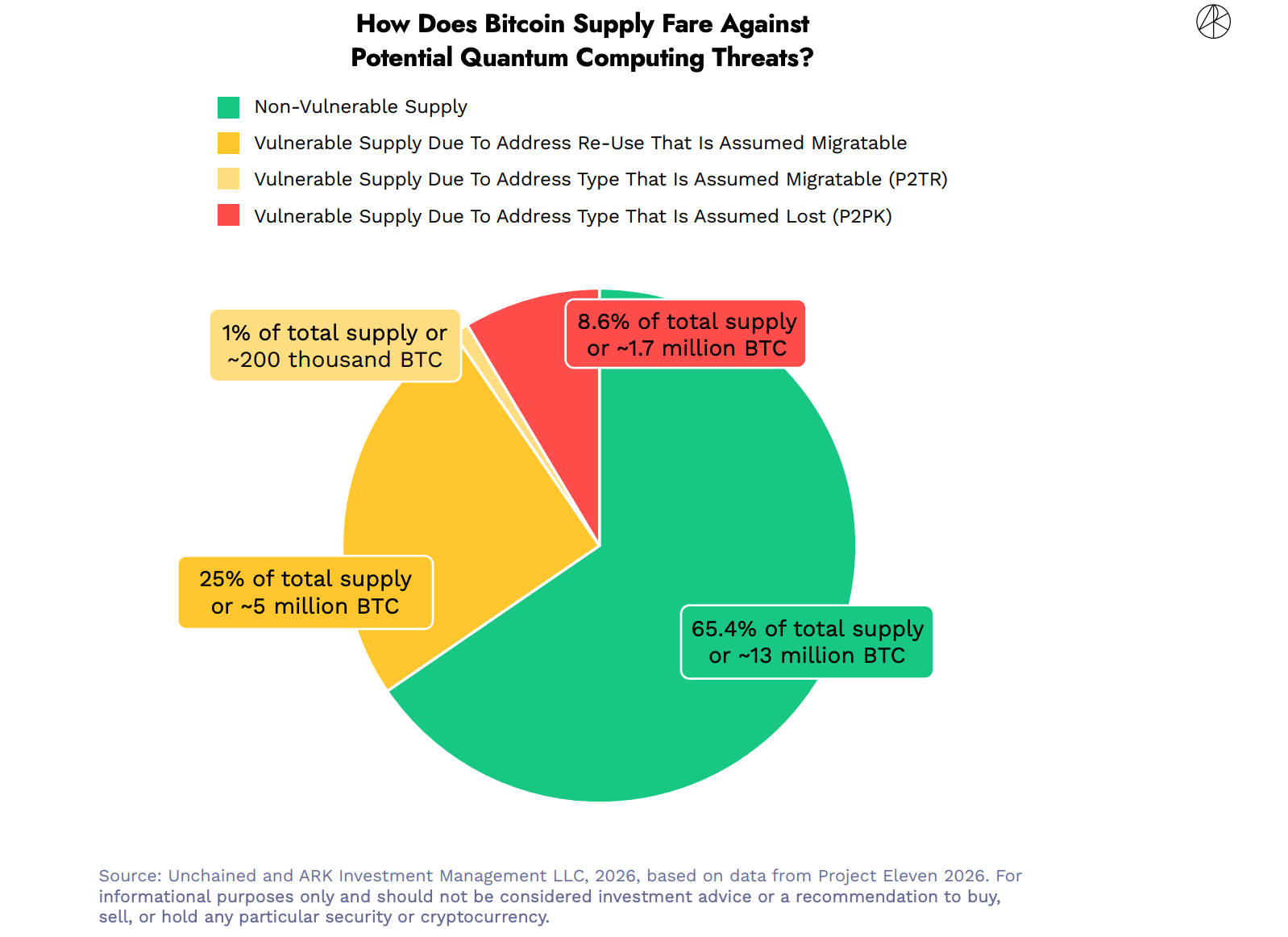
However, the majority of bitcoin remains stored in quantum-resistant address formats, and developers already have potential solutions in motion.
Several initiatives are underway across the crypto ecosystem. Exchanges like Coinbase have established quantum advisory boards, while developers are discussing proposals such as Bitcoin Improvement Proposal (BIP) 360, which explores new address types designed to withstand quantum attacks.
Preparing Before the Threat Arrives
Security researchers emphasize that the broader internet, including banking systems, government communications, and cloud infrastructure, would face disruption long before bitcoin itself becomes vulnerable.
In parallel, post-quantum cryptography (PQC) standards are already being developed and deployed across the internet infrastructure. If necessary, bitcoin could eventually integrate similar cryptographic upgrades through protocol changes.
For investors and network participants, the takeaway is clear: quantum computing represents a long-term technological challenge rather than an urgent security crisis.
As with most transformative technologies, progress will likely unfold over decades, providing the bitcoin ecosystem ample time to adapt.
- Is Bitcoin at risk from quantum computers today?
No. Current quantum systems lack the computational power required to break bitcoin’s encryption. - How long before quantum computing could threaten Bitcoin?
Many projections place potential risks 10–20 years away or longer, depending on technological breakthroughs. - What parts of Bitcoin could be vulnerable?
Older address types, including early P2PK wallets, could eventually be exposed if quantum computers become powerful enough. - Why does this matter globally?
Regions with the most quantum research, the United States, Europe, and China, are also leading the development of post-quantum cybersecurity standards that could protect global financial systems, including cryptocurrencies.
免责声明:本文章仅代表作者个人观点,不代表本平台的立场和观点。本文章仅供信息分享,不构成对任何人的任何投资建议。用户与作者之间的任何争议,与本平台无关。如网页中刊载的文章或图片涉及侵权,请提供相关的权利证明和身份证明发送邮件到support@aicoin.com,本平台相关工作人员将会进行核查。


