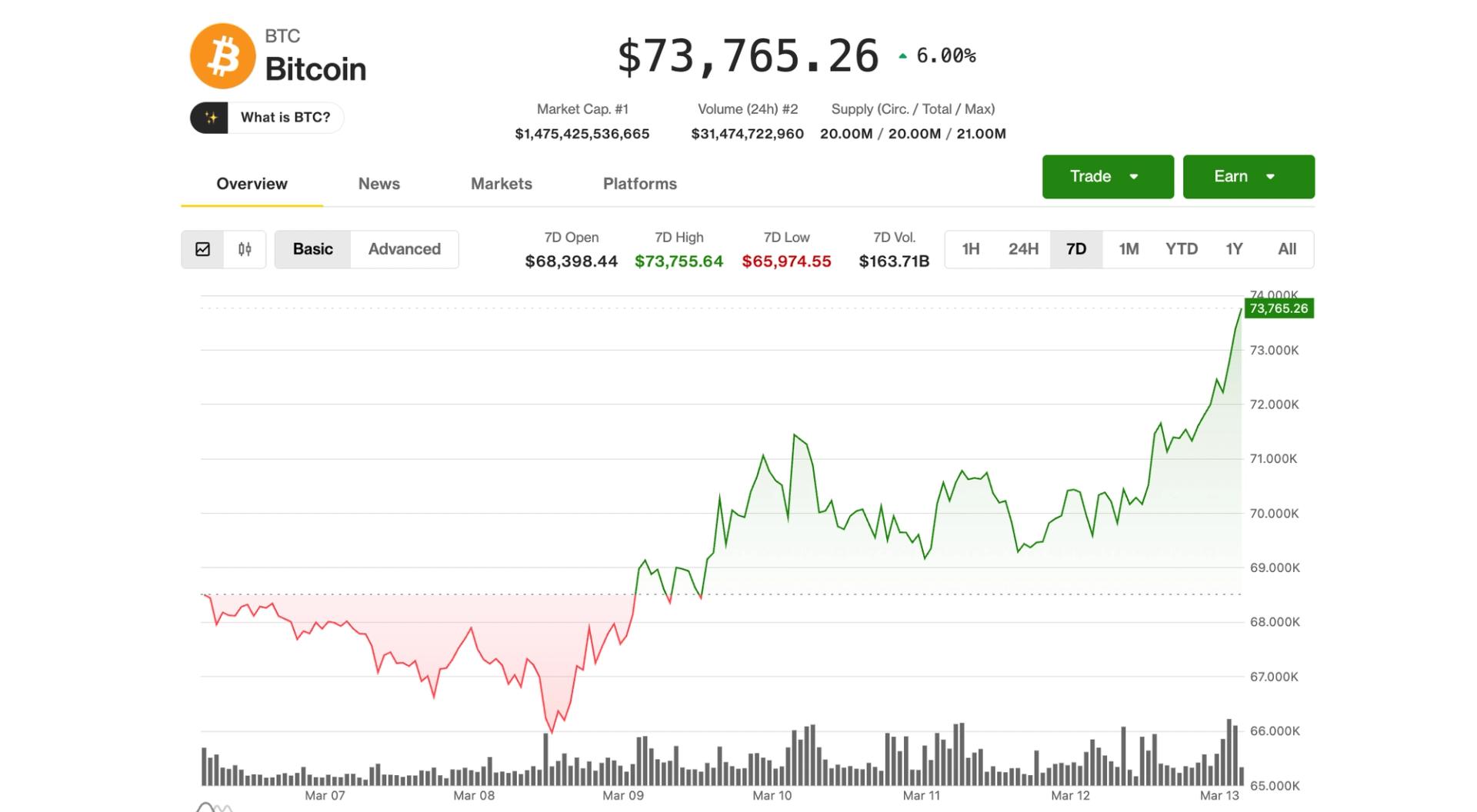
What to know : Bitcoin rose sharply Friday, taking aim at the $74,000 level in morning U.S. trade. The gains began Thursday evening after U.S. Treasury Secretary Scott Bessent said the Trump administration was taking steps to ease oil price pressures. Funding positioning of perpetual futures traders has been negative for the longest period since the bottom of the last major bear market in 2022.
Bitcoin is adding to overnight gains in early U.S. trading on Friday, continuing to show strong relative price action after many months of underperformance to assets like stocks and precious metals.
Trading at $73,500, bitcoin is higher by nearly 5% over the past 24 hours, with most of those gains coming after U.S. Treasury Secretary Scott Bessent on Thursday evening said the Trump administration is taking concrete steps to try and cap surging oil prices.
Bitcoin is now higher by about 11% since the Iran war broke out, outperforming broad U.S. stock indices and gold, both of which have lost ground since the bombs began dropping about two weeks ago.
WTI oil on Friday is trading at $94.50 per barrel, down from a high of nearly $98 on Thursday. U.S. stocks are posting gains of about 0.5%.
Oil raises stagflationary risk
The recent spike in oil prices is putting direct pressure on household budgets and, if sustained, could weaken consumer spending and slow economic growth, according to Olu Sonola, head of US economics at Fitch Ratings.
"Yes, the broader economy is still expected to grow at trend, but that forecast increasingly looks fragile as downside risks accumulate. ... The Fed can shrug off pockets of weakening growth, but resurgent inflation severely limits its room to maneuver, leaving policy potentially stranded for months," he wrote in a note.
Relief bounce
After a period of some of the worst sentiment in bitcoin's history, it's perhaps not too surprising that there's been some modest gains of late.
Funding positioning of perpetual futures traders has been negative for the longest period since late 2022, K33 Research analyst Vetle Lunde noted. This means traders who are shorting bitcoin are paying longs to keep their trades open, resulting in a negative funding rate. Late 2022, of course, coincided with the aftermath of the FTX crash when BTC traded around $16,000 versus $69,000 one year earlier.
The 30-day average funding rate has now been negative for 14 consecutive days, the longest since December 2022, Lunde pointed out. These negative streaks coincided with local price bottoms over the past seven years, he added.
In the meantime, bitcoin open interest in perpetual and dated futures has risen 9% over the past 24 hours to around 700,000 BTC, the highest level since Feb. 6. Add it all up, and that creates the conditions for a short squeeze.
Friday gain
The day isn't over yet, but this would be the first Friday gain since the Middle East conflict began on Feb. 27. That might suggest a less volatile weekend for crypto, which has gotten in the habit of declining on Saturdays and Sundays in recent weeks.
March is also shaping up to be a turning point for bitcoin. The asset is up about 8% so far this month. Again, it's early, but a March advance would break BTC's five-month losing streak.
免责声明:本文章仅代表作者个人观点,不代表本平台的立场和观点。本文章仅供信息分享,不构成对任何人的任何投资建议。用户与作者之间的任何争议,与本平台无关。如网页中刊载的文章或图片涉及侵权,请提供相关的权利证明和身份证明发送邮件到support@aicoin.com,本平台相关工作人员将会进行核查。


