AI development is moving at a blistering pace in 2026. Data compiled by the model tracker LLM Stats shows 267 models currently listed on its leaderboards as of Thursday, March 12, 2026, reflecting the fastest expansion of large language models and related systems since the generative AI boom began. Analysts say the surge is not merely about more models — it coincides with a new focus on AI agents capable of planning, reasoning, and completing tasks autonomously.
Across the first quarter of 2026, researchers tracking the sector estimate that dozens upon dozens of AI models have been released by major AI labs, including companies such as OpenAI, Anthropic, Google, xAI, Alibaba, Bytedance and Zhipu AI. Instead of annual flagship launches, labs are now rolling out updates every few weeks, dramatically accelerating development cycles.
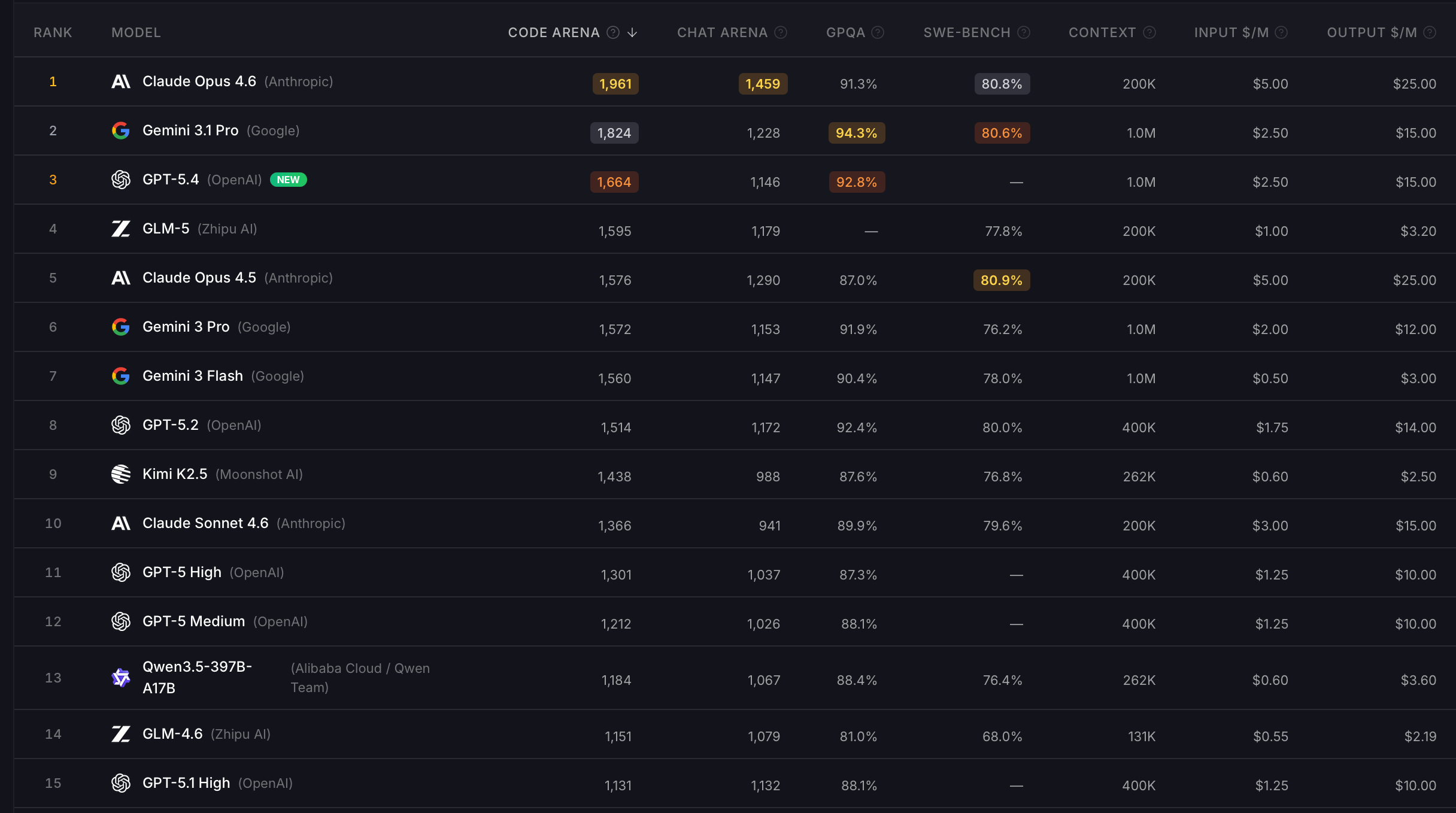
Top 15 models according to the LLM Stats leaderboard on March 12, 2026.
February alone delivered a concentrated burst of major releases. Among them were Claude Opus 4.6 and Claude Sonnet 4.6 from Anthropic, the latter introduced on Feb. 17 with an experimental context window approaching one million tokens and new collaborative agent features. Around the same period, GPT-5.3 Codex from OpenAI appeared as a coding-focused model designed to automate software development tasks.
Google added to the competition with Gemini 3.1 Pro, released Feb. 19. The model expanded multimodal capabilities, allowing users to analyze text, images, and structured data within a single workflow. Developers say such models are increasingly used for enterprise search, document analysis, and complex reasoning.
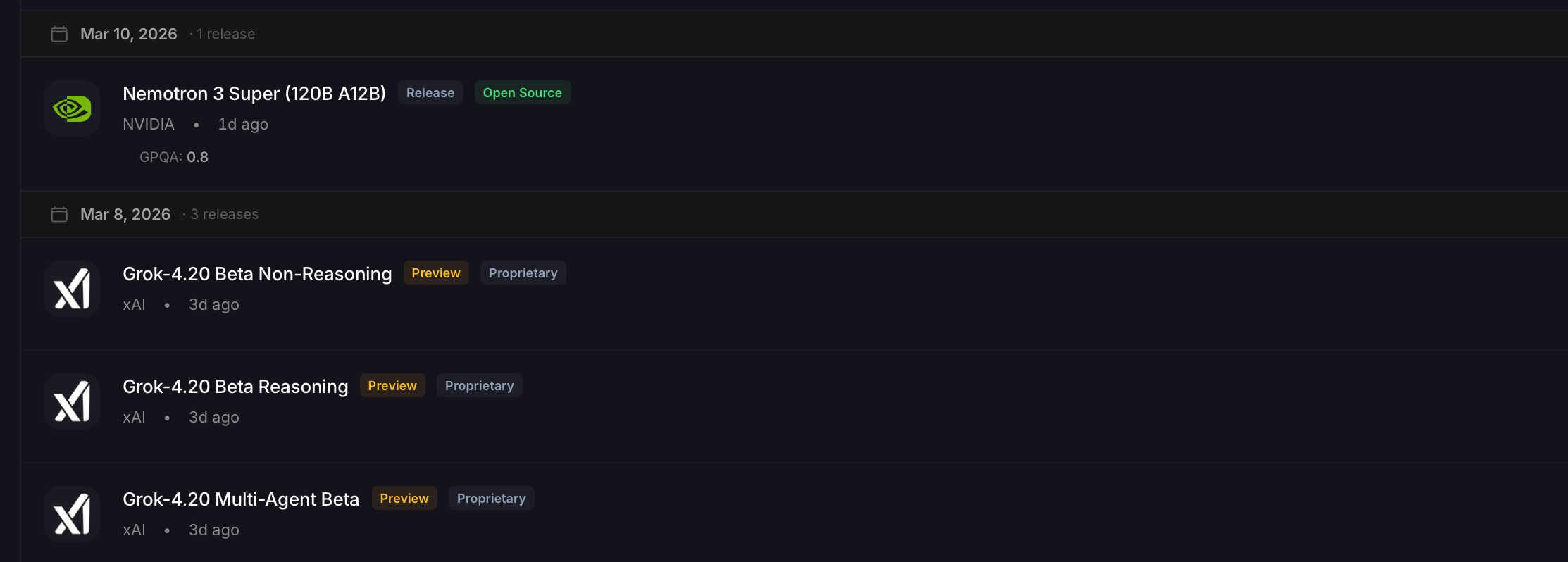
LLM updates as of March 10, 2026.
Other labs followed with their own contenders. Grok 4.20, developed by xAI, rolled out beta updates during February before adding multi-agent capabilities in early March. Meanwhile, Qwen 3.5 from Alibaba, Bytedance Seed 2.0, Minimax M2.5, GLM-5 from Zhipu AI, Mercury 2 from Inception, Longcat-Flash-Lite, and Step-3.5-Flash from StepFun rounded out a wave of roughly a dozen frontier model releases in a single month.
The flood did not slow as March began. Reinforcements quickly followed, including GPT-5.4, Grok-4.20’s multi-agent beta expansion, and Nemotron 3 Super, signaling that the rapid cadence is becoming the industry’s new normal rather than a temporary spike.
Yet the headline story is not just quantity. The new models increasingly emphasize “agentic” capabilities — systems designed to perform real-world tasks rather than simply generate text or answer questions. In practical terms, that means AI that can plan multi-step workflows, call software tools or APIs, interact with computers, and coordinate with other AI agents.
Enterprises are taking notice. Consulting and research firms say the shift toward task-driven AI is turning generative models from experimental tools into operational infrastructure. Surveys and forecasts from major industry analysts suggest a large share of enterprise software will incorporate AI agents within the next few years, with adoption rising sharply in sectors such as finance, healthcare, customer service and software development.

The rise in Openclaw’s popularity contributed greatly to the demand for autonomous AI agent systems and workflows.
The technological backbone behind this trend is the growing use of multi-agent orchestration systems, in which multiple specialized AI agents collaborate to complete complex workflows. Emerging standards such as the Model Context Protocol (MCP) — often described as a universal interface for AI tools — are making it easier for models to communicate with external systems and each other.
For businesses, the appeal is straightforward: measurable productivity gains. Companies deploying AI agents report faster coding cycles, automated data analysis, and reduced manual workloads. Analysts say these systems can compress hours of work into minutes when integrated into internal software pipelines.
Another factor fueling adoption is cost efficiency. New models such as Minimax M2.5 and Bytedance Seed 2.0 emphasize lower inference costs, allowing enterprises to run large volumes of automated tasks without the steep compute bills associated with earlier AI generations.
At the same time, competition between U.S. and Chinese labs is intensifying. Releases such as Qwen 3.5 and GLM-5show Chinese developers closing the performance gap while aggressively competing on price. Industry observers say the rivalry is pushing both sides to accelerate model releases and experiment with new architectures.
As the first quarter of 2026 nears its close, the takeaway is clear: the race to build better AI models has become a high-speed sprint. But the real prize may lie not in the models themselves, but in the armies of autonomous agents they enable.
- What does LLM Stats track?
LLM Stats aggregates and ranks artificial intelligence models, showing 267 models listed on its leaderboards as of March 12, 2026. - What are agentic AI systems?
Agentic AI refers to systems that can autonomously plan tasks, use tools or software, and complete multi-step workflows without constant human direction. One such system is Openclaw. - Why are AI model releases accelerating?
Competition among major AI labs and growing enterprise demand are driving labs to release new or updated models every few weeks. - Which AI models were major releases in early 2026?
Key models include Claude Opus 4.6, Claude Sonnet 4.6, GPT-5.3 Codex, Gemini 3.1 Pro, Grok 4.20, Qwen 3.5, Bytedance Seed 2.0, Minimax M2.5, GLM-5, Mercury 2, Longcat-Flash-Lite and Step-3.5-Flash.
免责声明:本文章仅代表作者个人观点,不代表本平台的立场和观点。本文章仅供信息分享,不构成对任何人的任何投资建议。用户与作者之间的任何争议,与本平台无关。如网页中刊载的文章或图片涉及侵权,请提供相关的权利证明和身份证明发送邮件到support@aicoin.com,本平台相关工作人员将会进行核查。


