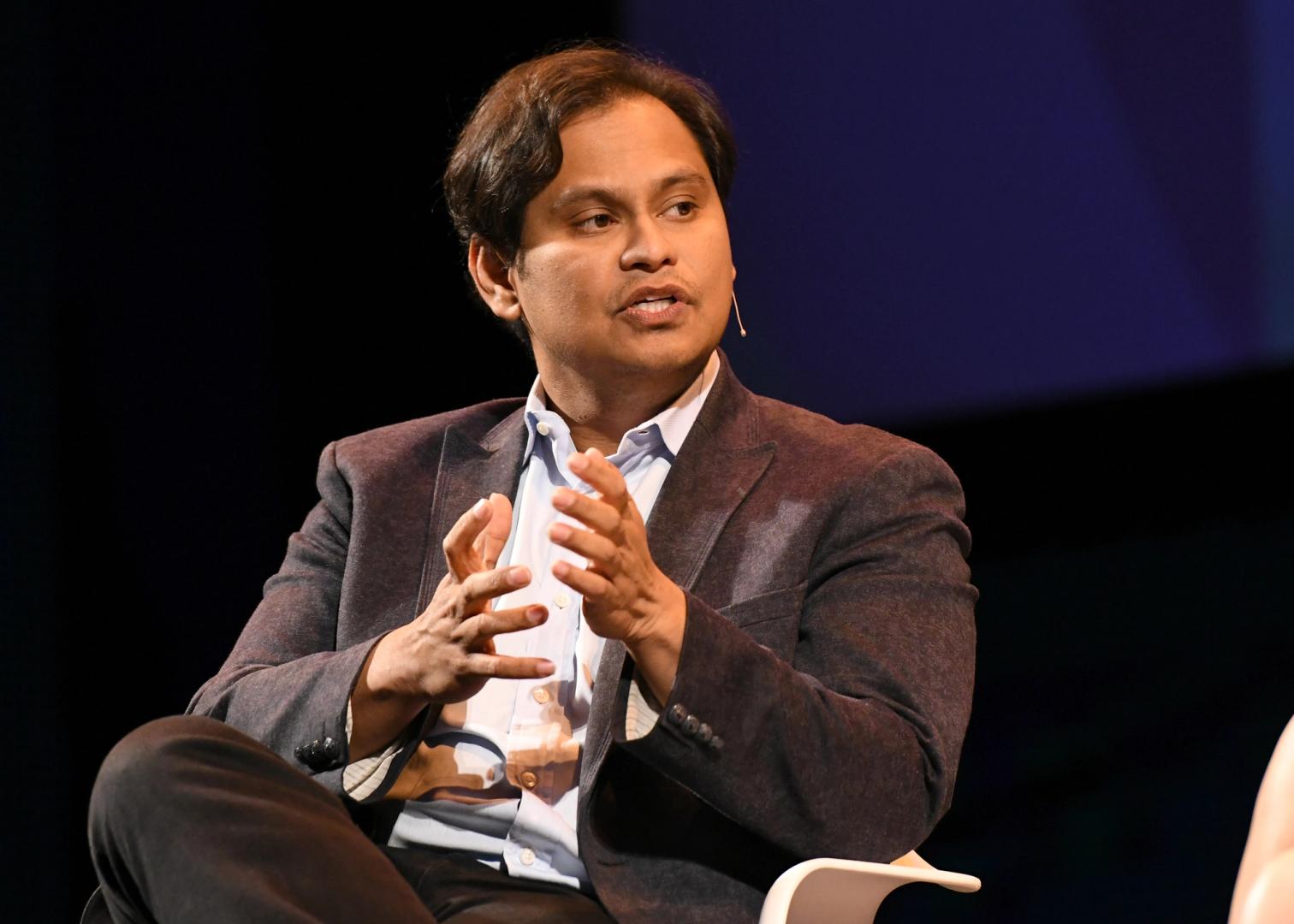
What to know : Tech investor Imran Khan says cryptocurrency plays little role in his AI strategy because he sees crypto and AI as driven by fundamentally different investment theses. His firm, Proem Asset Management, focuses its AI bets on productivity and economic growth, while limiting direct token exposure and treating crypto-related investments as part of a broader tech mandate. Khan argues that fears of AI-driven job losses echo past technological revolutions, even as AI stocks cool and some institutional investors quietly reassess crypto as a potential long-term value opportunity.
Tech investor Imran Khan says cryptocurrency does not play a meaningful role in his AI investment strategy, arguing the asset class operates on a fundamentally different thesis than the AI-driven productivity boom.
Despite the growing narrative that AI and crypto will converge, Khan said he largely views them as separate investment themes.
“Crypto is a different animal,” he said in an interview. “When it comes to AI, you are investing for productivity and economic growth.” That difference means crypto rarely fits the framework his firm uses, which focuses on businesses that benefit from structural technology shifts.
Khan is the founder and chair of the investment committee at Proem Asset Management, a technology-focused investment firm, with $450 million in assets under management. Before launching Proem, he served as chief strategy officer at Snap (formerly Snapchat), helping lead the company to its public listing, and previously ran global internet investment banking at Credit Suisse, where he worked on major deals including Alibaba’s record-breaking IPO.
However, he isn't anti-crypto.
While direct token exposure has not typically fit within the firm’s investment thesis, which focuses on fundamental private equity, Proem held positions in Coinbase (COIN), Robinhood (HOOD), as well as bitcoin miner Iren (IREN) and spot bitcoin through the iShares Bitcoin Trust (IBIT), according to its latest 13F filing. Those positions are not part of the firm's AI strategy, but rather a part of its broader focus on the tech sector, Khan said.
Crypto and AI intersection
While Khan argues that the two industries are completely different, some investors argue that an intersection of AI and crypto makes sense because both rely on decentralized computing networks and data infrastructure.
The argument is that blockchains can provide payment rails and coordination systems for AI services that operate across the internet without a central owner. In fact, last month, Citrini Research's report that laid out AI bubble fear and caused a brief market meltdown, mentioned that autonomous AI agents will disrupt traditional payment systems by bypassing credit card networks in favor of stablecoins.
Others say blockchain-based systems could also help track how AI models use data, verify outputs or manage digital identities for autonomous software agents.
While the idea of convergence of the two industries remains largely experimental, it has fueled a wave of startups trying to link AI development with crypto-based networks. Meanwhile, many bitcoin miners have already pivoted into the AI boom by repurposing their data centers and power infrastructure to support artificial intelligence computing
Even bitcoin could benefit from AI's growth, NYDIG, a financial services and infrastructure firm, said. The firm's analyst argued that if AI cuts jobs and wages, weakening consumer demand, it could force policymakers to cut rates to stabilize the economy, and adding a wave of liquidity could support the bitcoin price.
AI bubble fear
Khan’s comments come as the AI investment boom that surged after ChatGPT's launch is beginning to show signs of strain.
Nvidia (NVDA) — the dominant supplier of chips used to train AI models — and networking and custom AI chip maker Broadcom (AVGO) are both down roughly 5% year-to-date, reflecting growing questions about the pace of returns from massive AI spending.
Meanwhile, the Citrini report that caused the AI scare outlined a hypothetical 2028 scenario in which rapid AI adoption leads to widespread white-collar job losses and a sharp drop in consumer spending.
While it is a concerning scenario, Khan is looking at the bigger picture, saying that similar fears have accompanied nearly every technological revolution.
“If you read Karl Marx, he said the same thing about machines 200 years ago,” Khan said. “Now we’re having an AI revolution that could be as big as the Industrial Revolution, and people are making the same arguments.”
He added that new technologies have historically reshaped labor markets rather than eliminating jobs entirely.
“When there is new technology, you create new kinds of jobs,” Khan said.
免责声明:本文章仅代表作者个人观点,不代表本平台的立场和观点。本文章仅供信息分享,不构成对任何人的任何投资建议。用户与作者之间的任何争议,与本平台无关。如网页中刊载的文章或图片涉及侵权,请提供相关的权利证明和身份证明发送邮件到support@aicoin.com,本平台相关工作人员将会进行核查。


