
Daily market key data review and trend analysis, produced by PANews.
Macro Market
“Black Monday” sweeps the globe, and the geopolitical storm ruthlessly tears apart the defenses of risk assets. The Asia-Pacific stock markets were the first to suffer a bloodbath, with the MSCI Asia-Pacific index plummeting over 3%. The KOSPI index in South Korea fell by over 8%, triggering a 20-minute trading halt; the Nikkei 225 index collapsed more than 7%, falling below the 52000 point mark; the Taiwan Weighted Index plummeted by 2051.93 points, a decline of 6.11%; the VN30 index in Vietnam dropped over 6%, and the S&P 200 index in Australia fell more than 4% to a new low of 8492.20 points; the Composite Index in Indonesia also fell over 4%.
U.S. stocks similarly trembled, with all three major U.S. stock index futures falling sharply; Dow futures once dropped over 2%, while S&P 500 and Nasdaq 100 index futures fell 1.6%. Goldman Sachs data shows hedge funds are adding ETF short positions at a rare pace not seen in five years, increasing by 8.3%; veteran strategist Ed Yardeni raised the probability of a stock market crash in the U.S. this year to 35%. While the probability of the roaring twenties continues to be 60%, the chance of stagflation reoccurring has reached 15%. In the new week, U.S. stock trading hours officially switch to 21:30 to 04:00 Beijing time.
Safe-haven funds are pouring into the U.S. dollar, with the dollar index just a step away from the 100 mark, while the yield on 10-year U.S. Treasury bonds today reached a high of 4.216%. Precious metals rose sharply and then fell back; spot gold approached $5197.85 and nearly touched the $5000 mark. PIMCO's Daniel Ivascyn stated that he is hoarding cash and favors medium-term U.S. Treasury bonds; analysts from Ebury and Tradewave both pointed out that the dollar has replaced gold as the current preferred safe-haven asset; Bloomberg's Mark Cranfield flatly stated that the dollar has become the only safe haven.
Oil Storm
The blockade of the Strait of Hormuz is evolving into an epic energy nightmare, with the world losing 20 million barrels of oil supply daily, comparable in scale to the sum of the five largest supply disruptions in history. Due to the blockade in the Strait of Hormuz, Iraq's production decreased from 4.3 million barrels by 60% to 1.7-1.8 million barrels, Kuwait halted production directly, and the UAE was forced to cut production.
International oil prices opened with an epic surge. Brent crude and WTI crude both spiked about 30%, nearing the $120 mark, surging over 60% in seven trading days. Goldman Sachs warned that Brent crude could surpass the $140 peak from 2008, and former trader Stefano Grasso bluntly stated that every additional day of interruption increases the pressure, and in the short term “there is effectively no ceiling” for oil prices.
In the face of an out-of-control energy market, G7 finance ministers and the IEA are urgently discussing a joint release of 300 to 400 million barrels from strategic reserves (accounting for 25%-30% of the total 1.2 billion barrels). Following the news, the oil price gain was forced to be halved, with WTI and Brent's gains narrowing to less than 15% and 14%, respectively. However, Trump remains unconcerned about inflation, insisting that short-term high oil prices are a “small price to pay for peace, only a fool would think otherwise.”
On-chain oil trading has also become the biggest hotspot in the crypto market; Polymarket predicts a 76% probability that oil will reach $120 by the end of the month. The tokenized oil contract (CL-USDC) on Hyperliquid soared to $114.77, leading to nearly $40 million in short positions being liquidated; Sky co-founder Rune directly deposited 4 million USDC into the platform, betting on a 20x leveraged long position in WTI crude.
AI Sector Dynamics
Artificial intelligence is reshaping national strategies and capital markets, with a trillion-level super windfall already taking shape. Zheng Zhajie, director of the National Development and Reform Commission, proposed a significant goal: by the end of the 14th Five-Year Plan, the scale of AI-related industries will exceed 10 trillion yuan, with over 7 trillion yuan in investments flowing into the “six networks” and “artificial intelligence +” infrastructures. Minister of Industry and Information Technology Li Lecheng disclosed that by 2025, the scale of core industries will exceed 1.2 trillion yuan, with over 6200 enterprises and a manufacturing penetration rate of over 30%; generative AI users reach 602 million (penetration rate of 42.8%).
The emergence of the open-source intelligent agent OpenClaw (Little Lobster) has ignited a frenzy in the tech circle. In just four months, the project surpassed 248,000 stars to top GitHub, surpassing Linux, with founder Peter Steinberger quickly recruited by OpenAI. Nvidia's Huang Renxun praised it as “the most important software release of our time,” stating that it will trigger a “computing power vacuum” that could cause a thousandfold surge in token consumption.
Tech giants and local governments are rapidly joining the fray. Tencent swiftly began internal testing of QClaw to enable one-click deployment on both WeChat and QQ, while lightweight cloud service Lighthouse has attracted over 100,000 “shrimp farmers”, with even Ma Huateng exclaiming, “I never thought it would be this popular.” Longgang District in Shenzhen quickly launched the “Ten Measures for Lobster,” offering a maximum reward of 1 million yuan for projects that achieve 30% of the investment; Futian District has already allowed “government lobsters” to officially start work.
Related concept stocks are experiencing a surge, with MiniMax's stock price soaring over 15% in the afternoon; Yuke has risen nearly 20% based on its cloud deployment advantage, triggering a trading halt; Shunwang Technology, Zhongke Chuangda, Tuwei Information, Ruixingwei, and Beixin Source have all announced they have completed adaptation.
However, behind the frenzy lies hidden concern; the Ministry of Industry and Information Technology has urgently issued a high-risk warning, noting that OpenClaw's default configuration is highly likely to trigger cyberattacks and information leaks, reminding the industry that it must maintain security standards while rushing blindly.
Bitcoin Market
Bitcoin's recent performance has been violently jolted by the macro storm, as the price broke below the key defense line of $70,000, struggling for breath in the range of $65,500 to $67,000. The panic caused by the escalation of the conflict in the Middle East and soaring oil prices has led to indiscriminate selling in the crypto market. NYDIG research indicates that at least 75% of Bitcoin's recent volatility is driven by macro factors outside traditional stock indices, and the synchronous rise of the U.S. software sector is not structurally similar. Current market sentiment is extremely fearful, with institutions heavily buying put options to guard against black swans; bearish sentiment holds overwhelming advantage in the short term. According to unbias data, bullish and bearish analysts in the market are evenly matched.
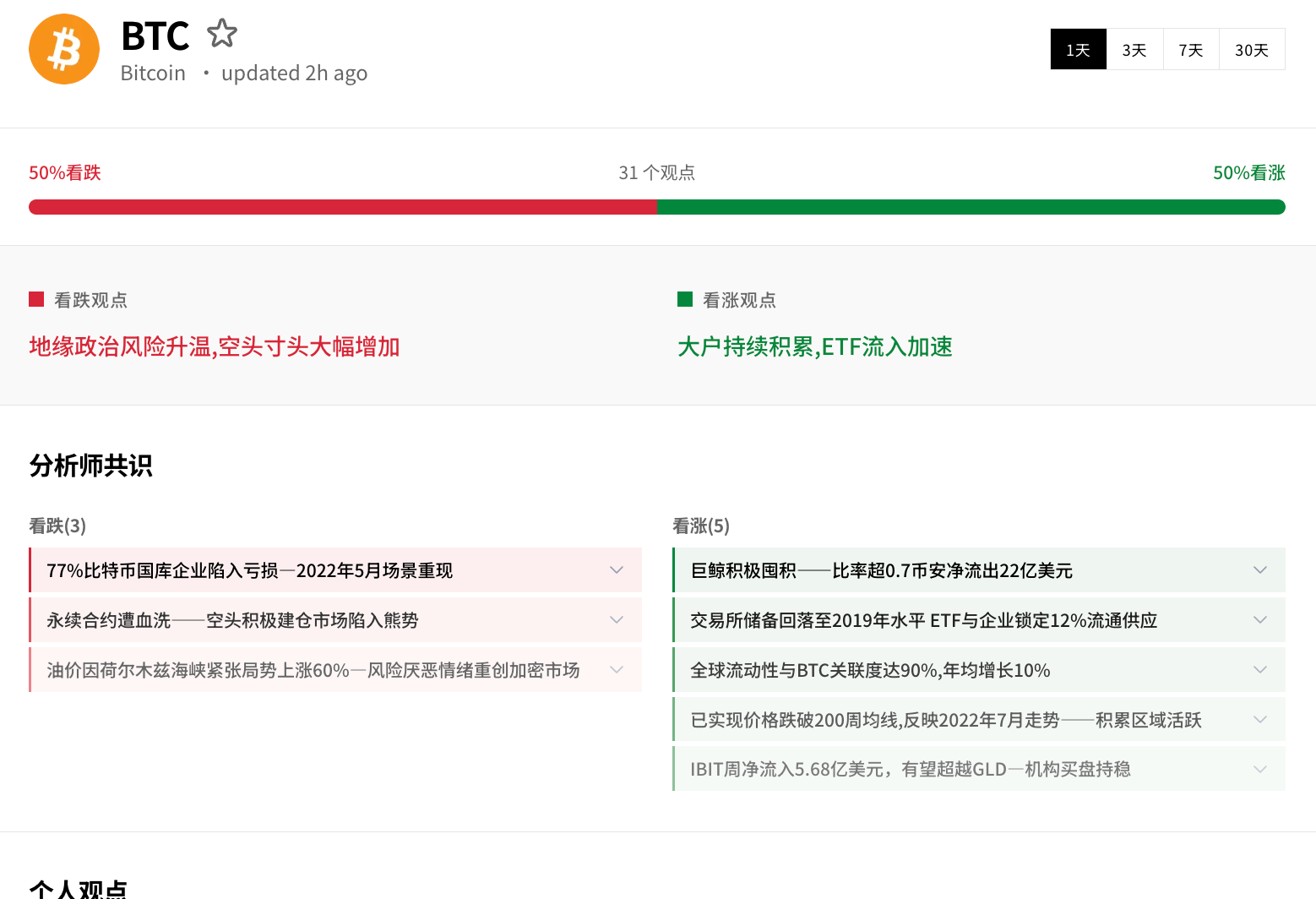
Bearish Viewpoints
Core Logic: Geopolitical conflicts and energy crises triggered inflation and recession worries, forcing funds to flee risk assets, and the options market has begun to price extreme black swan events urgently.
Darkfost: Tensions in the Strait of Hormuz leading to soaring oil prices create an extremely unfavorable environment for risk assets like Bitcoin; history shows that rising oil prices often coincide with the end cycle of BTC, which is not favorable for speculative asset risk exposure.
Godot: Institutional traders are panic-buying put options (accounting for 29.16%) to guard against a crash; the one-day ATM implied volatility soared to 52.45%, with the 0.15 Delta Skew chart deteriorating to a terrifying -16.1 and -16.37 on March 10 and 11, indicating a significant probability of a sharp downward trend.
Coin Bureau: Polymarket data indicates that 75% of traders are betting that BTC will drop to $55,000, and the market is even starting to price the possibility of falling below $45,000 by 2026.
CK Zheng (ZX Squared): Bitcoin has entered a deep bear market, influenced by the “four-year cycle” pattern and retail panic selling, with prices potentially further declining by about 30% by 2026.
AlphaBTC: BTC has lost the critical defense line of $70,000, likely forming lower high points and continuing downward unless a strong catalyst appears.
Bullish Viewpoints
Core Logic: The current plunge is merely a short-term liquidity cleanout and consolidation in a macro bull market, with strong buying support at key support levels, and long-term models and technical fractals remain extremely optimistic.
Doctor Profit: We are currently in a wide fluctuation zone of 57k-87k (33% amplitude), which mirrors the fractal of a 44% rebound after a 52% correction from the 2022 peak. I have purchased spot at 60k and 68k (60k is currently showing a profit of 12%, while 68k shows a loss of 2%), estimating this rebound could peak at 88k, with a macro bottom expected to be 44k-50k in September-October, while my short positions at 115k-125k still hold.
Astronomer: The probability of Bitcoin dropping below $50,000 is now less than 10%, and the current trend still supports the core judgment made on February 6.
Honey: Bitcoin has completed the sweep of the 72.4k high, the retreat, and the rebound at 65k, establishing a “three hits” pattern, with the true rise toward the $80,000 trend now initiated.
PlanB: Although the current price hovers around $67,000, the S2F model indicates the average price in this cycle (2024-2028) should be $500,000; BTC is currently severely undervalued, presenting an excellent buying opportunity.
mooncakexbt / LP_NXT: Order books show strong buying interest in the $64k-65k area (nPOC); if support can be held, the price is expected to squeeze upwards to fill the CME gap at $68.1k-68.2k, and even challenge $70.5k-71.3k.
Key Data (as of March 9, 13:00 HKT)
(Data source: CoinAnk, Upbit, SoSoValue, CryptoBubbles)
Bitcoin ETF: $568 million net inflow last week
Ethereum ETF: $23.56 million net inflow last week
SOL ETF: $24.05 million net inflow last week
XRP ETF: $4.0855 million net outflow last week
Fear & Greed Index: 8 (Extreme Fear)
Upbit 24-hour trading volume ranking: XRP, BTC, ETH, SIGN, KITE
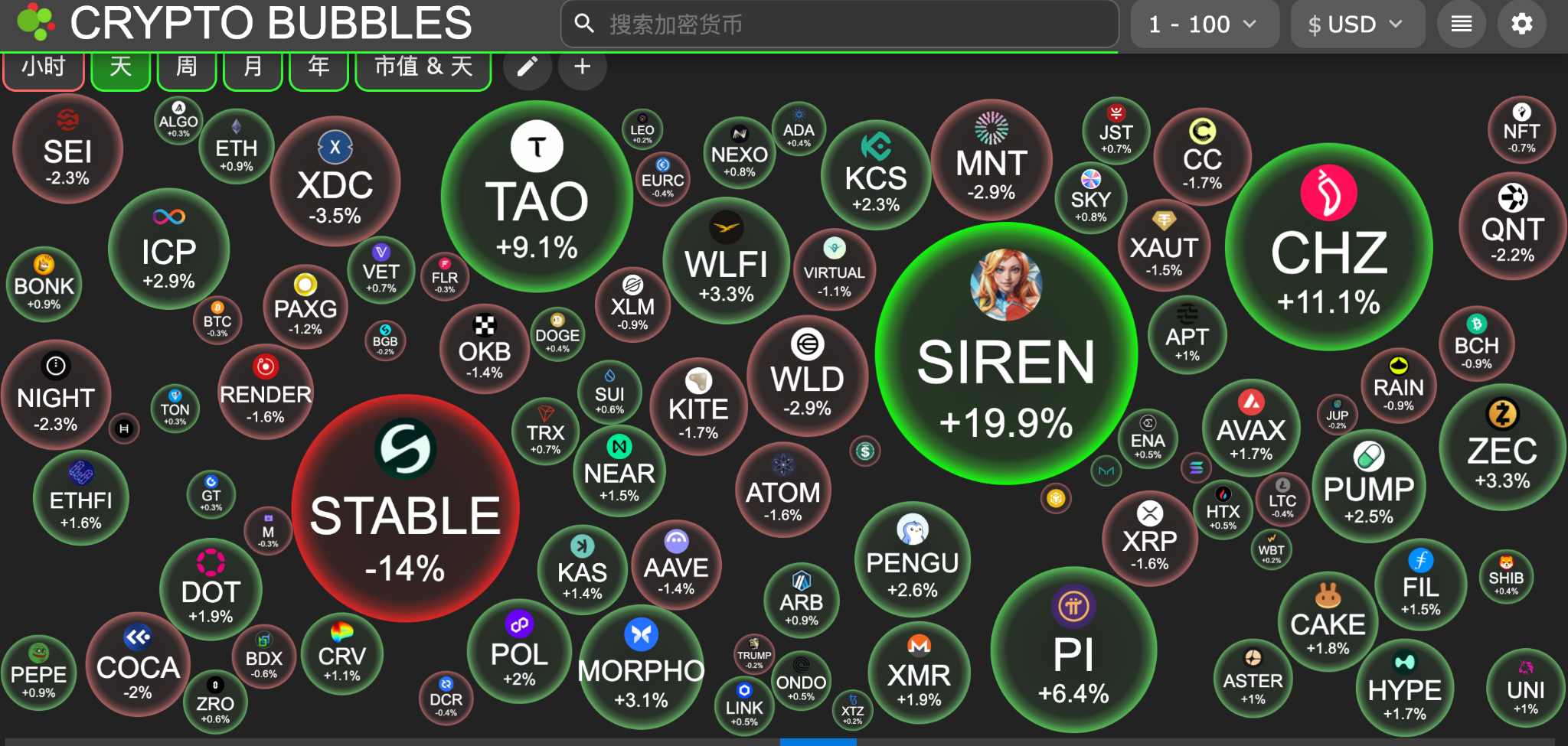
Sector Gains and Losses: The crypto sector has mixed gains and losses, with most altcoins experiencing slight fluctuations.
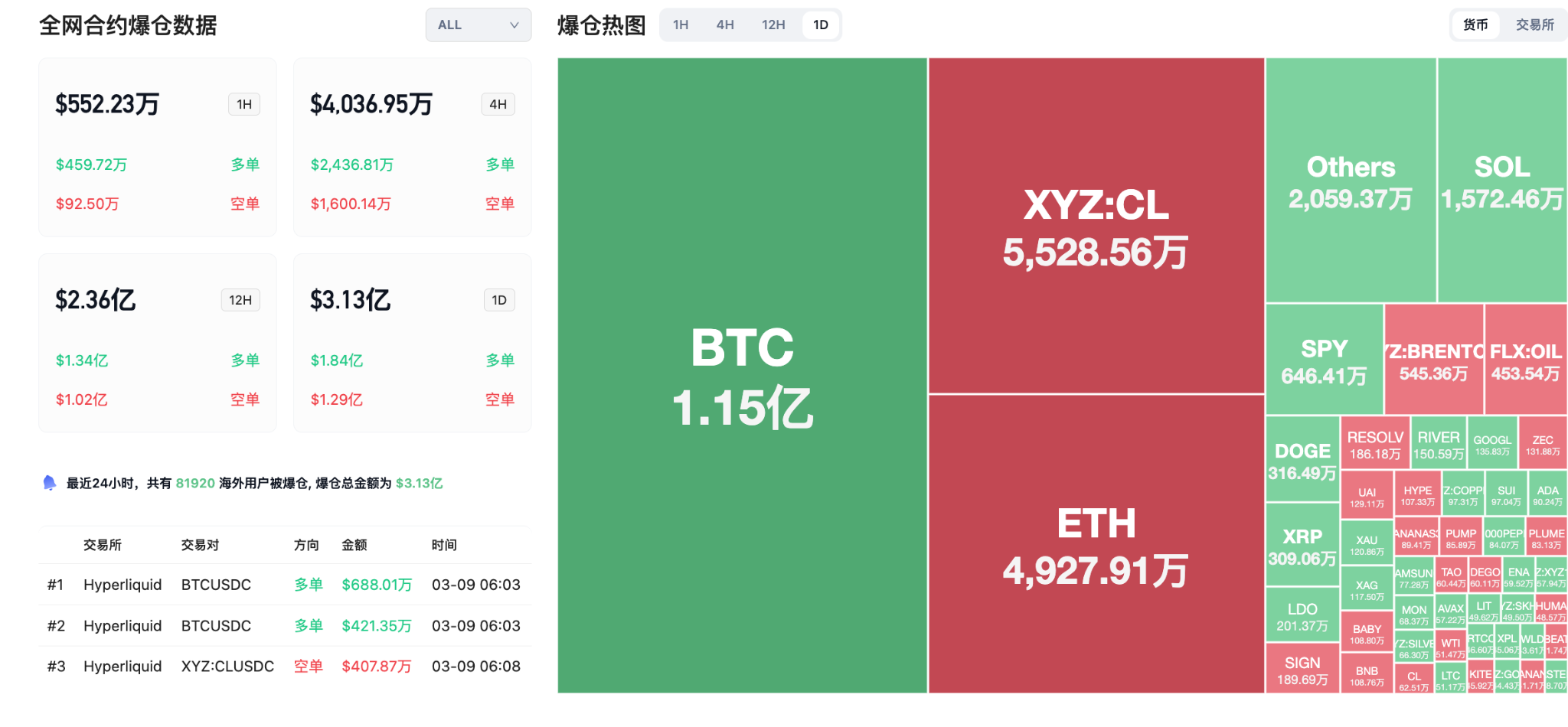
24-hour liquidation data: A total of 81,920 people were liquidated globally, with a total liquidation amount of $313 million, including $115 million in BTC liquidations, $49.2791 million in ETH liquidations, and $15.7246 million in SOL liquidations.
Today's Insights
Sharplink will hold a 2025 financial report conference call on March 9
Cross-game digital asset exchange platform Nexira plans to conduct TGE
Binance will upgrade the Ethereum network on March 10, expected to take one hour
Movement (MOVE) will unlock approximately 164 million tokens at 20:00 on March 9, valued at approximately $3.4 million
Today’s Top 100 Cryptocurrency Listings with Largest Gains: Siren up 19.9%, Chiliz up 11.1%, Bittensor up 9.1%, Pi Network up 6.4%, Zcash up 3.3%
Hot News
Ethena team and B2C2 respectively deposit 6500 ETH and 3050 ETH into exchanges
U.S. and Brent oil prices both rose over 20% today, with WTI crude breaking $112/barrel
Korean exchange triggers a trading halt for 20 minutes due to the KOSPI index dropping 8%
Binance wallet goes live with WTI crude (CL) perpetual contracts
ETH co-founder Jeffrey Wilcke reportedly sold nearly 80,000 ETH, valued at $157 million
免责声明:本文章仅代表作者个人观点,不代表本平台的立场和观点。本文章仅供信息分享,不构成对任何人的任何投资建议。用户与作者之间的任何争议,与本平台无关。如网页中刊载的文章或图片涉及侵权,请提供相关的权利证明和身份证明发送邮件到support@aicoin.com,本平台相关工作人员将会进行核查。


