On the daily chart, ethereum remains positioned below a cluster of longer-term trend indicators, underscoring the broader corrective structure. Price action is still operating beneath the $2,000 psychological level while forming consolidation behavior inside a wider multi-month downtrend channel.
The longer-term bias is therefore defined less by drama and more by gravity. Attempts to recover toward resistance near $1,980 to $2,000 have repeatedly faded, leaving the $1,930 zone as the immediate support band traders are watching like hawks guarding a particularly fragile nest.
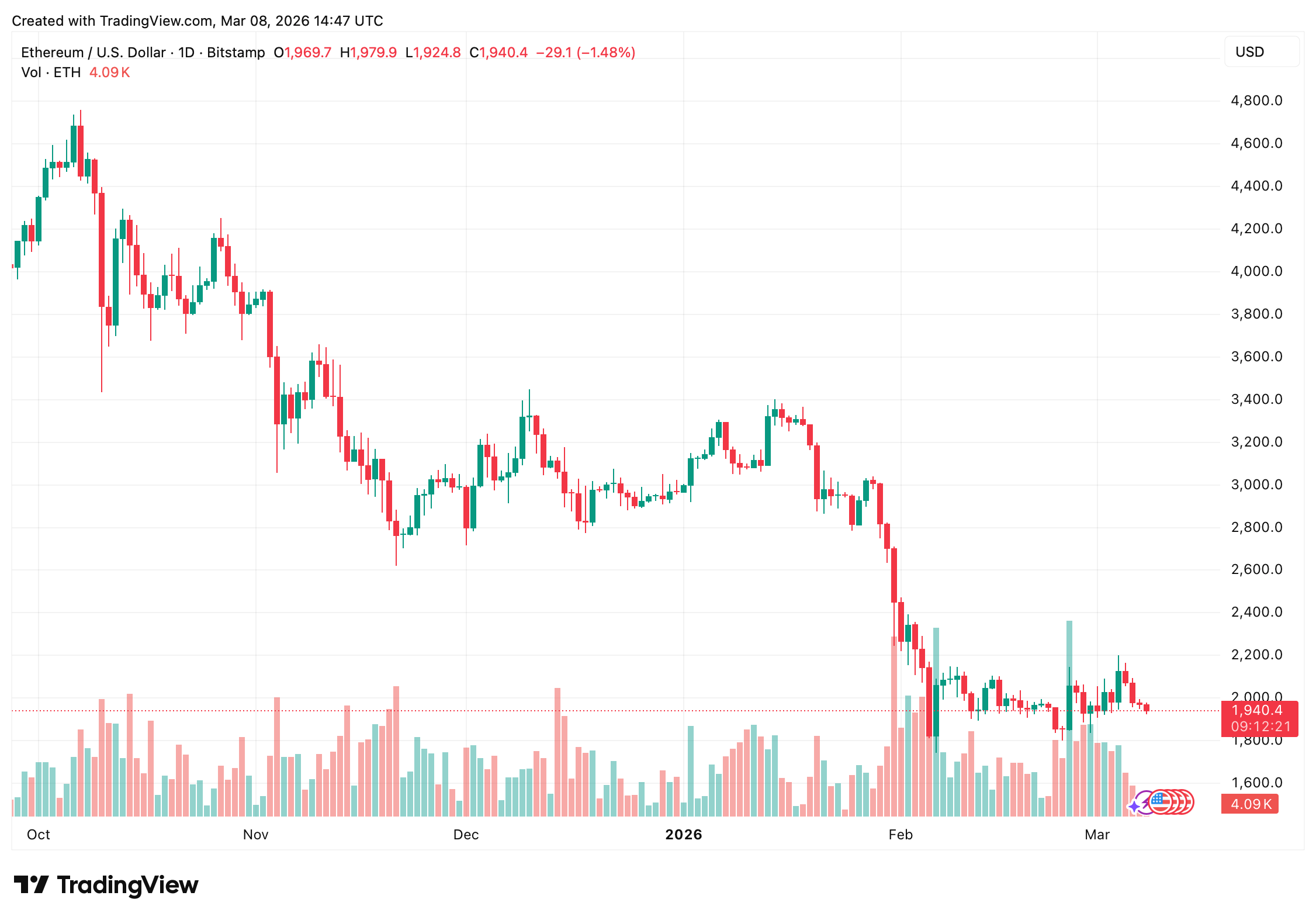
ETH/USD 1-day chart via Bitstamp on March 8, 2026.
Ether’s four-hour chart shows consolidation with a mild bearish tilt after rejection near the $1,960 to $1,980 region. Candles around the $1,930 to $1,940 range reflect indecision rather than conviction, which in market terms usually translates to a standoff between impatient momentum traders and longer-term participants waiting for confirmation. Resistance remains layered near $1,980 and the $2,000 threshold, while the downside support corridor stretches from roughly $1,930 toward the $1,880 to $1,900 band. In other words, the market is compressing, and compression rarely lasts forever.
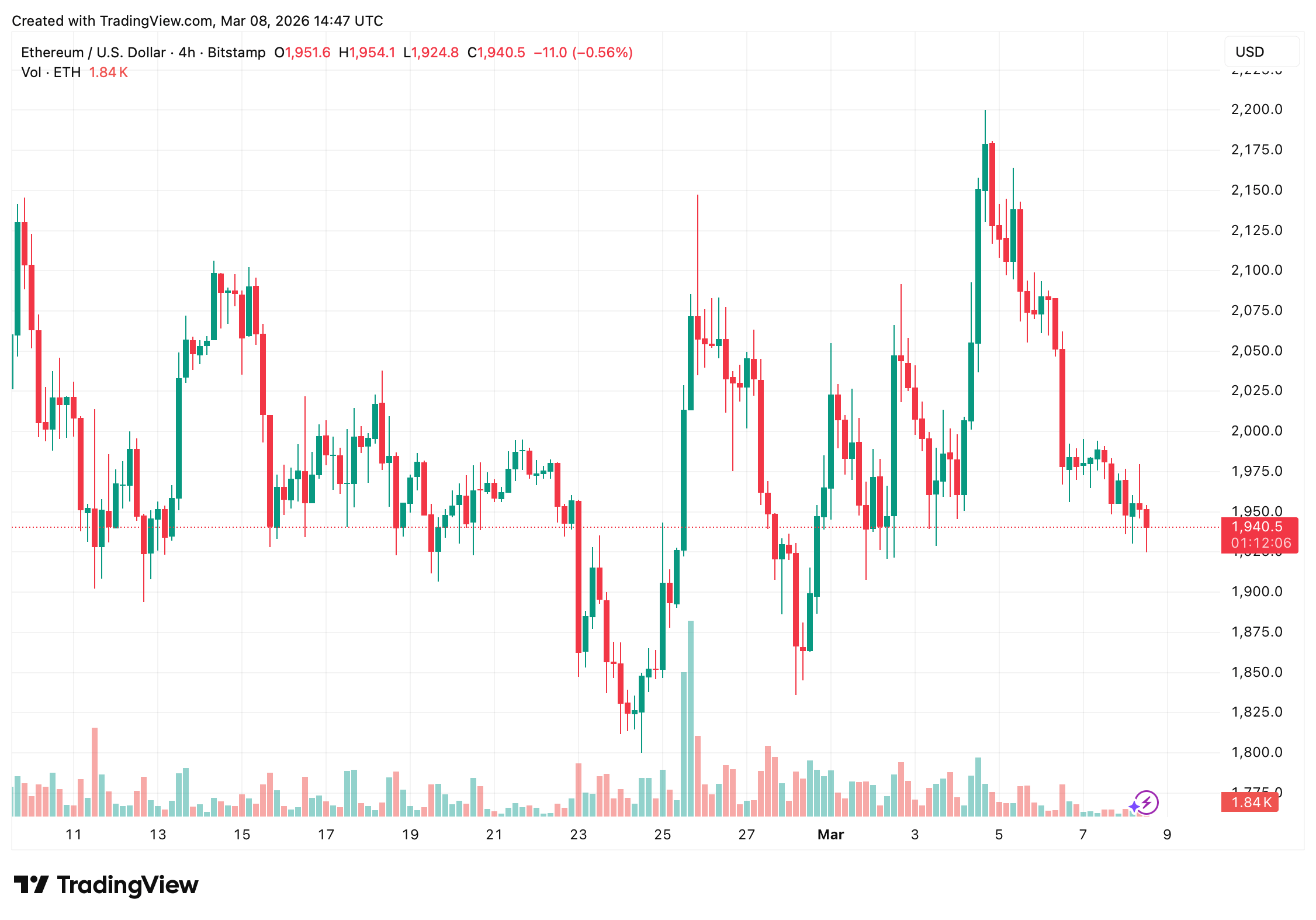
ETH/USD 4-hour chart via Bitstamp on March 8, 2026.
Short-term activity on the one-hour chart reflects minor fluctuations around the current price level and continued rejection near a descending trendline in the $1,960 to $1,980 area. Momentum signals show limited strength in either direction, reinforcing the sense that the market is testing support rather than launching a decisive move. The relative strength index ( RSI) reads 42.4, while the Stochastic oscillator prints 40.4, and the commodity channel index (CCI) sits at −47.7. The average directional index (ADX) stands at 29.9, suggesting a trend exists but lacks overwhelming strength.
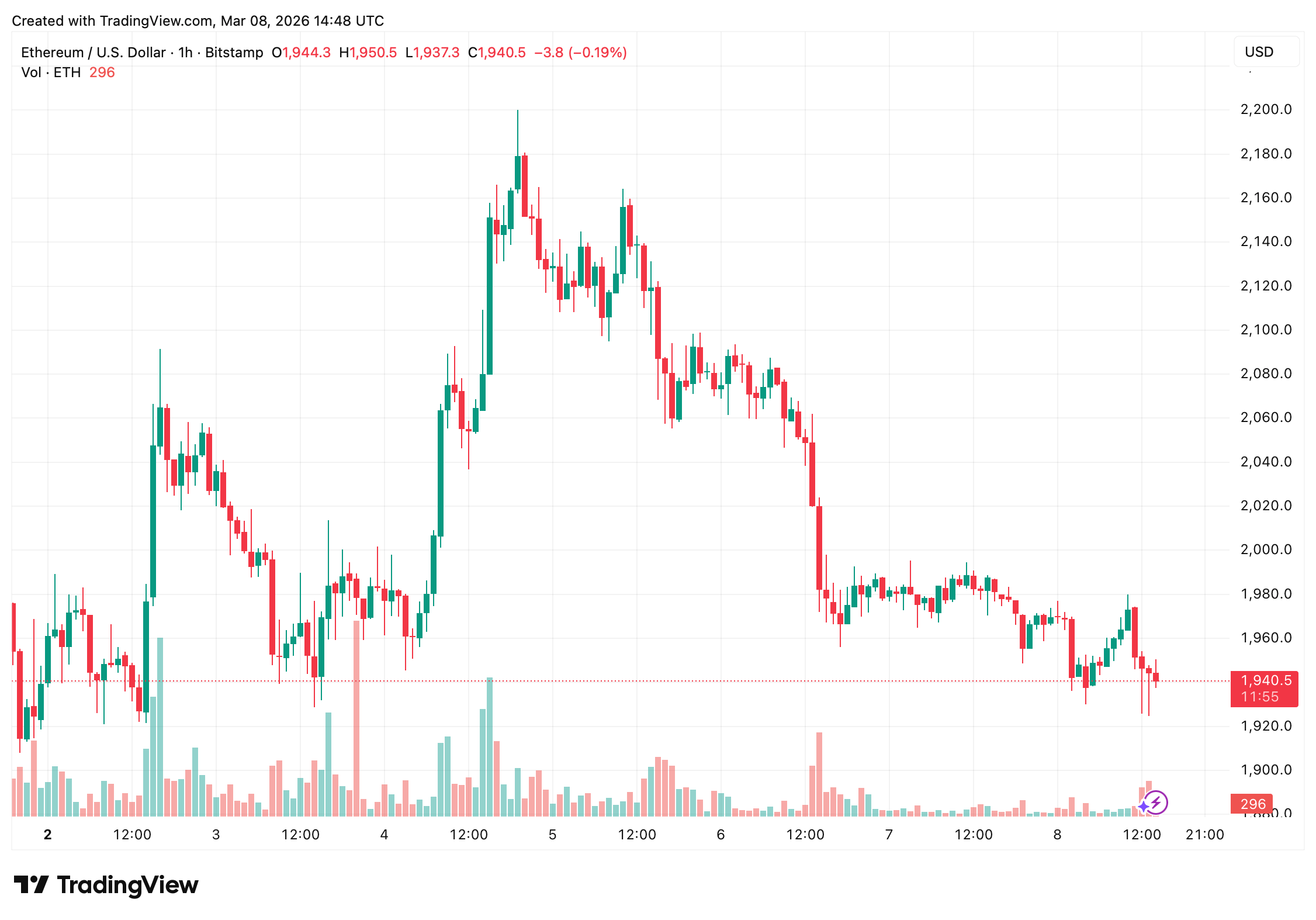
ETH/USD 1-hour chart via Bitstamp on March 8, 2026.
Ether’s moving averages (MAs), however, tell a far less diplomatic story. Nearly every major trend indicator sits above current price levels, creating a ceiling of technical resistance. The exponential moving average (EMA) and simple moving average (SMA) at shorter intervals both remain above spot price, including the $1,990 EMA (10) and $1,993 SMA (10), followed by the $2,017 EMA (20) and $1,975 SMA (20).
Higher-period indicators widen the gap even further, with the $2,249 EMA (50), $2,272 SMA (50), $2,587 EMA (100), and $2,673 SMA (100) all sitting well overhead. Longer-term trend markers such as the $2,899 EMA (200) and $3,324 SMA (200) reinforce the broader bearish structure.
Essentially, the technical picture is neither chaotic nor especially optimistic. Oscillators lean neutral, suggesting momentum has not reached extreme conditions, while the overwhelming alignment of moving averages above the market reinforces the prevailing downward pressure.
Ethereum’s current position near $1,930, therefore, represents less of a triumphant stand and more of a cautious balancing act. Should price reclaim the $1,980 to $2,000 region, the tone of the chart could shift. Until then, the technical landscape continues to resemble a market politely stuck under a very large ceiling.
Bull Verdict:
If ethereum stabilizes above the $1,930 support zone and manages to reclaim the $1,980 to $2,000 resistance band, the technical posture could shift from defensive consolidation to early-stage recovery. Oscillators currently sitting in neutral territory leave room for upward momentum to develop, particularly with the moving average convergence divergence ( MACD) already signaling a potential bullish crossover. A sustained move back above the Ichimoku Base Line near $1,999 would place the price back inside a psychologically important range and open the door for tests of higher resistance levels as momentum traders regain confidence.
Bear Verdict:
Despite neutral oscillators, the broader trend structure remains firmly under pressure as price trades below nearly every major exponential moving average (EMA) and simple moving average (SMA) across short-, medium-, and long-term intervals. Continued rejection beneath the $1,980 to $2,000 resistance corridor, combined with a breakdown below $1,930 support, would reinforce the existing bearish structure. In that scenario, the chart would likely shift focus toward the $1,880 to $1,900 support zone, with the heavy overhead cluster of moving averages continuing to act as a persistent technical ceiling.
- Why is ethereum trading below $2,000?
Ethereum remains below $2,000 as strong resistance from multiple moving averages continues to cap upward price momentum. - What do ethereum’s technical indicators show right now?
Most oscillators signal neutral momentum while moving averages indicate a strong bearish trend. - What are the key support and resistance levels for ethereum?
Immediate support sits near $1,930 with resistance concentrated between $1,980 and $2,000. - What could move ethereum’s price next?
A decisive break above $2,000 or below $1,930 could determine ethereum’s next directional move.
免责声明:本文章仅代表作者个人观点,不代表本平台的立场和观点。本文章仅供信息分享,不构成对任何人的任何投资建议。用户与作者之间的任何争议,与本平台无关。如网页中刊载的文章或图片涉及侵权,请提供相关的权利证明和身份证明发送邮件到support@aicoin.com,本平台相关工作人员将会进行核查。


