The spike unfolded while traditional commodity exchanges were closed, giving crypto-based traders a chance to react first to escalating geopolitical tensions tied to the U.S.-Israel conflict with Iran and mounting disruptions near the Strait of Hormuz.
West Texas Intermediate (WTI) crude perpetual futures traded on Hyperliquid climbed as high as $115 per barrel Sunday, while Brent equivalents touched roughly $117. The move came just days after conventional markets closed Friday with WTI around $89.04 and Brent at $93.33, levels already considered elevated following a week of military escalation across the Persian Gulf.
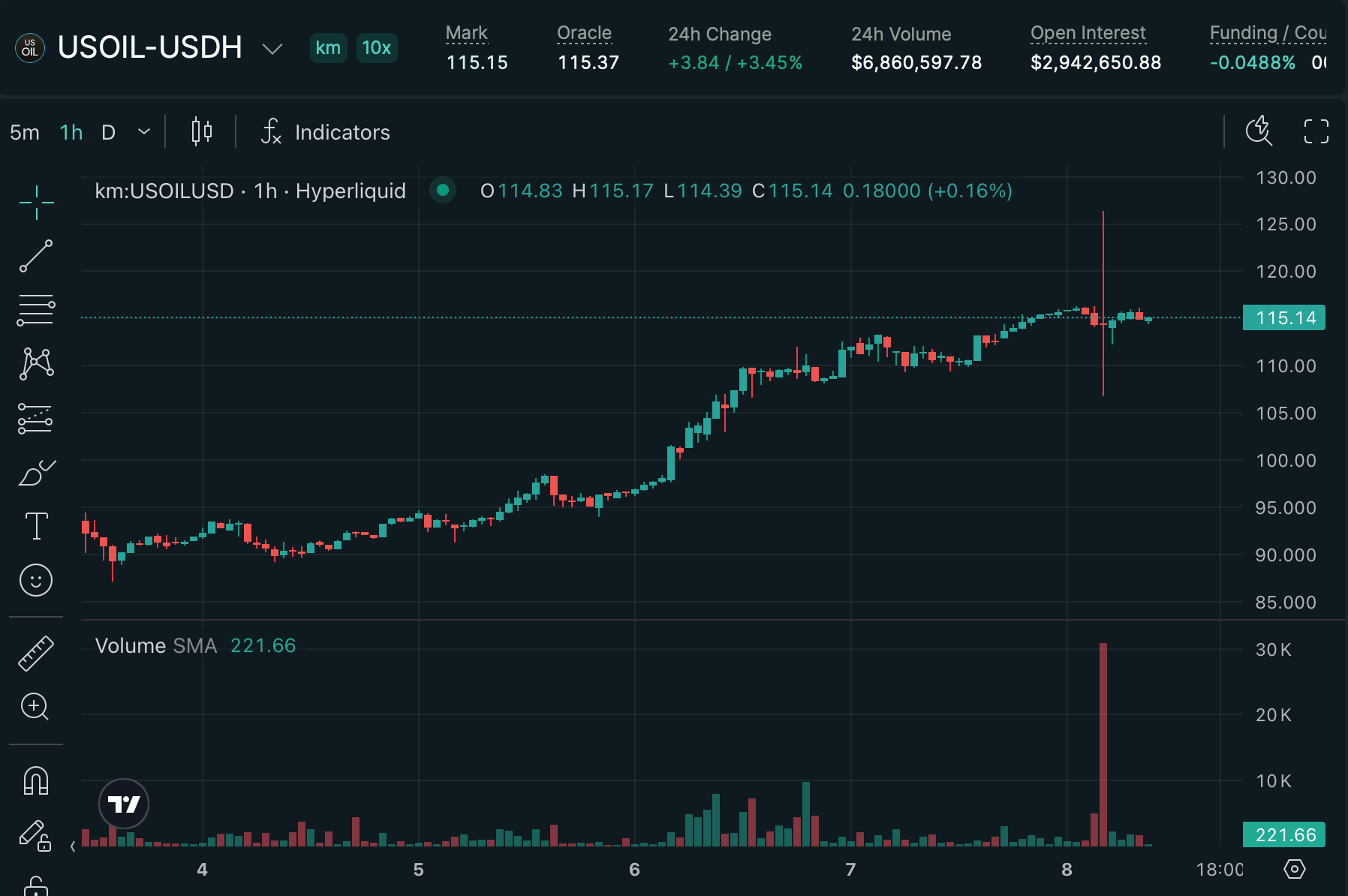
West Texas Intermediate (WTI) futures on Hyperliquid on Sunday morning.
The rally was fueled in part by sudden production adjustments from key exporters. Kuwait began cutting output Saturday by roughly 100,000 barrels per day and signaled deeper reductions could follow as export disruptions and full storage tanks forced the country to slow operations across several major fields and refineries.
Officials indicated the reductions could nearly triple if tanker traffic through the Strait of Hormuz does not normalize. The narrow waterway carries about 20% of global oil shipments, making it one of the most important energy chokepoints on the planet.
In a note provided to the Wall Street Journal (WSJ), UBS commodity strategist Giovanni Staunovo explained that “storage is limited in the Middle East, and the only fix to avoid tanks running over is to curb production.” He added, “The longer the strait stays closed, the more barrels of crude and refined products will be missing, leading to higher prices.”
The United Arab Emirates also began adjusting offshore production levels as export bottlenecks caused storage to swell. While some shipments are being rerouted through the Fujairah pipeline that bypasses Hormuz, officials said output must be balanced with available storage capacity to prevent operational strain.
Other producers in the region are facing similar pressures. Iraq reportedly cut production sharply in several fields, while Saudi Arabia temporarily halted operations at a refinery following attacks tied to the broader conflict.
Those supply concerns collided with a different kind of market dynamic on Hyperliquid, a decentralized derivatives exchange that allows traders to buy and sell perpetual futures contracts around the clock. Because the platform operates continuously, prices can move even when legacy markets such as NYMEX and ICE remain closed for the weekend.
Crypto-native traders flooded the platform as geopolitical headlines intensified, pushing open interest in oil perpetuals past $50 million at times and sending daily trading volumes above $100 million during peak activity.
Liquidity and high leverage helped magnify the price swings this past week. Large traders opened aggressive long positions as speculation grew that oil could jump sharply if the Strait of Hormuz becomes fully blocked.
When traditional futures markets reopen, prices could very well drift back toward levels supported by physical supply and demand, but there’s a possibility they stick too. Still, the Hyperliquid move offered a glimpse of how quickly markets can react when geopolitical risk collides with always-on trading infrastructure.
The underlying conflict driving the volatility began Feb. 28 when the United States in collaboration with Israel launched coordinated strikes on Iranian military and nuclear facilities. Iran has responded with waves of drones and missiles targeting Israel, U.S. bases and infrastructure across the Gulf region.
The fighting has already begun to affect critical energy routes. Tanker traffic through Hormuz has slowed significantly, forcing exporters to reduce shipments and redirect cargoes where possible.
Several investment banks have previously warned that a full closure of the strait could send crude toward the $100 to $150 range depending on the duration of the supply shock.
Higher oil prices also threaten to complicate global inflation trends. Rising fuel costs typically ripple through transportation, manufacturing and food supply chains, placing pressure on consumers and central banks alike.
President Donald Trump, however, suggested the spike may not last. In comments about the conflict, Trump described the recent oil jump as a temporary market reaction and indicated prices should stabilize if the situation cools. Trump told press oil prices will eventually “come down.”
The U.S. President insisted:
Trump also took to Truth Social this weekend to declare that the U.S. is already winning and tossed in a statement to the United Kingdom for good measure. “The United Kingdom, our once Great Ally, maybe the Greatest of them all, is finally giving serious thought to sending two aircraft carriers to the Middle East,” Trump wrote. “That’s OK, Prime Minister Starmer, we don’t need them any longer — But we will remember. We don’t need people that join Wars after we’ve already won!”
Meanwhile, Hyperliquid’s sudden role as a real-time barometer for geopolitical risk has caught the attention of traders and media in both crypto and traditional finance (TradFi). The exchange, built on its own layer one (L1) blockchain network, has rapidly grown into one of the largest venues for decentralized derivatives trading.
Whether the weekend’s price shock proves to be a fleeting moment or an early warning sign depends largely on what happens next in the Persian Gulf. For now, oil traders appear to be bracing for more turbulence.
- Why did oil hit $115 on Hyperliquid?
Oil prices spiked due to Middle East conflict risks and production cuts from Kuwait and the UAE during weekend trading on the 24/7 crypto exchange. - What is Hyperliquid and why does it affect oil prices?
Hyperliquid is a decentralized derivatives exchange where traders can buy oil perpetual futures around the clock, allowing prices to move when traditional markets are closed. - How important is the Strait of Hormuz to global oil supply?
Roughly 20% of the world’s oil shipments pass through the Strait of Hormuz, making disruptions there a major driver of energy price volatility. - Could oil prices rise further if the conflict continues?
Analysts say prolonged disruptions in Gulf shipping routes could push crude prices toward $100–$150 depending on how long supply constraints last.
免责声明:本文章仅代表作者个人观点,不代表本平台的立场和观点。本文章仅供信息分享,不构成对任何人的任何投资建议。用户与作者之间的任何争议,与本平台无关。如网页中刊载的文章或图片涉及侵权,请提供相关的权利证明和身份证明发送邮件到support@aicoin.com,本平台相关工作人员将会进行核查。


