On the 1-day chart, bitcoin continues to digest the sharp rejection that followed the early-March rally toward the mid-$70,000 range. Price action now sits near the middle of a broader consolidation band between roughly $64,000 and $72,000, a zone that has contained the market for several weeks.
Recent daily candles show shrinking volatility, suggesting that the aggressive selling pressure seen earlier in the week has cooled. Still, the structure of lower highs since the March 5 peak near $74,000 keeps the broader short-term trend cautious. The $65,500 to $66,000 region now acts as a key support cluster, while upside attempts face heavy resistance beginning near $68,200 and extending toward $70,000.
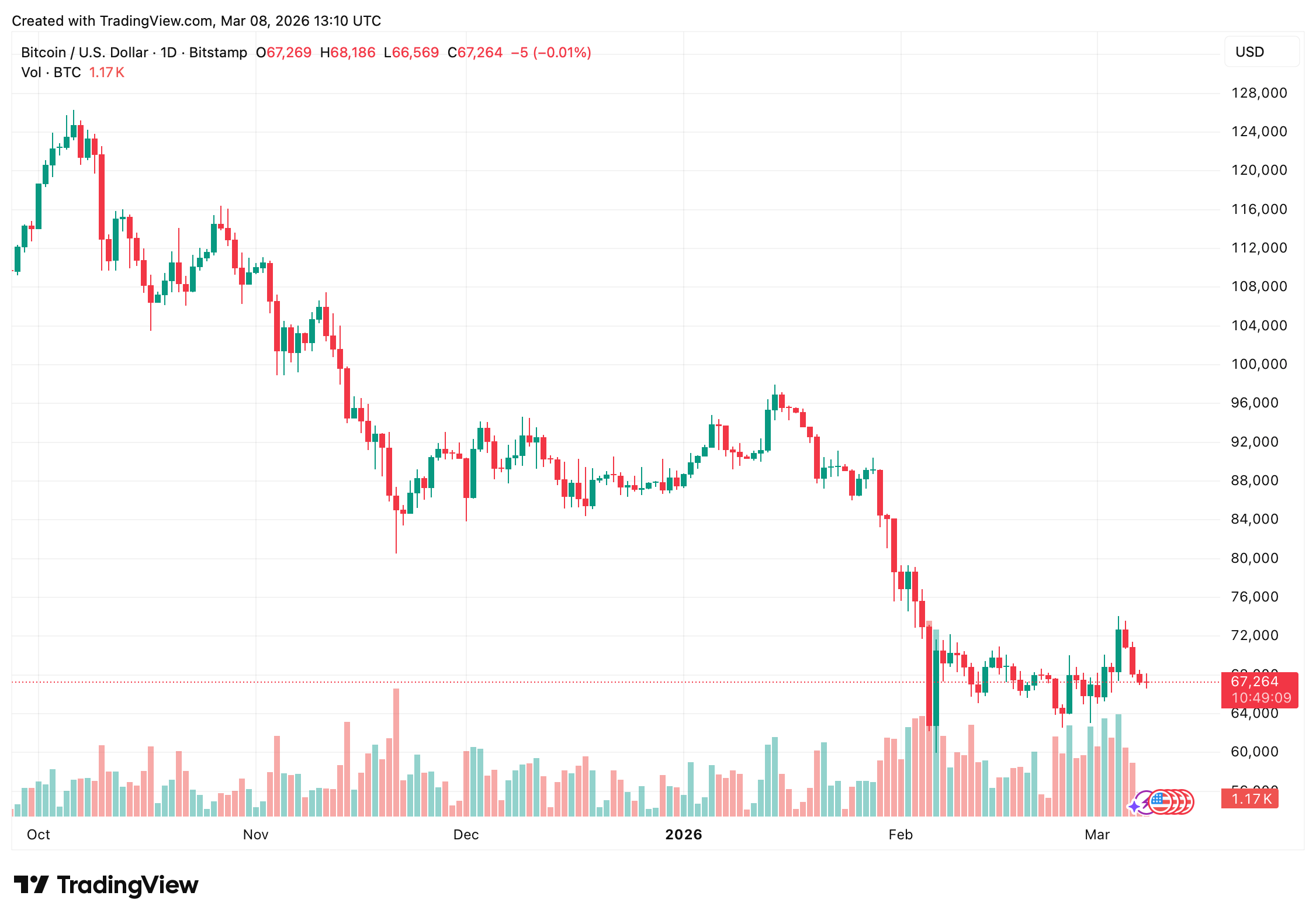
BTC/USD 1-day chart via Bitstamp on March 8, 2026.
The 4-hour bitcoin chart presents the clearest picture of the current structure. After a strong bearish impulse pushed bitcoin rapidly from the $74,000 area down toward the mid-$66,000 range, price transitioned into sideways consolidation. This pattern resembles either a developing bear flag or a simple cooling-off period following the earlier decline. The midpoint of this range sits near $67,200, close to the current market price. Repeated defenses around $66,600 suggest short-term buyers are active there, while rallies toward $68,200 to $68,500 continue to stall. Until either boundary breaks decisively, the market remains in a contained rotation that reflects uncertainty rather than conviction.
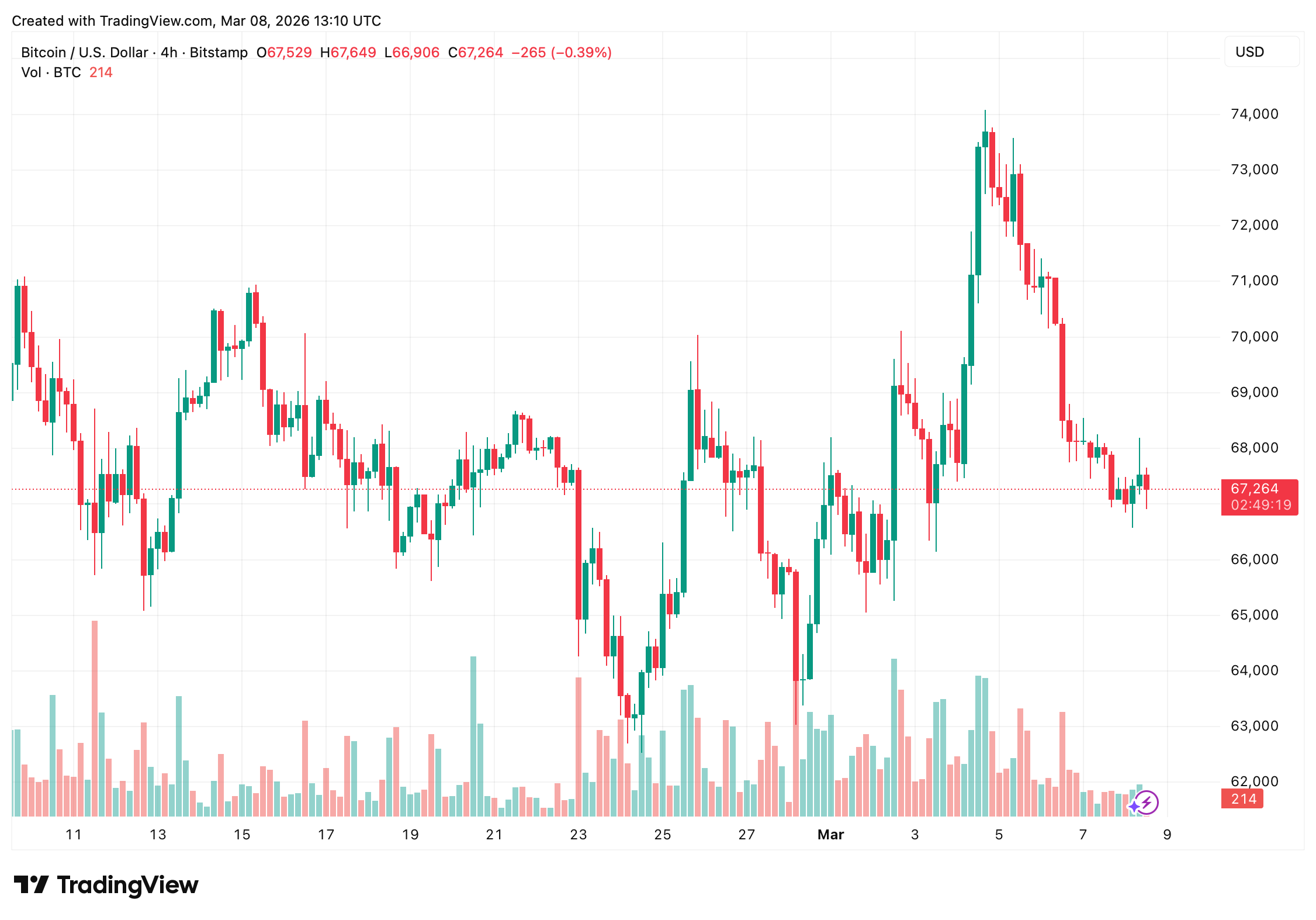
BTC/USD 4-hour chart via Bitstamp on March 8, 2026.
On the 1-hour chart, bitcoin’s price action becomes noticeably choppier, reflecting a short-term tug-of-war between buyers defending support and sellers leaning into overhead resistance. The chart continues to produce a sequence of minor lower highs since the March 5 peak, reinforcing the broader cooling trend. Price recently bounced from roughly $66,600, confirming that level as an immediate intraday floor. However, each push higher struggles to clear the $67,800 to $68,200 region. For now, the 1-hour structure resembles a tight sideways channel, where volatility has contracted and directional momentum has faded.
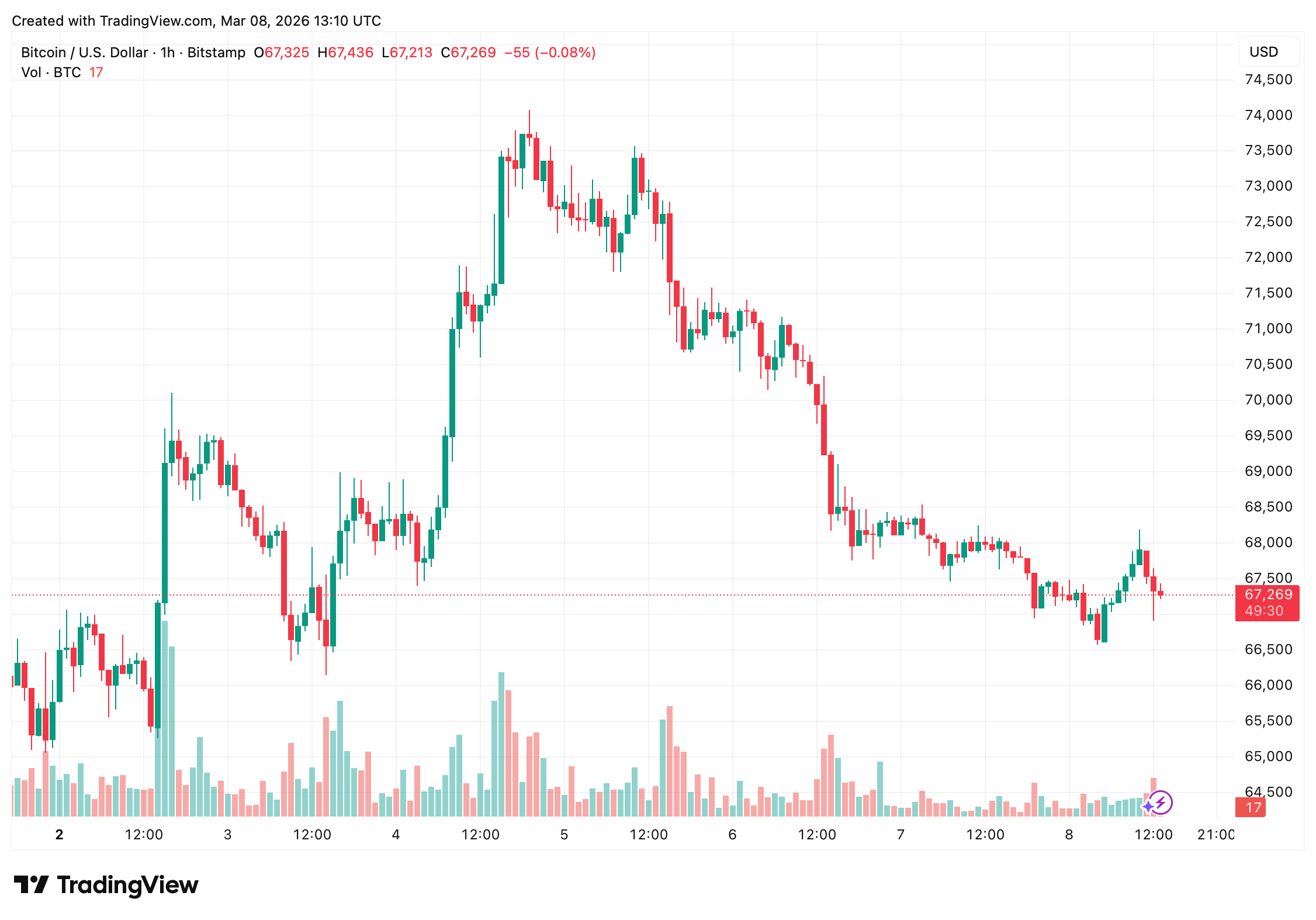
BTC/USD 1-hour chart via Bitstamp on March 8, 2026.
Oscillators reinforce the narrative of a market lacking strong momentum. The relative strength index ( RSI) stands at 45, indicating neutral conditions with neither overbought nor oversold pressure dominating. The Stochastic oscillator reads 44, while the commodity channel index (CCI) prints −9, both suggesting equilibrium between bullish and bearish forces. The average directional index (ADX) at 35 shows that a trend recently existed but is now weakening.
At press time, the Awesome oscillator registers around 1,200 but remains directionless. Momentum (10) prints −148 and the moving average convergence divergence ( MACD) level at −1,224 hints at easing downside pressure. The Stochastic relative strength index (Stochastic RSI) at 57, Williams percent range at −58 and the ultimate oscillator at 52 all cluster in neutral territory, collectively reflecting a market pausing after its recent move.
Moving averages (MAs) present the clearest technical hurdle. Price currently trades beneath nearly every major moving average tracked on the chart, reinforcing the near-term resistance overhead. The exponential moving average (EMA) and simple moving average (SMA) across shorter periods both sit above current price, with the 10 EMA at $68,212 and the 10 SMA at $68,211. The 20 EMA stands at $68,648 while the 20 SMA sits at $67,536. Further overhead resistance appears at the 30 EMA near $70,058 and the 30 SMA at $67,955.
Longer-term measures widen the gap even more, including the 50 EMA at $73,517 and the 50 SMA at $74,171. The 100 EMA rests near $80,903 and the 200 EMA near $89,094, with the 100 SMA at $82,184 and the 200 SMA at $95,428. Additional signals show the volume weighted moving average (VWMA) around $67,733 and the hull moving average (HMA) near $68,232, while the ichimoku base line sits at $68,300. Together they form a layered resistance band above the market, meaning bitcoin will need stronger upside momentum before reclaiming a more constructive technical posture.
Bull Verdict:
If bitcoin continues defending the $66,600–$66,800 support band, the market could attempt another rotation toward overhead resistance. A push above $68,200 would be the first signal that short-term momentum is rebuilding, potentially opening the door for a retest of $69,500 and the psychologically important $70,000 level. Stabilizing oscillators and fading downside momentum in the moving average convergence divergence ( MACD) suggest the recent decline may be losing steam. If price can reclaim several of the shorter-term moving averages clustered between roughly $67,700 and $68,600, the technical structure would begin shifting from consolidation toward recovery.
Bear Verdict:
Failure to hold the $66,600 support zone would likely invite renewed downside pressure, particularly with bitcoin currently trading beneath nearly every major moving average. A decisive break below $65,800 would invalidate the current consolidation structure and could accelerate a move toward the broader range floor between $63,000 and $64,000 on the daily chart. The persistent stack of overhead exponential moving averages (EMA) and simple moving averages (SMA) reinforces the bearish risk, as rallies continue to stall beneath resistance. Until bitcoin climbs back above the $68,000–$70,000 region, the broader technical posture remains vulnerable to another leg lower.
- What is bitcoin’s price on March 8, 2026?
Bitcoin is trading around $67,259 on March 8, 2026, moving within a tight intraday range between roughly $66,636 and $68,109. - Is bitcoin trending up or down right now?
Technical charts show bitcoin consolidating with a slight bearish bias after a recent rejection from the $73,000–$74,000 resistance zone. - What are the key support and resistance levels for bitcoin?
Key support sits near $66,600, while immediate resistance is around $68,200 with stronger resistance building near $70,000. - What do technical indicators say about bitcoin’s momentum?
Most oscillators are neutral and bitcoin remains below multiple moving averages, signaling weak momentum and ongoing consolidation.
免责声明:本文章仅代表作者个人观点,不代表本平台的立场和观点。本文章仅供信息分享,不构成对任何人的任何投资建议。用户与作者之间的任何争议,与本平台无关。如网页中刊载的文章或图片涉及侵权,请提供相关的权利证明和身份证明发送邮件到support@aicoin.com,本平台相关工作人员将会进行核查。


