Original video title: Ray Dalio: "AI Is Eating Everything - and It Might Eat Itself"
Original video source: All-In Podcast
Original text translation: Deep Tide TechFlow
Key Points Summary
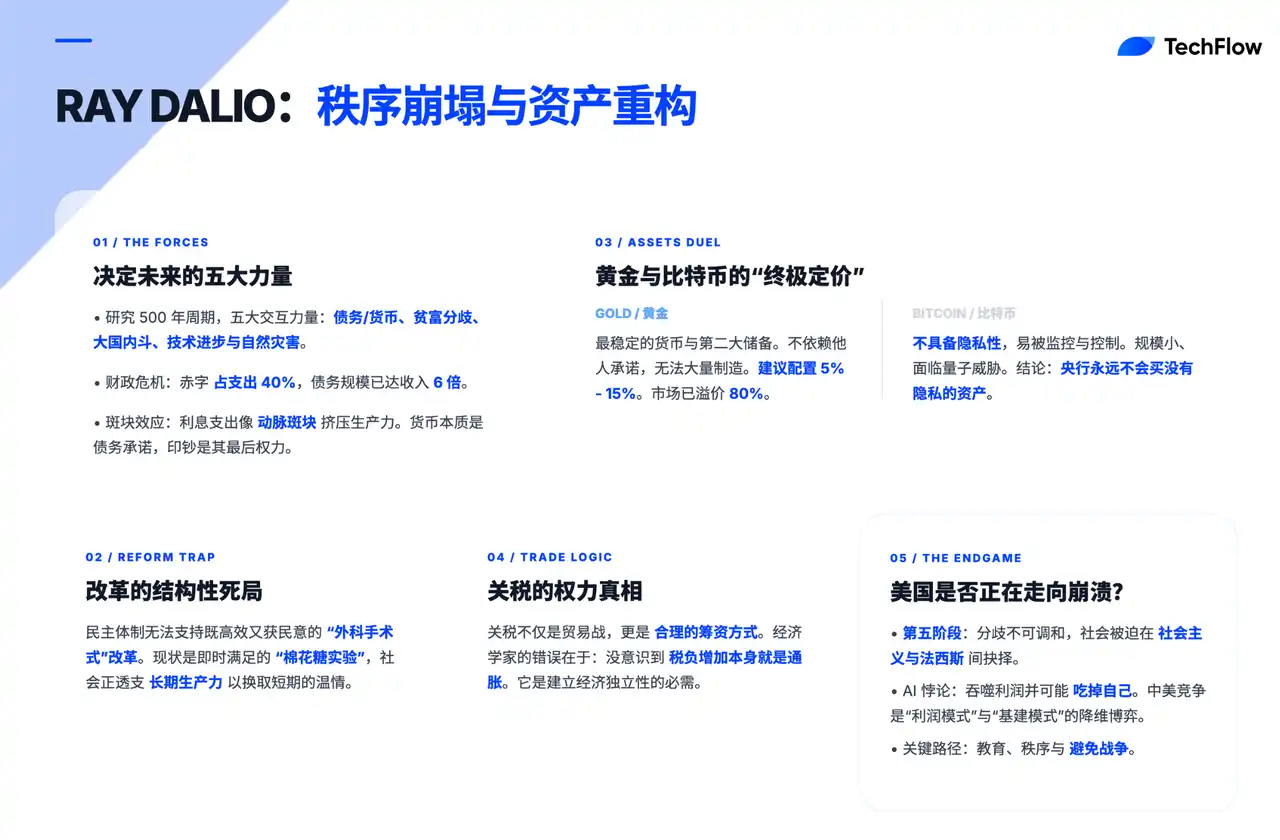
During his third appearance on the All-In Podcast, famous investor Ray Dalio delved into the seriousness of the U.S. debt crisis and made predictions about possible future directions. He discussed in detail the five forces reshaping the global order, the structural limitations facing government efficiency sectors, the driving factors behind gold prices reaching historic highs, the reasons behind Bitcoin's poor performance, and the real stories behind tariffs and trade deficits. He also explained why he believes the U.S. may be approaching the brink of collapse.
Highlights of Key Points
On the nature of debt and the economy
· The issues surrounding the debt cycle are akin to the circulatory system of the human body. When the cost of debt servicing continues to grow relative to income and becomes unmanageable, it compresses other expenditures like the plaque accumulating in arteries.
On the structural dilemmas of government reform
· In an efficient government, making it even more efficient is not easy. Attempting to reform in a 'surgical' manner, while being both efficient and fast, without triggering too much opposition, is virtually impossible.
On the core logic of currency
· Mechanically speaking, currency is essentially a form of debt. When you hold currency, you are essentially holding a debt instrument, which is merely a promise that someone will give you currency. When central banks accumulate excessive debt, their power is to print money.
On the irreplaceability of gold
· Gold is the only long-term historical asset that can be transferred, cannot be manufactured in large quantities, and does not rely on the promises of others. In other words, most currencies, debts, stocks, etc., are simply someone's promise to redeem purchasing power.
On the difference between Bitcoin and gold
· Bitcoin lacks privacy; its transactions can be monitored and may even be subject to control. Central banks would not want to purchase or hold Bitcoin. Moreover, there are questions regarding the development of new technologies, such as whether quantum computing will impact Bitcoin.
On misunderstandings about tariffs and inflation
· A common mistake made by economists is not accounting for taxes in inflation. I mean, if your tax burden increases, that is also inflation. Why should this differ from the impact of rising home prices on you?
On three keys to national success
· First, you must educate the children well. Second, society needs to provide an orderly, civilized environment. Third, you must avoid war. If these three points are achieved, the country will succeed. This is a fact repeatedly proven by history.
On the endgame of societal division
· We are moving toward that 'war', and in fact, we are already in it. When the positions people support become more important to them than the system itself, the system will face a crisis.
On the paradox of AI 'eating itself'
· Artificial intelligence seems to be consuming everything, but it might 'eat itself'. It may not be able to generate enough profit… China may consider artificial intelligence as infrastructure similar to electricity, providing free access to everyone. In that case, how do we compete?
On the metaphor of the current state of America
· This is exactly our problem—the demand for instant gratification, and the ignorance of whether certain things will lead to productivity.
Five Forces Determining America's Future
David Sacks: Reflecting on the government's actions over the past year, Congress's conduct, and economic performance, I want to ask you: Are we currently on the right path? Or is there not much change compared to a year ago? Or are we moving too slowly?
Ray Dalio: I have studied historical major cycles over the past 500 years and found that five key forces intertwine to jointly determine the answer to your question. The first is the debt and monetary issue, which I will detail shortly. The second is the issue of domestic divergence, including gaps in wealth and values. These gaps have led to irreconcilable differences between the left and right, affecting tax policies, democratic systems, and everything about how things operate. The third is the great power conflicts between nations. This follows the typical 'rise of great powers challenging existing powers' model, altering the global order. The fourth is technological advancement. Throughout each historical cycle, technology has played a significant role. Lastly, there are natural disasters, including droughts, floods, and pandemics.
When we talk about order, we mention monetary order, and all monetary orders will ultimately collapse for the same reasons. Similarly, all political orders, both domestic and international, will also change. The political order in the U.S. has been relatively stable for the past 250 years, although it has experienced a civil war. At the international level, the changes in order have been more frequent, exemplified by the shift from a unipolar world to a multipolar one, alongside continual technological changes in the world.
Now that these factors exist, let me further explain the government's financial situation and answer your question. The economic operation of a country is fundamentally similar to that of a company or individual, except that the government has the ability to print money. If we view the government as a company or individual, its expenditures are around $7 trillion, while its revenue is only $5 trillion, leading to a 40% deficit relative to expenditures. For a long time, the U.S. has been running a deficit; the current debt size is six times its revenue, from which forecasts can be made.
The issues with the debt cycle are like the circulatory system of the human body, with capital markets delivering credit to various parts of the economy. If this credit is used to enhance productivity and generate enough income to cover the cost of servicing the debt, then it's a healthy process. The problem arises when the cost of servicing debt continues to grow relative to income and becomes unmanageable, compressing other expenditures like plaque in arteries.
Currently, the U.S. has a $2 trillion deficit, half of which is interest payments, and we also need to roll over $9 trillion of maturing debt. If we apply this situation to a company or individual, it is obviously a problem. To stabilize the situation, a deficit of around 3% of GDP might be a reasonable level. But the current situation is quite unhealthy, not only because it compresses expenditures but also due to issues with the supply and demand of the debt.
We need to roll over $9 trillion of maturing debt and also sell an additional $2 trillion in debt. So who are the buyers of this debt? Part of it is from domestic buyers, and part is from foreign buyers, accounting for about one-third. From their perspective, this situation is riskier.
First, the proportion of dollar-denominated debt in their portfolios is already high, possibly exceeding prudent investment limits, and there are geopolitical risks. For instance, you can imagine potential conflicts with China or rising tensions with Europe. Europeans might worry about facing sanctions that could halt debt service payments, and the U.S. must also be concerned about attracting sufficient capital.
The situations I have described have historically repeated themselves. For instance, between 1929 and 1945, we saw similar dynamics. Thus, this financial situation is not healthy for the U.S. government, but larger issues compound these problems.
Why Government Reform Is Almost Impossible
David Sacks: You previously mentioned this issue and provided a diagnostic opinion: If we could reduce the deficit-to-GDP ratio to 3%, we could alleviate the impacts. But this hasn't happened. Last year, we had high hopes when Elon Musk took over the efficiency department, as he planned to carry out some sweeping reforms, including cutting government spending and combating fraud, etc.
Do you think the failure of this reform was due to inherent issues with the actions taken, or is it that the entire system has become unchangeable at this stage of the cycle? Is it because there is too much capital movement in the economy, making the economy overly dependent on this capital, and too many individuals and businesses reliant on it, leading us to structurally fail to escape this predicament? Does this attempt tell us about the potential for government reform at this stage?
Ray Dalio: In an efficient government, making it even more efficient is not easy. Especially when quick action is required because of electoral pressures, and people generally do not favor these reforms, ultimately you may lose public support. Furthermore, in our society, anything you do will be criticized and questioned. This leads to a question: Can democracy and our system truly support a model of administrative leadership that is both efficient and accepted by all?
For instance, when we discuss cutting expenditures, programs such as school lunch plans will be cut. Attempting to reform in a 'surgical' manner, while being both efficient and fast, while avoiding too much opposition, is nearly impossible.
If we look back in history, from a political perspective, or simply from common sense, you will find that seeking an administrative leadership model that satisfies the majority while also quickly advancing reform is a very challenging task.
David Sacks: Recently, there has been significant news indicating potential widespread fraud in public funding in California. For instance, some non-existent daycare centers have received billions of dollars in funding. Do you see this as a symptom of the current stage of the cycle? How do you view the relationship between this situation and the issues we are discussing?
Ray Dalio: Yes, this is indeed a manifestation of this stage of the cycle. If you want a well-managed government, you must ask yourself: How well can the government manage affairs? For example, a visit to the Department of Motor Vehicles will reveal how large, complex, and chaotic the system is. So, when you see these inefficiencies, are you surprised? You might not be.
Gold vs Bitcoin
David Sacks: You previously mentioned that a portion of your portfolio is gold, and the price of gold has risen from $2,900 per ounce to $5,200. How has gold performed in the past year? Is this because the market finally recognizes the cyclical stage you have mentioned for years, or is it because China has structurally moved away from the dollar and U.S. bonds, opting for more gold? Or is it due to other central banks also shifting towards gold? Or is it due to increased interest in gold from individual speculators and market participants?
Ray Dalio: This is related to larger cycles. What we need to understand is that gold is not merely a speculative precious metal, as most people believe. Gold is one of the oldest and most stable currencies, and it is the second-largest reserve currency held by central banks. Thus, for various reasons—economic supply and demand dynamics, politics, geopolitics, etc.—central banks themselves are also buying gold to increase reserves. Meanwhile, individuals and other investors are seeking alternative currencies.
The question is, what is currency? Mechanically speaking, currency is essentially a form of debt. I mean, when you hold currency, you are essentially holding a debt instrument, which is merely a promise that someone will give you currency. As I mentioned earlier, when central bank debt becomes excessive, their power is to print money. If you understand this, you will come to grips with what is happening now. The key question is, David, what type of currency do you think is safe?
David Sacks: What I want is an asset-backed currency, an asset with real physical limitations.
Ray Dalio: Particularly assets that can be transferred from one place to another. After all, currency is both a medium of exchange and a means of storing wealth. If a country's central bank or government wants to make payments to another government, it needs real money, not fixed assets like buildings. If you want to engage in transactions, you must use something transferable. And gold is the only long-term historical asset that can be transferred, cannot be manufactured in large quantities, and does not depend on the promises of others. In other words, most currencies, debts, stocks, etc., are merely someone's promise to redeem purchasing power.
Wealth and currency need to be distinguished. Wealth can exist in the forms of stocks, buildings, companies, etc., but you cannot directly spend this wealth. When you want to spend, you need to convert it to currency. And presently, our ratio of wealth to currency is exceedingly high. The issue is when you attempt to convert wealth into currency, they might choose to print money. This has been happening since we adopted fiat currency.
David Sacks: So, when you communicate with market participants, are they converting wealth or currency into gold? How much growth potential is there in the market cycle for gold priced in dollars?
Ray Dalio: I usually observe who holds what types of assets, including those held by central banks and the composition of those assets. I look at the ratio of wealth to currency, or wealth to gold. We can see that the total amount of wealth and the amount of other currencies held by central banks are quite large in comparison to hard currencies like gold.
Gold's price has risen from a very low level to a higher level, and this price increase and changes in asset composition have almost restored to historical averages, though not completely. However, as the total wealth relative to currency remains high, this is still a significant issue.
For a concrete example, a wealth tax poses a potential risk. One might ask: "Are we in a bubble now?" For instance, do stocks related to artificial intelligence and similar stocks represent a bubble? But we know that a characteristic of bubbles is that they create demand for currency, which compels people to sell assets to acquire funds to meet these demands.
Typically, this demand originates from borrowing to purchase assets, driving asset prices up. But this situation cannot last because debt service costs must be paid, and the assets themselves do not generate enough cash flow to cover those costs. Eventually, individuals must start selling assets to repay debts or to liquidate their wealth tax liabilities.
Regardless of whether individuals support a wealth tax, such a tax may itself lead to wealth flowing towards cash. The only way to gain cash is to sell assets or borrow against them, which triggers cash flow problems. Additionally, the societal impact of wealth disparity also complicates this issue politically.
Therefore, I believe that both individuals and companies, and even nations, should be concerned about whether they hold enough gold. Even if you don't have a particular view on gold, you should allocate 5% to 15% of your portfolio to it. Because gold has a negative correlation with the performance of other assets, when economic problems arise, gold tends to perform well while other assets often do poorly.
David Sacks: Why hasn't Bitcoin shown trends similar to gold? After our last conversation, gold rose 80%, while Bitcoin fell 25%. How do you view Bitcoin's performance and why hasn't it become the safe-haven asset many believe it to be?
Ray Dalio: Bitcoin and gold have some key differences. First, Bitcoin lacks privacy; its transactions can be monitored and may even be indirectly controlled. Central banks would not want to purchase or hold Bitcoin. Thus, it is unlikely that not just individuals, but also institutions and central banks will view Bitcoin as a reserve asset. Additionally, there are questions regarding new technological developments, such as whether quantum computing will impact Bitcoin.
Bitcoin's market size is relatively small, making it easier to manipulate. Despite attracting considerable attention, its scale as a currency remains minor compared to gold. Thus, these are the dynamic differences between Bitcoin and gold.
David Sacks: And silver? Silver's price has also risen significantly in the past year. Is this a derivative of gold, or are people just speculating on silver following gold's trend?
Ray Dalio: Silver is a byproduct in production, and its supply is difficult to increase. Historically, for example, the pound was pegged to silver, and silver was also viewed as a currency, but it gradually became a speculative asset, leading people to chase it due to its popularity.
David Sacks: Last time we met, you talked about the importance of keeping interest rates low to address the impacts of the current economic cycle. So, what is your view on the current interest rate level and the actions taken by the Federal Reserve over the past year? Are these measures sufficient to alleviate the effects we are facing at this stage of the cycle?
Ray Dalio: Interest rates are one of the three main considerations for economic management, along with taxes and government spending. However, we cannot artificially keep interest rates too low, as one person's debt is another person's asset. If rates are too low, creditors will be adversely affected, resulting in the dynamics we are familiar with: more borrowing being funneled into various things, thus fueling bubbles.
At the same time, interest rates cannot be too high, or debtors will be excessively burdened and struggle to cope. Therefore, a balance is required: interest rates must be high enough to satisfy creditors' needs but not so high as to be unbearable for debtors. When there are large amounts of 'dead assets' and liabilities in the economy (as each dead asset corresponds to a liability), achieving this balance becomes very challenging.
This situation is further complicated in the so-called 'K-shaped economy'. In other words, certain parts of the economy have bubble phenomena, such as asking "Who will become the next trillionaire?" This concerns the wealthiest 1%. Meanwhile, another part of the economy is struggling, such as 60% of Americans reading below the sixth-grade level. Making these individuals more productive, especially as we face labor replacement issues, is a daunting task.
When the scale of assets and liabilities is too large and extreme inequality exists in the economy, achieving that balance becomes even more difficult, making the formulation of monetary policy extremely complex.
David: In the past year, there have been many reports indicating that numerous global central banks have stopped buying U.S. Treasuries and shifted to investing in gold. In this shift in the global market, does the Federal Reserve need to restart its Treasury purchases and expand its balance sheet? In the current stage of the economic cycle, do you think that another expansion of the Fed's balance sheet is inevitable?
Ray Dalio: I believe that in the long run, this scenario is possible. Currently, the Federal Reserve is addressing this issue by shortening the duration of debt, which increases the risks of rolling over debts. The government is trying to reduce the issuance of long-term debt, keeping short-term rates low to combat rises in long-term rates. At the same time, the government might use diplomatic means to persuade other countries to buy or hold U.S. Treasuries or attract other forms of capital into the U.S.
Economists' Misjudgments About Tariffs
David Sacks: Over the past year, many economists have strongly opposed tariffs, fearing that they might lead to inflation and reduced consumption, potentially having a negative impact on GDP growth. The president and government implemented a series of tariff policies under the Emergency Economic Powers Act, although the Supreme Court recently overturned this act. Reflecting on the impact of tariffs on the economy, what do you think are the correct and incorrect predictions made by economists regarding the effects of tariffs? Have they overlooked or misunderstood certain fundamental issues?
Ray Dalio: First, an important aspect of tariffs is tax revenue. A common mistake made by economists is not taking taxes into account in inflation. If your tax burden increases, that is also inflation. Through history, we can see that tariffs have been one of the main sources of government revenue for most periods. For many countries, tariffs are a perfectly reasonable method of raising funds, and we should include them in our considerations. Furthermore, foreigners also pay a part of the tariffs.
But from a big cycle perspective, one major issue we face is that our economy is not independent. We have experienced the 'hollowing out' of manufacturing and the middle class; this is a significant concern. The current question is whether we should attempt to rebuild these industries? Should we continue to maintain massive trade deficits? The U.S. trade deficit is unsustainable; it relies on foreign capital to cover its deficit, and this dependence is unsustainable, so we need to find some way to correct this issue.
Tariffs can be part of the solution, and I believe they are entirely reasonable. But this is not a one-size-fits-all solution; instead, it needs to be part of a larger plan. This includes developing the industries we need, building infrastructure, and attracting相关行业. Doing so is necessary not only for economic reasons but also for geopolitical considerations.
We are entering an increasingly conflictual world, transitioning from a multilateral world order to a confrontational global economy based on power. In this environment, the threats between countries are increasing, with the possibilities of commodity wars and capital wars on the rise. Thus, we must establish independence economically and politically, as part of constructing the future world.
David Sacks: In this week's State of the Union address, President Trump shared his vision that tariffs could completely replace income tax in the U.S. Do you think this is a viable path? Can tariffs become an effective tax tool, even completely replacing other forms of taxation?
Ray Dalio: I don’t think that is realistic. Primarily because of the scale of tariffs combined with their impacts, tariffs are a regressive tax system, and we still need to deal with the issue of wealth disparity. In my opinion, wealth disparity is not only a major social issue, but also a productivity issue. We must make most people more productive through means like developing infrastructure; I believe this is a significant issue that needs to be addressed.
David Sacks: According to my analysis, nearly half of Americans are directly or indirectly working for the government or for government service providers. In the past year, the federal workforce has decreased by about 317,000 people, which is about 14% of the total federal workforce. This administration has reduced the size of some agencies and trimmed staff. Do you think these individuals will enter the private sector and become more productive, or will they be absorbed by other government agencies and continue to engage in work that does not contribute substantively to economic growth?
Ray Dalio: I have studied these data, but I do not think I can fully answer this question. Overall, government efficiency is very low. While the government has its important roles, even those roles are executed with considerable inefficiency. Other countries may manage areas like education better; we need fundamental reforms.
For instance, education is one of the most worthwhile areas to invest in. Regardless of where these government employees go, the issues of their relocation and roles, as well as the inefficiency of the system itself, are problematic. One of the benefits of a capitalist system is that if something cannot attract investment or generate profits, it cannot sustain itself, but even so, the system is still full of inefficient personnel and ineffective mechanisms.
David Sacks: Is there currently a lack of enough productivity-driven economic growth to provide more people with opportunities to increase their income, wealth, and standard of living? Or is it that people’s abilities and education are insufficient for them to be productive, thus it is the system itself that has let them down?
Ray Dalio: The keys to success boil down to three points. First, educate children well, so that they have the ability to be part of productivity and are also taught how to coexist civility with others. Second, society needs to provide an orderly, civilized environment where people can compete and cooperate, thus achieving productivity improvements and benefiting the majority. Third, you must avoid war, including civil and international wars. If these three conditions are met, the country will succeed. This is a fact repeatedly demonstrated by history.
David Sacks: Are these the countermeasures to address current societal problems? For instance, the rise of unions, increased support for socialist movements, and discussions on wealth taxes—can these phenomena all be addressed through education, civilized environments, and avoiding wars?
Ray Dalio: We need to stop the infighting; the current situation is that we face irreconcilable differences. When the positions people support become more important to them than the system itself, the system will face a crisis. Our system is in danger because people will not accept the existing system or alternatives; they will choose to fight.
David Sacks: How does this affect productivity?
Ray Dalio: When we try to establish a good educational system, we face chaos and inefficiencies, and no one can really take control of the situation. If we look back in history, Plato wrote about the cyclical theory of democracy and its threats around 350 B.C. The current situation is similar to during the time of Julius Caesar, who was assassinated in the Senate.
We need a strong leader to push reforms that keep the nation functioning well. But the question remains how to get these divided groups to stop fighting and focus on improving productivity. This requires a strong leader who can compel everyone to take different actions, to stop the internal strife, and instead focus on common goals.
Is America on the Path to Collapse?
David Sacks: It sounds like we are on an inevitable path, ultimately having to choose between some form of socialism and some form of fascism. Is this the current state of the nation?
Ray Dalio: I believe yes, we are moving toward that 'war'; in fact, we are already in it. I refer to this as the 'fifth stage'. When a country's financial situation deteriorates, accompanied by huge wealth and value gaps and irreconcilable differences, and with both internal and external threats, such dynamics occur. I think this is precisely our situation now.
I see myself as a mechanic; my goal is not to act from an ideological perspective, but rather to make money in the market and describe what is happening. From my perspective, this is the current state.
David Sacks: Regarding the bubble in artificial intelligence, what is your view? Many people believe they are investing in technology, but in fact, they are investing in the stocks of these companies. Do you think this is a misunderstanding?
Ray Dalio: This is indeed a common misunderstanding; there is a significant difference between technology and the performance of companies. Generally, many startup companies fail, and only a small fraction succeed, while technology itself continues to evolve and improve. I want to emphasize that this dynamic has a crucial impact on the market. We can look back at the tech bubble of 2000, or even trace back to situations in the late 1920s, technology will continue to advance, but the companies may not survive.
Currently, it seems that artificial intelligence is consuming everything, but it may “eat itself,” as it might not generate enough profit. We cannot view this solely from a domestic perspective; we also need to consider the situation in China, where the economic philosophy differs from that of the U.S. The U.S. economy is mainly profit-driven, while China may consider profit a secondary concern. For instance, they might view artificial intelligence as a form of infrastructure, akin to electricity, providing everyone with free access and even open-sourcing it. In this way, they might achieve greater utilization and subsequently enhance productivity through usage.
In that case, how do we compete? Suppose their technology is nearly as good as ours and is free and open-source, while we need to generate profits to sustain ourselves. This difference in systems presents potential risks for artificial intelligence, and of course, there are many unknowns.
David Sacks: Looking back at American history, I often ask myself: How did we arrive at this point? Whether it's the size of the debt, government spending, or the role of central banks juxtaposed with the risks we currently face, all seem to be scenarios that could have been avoided with different decisions made earlier. If you could go back in time and become one of the founders of America, re-drafting the Constitution, what different choices would you make? What clauses would you include in the Constitution to avoid our current predicament?
Ray Dalio: This question reminds me of the "Marshmallow Experiment," where a child can choose to eat one marshmallow now or wait 20 minutes and eat two. Those who choose to wait tend to develop better decision-making skills in life. This is precisely our problem—the demand for instant gratification and the ignorance of whether certain things will lead to productivity.
However, I must also say that this system shows an astonishing ability to adapt. We have gone through crises, cleaned up debts, and eventually emerged from them; we always find ways to overcome difficulties. Balancing fiscal prudence with creative innovation is a challenging issue. Take the current artificial intelligence situation, for instance; no one knows what results it will yield or whether it will bring returns. Writing clauses into laws to ensure fiscal prudence and control, while not stifling innovation and entrepreneurial spirit, is indeed very difficult to achieve.
Perhaps the main point I would suggest is: read history. Understand these patterns and strive to find balance in all aspects. The key to everything lies in balance—whether facing the pain of failure or the pain of investing failures, finding balance is what matters most.
免责声明:本文章仅代表作者个人观点,不代表本平台的立场和观点。本文章仅供信息分享,不构成对任何人的任何投资建议。用户与作者之间的任何争议,与本平台无关。如网页中刊载的文章或图片涉及侵权,请提供相关的权利证明和身份证明发送邮件到support@aicoin.com,本平台相关工作人员将会进行核查。