Far fewer remember that October was also the month the U.S. government announced what it described as its largest Bitcoin seizure ever—coins tied to an alleged international crypto money-laundering network that, at the same moment, was being hit by coordinated enforcement actions across the U.S., U.K., Singapore, Thailand, Cambodia, and China.
The timing begs the question of whether there was a connection between the two events.
This article lays out a hypothesis that has circulated on Chinese Crypto Twitter but barely registered in Western coverage: that the October 10 crash may have been amplified by a sudden withdrawal of shadow-banking liquidity—what Chinese underground banking slang calls cháqián, or “tea money”—after a major crackdown disrupted the laundering rails that quietly feed crypto markets.
To be clear, there are multiple contributing factors to what happened on 10/10. Markets were already fragile. Leverage was high. Liquidity was thinner than many realized. A macro shock also hit the tape that day. And venue-level issues—exchange outages, cascading liquidations, and various “plumbing” failures—likely acted as accelerants.
But the “tea money” theory adds a potential missing piece: what if a major, steady bid—capital moving through offshore and underground channels—was abruptly turned off in the days and weeks before the spark?
Let’s start with a brief timeline of events showing some interesting coincidences:
- December 28, 2020: The LuBian mining pool in China is hacked for 127k BTC – the biggest hack ever.
- July 2024: Those coins get moved from the hacker’s wallet to another address that is later labeled by Arkham as belonging to the US Government.
- Oct 8 2025: The Eastern District of New York announces an indictment against Cambodian national Chen Zhi – alleged controller of LuBian – for allegedly laundering billions in BTC and stablecoins from scams and funneling it through businesses in NY, thus justifying US intervention. A massive wave of takedowns, raids, and seizures unfold in several “scam compounds” all over SEA.
- Oct 10 2025: Bitcoin tops out and almost every altcoin on every exchange scam wicks to zero. Silver immediately embarks on a 153% rally while gold also makes new all-time highs.
- Oct 14 2025: US announces it seized 127k BTC (the exact amount hacked from Lubian) from Chen Zhi, but doesn’t reveal who the original “hacker” was.
- November 2025: China accuses the US of stealing the 127k BTC
What follows is the connective tissue between what LuBian was, why Chen Zhi matters, how the laundering machinery works, and why an “invisible” flow—what Chinese underground banking slang calls cháqián, or “tea money”—might matter more to crypto pricing than most traders admit.
The LuBian mining pool
LuBian matters here for one reason: if prosecutors are right that Chen Zhi’s network moved enormous volumes through Bitcoin and stablecoins, then LuBian wasn’t just a mining business—it may have been part of the plumbing that fed (and recycled) the same cross-border liquidity traders treat as “organic” market demand.
It is not known who founded LuBian, but it has been closely linked with Chen Zhi, the chairman of the Cambodia-based Prince Group – a conglomerate focused on real estate, financial services, and consumer services, but has now been exposed as running a massive scam and money laundering empire. Lubian began mining in March/April 2020, with operations in both China, and Iran. The pool quickly became a top 10, sometimes top 5, player before abruptly shuttering in early 2021 after the hack. Hackers were able to brute force LuBian’s wallets due to the amateurish use of Mersenne Twister, a general-purpose pseudorandom number generator that LuBian used for its mnemonic seed phrases.
If LuBian were still around, its 127k BTC stash would make it the second biggest Bitcoin treasury in the world, just behind Strategy. It would likely be bigger if it had been able to continue mining. The company sent on-chain messages to the hacker offering a reward for the return of the coins, but never got a response. LuBian never publicly acknowledged the hack, and no one ever even reported on it for four years.
It’s worth asking what Chen Zhi was doing in the Bitcoin mining industry.
Was he interested in the philosophy of peer-to-peer digital cash and non-inflationary money – or was mining complementary to a multi-billion dollar laundering empire?
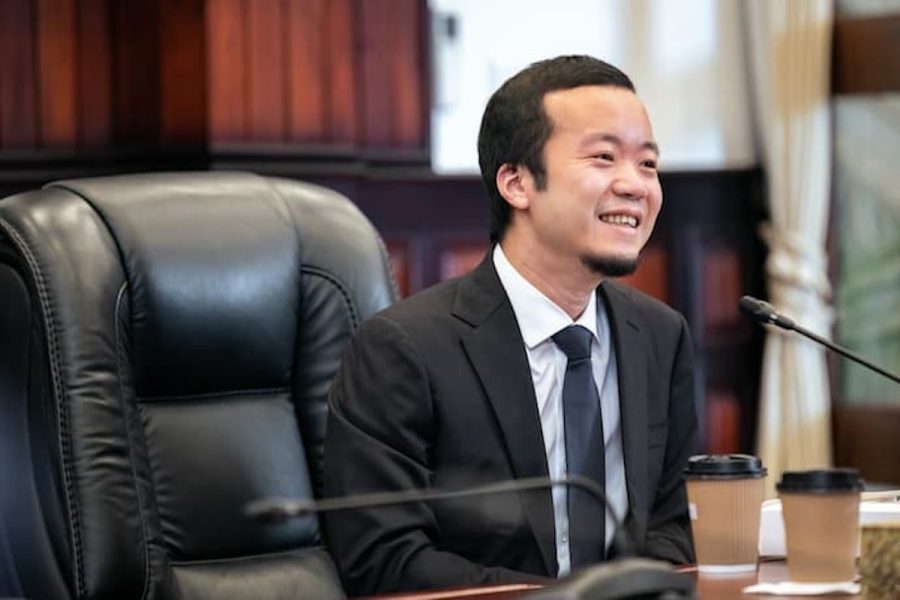
In the October 8, 2025, indictment from the Eastern District of New York, prosecutors accused Zhi of running pig butchering scams, “jingliaos” or scripted chat scams, investment frauds, and other schemes by recruiting migrant workers and setting up compounds filled with thousands of mobile phones farming victims.
In the “Golden Fortune” scam compound outside a village south of Phnom Penh, locals told journalists that they saw workers “beaten until they [were] barely alive” before being forcefully returned after escaping. These scam compounds are well known to exist all over SEA and India in similar fashions: workers are enticed by supposedly good salaries and benefits, only to be essentially imprisoned like animals working the phone lines and manning the scams.
According to the indictment:
“In the summer of 2022, Co-Conspirator-2 boasted that, in 2018, Prince Group was earning over $30 million a day from fraudulent sha zhu pan schemes and related illicit activities.”
Given the scope of Zhi’s alleged operations, it seems plausible that they were being used not just for his own personal gain, but as a proxy for larger, dark money operations to launder their funds or get capital out of Asia under the radar.
Coming Out Of Nowhere
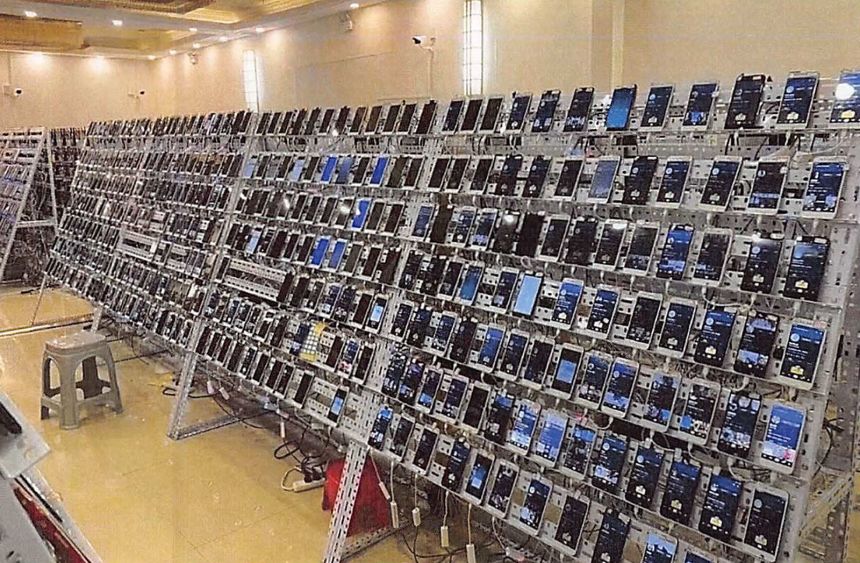
Chen Zhi was born into an ordinary family in 1987 in Xiao’ao Town, Lianjiang County, Fuzhou, Fujian Province, China. He dropped out of school before finishing junior high, and went to Shanghai, where he set up a server for The Legend of Mir 2, an online role-playing game created by Korean-based WeMade Entertainment. That is supposedly how he made his first fortune, which he then decided to convert into real estate in Cambodia. He launched Prince Group when he was just 27, which quickly became one of the biggest business groups in Cambodia, operating banking, finance, and tourism businesses.
Chen and his company were known for philanthropy, contributing millions to fund scholarships, purchasing vaccines, and actively participating in charity. He served as an advisor to the Ministry of Interior until 2017, and later became the founding chairman of Cambodia Airways.
However, no one really knows how Chen could have possibly gotten this rich and powerful, or why he decided to suddenly relocate to Cambodia.
The Beijing Municipal Public Security Bureau set up a special task force dedicated to investigating Prince Group in 2020, and separate Chinese police investigations unfolded between 2020 and 2022, but Chen managed to avoid the charges.
Chen’s mysterious success story ends in October of 2025 when the US indicts him and his colleagues, and an international campaign of anti-scam enforcement actions hits SEA.
The Raids and Seizures Begin
- The EDNY indictment in October foreshadowed many raids and enforcement actions that rained down on the scam centers of Cambodia and SEA. Cambodian authorities said that nearly 200 scam centres were closed, 173 senior crime figures were arrested, and 11,000 workers were deported. Chen Zhi’s operations were shut down, and his global assets were also seized, including 19 different properties in London.
- On October 20, Myanmar authorities announced the capture of a notorious scam compound on the border with Thailand, believed to be linked to Triad kingpin Wan Kuok Koi, better known as Broken Tooth, who we later find out is linked to Chen.
- Singapore launched its own investigation on Oct. 30 after seizing over $114 million of Zhi’s assets, including cash, a yacht, and shelves of liquor.
- In early November, Taiwanese prosecutors seized $150 million in assets from Zhi; 26 luxury cars, including a Bugatti, a Porsche, and a Ferrari, plus 11 different apartments in an upscale Taipei neighborhood.
- On the same day, Hong Kong police also confiscated $353 million in assets, mostly cash and stocks linked to Zhi.
- Later on, Thai authorities seized $420 million in assets, including blocks of land, condos, vehicles, yachts, and bank deposits, announcing they found evidence “indicating a network involving online fraud, labour trafficking, and money laundering via digital currencies, linked to Chen Zhi.”
- Ly Kuong (also referred to as Kuong Li), a Cambodian scam boss known for using digital assets to launder funds was also arrested on January 16.
- In the summer leading up to all of this, an INTERPOL-coordinated operation across 40 countries and territories resulted in the recovery of $439 million: $342 million, along with $97 million in physical cash and crypto.
- According to the Global Initiative Against Transnational Crime, the arrests and seizures were “signalling a potential broader campaign against influential individuals involved in scam activity.”
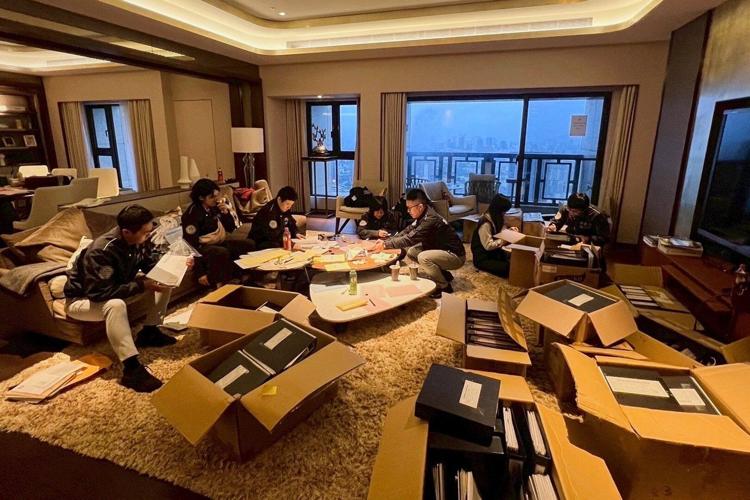
As part of the DOJ’s charges against Zhi, the US government also targeted Prince Group TCO members and associates, including Guy Chhay, Lei Bo, Ing Dara, Zhu Zhongbiao a.k.a. Jack Zhu, Sin Huat Alan Yeo a.k.a. Alan Yeo, Zhou Yun a.k.a. Sandy Zhou, Chen Xiuling a.k.a. Karen Chen, Wei Qianjiang, and Thet Li.
Here’s What This Has to Do With Crypto And October 10
In the EDNY’s indictment, prosecutors say that professional laundering operations received fraudulent proceeds “misappropriated from victims of Prince Group’s scam operations and then funneled them back to Prince Group,” largely with Bitcoin and stablecoins.
“One common method was to collect scam proceeds in the form of bitcoin or stablecoins such as USDT or USDC and then off-ramp them into fiat currencies. The launderers then used that cash to purchase clean bitcoin or other cryptocurrencies. The defendant CHEN ZHI was directly involved in coordinating these laundering efforts and spoke with co-conspirators about his use of ‘illegal money shops’ and ‘underground money houses.’ CHEN maintained documents that explicitly discussed ‘ BTC washing’ and ‘ BTC money laundering people.’”
Let’s lay out how this process might have functioned:
- Obtain digital assets: Various scams and thefts receive proceeds in fiat currency, which is then sent to offshore or non-KYC exchanges and converted into crypto. “Black” crypto from hacks (via Lazarus Group, for example) is sold at a discount to Chaoshan banks. The crypto is washed in “mule fleets” in China and Southeast Asia.
- Sell clean crypto to Chinese citizens desperate to move assets abroad.
- Purchase assets in other countries, park crypto (especially stablecoins) in yield-generating places.
Crypto also modernizes a well-known money laundering method called mirror trading by which large scale currency exchanges can take place without money ever crossing borders. The classic example is the exchanges that take place between Mexican cartels and Chinese elites looking to get capital out of China and into investable assets like real estate in Vancouver, London, Sidney, etc..
The cartels want to get rid of dollars, and the Chinese need dollars.
That’s where “brokers” run by Triads step in.
The Triads already have an extensive relationship with the cartels and networks in Mexico because they provide the precursor chemicals for methamphetamine and opioids that later get processed and sold to street dealers in North American cities.
Triads use their brokers to buy the dollars from the cartels, while simultaneously selling dollars to Chinese elite, all obfuscated within local legal entities, meaning money never officially crosses borders and triggering red flags.
As documented by a report from TRM Labs on Chinese Shadow Bankers:
Cryptocurrency adds a modern twist to this mirror exchange system. Instead of relying solely on cash deliveries and commodity shipments to settle accounts, brokers increasingly use crypto as the intermediary value transfer. This innovation now allows for a trustless network. Whereas before, Chinese underground banking brokers relied on trusted associates in each geographical location they served, crypto now allows for a much looser confederation. There is no trust required or even a shared ledger when stablecoins form the medium of exchange.
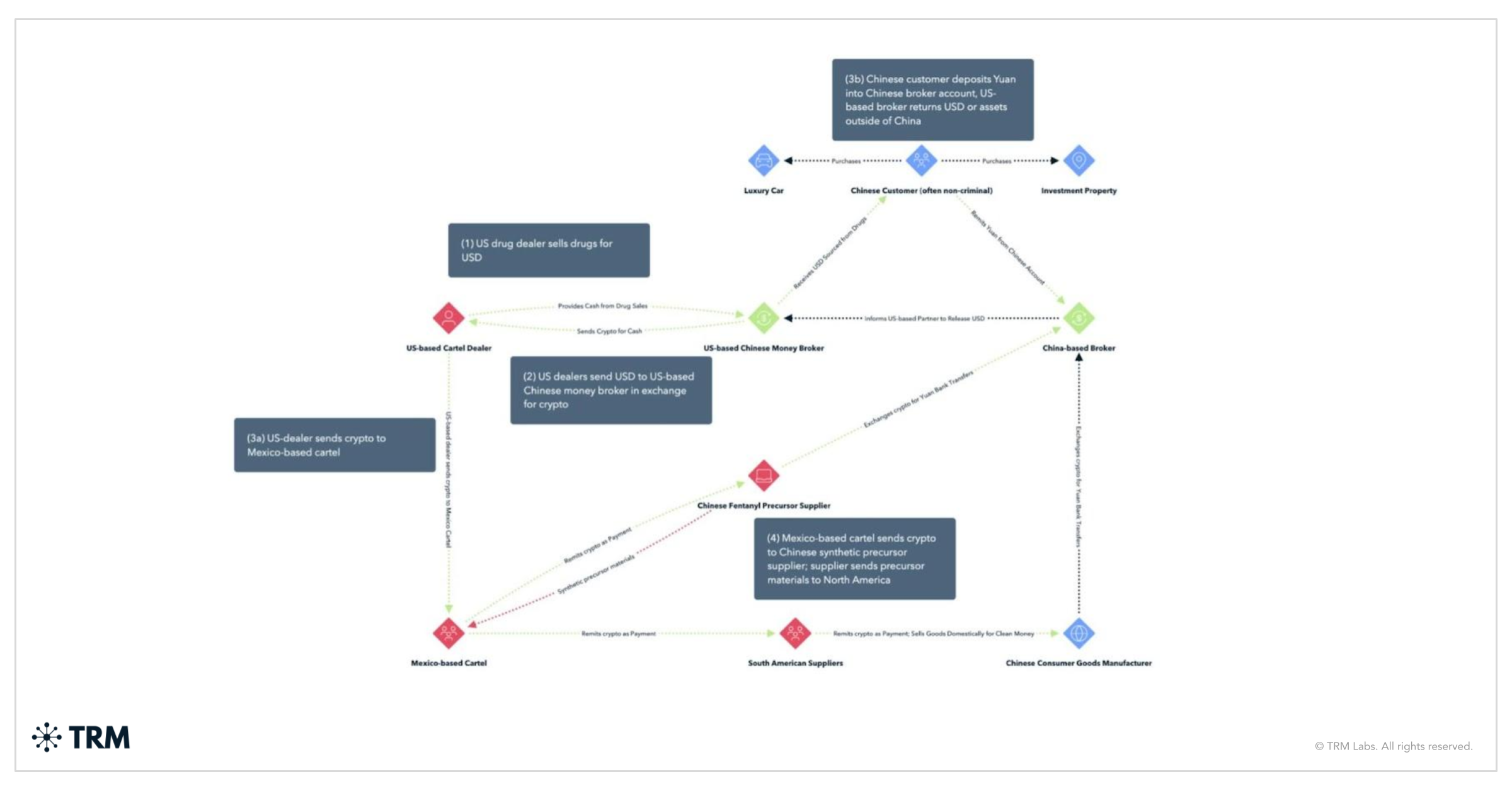
The implication is straightforward. When authorities disrupt major laundering corridors and simultaneously seize a massive cache of tainted bitcoin, they don’t just arrest individuals, they stress the liquidity infrastructure that moves value through crypto.
If that infrastructure tightened in early October, it would help explain two things that otherwise look coincidental: a sudden thinning of order books across digital assets, and a near-immediate rotation into traditional stores of value—most visibly, the sharp bid in precious metals.

As @agintender says, crypto bull markets are often associated with the rise in price of “茶钱” or cháqián, which is literally “tea money,” or the underground broker’s take, i.e. the “cut” or commission/spread you pay to move value through an underground channel.
“When you see a KOL on Twitter shouting ‘The bull market is here,’ you might as well go to a teahouse in Luohu, Shenzhen and ask how much ‘tea money’ is now.
In the slang of underground banks, “tea money” is not just a commission paid to middlemen; it is also a ‘pressure index’ of global capital controls. When ‘tea money’ rises from 0.3% to 2%, it means that underground channels are tightening, regulatory hounds are closing in, or more likely, that a super-rich entity is using this channel to drain liquidity from the market.
These micro-level, underground signals often foreshadow market crashes a week earlier than any news on the Bloomberg Terminal. If you don’t understand how to interpret the fluctuations in ‘tea money,’ you’re not qualified to talk about Alpha in the crypto market.”
Was Chen Zhi’s need to convert fiat to crypto one of the key pillars of buy-side support for digital assets?
If so, the mass shutdown of money laundering operations in SEA would’ve cut off a main stream of liquidity that could have easily created a domino effect in the Rube Goldberg-esque crypto markets.
While no “official” explanation for October 10th has ever been agreed upon, the general consensus is that it was ostensibly the result of longstanding mechanical weaknesses of liquidity. And of course, October 10th was also the same day that President Trump announced a major escalation of tariffs: an additional 100% tariff on Chinese imports.
As Benjamin Cowen said in an analysis of the event:
“The decline did not stem from a single catalyst. It developed as restrictive liquidity conditions, deteriorating internal breadth, declining participation, and a maturing Bitcoin cycle all aligned. When those pressures accumulated sufficiently, the market’s fragility became visible.”
Cowen also posited that “the crash did not create the weakness,” but “revealed what had been there all along.”
Dragonfly’s Haseeb Qureshi says that a series of unfortunate events, starting with markets getting spooked on a Friday night and a malfunction of Binance APIs, is what caused the crash.
It’s entirely possible the crash of October 10th was purely a mechanical failure created by a combination of technical issues, market uncertainty, and razor-thin liquidity on a Friday night.
However, there is quite clearly an immeasurably large underground economy that depends on digital assets for its payment rails, which was largely shut off by authorities in October of 2025.
If we accept this fact, then we must also accept that the global dragnet on Chen Zhi’s empire throughout early October caused the Chinese shadow banking network to pull its liquidity, drastically thinning order books.
Then, the spark happens:
Trump drops the 100% tariff bomb, creating an immediate macro shock.
Because the tea money liquidity floor was gone, the initial sell-off sliced straight through the thin order books, triggering the mechanical failures, including the Binance API overload, oracle depegs, and perp DEX ADL
At the next major market turn, let’s see what’s happening in the world of Chinese “tea money” and if it correlates with the crypto world.
免责声明:本文章仅代表作者个人观点,不代表本平台的立场和观点。本文章仅供信息分享,不构成对任何人的任何投资建议。用户与作者之间的任何争议,与本平台无关。如网页中刊载的文章或图片涉及侵权,请提供相关的权利证明和身份证明发送邮件到support@aicoin.com,本平台相关工作人员将会进行核查。


