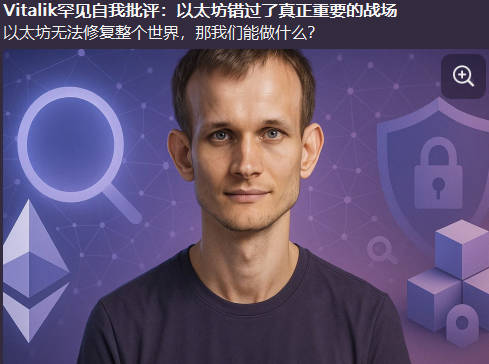
Vitalik Buterin published a rare self-critique long article on March 5, 2026, acknowledging that Ethereum's actual influence has been very limited in facing major global issues (government surveillance, corporate power expansion, wars, information warfare, AI risks, etc.) over the past few years, and it has been nearly absent from the battlefield that could truly bring liberation and protection. He pointed out that, despite many concerns about the direction of the world, the Ethereum community often remains in the comfortable zone of "finance as the main stage," focusing solely on DeFi, anti-inflation, etc., without addressing deeper issues of freedom, privacy, digital security, and community self-organization. Simply building a perfect decentralized financial system is still insufficient to address most of the profound anxieties. Vitalik emphasized that Ethereum cannot fix the whole world, nor should it attempt to project power or completely reshape society like centralized entities do (as that would contradict the spirit of decentralization). He proposed a new positioning framework - "sanctuary tech": the core goal: to build a free, open-source, resilient technology stack that allows individuals and groups to live, work, communicate, manage risks, accumulate wealth, and collaborate around common goals safely under external pressures (political, economic, censorship, surveillance).
The essence: not "decentralize everything" (putting all finance, governance, UBI on-chain), but de-totalization - preventing any party (government, corporate, winners) from obtaining total control, and avoiding the complete eradication of losers. Create "digital stability islands" to ensure that interdependence is not weaponized.
Ethereum's unique role: to provide "ownerless shared digital space" to support durable social arrangements (such as currency, multi-signature wallets, markets, governance structures, etc.), allowing different entities to interact safely.
He called on the Ethereum community: do not imitate Apple or Google by treating cryptocurrency as an "efficiency + glam" tool.
More proactively build a full-stack ecosystem: upwards to wallets, application layers (including AI interactions), downwards to operating systems, hardware, and even physical/biological security.
Actively seek out users (individuals or institutions) who truly need such sanctuary, optimizing applications like payments, DeFi, decentralized social, into tools for resisting external pressures.
Open collaboration with allies both within and outside the crypto circle (including technologies like Starlink, Signal, local open-source large models, Community Notes, etc.) instead of closed confrontation.
In response to community skepticism, Vitalik further clarified: he recognizes that technologies like Starlink do indeed bring freedom, but the ideal state is to have multiple competing and diverse alternative systems, preferably with open-source protocol versions.
As a whole, Ethereum should focus on "Path 1" - shaping a higher structure in the world that favors the rights of marginalized groups (value-neutral but inclined), rather than getting involved in specific political expressions of events (Path 2). Individual contributors can have their own stances, but the community as a whole should not be overly politicized.
Overall, this article marks a profound reflection and reanchoring of Vitalik's vision for Ethereum: shifting from "financial revolution" to a broader "digital sanctuary and resilience infrastructure," trying to make Ethereum a true cornerstone for protecting freedom and diversity in chaotic times, rather than just being the winner in the financial arena.
免责声明:本文章仅代表作者个人观点,不代表本平台的立场和观点。本文章仅供信息分享,不构成对任何人的任何投资建议。用户与作者之间的任何争议,与本平台无关。如网页中刊载的文章或图片涉及侵权,请提供相关的权利证明和身份证明发送邮件到support@aicoin.com,本平台相关工作人员将会进行核查。


