How to DIY Dual Currency so Exchanges Cannot Take a Cut (Not Transaction Fees) — — Deribit Options Beginner's Tutorial (Low Price Accumulation + Premium)
😂 I see many friends wanting a DIY tutorial on dual currency, specifically to avoid exchanges taking a cut (transaction fees still need to be paid), so I will write a plan on how to switch from dual currency to a pure options model to earn premiums, with the exchange we need to use being Deribit.
PS: I have no financial interest in Deribit, and there is no commission or promotion relationship.
Let me say upfront, the best depth for options is unquestionably Deribit, so skipping the dual currency strategies on Binance and OKX, the best option is Deribit. However, operating on Deribit is significantly more complex than dual currency, so I will explain it as clearly as possible. If there are errors or anything unclear, please point them out, friends.
First, our goal is to buy Bitcoin at a low price, buying it if we can, and if we cannot buy it, we earn the premium. This is equivalent to earning interest if we couldn't buy in dual currency, but everything in Deribit is measured in Bitcoin, and the premium is also given in Bitcoin.
Starting the main content
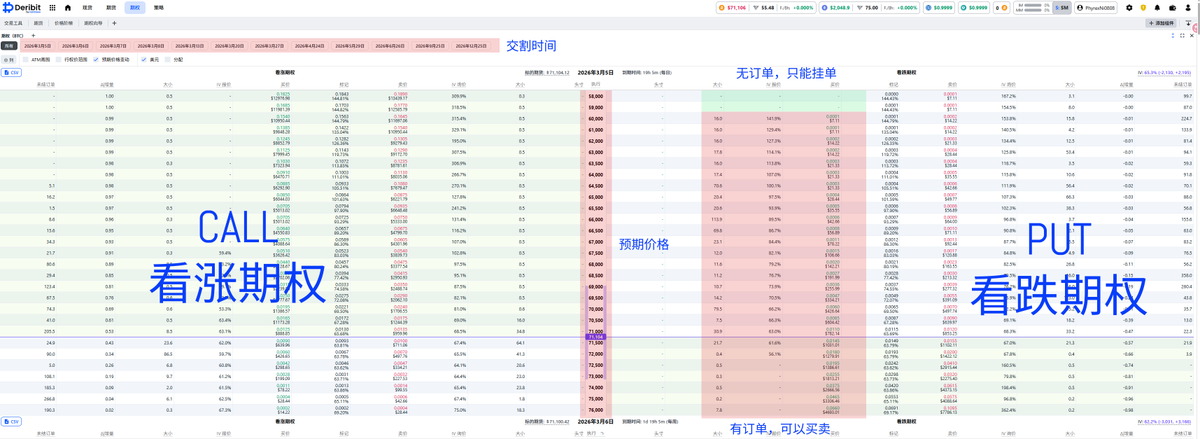
If friends want to plan to buy Bitcoin at the $60,000 level at a low price, and if they cannot purchase it, they will earn interest; this is possible, but like with the exchanges, this price is not available every day. It is necessary to look at whether the expected price coincides with the delivery time. If it does, then you can buy and sell directly; if not, you can only post your orders. For most friends, it is still better to find those with completed transactions to save time posting orders.
The above image shows Deribit's options interface, and the time in the upper left corner is the delivery time. To buy or sell, you first need to select the time you want to target. For example, if we are in dual currency, we prepare for one to two days, so we choose the nearest time. For example, in the image, the earliest delivery is March 5, 2026, so we would choose either March 5 or March 6. The closer the time, the lower the premium. The following times are all in Beijing time.
Because we want to buy Bitcoin at a low price, but if we cannot, we earn the premium, then this is "selling a PUT." We need to operate in the PUT area on the right side of the screen. Next, we need to choose the expected price at the $60,000 level and click the mouse on the right side of $60,000.
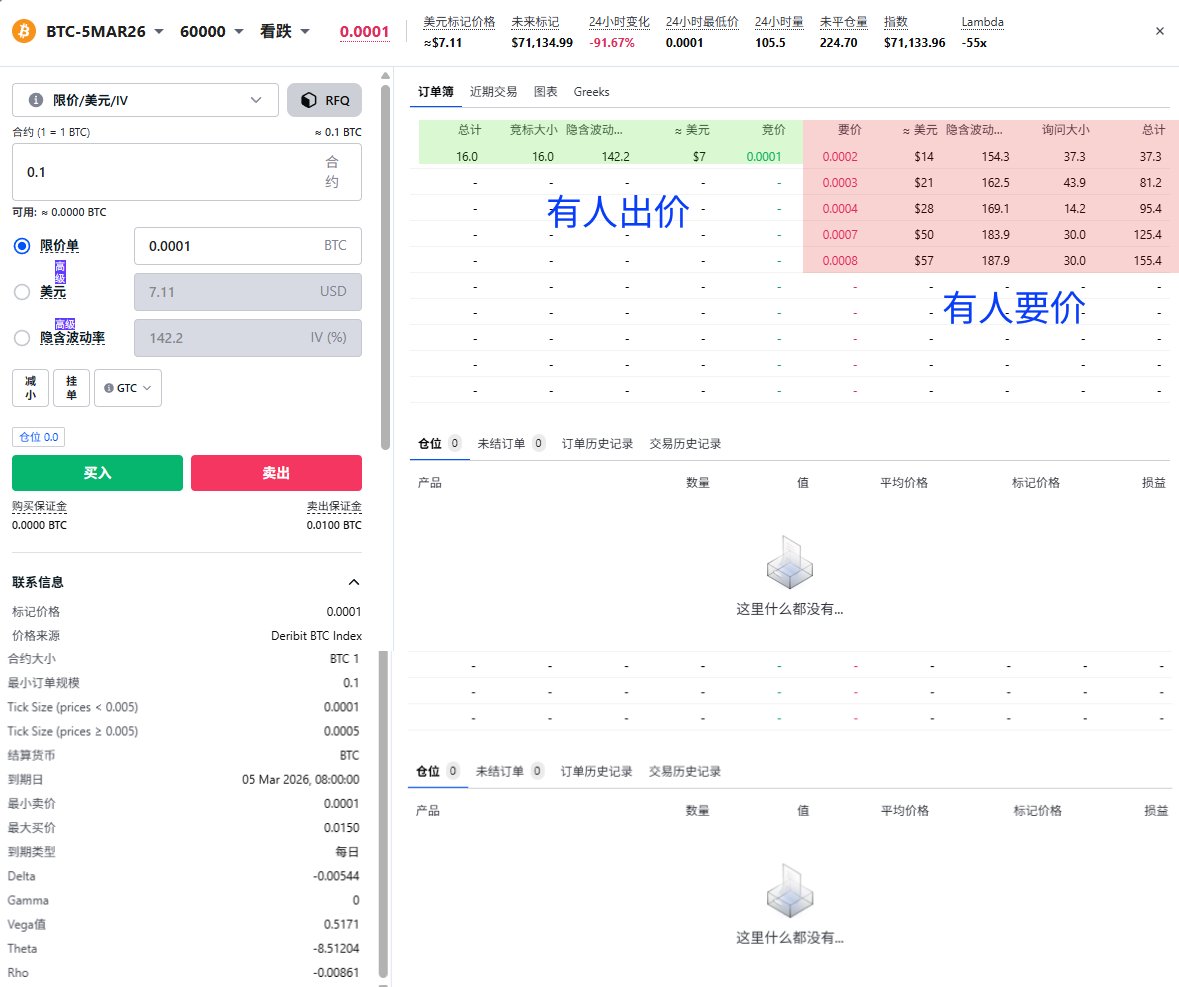
Now what we see is the buying and selling interface, where there are both bids and asks. For the bids, we can trade directly; for example, in the image, there is a bid of 0.0001, with the target price being $7. This means $7 (of Bitcoin) is your premium (interest). Of course, it is better for the premium to be higher when selling a PUT. If you are not satisfied with the price, you can place your order, but whether you can execute it is another matter.
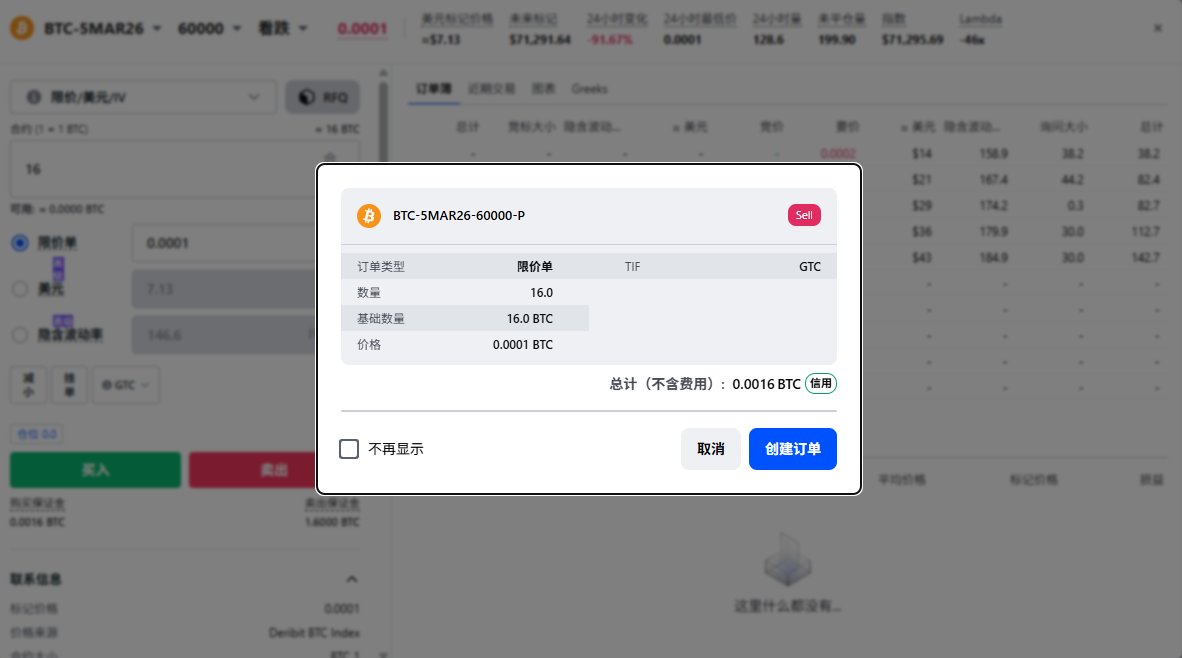
Additionally, you can see that the bid size in this column is 16, indicating that the buyer wants to buy 16 contracts, with each at a price of $7. These 16 contracts represent 16 Bitcoin (notional). If all 16 contracts are sold, the premium will be $7 x 16 = $112 (of Bitcoin). This means if the price of $BTC does not reach $60,000 or below by the expiration date at 4 PM Beijing time, then you will receive the premium of $112, which is the interest. So what do you need to pay?
First, you need to have margin. The margin is dynamically calculated, and often the short PUT will have a lower limit close to 0.1 BTC per contract. Currently, the margin is about 0.1 BTC. If you buy 16 contracts, that means you need a margin of 1.6 BTC. The margin is refundable if you successfully complete the delivery. When the price of BTC is above $60,000 before 4 PM on the expiration day, you will receive the premium and get back your 1.6 BTC margin.
However, if at 4 PM on the expiration day, the price of BTC is below $60,000, it will become problematic. It’s best to have sufficient margin. If the price of BTC falls to $55,000, the difference from $60,000 is $5,000.
5,000 x 16 / 55,000 = 1.45
So your margin will be deducted by 1.45 BTC. But if the price of BTC continues to drop and falls below your margin limit of 1.6 BTC, you'll be liquidated. You won't have to wait for the final delivery. This is also the biggest difference from dual currency; with dual currency, you wait until the end to look at the price, while with options, you need to monitor the price in between. If the margin is insufficient, you are liquidated. There would be no further action.
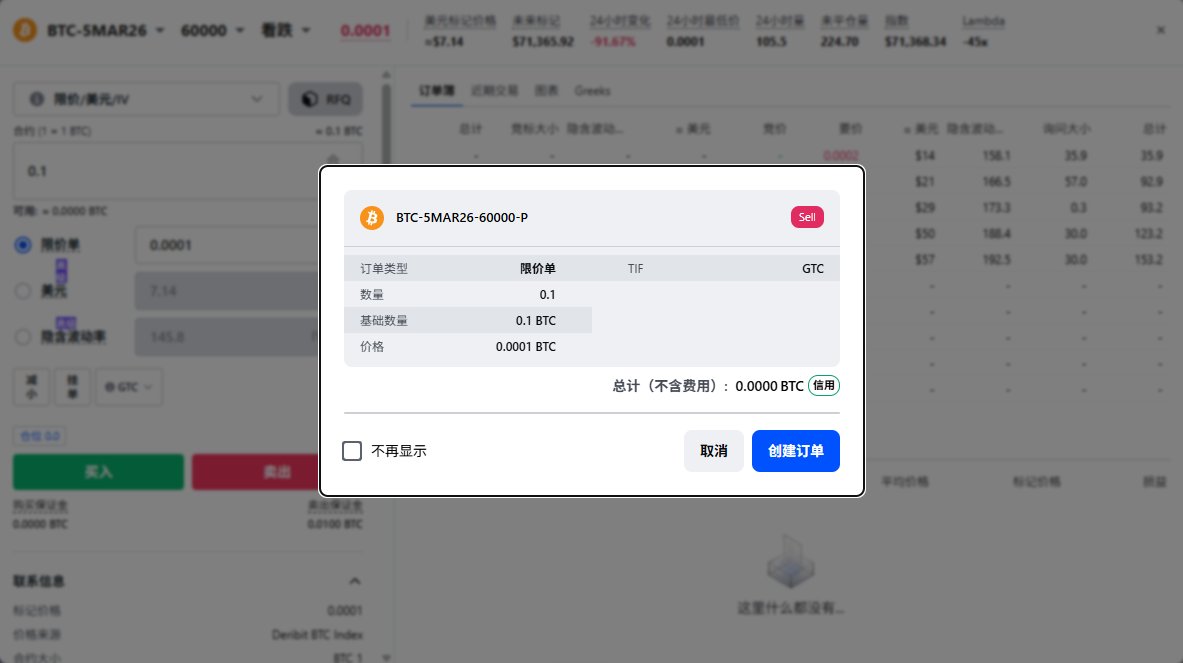
So what if you still sell one contract at the same price of 0.0001 and $7?
Then our premium, or interest, would only be $7 (of BTC), but the margin would also be reduced to 0.1 Bitcoin. If at the time of delivery on the expiration day, the price of BTC is below $60,000, our profit would be this $7. It’s important to know that the premium is given to you the moment the transaction is completed, not waited until delivery.
If the price of BTC at the expiration is $55,000, then — —
5,000 x 1 / 55,000 = 0.091
You will need to deduct 0.091 BTC from your margin and return your margin. If the price of $BTC continues to drop and goes below the 0.1 BTC margin and you do not add more margin, then the result will also be liquidation.
Thus, the beginner's DIY dual currency in options ends here. Compared to dual currency with exchanges, isn’t it more complicated? Although the premium earned may be higher, the trouble is also more. Firstly, the BTC you can gain from selling a PUT is only the premium or interest, while the loss is not simply from buying at a low price like dual currency; it comes from deducting the lost amount from your account.
In summary, the PUT selling method in options can indeed generate more premiums (interest), but if the directional prediction is wrong, the losses can be greater. Unlike dual currency, where at least there is still a chance to buy the spot if the price goes up and break even.
This is also why I suggest friends use dual currency, as it is simpler and can serve as a tool for market bottoming. Even if the direction is wrong, the losses are not too great, and there is even a chance of recovery.
The end.
免责声明:本文章仅代表作者个人观点,不代表本平台的立场和观点。本文章仅供信息分享,不构成对任何人的任何投资建议。用户与作者之间的任何争议,与本平台无关。如网页中刊载的文章或图片涉及侵权,请提供相关的权利证明和身份证明发送邮件到support@aicoin.com,本平台相关工作人员将会进行核查。


