Original author: Eric, Foresight News
In the early hours of March 3, Beijing time, the collective lawsuit demanding Uniswap and Uniswap founder Hayden Adams be held accountable for fraudulent tokens on Uniswap was dismissed by the U.S. District Court for the Southern District of New York. Brian Nistler, Chief Legal Officer at the Uniswap Foundation, called it a "milestone ruling for DeFi."
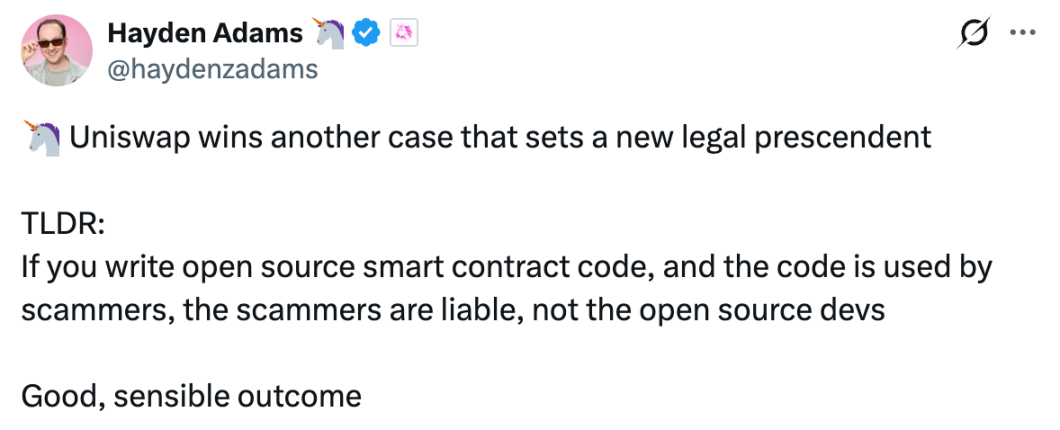
Hayden Adams also tweeted, "If you write open-source smart contract code and that code is used by fraudsters, then the fraudsters are the ones who bear responsibility, not the open-source developers. This is a reasonable and fair outcome."
This is undoubtedly good news for Web3 developers. However, it is little known that the judge who made this "just ruling" is the same person who previously ruled that Tornado Cash developers were guilty during the tenure of former SEC Chairman.
The Final Ruling
From the initiation of the collective lawsuit against Uniswap to today’s conclusion, nearly four years have passed.
In April 2022, a collective lawsuit was filed in court by Uniswap users represented by Nessa Risley, accusing defendants including Paradigm, a16z, Uniswap, and its founder Hayden Adams of violating federal securities laws by issuing and selling unregistered securities, including UNI, in the form of tokens on Uniswap. Additionally, the defendants failed to register Uniswap as an exchange or broker-dealer under applicable securities laws and did not provide investors with the registration statements for the securities they issued and sold.
This lawsuit was initiated by the law firms Kim & Serritella and Barton, representing users who traded EtherumMax, Bezoge, MatrixSamurai, Alphawolf Finance, RocketBunny, and BoomBaby.io tokens on Uniswap between April 5, 2021, and April 4, 2022.
The term "unregistered securities" held unusual destructive power for the crypto industry at the time, but the lawsuit surprisingly tilted quickly in favor of Uniswap.
Judge Katherine Polk Failla, the presiding judge, acknowledged that the "fraud tokens" identified by the plaintiffs were indeed securities but ruled that Uniswap was not responsible for them. Failla determined that the decentralized nature of Uniswap meant that the protocol could not control which tokens were listed on the platform or who could interact with it; she stated, "The case is more akin to holding the developers of a self-driving car responsible for traffic violations or bank robberies committed by third-party users of that car."
Therefore, Failla dismissed the federal securities law allegations in August 2023, after which the plaintiffs appealed. The Second Circuit Court of Appeals confirmed the dismissal of the federal part in 2025 but remanded the state law part for reconsideration.
Subsequently, the plaintiffs amended the complaint and sued again. This time, the losing investors alleged that defendants, including Uniswap, assisted and abetted fraud and false statements, profiting from transactions involving the fraudulent tokens, and also violated multiple state fraud laws.
After again being reviewed by the same judge Failla, the amended lawsuit was dismissed once more, and the plaintiffs were not permitted to amend it again, concluding the case entirely.
The judge's reasoning this time was essentially the same as before: Uniswap was not aware of the fraudulent tokens, and even if it were, it did not provide substantial assistance, nor did it meet any definition of fraudulent conduct under state laws. Regarding unjust enrichment, Uniswap did not receive direct benefit, and the speculation that such fraud projects expanded the user base leading to indirect benefits was too tenuous.
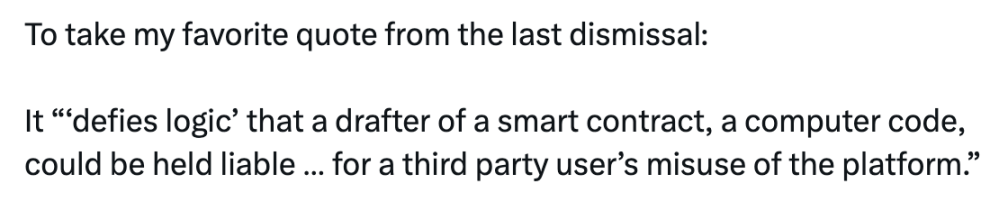
Brian Nistler stated in a tweet, quoting a line from the previous ruling, that it is "illogical" for the drafters of smart contracts to be held liable for third-party users' abuses of the platform.
Another Outcome for Tornado Cash
Facing the same judge, Tornado Cash's Roman Storm faced a different outcome.
Tornado Cash was first listed on the U.S. Treasury Department's Office of Foreign Assets Control (OFAC) sanctions list on August 8, 2022, accused of helping criminals, including North Korean hackers, launder over $7 billion. Two days after being listed, Dutch police arrested one of the core developers of Tornado Cash, Alexey Pertsev.
On May 14, 2024, a Dutch court convicted Alexey Pertsev of money laundering and sentenced him to 64 months in prison. The court found that Pertsev was aware his platform was being used for criminal activity but did not stop it, thus subjectively permitting Tornado Cash to be used as a money laundering tool. Alexey Pertsev is still appealing, with no updates on the progress.
Seven months before Alexey Pertsev was convicted, the U.S. Department of Justice indicted two other developers, Roman Storm and Roman Semenov, in the Southern District of New York. Roman Storm was previously arrested in Washington State, while Roman Semenov is at large.
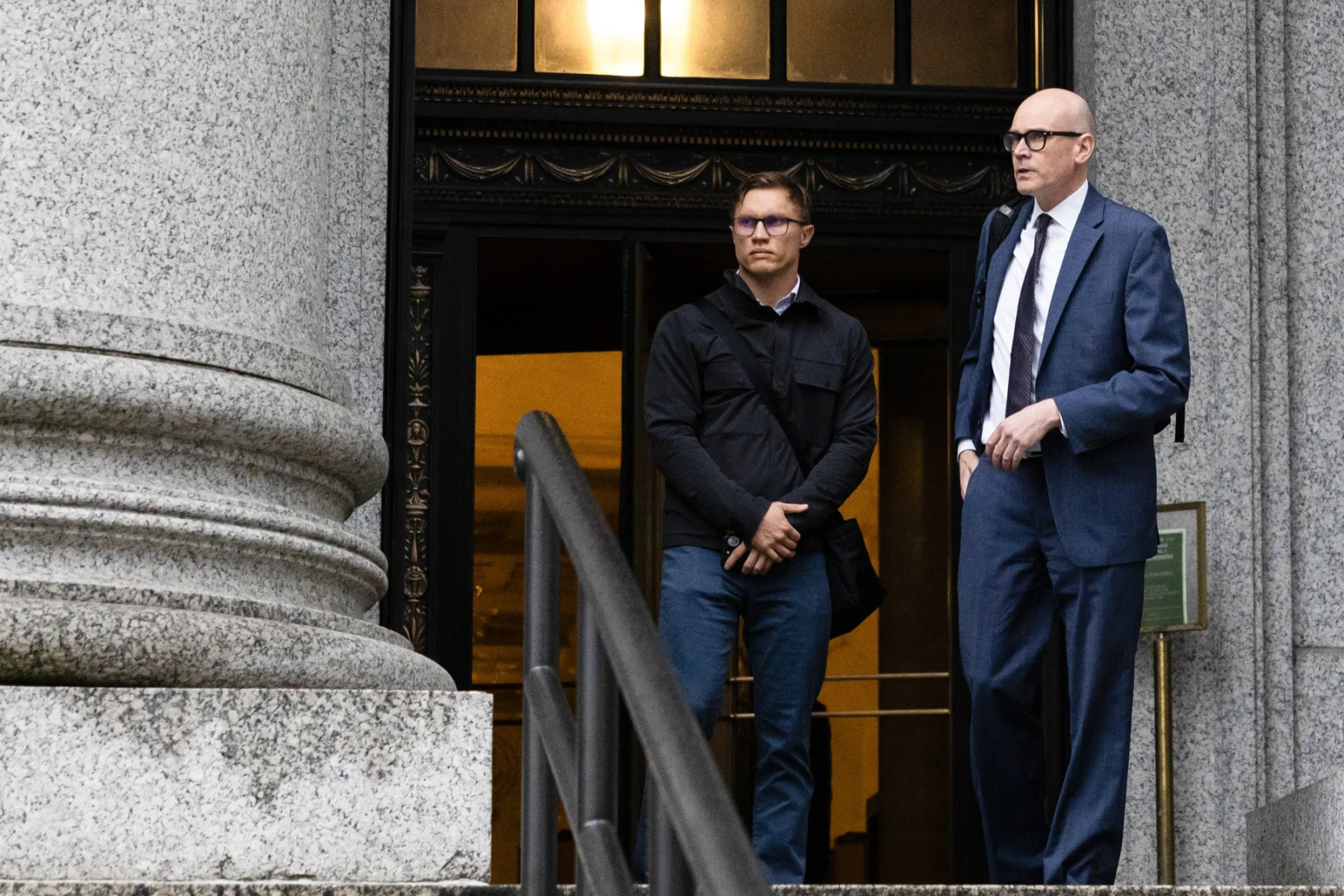
Roman Storm in court
Afterward, despite the appeals, the court determined that OFAC's sanctioning of Tornado Cash was an overreach and the sanctions were invalid. However, Roman Storm was still placed in the defendant's seat last July. After being heard by presiding judge Katherine Polk Failla, the jury found that Roman Storm "conspired to operate an unlicensed money transmitting business," but as of now, sentencing has not been officially carried out.
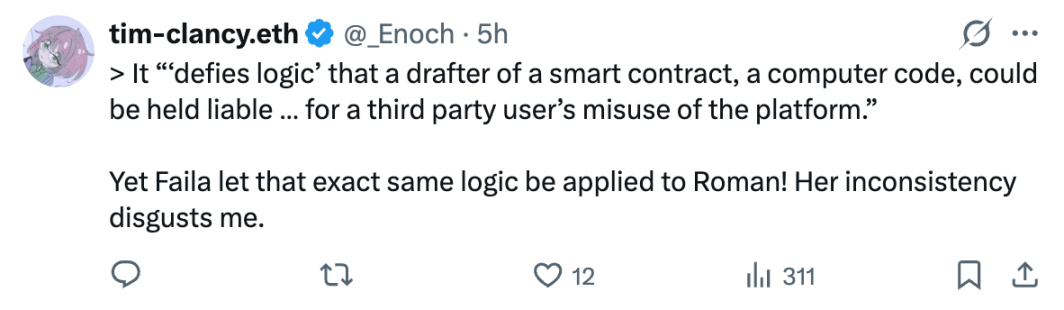
Under Brian Nistler's tweet celebrating Uniswap's victory, a comment from Sigil developer tim-clancy.eth criticizing Failla's contradictory judgments (the judgment against Roman Storm was actually made by the jury) received the highest number of likes among all comments.
Decentralization Is Allowed, but Privacy Is Not
I am not a professional lawyer, but setting aside political factors and based on plain feelings, one can generally understand why Uniswap and Tornado Cash ended up with different outcomes.
The core reason is that the developers of Tornado Cash should have known perfectly well that mixers would be used for money laundering. This also clearly reveals the regulatory stance: decentralization is permitted, but it must be traceable. Tether has faced the same dilemma, prompting it to cooperate with money laundering investigations and enhance its freezing capabilities.
Perhaps Roman Storm, upon learning of today's ruling from behind bars, feels it is unjust, but he should understand that even in a pro-crypto U.S. under Trump, a platform that aids North Korean state-sponsored hackers in money laundering cannot be tolerated. With the power of Crypto today, it is still insufficient to combat the power of the state.
Practitioners in Web3 voice their discontent for the developers of Tornado Cash and cheer for Uniswap's victory. Because in our eyes, the two protocols are not essentially different, and Tornado Cash even excels in privacy protection. Uniswap's addition of front-end blocking for sanctioned addresses in 2022 sparked some controversy, and now it seems that under the existing legal framework, permissionless operation might be the only way for decentralized protocols to survive.
However, the question remains: Does Uniswap really bear no responsibility at all in these fraud cases?
Strictly speaking, as the judge's analogy suggests, you cannot hold Mercedes accountable for losses at a bank robbery just because the robber drove a Mercedes. But on a commercial level, we tend to believe that giants should provide protection within their capacity. The current security tools are already capable of identifying a large number of potential scam projects beforehand, and for these established projects reaping the benefits of Web3 development, simple screening should not be cumbersome.
While it is not a mandatory obligation to take steps to protect investors, it is a responsibility that ordinary investors hope Uniswap and others can proactively undertake.
免责声明:本文章仅代表作者个人观点,不代表本平台的立场和观点。本文章仅供信息分享,不构成对任何人的任何投资建议。用户与作者之间的任何争议,与本平台无关。如网页中刊载的文章或图片涉及侵权,请提供相关的权利证明和身份证明发送邮件到support@aicoin.com,本平台相关工作人员将会进行核查。


