What is Pre-IPO SPV and SPV Mirror — — What are the risks?
There are no vested interests, just thinking this matter is quite popular, understanding it objectively is not a bad thing, after all, these days, making money is hard, and eating shit is even harder. Just consider it as useless knowledge +1.
I asked around and generally understood that there are indeed many "secondary market sales" currently selling these. In the words of the crypto circle, this situation is quite similar to the "agent investment" market before 2020, but the problem is that if you don’t receive the actual tokens in a day, you won’t know if it's real or fake, not to mention that many agent investments just ran away after taking the money.
This time, I cannot say the MSX Pre-IPO is 100% certain, but it should be over 90% likely bought from the secondary market, and whether those in the secondary market are good or bad, that will depend on luck.
Then I read the "Service Agreement", looked at the subscription process, and roughly understood the logic of the operation. Here I want to reiterate that the result of purchasing from the secondary market is unpredictable. There is no implication of "dark" or "provocation"; this matter has recently received a large response, and this is just my interpretation, perhaps my interpretation is incorrect.
What can be confirmed first is that this Pre-IPO issues tokens, and the structure of the tokens is SPV mirror. So, what is an SPV mirror? We need to first understand what SPV is and the direct relationship between SPV and SPV mirror.
SPV (Special Purpose Vehicle) is a "special purpose vehicle." In Pre-IPO investment, it is usually a partnership (LLC or LP) specifically set up to purchase equity in a specific company (such as SpaceX). In the cooperation with MSX, the funds labeled in cooperation with Republic Ventures are a type of SPV.
The biggest use of SPV is to fractionalize investments, for example, the direct investment threshold in SpaceX may reach tens of millions of dollars, which ordinary high-net-worth individuals cannot enter. SPV can pool money from dozens of investors together (for example, each contributing $200,000), raising enough to $10 million to buy as a whole.
The key point is coming!! SPV requires compliance thresholds.
In the real world, in order to legally raise funds, SPV must prove that its investors have the ability to bear risks, and different regions have clear financial hard indicators. I won’t elaborate on this; the main compliance directions are three:
The first is registration and licensing requirements, for example:
In the United States, the institution managing SPV usually needs to register as an RIA (Registered Investment Adviser), and some institutions may also take the ERA (exempt reporting adviser) path.
In Europe, managers must obtain AIFM authorization.
In Singapore, if the structure is recognized as a collective investment scheme (CIS), the institution must enter the SFA regulatory framework.
In Hong Kong, institutions managing SPV must hold a license issued by the Hong Kong Securities and Futures Commission (SFC) No. 9 (Asset Management).
Even in the most flexible Cayman Islands, all closed-end SPVs for Pre-IPO must be registered with the Cayman Islands Monetary Authority (CIMA).
The second is user requirements. All SPVs need to complete full KYC and AML, and only qualified investors can participate, for example:
In the United States, the minimum annual income must exceed $200,000 or the net worth must be over $1 million, not including real estate.
In Singapore, the minimum annual income must exceed SGD 300,000, or financial assets must be no less than SGD 1 million.
Even in the most flexible Cayman Islands, the minimum investment amount must start at $100,000.
Of course, Republic does have small investment SPVs, but they require very strict KYC and are only available for purchase on the Republic platform.
The third is that all funds must be custodial. Stablecoins can indeed be used as the subscription fund for SPV, but they must do a conversion of stablecoins and fiat currency, and the finalized custody funds are fiat currency.
After understanding SPV, what is SPV mirror?
The SPV mirror is slightly more complex; simply put, it is a shell of an SPV, for example, for cross-border investors.
Taking SpaceX as an example, an American SPV has already obtained shares of SpaceX. However, due to foreign exchange or legal reasons, Chinese investors cannot directly remit money to the American SPV, so this SPV would set up a mirror SPV in the Cayman Islands or Hong Kong, which has the same underlying assets, profit distribution ratios, and management fee rates as that American SPV, fully "replicating" it. Investors invest their money in the mirror SPV, and the mirror SPV then links with the main SPV through some financial agreement (such as a participation agreement).
Additionally, some SPVs sell not equity, but derivatives or contract exposures without real equity registration. It could be another secondary transaction subject of another seller, or it could mean that no shares were actually purchased, just a "promise to buy in the future," and what you're buying is a "commitment letter," which may never settle.
This is also why I say MSX is an SPV mirror. In fact, it should not even be counted as an SPV mirror.
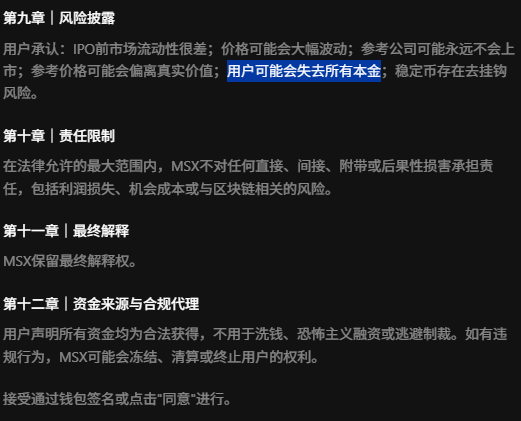
So, by now, friends should be very clear that even compliant SPVs carry a lot of risks, let alone the nested SPV mirrors:
1. Underlying asset and settlement risk
SPV raises money externally, but the underlying shares are not successfully purchased or are delayed in settlement. What users receive is merely a "promise to hold position."
Pre-IPO companies often have ROFR (Right of First Refusal), transfer windows, board consent, etc., which can cause transactions to fail or delay for many years.
2. Lack of transparency
Investors may not be able to fully understand the performance, risk, or details of the internal assets of the SPV, leading to decision-making errors or information asymmetry. A complex multi-layer asset structure may hide debts or actual value.
3. Liquidity and exit risk
Compliant SPV shares typically cannot be freely transferred. Moreover, companies may not be listed for a long time, and even if the valuation falls, they may not repurchase. Even when an exit occurs, settlement, auditing, taxes, and capital repatriation may drag on for a long time.
PS: Not to mention this is a token trade, liquidity will be even worse.
4. Overvaluation
This need not be expanded; I looked at MSX's valuation this time, and it seems reasonably close to the market without being overly high, but even so, the increase compared to the original valuation is significant.
5. Fees
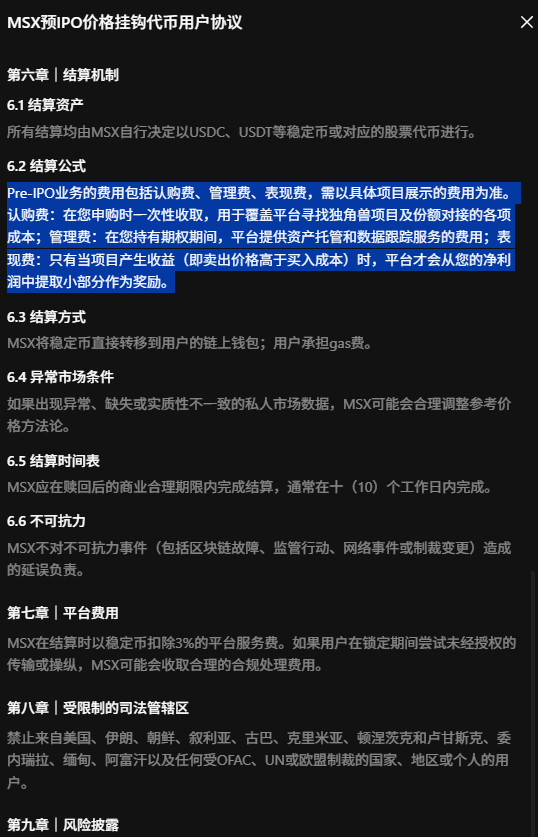
This cannot be overlooked. MSX’s actual fees can be as high as 20%, something many friends might not have noticed. For example, with ByteDance’s $550 billion valuation, the actual purchase cost might increase by 20%, including a 1% management fee, a 6% subscription fee, a 10% performance fee, and finally a 3% platform service fee deducted in stablecoins at settlement.
And the risks added by the SPV Mirror:
6. Confirmation risk
The legality of the mirror SPV entirely depends on the participation agreement it has with the main SPV. If this agreement is not legally recognized as a "true sale," or if the main SPV's articles prohibit such splits, then the investor's investment may legally just be an unsecured contract claim.
Of course, in this sale, since there is no settlement, this can no longer be called a "risk"; what users are buying is just a price corresponding to an underlying asset. It has absolutely nothing to do with the actual asset.
Moreover, due to price opacity and liquidity differences between platforms, the fluctuations in this price may exceed expectations.
Therefore, from the final perspective
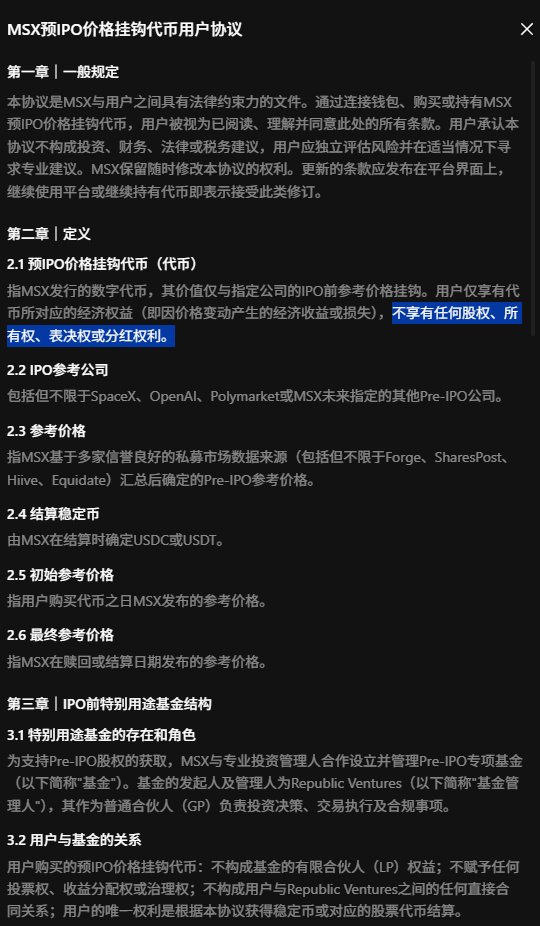
I cannot be sure if this sales of MSX has problems. However, from the terms, investors cannot obtain any actual qualifications for the Pre-IPO nor any asset of the investment subject, and many investors may not even be compliant investors.
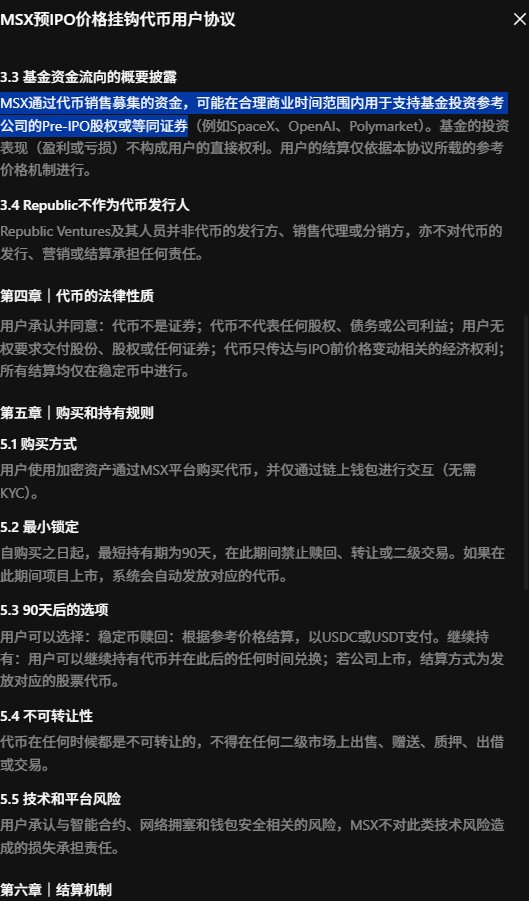
Furthermore, according to the terms, MSX should use user participation funds for Pre-IPO financing to buy asset subjects in the secondary market, with MSX extracting a maximum fee of 20% from users, while users are merely getting a "price" of the same name but with a completely different asset structure.
In simpler terms, users are buying merely a price of a token called SpaceX, and the price of this SpaceX token may anchor to the price at any period of SpaceX and will have significant price fluctuations due to liquidity issues.
In actual operation, buying into ByteDance’s Pre-IPO on MSX now amounts to using a valuation of $550 billion x 20% to enter a bullish contract, and the fluctuation in price does not depend on the actual market price but on the platform's depth and liquidity.
In simpler terms, the final pricing authority is determined by MSX and can be adjusted unilaterally. Moreover, many provisions are related to Republic, and this part of the correlation indicates that the sale of tokens is unrelated to Republic, and Republic Ventures and its personnel are not the issuers, sales agents, or distributors of the tokens, nor do they assume any responsibility for the issuance, marketing, or settlement of the tokens.
Thus, this Pre-IPO has quite a few "BUGs". Because even compliance, small-scale participation can only be realized on the Republic platform.
PS: I should add, this type of purchase is "securities." There are strict regulations in both China and the United States. Especially in the U.S. where X is located, if it is a paid promotion, it must be disclosed, otherwise, it will be considered illegal. (Securities Act Section 17(b))
Furthermore, if the target of a promoter includes the mainland public of China, Chinese regulatory documents have long listed "fabricating imminent listings, inducing the public to purchase so-called 'original shares/unlisted equity'" as one of the typical illegal securities activities; as well as the risk of illegal fundraising "under various names from the public."
The end.
免责声明:本文章仅代表作者个人观点,不代表本平台的立场和观点。本文章仅供信息分享,不构成对任何人的任何投资建议。用户与作者之间的任何争议,与本平台无关。如网页中刊载的文章或图片涉及侵权,请提供相关的权利证明和身份证明发送邮件到support@aicoin.com,本平台相关工作人员将会进行核查。


