Source: WeChat Official Account: Lang Hanwei Will
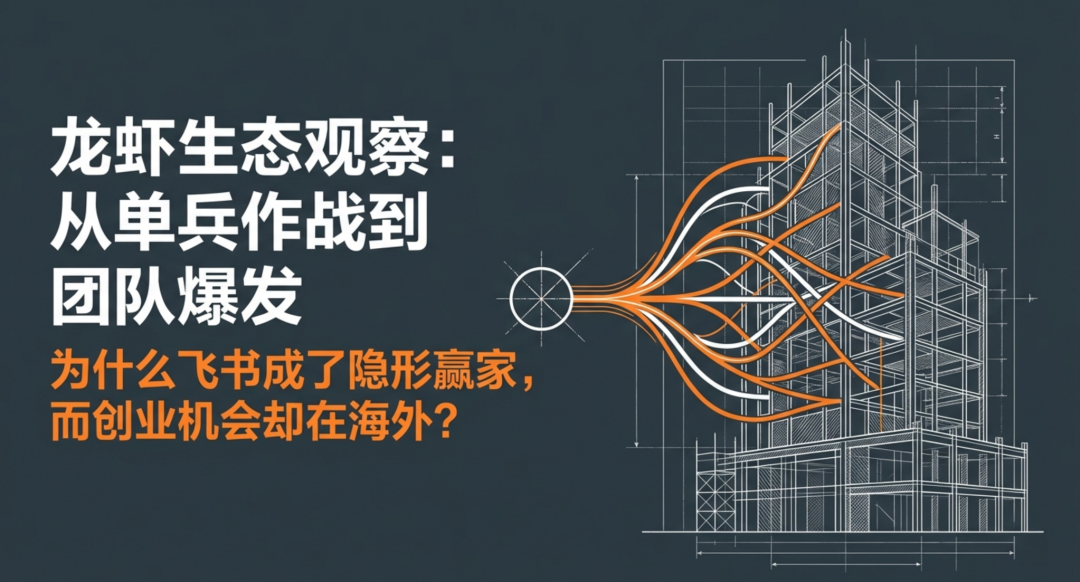
Writing in Advance: I have seen a huge productivity explosion
In the previous two articles, I made two judgments: the first article sorted out the entrepreneurial stratification of the lobster ecosystem from the user's perspective, with deployment faction, workbench faction, and evolution faction each having their own logic; the second article, after looking at a lot of cases, predicted that the correct form of agents should be embedded in the communication software you use daily, and independent apps won't go far.
After sending out these two articles, I saw some surprising scenes: some people have already started running lobsters at the team level, and an incredible productivity explosion has occurred. The degree of this productivity explosion far exceeds my expectations in the first two articles.
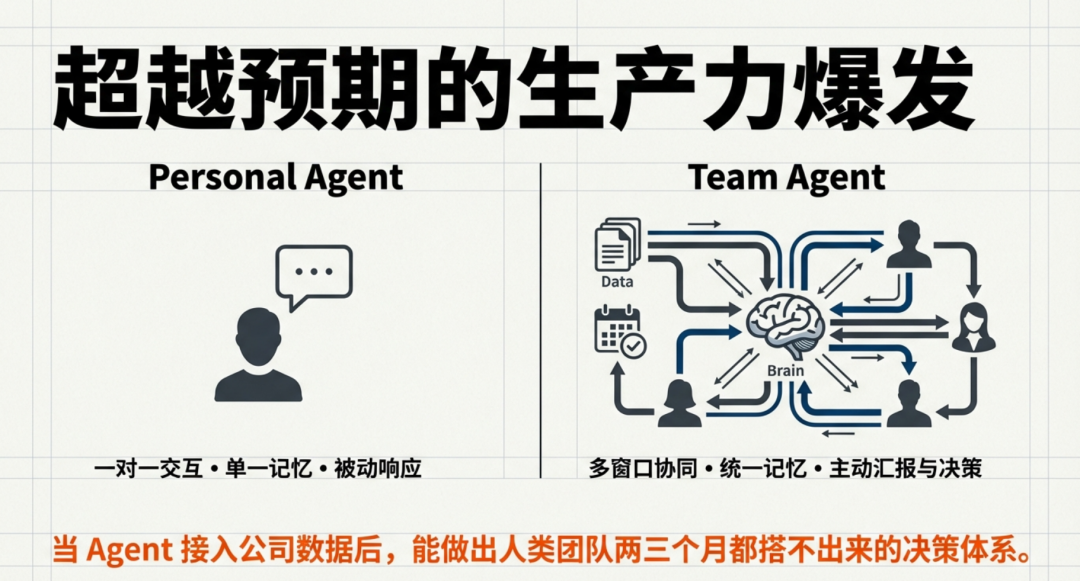
The reason I pay so much attention is twofold.
The first reason is technological deduction. When writing the first two articles, I judged that the next step for agents must be to shift from individual operation to team collaboration—multiple windows, major managers, unified memory, proactive reporting, all of which I have written about. But at that time it was more logical deduction; I hadn’t seen real cases that worked.
The second reason is I have really come into contact with it. In the past three weeks, I have been intensively in touch with several teams working on the team direction. The approaches vary, and the specific technical solutions involve trade secrets I won’t elaborate on. However, some cases they showed me were, to be honest, extremely impactful, not just in the sense of "wow, what else can AI do?" but a shock realization of how many limitations humans have. My first reaction after seeing it was: I really wish I could use it immediately; not using it makes me itch, it's a serious FOMO.
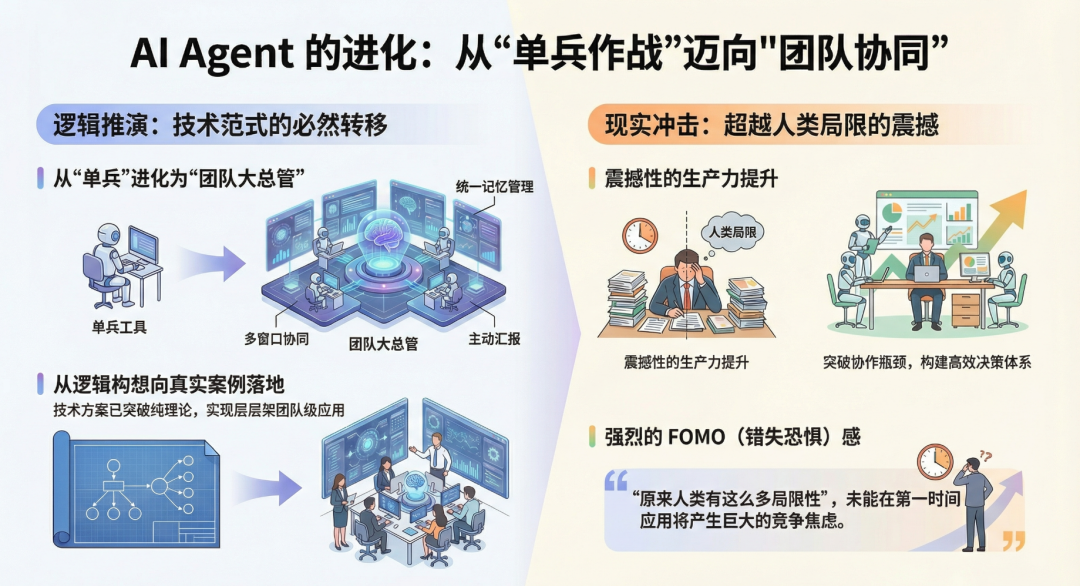
This feeling is the greatest driving force for me to write this article. When you see an agent connected to company data making a decision-making system that a human team could not build in two to three months, you realize that team agents are already usable, and their effectiveness far exceeds expectations.
It’s just that most people cannot debug these things.
The teams I came into contact with that successfully ran team agents are mostly those that already work with agents or have rich experience in multi-platform trials, having gone through numerous APIs, permissions, and pitfalls. For them, integrating the entire process is seamless. But ordinary teams do not have this capability. Currently, there are many pitfalls on these platforms; many people get stuck at some step, possibly due to unclear bot permissions in Feishu, or because they can’t find the authorization entry for Notion’s API, or they have poor models resulting in inadequate output quality, or issues with cross-platform data synchronization. When they get stuck, they give up, and they will never experience the true power of team agents.
What I want to talk about in this article is this: when lobsters transition from individual to team, what kind of infrastructure is needed? What technical pathways are competing in the market? And—why I believe Feishu is the biggest winner in this round.
I. What Makes Team Agents Stronger than Individual Agents?
First, let’s answer a fundamental question: what exactly is the incremental value of team agents? Why isn’t it just a "larger version of individual agents"?
Using lobsters individually, the tasks you can accomplish are limited. Whether you have it help you write emails, research, or organize notes, it does well, but essentially, you are still using a smarter tool by yourself. Your information is its information; your bottleneck is its bottleneck.
In a team context, the increments come from three areas.
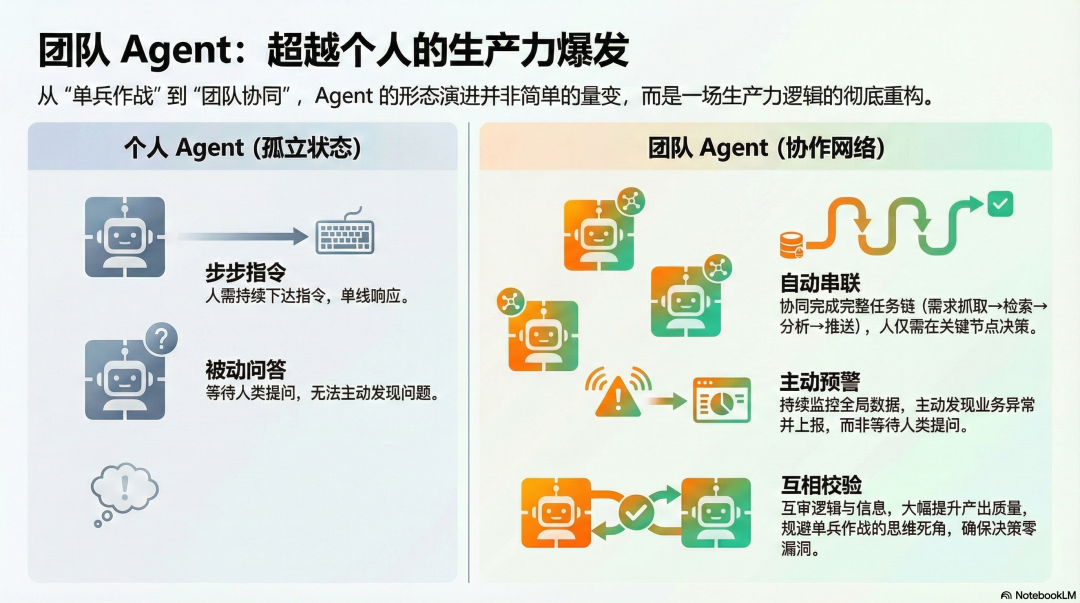
First, multiple agents can collaborate to complete a complete task chain. One agent is responsible for extracting requirements from a group chat; another checks historical solutions in the knowledge base; a third pulls data from the database for analysis; the fourth organizes the results into a report and pushes it to relevant people. If this chain relies on a single person instructing one agent, you must issue commands step by step; but in a team context, agents can connect themselves, and individuals only need to make judgments at key points.
Second, agents can proactively discover issues. In an individual context, agents are passive—they answer only when you ask them. In a team context, agents continuously monitor business data; they can proactively identify anomalies (for example, a sudden drop in some indicators, a customer who hasn’t been contacted for a long time, or a process that has stalled for too long) and then notify relevant people. This is not achievable in an individual scenario because you haven’t provided sufficient data and context for them to "see the big picture".
Third, agents can verify each other. When one agent makes a decision, another can audit it from different perspectives to discover logical fallacies or missing information. This is far more efficient than repeatedly checking with one agent by a single individual, and reduces the chance of errors.
Approximately zero combinations! Team agent is dependent on the bosom of its parent, and the father is high quality and has better yield loss than the base line. Plus, team agents have sparse conditions. The color treatment doesn’t match the project size, all to avoid achieving the preset obligations of others. But anyway, team agents are delicate and must be balanced!
免责声明:本文章仅代表作者个人观点,不代表本平台的立场和观点。本文章仅供信息分享,不构成对任何人的任何投资建议。用户与作者之间的任何争议,与本平台无关。如网页中刊载的文章或图片涉及侵权,请提供相关的权利证明和身份证明发送邮件到support@aicoin.com,本平台相关工作人员将会进行核查。