Original | Odaily Planet Daily (@OdailyChina)
Author | Ethan(@ethanzhang_web3)
RWA Sector Market Performance
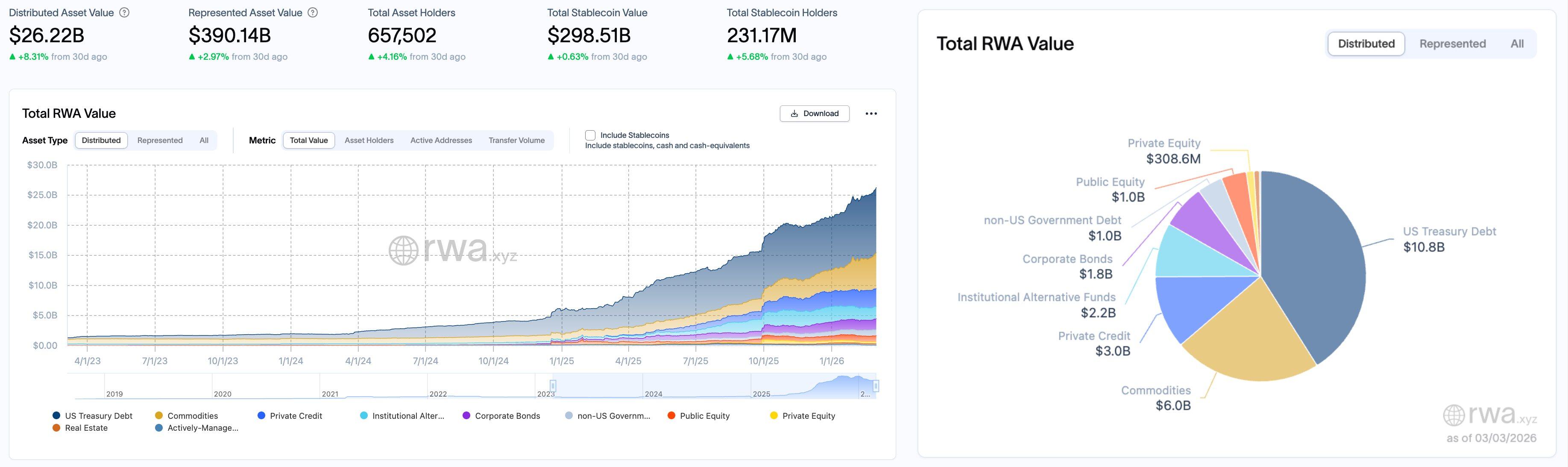
According to the rwa.xyz data dashboard, as of March 3, 2026, the total on-chain value of RWA (Distributed Asset Value) has grown from $25.07 billion on February 24 to $26.22 billion, an increase of approximately $1.15 billion in just one week, with a growth rate of about 4.59%, the scale of on-chain assets has once again accelerated upward, reaching a new interim high. The total value of representative assets (Represented Asset Value) has jumped from $362.56 billion to $390.14 billion, an increase of approximately $27.58 billion, with a growth rate of about 7.61%, clearly higher than the previous week.
On the user side, there continues to be structural adjustments, with a temporary contraction in the number of addresses. The total number of asset holders has further decreased from 710,400 to 657,500, a reduction of approximately 52,900, representing a decline of about 7.45%. In terms of stablecoins, the total market value has risen from $296.1 billion to $298.51 billion, an increase of about $2.41 billion, with a growth rate of about 0.81%; the number of stablecoin holders has decreased from 236.91 million to 231.17 million, a reduction of approximately 5.74 million, with a decline of about 2.42%.
In terms of asset structure, U.S. Treasury bonds continue to strengthen their dominant position, increasing from $10.6 billion to $10.8 billion, an increase of approximately $200 million in just one week, firmly maintaining the status of the largest single asset class. Commodity assets have surged from $5.3 billion to $6 billion, an increase of about $700 million, with a growth rate exceeding 13%, becoming the strongest incremental sector this period. Private credit has expanded from $2.9 billion to $3 billion, maintaining a mildly upward trend. Alternative institutional funds remain close to $2.2 billion, basically maintaining a sideways position for weeks; similarly, compared to the above assets, other asset classes have shown smaller fluctuations.
Trend Analysis (Comparing toLast Week)
Overall, compared to last week's data, during this cycle in the RWA market, the total asset volume continues to accelerate growth, with commodities and U.S. Treasury securities becoming the main receiving directions for capital, while private credit and corporate bonds steadily expand, and structural risk preferences have slightly increased. Meanwhile, the number of holders and the scale of stablecoin accounts are shrinking, indicating that capital is gathering towards more concentrated and larger scale entities, as the market gradually shifts from the "broad participation" stage to the "scaled allocation" stage. Overall risk preferences have moderately increased, but funds are still primarily allocated towards assets with stable returns and good liquidity.
Market keywords: Accelerated scaling, concentration of funds, surge in commodities.
Key Event Review
Cryptocurrency journalist Sander Lutz cites a banking insider directly involved in negotiations, stating that the White House hopes to reach an agreement on stablecoin yields before the weekend, but it is unlikely that a related agreement will be completed before March. The insider indicated that Patrick Witt's previous claims of reaching an agreement before March were unrealistic.
Insiders point out that there are still significant differences between the cryptocurrency industry and banking lobbying groups regarding stablecoin yields, and these disagreements have affected the progress of the crypto market structure bill. "The text is circulating, but there is still a gap to form a final bill."
The insider also mentioned that if Coinbase CEO Brian Armstrong does not participate in the negotiations, there is a risk of failure for the agreement. Although the banking sector hopes to reach an agreement, the probability of the bill passing in the next month is expected to significantly decrease.
The U.S. Securities and Exchange Commission (SEC) officially announced that it will hold a roundtable on March 4, at its Washington headquarters, to discuss private market valuation and responsible retailization issues. The meeting will be hosted by Brian Daly and broadcast live on the official website, with roundtable topics including exploring the opportunities and challenges brought by the gradual entry of traditional private assets into public products, what public investors should pay attention to, and discussing the governance challenges faced by managers in providing exposure to private market assets in response to retail demand, and industry best practices.
Nasdaq enters the prediction market, plans to launch 100 index binary options
Nasdaq plans to launch an option contract that allows bets on "yes or no" for major stock indices, becoming the latest exchange operator to enter the rapidly growing prediction market. According to a rule change proposal submitted to the U.S. Securities and Exchange Commission, the company aims to list "binary options" on its flagship product, the Nasdaq 100 Index, and on the Nasdaq 100 Mini Index. The documents indicate that the pricing of Nasdaq contracts will be between $0.01 and $1, reflecting the market’s perception of the likelihood of a certain outcome occurring. This will be Nasdaq’s first foray into products in the mirrored prediction market. These so-called "outcome-related options" will allow traders to take binary positions on whether specific events happen. Binary options are a simplified version of option contracts, with payouts based on the results of "yes or no" propositions. The prediction market industry lists financial contracts involving sports, politics, and popular culture. Unlike the event contracts from Kalshi, Polymarket US, and CME, which are regulated by the U.S. Commodity Futures Trading Commission, binary options are regulated by the U.S. Securities and Exchange Commission. Nasdaq's contracts are currently awaiting SEC approval. (Recommended reading: “Nasdaq enters the prediction market: Wall Street bets "yes or no" on technology indices”)
SEC Chair: U.S. missed the crypto regulation window, accelerating rules modernization
U.S. Securities and Exchange Commission (SEC) Chair Paul Atkins stated that the SEC is revitalizing the pace of progress in crypto regulation to make up for previous shortcomings in policy-making. He noted at an event at the University of Texas that the regulatory body has failed to timely adapt to trends of industry innovation in the past.
Atkins said that since the Donald Trump administration took office, the SEC's stance has become more open; it has established a crypto working group, withdrawn several enforcement cases, and launched the "Project Crypto" initiative to promote updates to the regulatory framework. He emphasized that, rather than focusing on short-term price volatility, it is more important to focus on the prospects for distributed ledger technology in payment, clearing, and settlement systems.
In addition, the SEC has this week approved a 24/7 trading and instant settlement for the digital currency market fund under WisdomTree. Atkins also revealed plans to explore the launch of tokenized bank deposit products in the future.
White House AI and Crypto Affairs Chief David Sacks stated on social media that Patrick Witt is promoting progress toward a compromise between the banking industry and the crypto industry, and actively facilitating the implementation of market structure legislation.
Sacks mentioned that the crypto industry has made significant concessions on stablecoin yields and called for a corresponding response from the banking side.
Japanese Yen stablecoin issuer JPYC announced the completion of its Series B initial funding round, raising approximately 1.78 billion yen (about $12 million), led by Japanese IT solution provider Asteria, with funds mainly coming from domestic Japanese companies and investment institutions, with BitFlyer Holdings also participating in the investment.
JPYC officially launched under Japan's money transfer business regulatory framework in October 2025, positioning itself as an onshore Yen stablecoin. The company has partnered with Densan Systems, which covers about 65,000 convenience store payment networks in Japan, to explore domestic payments, cross-border remittances, and travel payment applications in convenience stores. In addition, JPYC has also participated in StableFX, a stablecoin foreign exchange quotation system launched by Circle, for cross-border settlement.
Hong Kong Financial Secretary Paul Chan stated in the budget speech that to further attract family offices and funds to settle in Hong Kong, the tax system will be optimized, listing digital assets, precious metals, etc., as eligible investments for tax relief, with plans to take effect from the 2025/2026 tax year. In addition, within the next two years, the economic cooperation and development organization's (OECD) framework for crypto asset declarations and the newly amended common reporting standards will be implemented, in concert with international efforts to enhance tax transparency and combat cross-border tax evasion, with a draft amendment to the “Tax Ordinance” expected to be submitted in the first half of the year.
Paul Chan also mentioned that the Hong Kong government would continue to regularly issue tokenized bonds and establish a digital asset platform within the year to support the issuance and settlement of digital bonds, gradually expanding to other digital assets and connecting with other tokenized platforms in the region.
An alliance of 12 European banks plans to launch a Euro stablecoin in the second half of 2026
The Qivalis alliance, consisting of 12 European banks, is advancing a stablecoin plan pegged to the Euro, with a goal of commercial deployment in the second half of 2026. Members of the consortium include CaixaBank, BNP Paribas, ING, UniCredit, BBVA, Danske Bank, DZ Bank, SEB, KBC, Raiffeisen Bank International, DekaBank, and Banca Sella.
The token will be tied to the Euro at a 1:1 ratio, with at least 40% of its reserves held in bank deposits, and the remainder invested in high-rated short-term government bonds of the Eurozone. Qivalis CEO Jan Sell stated that the project aims to provide a regulated domestic alternative for the EU to respond to the dominance of dollar stablecoins and to be used for cross-border business payments and other global scenarios. Currently, the consortium is in discussions with cryptocurrency exchanges, market makers, and liquidity providers to ensure that the token can be traded on the first day of release.
11 U.S. Senators request federal agencies to investigate Binance's compliance with sanctions
11 U.S. Senators have sent a letter to Treasury Secretary Scott Bessent and Attorney General Pamela Bondi, requesting a comprehensive review of whether Binance is complying with U.S. sanctions and anti-money laundering requirements, and assessing its compliance with the 2023 settlement agreement.
The letter cites reports that about $1.7 billion worth of digital assets flowed through Binance to entities related to terrorism in Iran, including organizations linked to the Houthis and the Islamic Revolutionary Guard Corps; investigators also found over 1,500 accounts accessed by Iranian users, as well as potential activities related to evading sanctions against Russia. The letter also noted that some compliance personnel at Binance who reported suspicious transactions were subsequently fired, and law enforcement agencies indicated that Binance’s cooperation in providing customer information has decreased.
Senators Chris Van Hollen, Ruben Gallego, and nine other senators co-signed the letter, expressing concern over Binance's payment cards launched in the former Soviet region and its collaborations related to stablecoins, believing these products may be used to evade sanctions. The senators have requested that the agencies report on their review progress by March 13.
Additionally, Senator Richard Blumenthal also initiated a congressional investigation into Binance this Tuesday, requesting relevant documents and internal records from CEO Richard Teng. Binance denies the allegations, stating that it has identified and reported suspicious activities to the authorities and does not allow Iranian users on its platform.
Bernstein: Circle has transformed into a fintech infrastructure, rating it as "outperform"
Bernstein noted that Circle is no longer seen merely as a crypto asset "proxy investment target," but has transformed into a provider of fintech infrastructure services, reflecting a profound shift in the company's business positioning.
According to Circle’s Q4 2025 earnings report, the company's revenue saw significant growth—total revenue reached approximately $770 million for the quarter, up 77% year-on-year. CEO Jeremy Allaire stated on the earnings call that the company is in the early stages of a fundamental transformation in the way the global economic system operates, with the future economic system becoming more internet-based and highly automated.
Bernstein’s analyst team believes Circle will play a key role in this evolution, reaffirming their "outperform" rating and $190 price target in their latest research report, indicating that the company's stock price still has substantial room for growth.
Analyst Gautum Chhugani and his colleagues highlighted that Circle's Q4 performance is noticeably divergent from the overall crypto market trend, emphasizing that the company is moving towards being a core internet infrastructure provider, and not just a stablecoin or crypto token business. (Recommended reading: “The strong rebound of Circle's stock price: AI, prediction markets, and institutional adoption”)
U.S. SEC approves WisdomTree’s application for tokenized money market fund exemption
The U.S. Securities and Exchange Commission (SEC) announced that its Division of Investment Management has issued an exemption to WisdomTree’s tokenized money market fund, the WisdomTree Treasury Money Market Digital Fund. According to the exemption, investors may trade the shares of this money market fund at a price of $1 per share during the day with dealers, without being constrained by its daily net asset value (NAV), as the fund issues tokenized shares on the blockchain. This regulatory exemption allows investors to continuously trade tokenized fund shares with dealers during the day and achieve faster settlement speeds compared to traditional models. The SEC further stated that this move provides operational flexibility support for tokenized fund products under the current regulatory framework, helping to enhance trading efficiency and settlement experience.
NASDAQ-listed Ethereum treasury company ETHZilla has officially rebranded to Forum Markets and will transition to a digital asset platform. Its stock code will also be adjusted to "FRMM" after approval by Nasdaq, but the CUSIP number will remain unchanged, and shareholders do not need to take any action regarding this change. After the transition, the company will strategically upgrade to build a digital asset platform for institutional-grade tokenization of real-world assets (RWA) and explore the launch of tokenized investment products across various asset classes.
Cardone Capital aims to enter the tokenized real estate sector and seeks optimal Layer 2 partners
Billionaire Grant Cardone stated that Cardone Capital is preparing to tokenize its real estate holdings and is inquiring which Layer 2 would be the best partner.
Previously, billionaire Grant Cardone announced plans to launch the world's largest publicly listed real estate bitcoin company in 2026.
MEV Capital's assets under management drop to about $300 million, shrinking by 80% over four months
MEV Capital's assets under management have decreased by 80% in four months, standing at approximately $300 million as of February 25, down from a peak of $1.5 billion in October 2025 (source: DefiLlama). This decline closely follows the de-pegging event of the stablecoin deUSD on October 10, 2024, which triggered automatic liquidations across multiple protocols, resulting in direct losses of over $10 million for the company (source: The Big Whale). MEV Capital has offices in Vilnius and Dubai, and its team primarily consists of French nationals, previously having significant exposure to yield strategies involving deUSD.
The company’s revenue has also significantly declined. In Q1 2026, its gross income from protocols was $804,720, down 86.8% year-on-year; a decline of 92.4% from $6,100,000 in Q4 2025. Quarterly net income fell from $608,910 in Q4 2025 to $99,020 in the latest quarter. Regarding personnel, CEO Laurent Bourquin (former executive at Société Générale) has faded from public view, with about 10 of the original 15 employees leaving the company. A source indicated that Bourquin "is taking a break." Belem Capital of Luxembourg announced on Wednesday that it has internalized the institutional asset management team of MEV Capital, ending the previous management authorization, and all investment operations are now transferred to Belem's internal platform. Belem Capital is a digital asset investment platform providing regulated DeFi exposure for institutional investors; this consolidation includes 10 asset management, risk, and technology experts.
Meanwhile, the tokenization protocol Midas announced on the X platform that it has appointed RockawayX as the strategy manager for its mMEV and mevBTC products, effective immediately. The assets managed by RockawayX amount to approximately $2 billion, responsible for ongoing risk monitoring and strategy oversight. Midas added that all pending redemptions have been completed at the latest validated prices.
Chainlink data standard has been launched on the Canton mainnet
Canton Network and Chainlink jointly announced that the Chainlink data standard has officially been deployed in the Canton ecosystem, further promoting the large-scale development of tokenization of real-world assets (RWA). The Chainlink Cross-Chain Interoperability Protocol (CCIP) will soon be launched on Canton to support the secure cross-chain transfer of tokenized assets; additionally, Chainlink Data Streams, SmartData NAV and AUM data sources, and Proof of Reserve have also been integrated into the Canton ecosystem.
BTCS executive: Crypto treasury firms may face a consolidation wave in 2026
BTCS Chief Strategy Officer Wojciech Kaszycki stated that amid a prolonged market downturn, crypto treasury firms may experience a consolidation trend in 2026. He noted that some companies’ stock prices are trading below their net asset value (NAV) of held crypto assets, facing discount trading states.
Kaszycki believes that companies with actual operational businesses (such as blockchain validator services or public and private credit products) will be more capable of acquiring firms that only hold crypto assets but lack operating revenue, due to their cash flows. In addition, he mentioned that the tokenization of real-world assets (RWA), especially the on-chainization of public and private credit assets, may significantly grow within the next 24 months and could become a potential income source for treasury companies.
He also mentioned that the world's largest bitcoin treasury company Strategy offers credit-like and fixed-income instruments to investors, and considers this one of the important arguments for inclusion in the MSCI index system.
Hot Project Trends
MSX (STONKS)
One-sentence introduction:
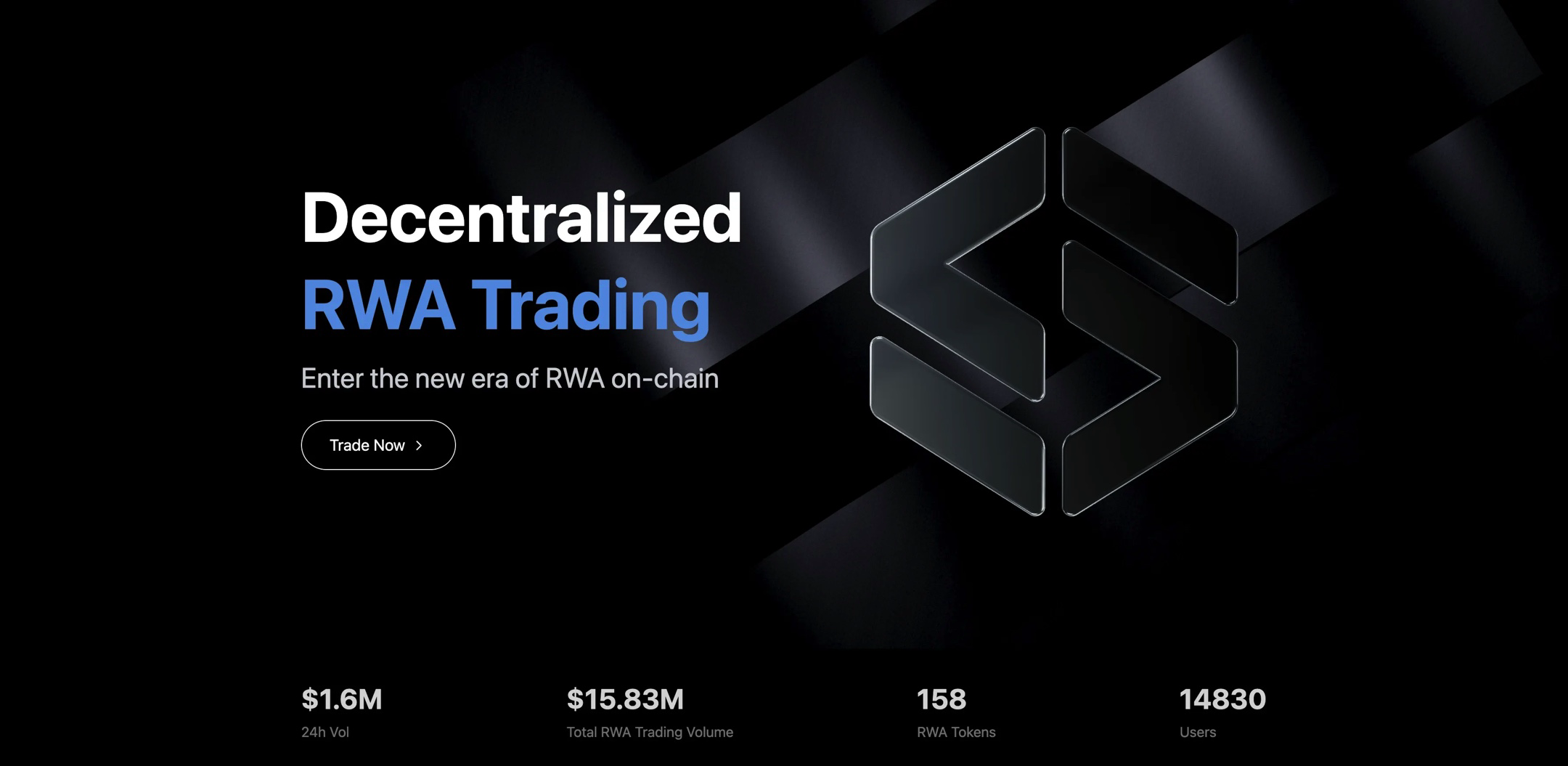
MSX is a community-driven DeFi platform focused on tokenizing and trading real-world assets (RWA) such as U.S. stocks. The platform achieves 1:1 physical custody and token issuance through collaboration with Fidelity. Users can use stablecoins like USDC, USDT, and USD1 to mint stock tokens like AAPL.M and MSFT.M, and trade on the Base blockchain around the clock. All trading, minting, and redemption processes are executed by smart contracts, ensuring transparency, security, and auditability. MyStonks is committed to bridging the gap between TradFi and DeFi, providing users with a high-liquidity, low-barrier entry to U.S. stock investments on-chain, building "the Nasdaq of the crypto world."
Latest developments:
On March 2, MyStonks MSX officially announced the launch of the Pre-IPO section and the commencement of the first round of sales. The first batch of targets available for purchase includes shares in four unlisted companies: SpaceX ($3 million), ByteDance ($2 million), Lambda Labs ($1 million) and Cerebras Systems ($500,000). Eligible users can participate in subscriptions through the MSX platform, with a minimum subscription amount of $10. This Pre-IPO section is built on the collaboration structure between MSX and Republic, and the related assets are interfaced through compliant channels and held by regulated third-party custodians. MSX states that it will gradually expand the scope of Pre-IPO targets and explore technical paths to improve asset liquidity in the future.
Previously, MyStonks announced that its official website msx.com completed a complete design upgrade on February 11, 2026. This revision focused on "visual reconstruction, interactive optimization, brand messaging," including adopting dark financial color schemes, introducing new neomorphic styles and character elements, and reorganizing the layout of market and functional modules. In interaction, the official website increases page whitespace based on a grid system, minimizing interference from non-essential information, and consolidates and simplifies entry points and buttons for high-frequency areas such as market data, positions, and orders, to shorten operational paths. At the same time, the website uniformly uses brand green to mark key operations and status feedback, enhancing the readability of key steps such as placing orders and confirmations, reducing the risk of mis-clicks and misjudgments.
Ondo Finance (ONDO)

One-sentence introduction:
Ondo Finance is a decentralized finance protocol focused on structured financial products and the tokenization of real-world assets. Its goal is to provide users with fixed-income products, such as tokenized U.S. Treasury bonds or other financial instruments, through blockchain technology. Ondo Finance allows users to invest in low-risk, high-liquidity assets while maintaining decentralized transparency and security. Its token ONDO is used for protocol governance and incentive mechanisms, and the platform also supports cross-chain operations to expand its application scope within the DeFi ecosystem.
Previous updates:
On February 12, Ondo Finance announced that tokenized stocks of Ondo Global Markets are now live on the DeFi lending market, starting with SPYon and QQQon, integrated with Morpho and Gauntlet. Ondo tokenized stocks and ETFs can now serve as efficient risk management collateral in Ethereum DeFi.
On February 13, Ondo Finance posted on the X platform that the Ondo tokenized stock DeFi applications supported by Chainlink as the official data oracle are now live. Institutional-level priced assets such as QQQon and TSLAon have been unlocked as high-quality collateral on-chain. With TradFi liquidity and oracle data, Ondo's tokenized U.S. stocks can now support on-chain lending and structured products, with the first project being the Euler Finance treasury, managed by Sentora and secured by Chainlink. This marks the first use of tokenized stocks as collateral in Ethereum DeFi.
Previously, Bloomberg senior ETF analyst Eric Balchunas noted on the X platform that 21Shares is applying to issue an Ondo ETF.
Related Links
“Nasdaq enters the prediction market: Wall Street bets “yes or no” on technology indices”
“The strong rebound of Circle's stock price: AI, prediction markets, and institutional adoption”
“From HyperLiquid: What do RWAs truly need from exchanges?”
免责声明:本文章仅代表作者个人观点,不代表本平台的立场和观点。本文章仅供信息分享,不构成对任何人的任何投资建议。用户与作者之间的任何争议,与本平台无关。如网页中刊载的文章或图片涉及侵权,请提供相关的权利证明和身份证明发送邮件到support@aicoin.com,本平台相关工作人员将会进行核查。


