Written by: imToken
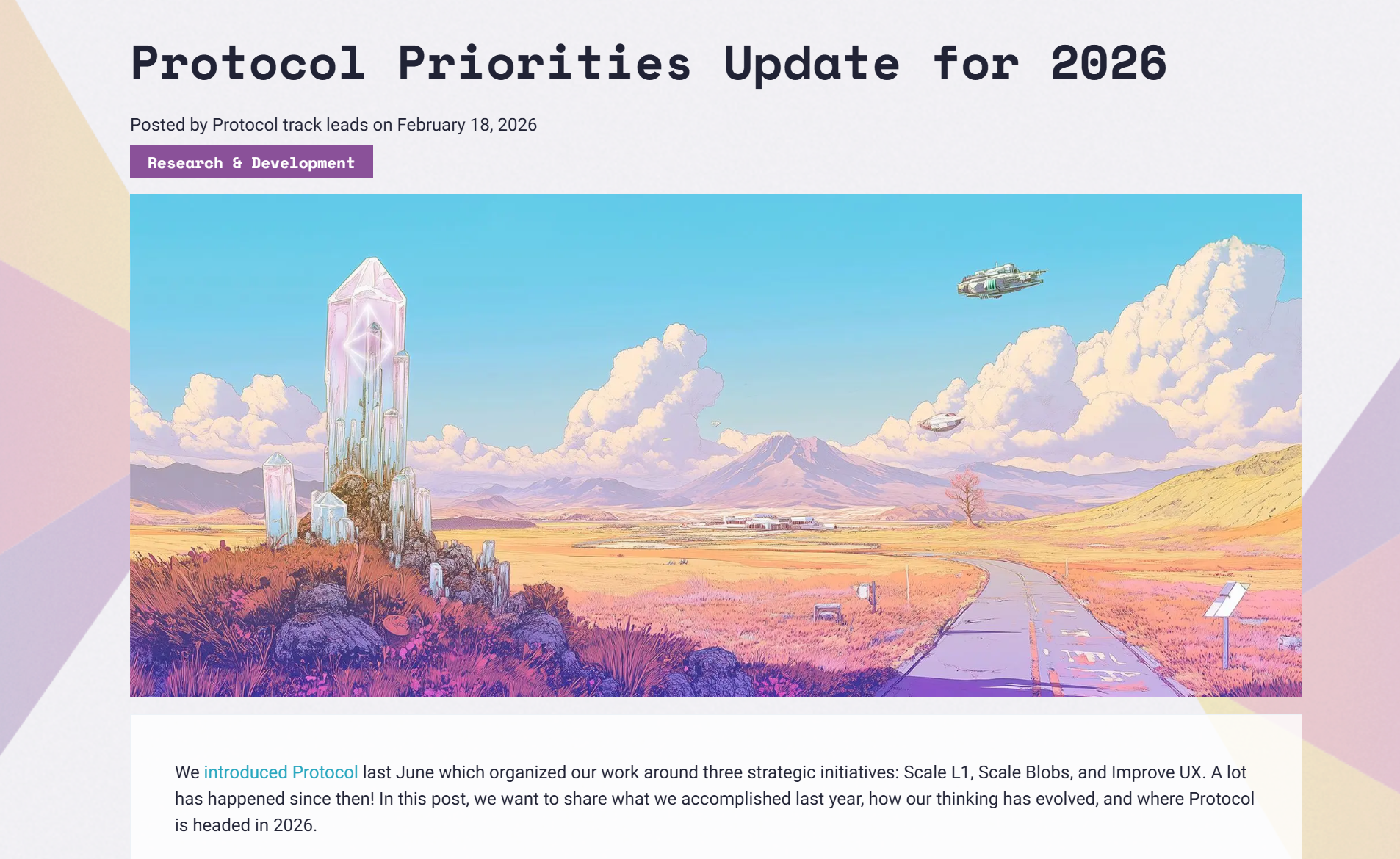
On February 18, the Ethereum Foundation (EF) released the "Protocol Priorities Update for 2026." Compared to previous fragmented updates centered around EIPs, this roadmap resembles a strategic schedule, clarifying the upgrade pace, priority allocation, and the three main lines the protocol layer will focus on in the upcoming year: Scale, Improve UX, Harden the L1.
Behind this, from the successful delivery of two hard forks in 2025 (Pectra/Fusaka) to the early planning of dual lines for Glamsterdam and Hegotá in 2026, we have witnessed a profound shift in Ethereum development toward "predictable engineering delivery," which could be the most significant protocol layer signal in recent years.
1. Ethereum in 2025: Turbulence and Institutionalization
If you have been following Ethereum, you will know that 2025 was a year marked by contradictions for this protocol. The ETH price may have hovered at low levels, but the protocol layer experienced unprecedented intensive changes.
Especially at the beginning of 2025, Ethereum underwent a fairly chaotic period. At that time, the EF found itself at the center of a public relations storm—community criticisms surged, and some even called for the introduction of a so-called "war-time CEO" to push for change. Ultimately, a series of internal struggles became public, forcing the EF to undertake the highest-level power restructuring since its establishment:
- On February, Executive Director Aya Miyaguchi was promoted to President, and Vitalik Buterin committed to restructuring the leadership;
- Following that, Hsiao-Wei Wang and Tomasz K. Stańczak were appointed as Co-Executive Directors;
- Also, a new marketing narrative agency named Etherealize was established, led by former researcher Danny Ryan;
- Meanwhile, the EF further restructured its board and clarified its values guided by the cypherpunk ethos;
- By mid-year, the foundation also restructured its research and development department, consolidating teams and adjusting personnel to ensure focus on core protocol priorities;
It turned out that this series of moves significantly strengthened Ethereum's execution capability. Especially just seven months after the Pectra upgrade in May, the successful deployment of the Fusaka upgrade by the end of the year proved that the EF, after major leadership adjustments, still had the ability to push significant updates, marking Ethereum's formal entry into an accelerated development rhythm of "two hard forks a year."
After all, since the Ethereum network transitioned to PoS with The Merge in September 2022, it has essentially aimed at one major upgrade per year, such as the Shapella upgrade in April 2023 and the Dencun upgrade in March 2024: the former opened staking withdrawals and completed a key part of the PoS transition; the latter launched EIP-4844, officially starting the Blob data channel, significantly reducing L2 costs.
In 2025, two important hard fork upgrades, Pectra and Fusaka, were completed; more critically, it was the first time that systematic planning for the next two years' naming upgrades, namely Glamsterdam and Hegotá, was achieved.
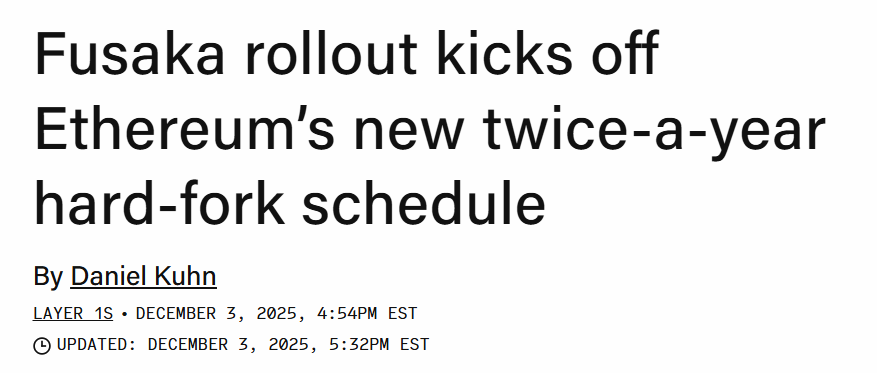
Although there was no formal specification, interestingly, at the end of last year, The Block cited sources from Consensys stating that since The Merge, Ethereum researchers aimed for one major upgrade per year, and now they are planning to "accelerate the pace of hard fork releases to every six months," directly stating that Fusaka opened the cycle for Ethereum's twice-a-year upgrades.
It can be said that this "institutional" change regarding the upgrade rhythm is quite milestone-worthy. The reason is simple: the previous release rhythm depended more on R&D readiness, which meant that for developers and infrastructure, the expected window was unstable. Those familiar with the situation should know that delays are not uncommon.
This also means that the successful delivery of the two major upgrades in 2025 validated the feasibility of "biannual upgrades." 2026 systematically planned the first two named upgrades (Glamsterdam and Hegotá), arranging priority settings around these two nodes on three development tracks, representing a further step toward institutionalizing the process.
Theoretically, this is somewhat similar to the release rhythm of Apple or Android systems, aimed at reducing developer uncertainty and potentially bringing three positive effects: enhanced predictability for L2, meaning Rollups can proactively plan parameter adjustments and protocol adaptations; clear adaptation windows for wallets and infrastructure, allowing product teams to plan compatibility and feature launches rhythmically; stable institutional risk assessment cycles, after all, it means that upgrades are no longer spontaneous events but the norm of engineering.
This structured rhythm essentially reflects engineering management and highlights Ethereum's transition from research exploration to engineering delivery.
2. The "Three Legs" of Protocol Development in 2026
Delving into the 2026 protocol priority update planning, it becomes apparent that the EF no longer simply lists scattered EIPs, but has reorganized protocol development into three strategic directions: Scale (expansion), Improve UX (enhancing user experience), and Harden the L1 (strengthening L1).
The first is Scale, which merges the previous "Scale L1" and "Scale blobs," as the EF recognizes that expanding the execution layer of L1 and broadening the data availability layer is two sides of the same coin.
Therefore, in the upcoming Glamsterdam upgrade scheduled for the first half of the year, the most notable technology will be "Block-level Access Lists," aimed at fundamentally changing Ethereum's existing transaction execution model—understood as transforming from sequential "single-lane" processing to parallel "multi-lane" processing:
Block producers will pre-calculate and mark which transactions can be run simultaneously without conflict, allowing clients to allocate transactions across multiple CPU cores for parallel processing, significantly enhancing efficiency; at the same time, ePBS (embedded proposer-builder separation) will be included in the upgrade, embedding the currently relay-dependent MEV-Boost process into the protocol itself, reducing centralization risks while reserving more ample time windows for validators to verify ZK proofs.
With these fundamental optimizations, the gas limit competition will reach a fever pitch in 2026, with the EF currently setting the target at "moving towards 100 million and above." Radicals even predict that after ePBS, the gas limit could double to 200 million or higher, and for L2, increasing the number of blobs is also crucial, with the number of data blocks per block expected to exceed 72, supporting L2 networks to process hundreds of thousands of transactions per second.
The second is Improve UX, aiming to eliminate cross-chain barriers and popularize cross-chain interoperability and native account abstraction. As mentioned earlier, the EF believes that the key to solving the fragmentation of L2 is to make Ethereum "feel like one chain again," and this vision relies on the maturity of the intent structure.
For example, the Open Intents Framework, launched collaboratively by the EF and several teams, is becoming a common standard, allowing users to transfer assets between L2s simply by stating their "desired outcome," while the underlying solver network completes the complex path calculations (further reading "When 'Intent' Becomes the Standard: How OIF Ends Cross-Chain Fragmentation and Returns Web3 to User Intuition?"); furthermore, the Ethereum Interoperability Layer (EIL) aims to build a trustless transport layer, aiming to provide cross-L2 transaction experiences comparable to single-chain transactions (further reading "Ethereum Interop Roadmap: How to Unlock the 'Last Mile' for Mass Adoption").
At the wallet level, native account abstraction will remain a focal point this year. Following the first step in the 2025 Pectra upgrade with EIP-7702, the EF plans to promote proposals like EIP-7701 or EIP-8141 in 2026, with the end goal of making every wallet on Ethereum a smart contract wallet by default, completely abolishing complex EOA wallets and additional gas payment intermediaries.
Additionally, the implementation of rapid confirmation rules for L1 will significantly shorten confirmation times from the current 13-19 minutes to 15-30 seconds, which will directly benefit all cross-chain applications that rely on L1 finality, having significant implications for cross-chain bridges, stablecoin settlements, and RWA asset trading.
The final focus is Harden the L1, aiming at a trillion-dollar security defense line, which is also due to the growing locked value in the Ethereum ecosystem, elevating the security resilience of the L1 layer to a strategic level.
In terms of censorship resistance, FOCIL (Fork Choice Inclusion List, EIP-7805) is becoming the core solution. It grants multiple validators the power to enforce the inclusion of specific transactions in blocks; even if block producers attempt to censor, as long as a portion of the network is honest, users' transactions can still be recorded on-chain.
Facing the long-term threat of quantum computing, the EF formed a new post-quantum (PQ) research team earlier this year, and work in 2026 will focus on researching quantum-resistant signature algorithms and beginning to consider how to seamlessly migrate them to the Ethereum mainnet, ensuring the security of billions of dollars' worth of assets against quantum algorithm breaches.
3. A More "Collaborative" Ethereum is Coming
Overall, if we were to summarize Ethereum in 2026 in one word, it would perhaps be "collaboration."
Upgrades will no longer revolve around any explosive innovations but will progress collaboratively around three main lines: Scale is responsible for throughput and costs; Improve UX is responsible for usability and popularity; Harden the L1 is responsible for security and neutrality, and these three collectively determine whether Ethereum can support the on-chain economy of the next decade.
Meanwhile, what deserves more attention than the technical roadmap is the strategic shift reflected behind this "three-track" structure.
As mentioned above, when the Fusaka upgrade was successfully completed at the end of 2025 and the rhythm of two hard forks a year was established, Ethereum effectively completed an "institutional" leap in its development model. The priority update released at the beginning of 2026 further extends this institutionalization to the planning level of technical directions—historically, Ethereum's upgrades often revolved around a "star proposal" (like EIP-1559, the Merge, EIP-4844), and now, upgrades are no longer defined by a single proposal but constructed by the collaborative advancement of three tracks.
From a more macro perspective, 2026 is also a key year for reconstructing Ethereum's "value narrative." In recent years, the market's pricing of Ethereum has largely focused on the "cost increase brought by L2 expansion," and as the mainnet's performance improves and L2's positioning shifts from "sharding" to "trust spectrum," Ethereum's core value is being remapped onto its undeniable identity as "the world's most secure settlement layer."
What does this imply? Simply put, Ethereum is transitioning from a platform reliant on "transaction fee revenue" to one that depends on "security premiums," and the far-reaching effects of this transition may gradually manifest in the coming years—when stablecoin issuers, RWA tokenization agencies, and sovereign wealth funds choose a settlement layer, they are not selecting the cheapest network but the safest one.
Ethereum is truly transforming from a "technology experimentation ground" into an "engineering delivery platform," and the institutionalization of Ethereum protocol governance may truly reach maturity in 2026.
And we may be at a remarkable junction: while the underlying technology becomes increasingly complex (such as parallel execution, PQ algorithms), the user experience is becoming simpler, with the maturation of account abstraction and intent frameworks pushing Ethereum toward that ideal endpoint—returning Web3 to user intuition.
If this can indeed be achieved, Ethereum in 2026 might genuinely transform from an experimental blockchain into a global financial foundation capable of supporting trillions of dollars in assets, where users do not need to understand the underlying protocols.
免责声明:本文章仅代表作者个人观点,不代表本平台的立场和观点。本文章仅供信息分享,不构成对任何人的任何投资建议。用户与作者之间的任何争议,与本平台无关。如网页中刊载的文章或图片涉及侵权,请提供相关的权利证明和身份证明发送邮件到support@aicoin.com,本平台相关工作人员将会进行核查。


