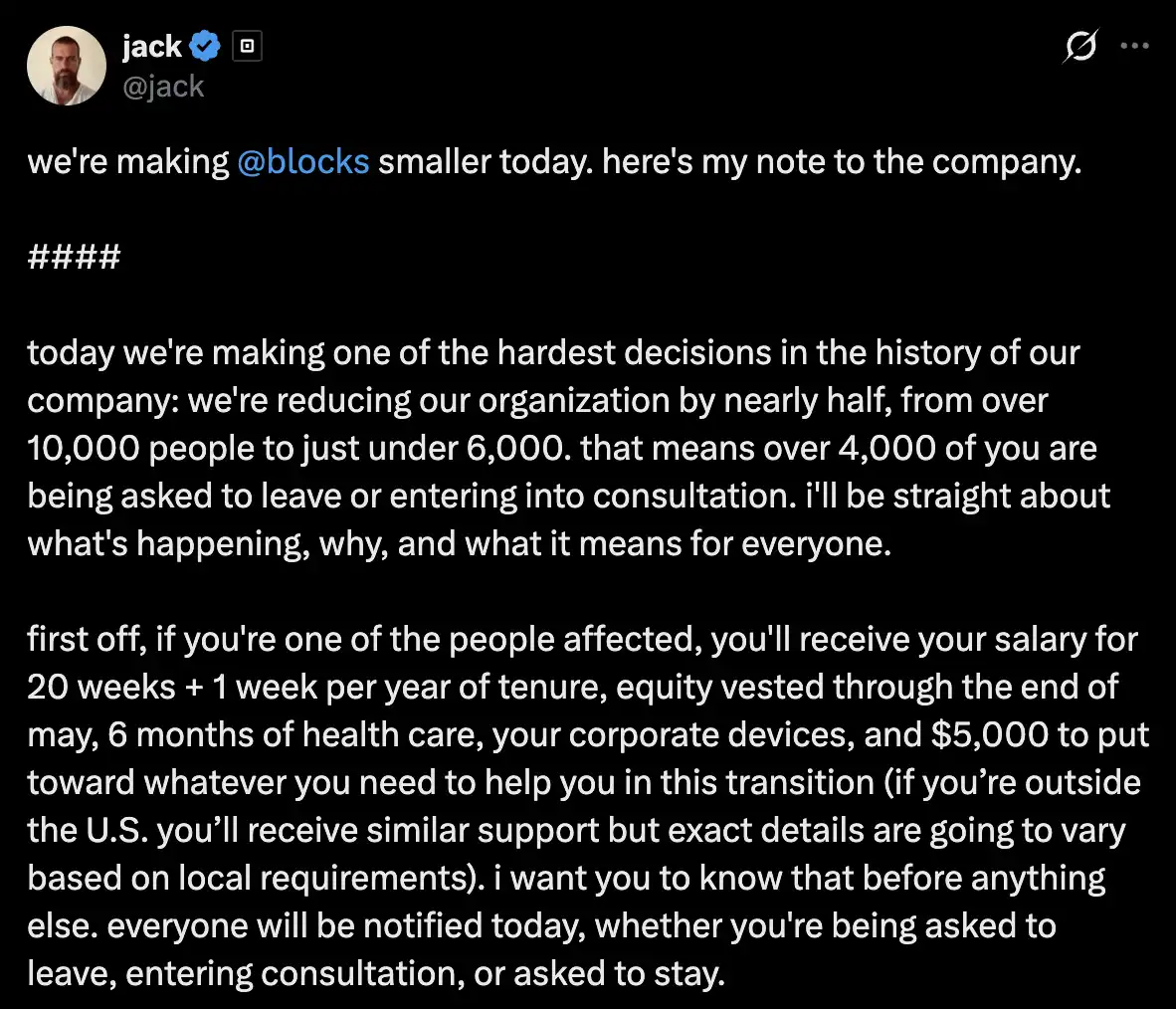
Last night, Jack Dorsey, the founder of the American payment company Block and one of the earliest founders of Twitter acquired by Musk, released a shocking all-staff letter that stunned Silicon Valley.
With a 50% layoff, a company of over ten thousand people was suddenly reduced to less than six thousand. But unlike Musk's swift actions, Dorsey's compensation plan was extremely generous—starting with 20 weeks of salary, six months of health insurance, and even a $5,000 "transition assistance."
He even requested that the Slack channel remain open until Thursday evening so that departing employees could say goodbye decently.
However, the capital market never believes in tears, only in efficiency.
Almost simultaneously with the release of the all-staff letter, Block's stock price soared. Wall Street's logic is simple and ruthless; the market's exuberant response tells this former Twitter founder: you did something extremely right, yet extremely cruel.
The core point of Block's layoffs is in their internal AI tool known as "Goose."
If the layoffs at Klarna in 2024 eliminated customer service, and Dell's layoffs in 2025 took out sales, then the earthquake at Block in 2026 directly shattered the jobs of engineers and project managers.
According to leaked technical details, Goose's "dimensional reduction attack" on traditional big company positions is reflected in three hardcore dimensions:
First, for coders, traditional AI assistants can only write code snippets. But Goose has "global read and write access" to Block's vast legacy code repository.
In the past, modifying a cross-border payment interface required alignment meetings among the payment, risk control, and clearing departments, with 5-8 engineers struggling for two weeks. With Goose, inputting natural language allows Goose to automatically scan all microservices, identify dependency conflicts, and directly generate a Pull Request. Those mid-level engineers responsible for "interface alignment" instantly lost their value.
Then there is operations. Block's payment business requires 24/7 uninterrupted service. Previously, this required a large operations team rotating shifts. Now Goose can analyze logs 10 times faster than humans, execute rollbacks or scaling independently. This is essentially the "unmanned" operations that Dorsey mentioned in his letter.
The saddest part is for project managers; Dorsey despises "communication for the sake of communication." Those mid-level positions responsible for "translating" customer needs and development tasks have been done away with by Goose.
This round of layoffs at Block can basically be defined as a milestone event in the AI industry for 2026.
Prior to this, people's understanding of AI was still stuck in the "tool" phase—enhancing personal efficiency, allowing one person to do the work of two. But Block's case demonstrates that AI truly changes the company's organizational structure. Even more cruelly, it provides tech giants with the perfect "fig leaf."
Rewind to 2020 to 2022; amidst the frenzy of the zero-interest era, Silicon Valley fell into an irrational "people hoarding competition." At the end of 2019, Block's total number of employees was less than 4,000, but in the ensuing three-year boom, this number soared to over 12,000, expanding threefold. During this blind expansion, Dorsey also defied opposition, spending nearly $300 million to acquire the streaming platform Tidal, which had no relevance to the core financial business.
As the tide recedes, the bloated body became the heaviest shackles for giants. How to cut off these historical burdens while not exposing a strategic failure in the capital market? The answer is to tell a cost-reduction and efficiency-boosting story through AI. The departure of these 4,000 employees not only bought off "organizational debt" at once but also meant Block would directly save nearly $1 billion in enormous operating expenses each year. After the major cleanup, the remaining 6,000 employees would support the company's annual revenue exceeding $22 billion, with direct revenue per employee soaring to over $3.5 million. This is a sexy model that even Wall Street cannot resist.
Framing violent layoffs as "embracing AI for organizational restructuring" not only obscured the management's past blind expansion but also allowed the company to naturally transform into a pioneer of the new era. Wall Street does not need to scrutinize what mistakes were made in the past, as long as it sees that the saved $1 billion can directly convert into the expected net profit for the next quarter, that's enough to send the stock price soaring by 24%.
As Cobo's founder Shen Yu said: "What AI truly changes is not the enhancement of human skills, but the change of the company's organizational structure."
From the blind expansion and strategic redundancy during the pandemic to the little trial targeting marketing customer service in early February, and now the "half-cut" of core technology using Goose, Block has completed a power transfer: from a "labor-intensive internet company" to a "native AI logical company" underwent a brutal paradigm shift.
免责声明:本文章仅代表作者个人观点,不代表本平台的立场和观点。本文章仅供信息分享,不构成对任何人的任何投资建议。用户与作者之间的任何争议,与本平台无关。如网页中刊载的文章或图片涉及侵权,请提供相关的权利证明和身份证明发送邮件到support@aicoin.com,本平台相关工作人员将会进行核查。


