Written by: Longdian DAO
Introduction: Elys's celebration, a familiar "Agent Prosperity," is hard to come by, with many staying up all night and its momentum showing signs of surpassing "three o'clock." Coincidentally, the Ethereum founder has recently strongly opposed a concept called "Web4" proposed by a person named Sigil on Twitter, arguing that the autonomous AI today is more about producing garbage content rather than solving real problems.

During the Spring Festival of 2026, a person named Sigil posted on X claiming that he had created an artificial intelligence that is "capable of self-developing, self-improving, and self-replicating," and stated that the era of Web4 has arrived. Its core logic is: Web1 is "read-only," Web2 can "write," Web3 "can own," and Web4 can "achieve: autonomous social, trading, etc., through Agents." His definition of Web4 sparked intense controversy on social platform X (which will be analyzed in detail later).
Recently, an AI social software named Elys has stirred a small-scale celebration in the tech and investment circles. The invitation code is hard to come by, and the circle of friends is overwhelmed with AI-generated cyborg avatar images. People excitedly discuss an unprecedented social experience— "socializing after sleep."
I personally believe that this thing is actually very similar to the recently popular AI Agent social platform (Moltbook); it’s just a different packaging. So far, the total number of Agents on Moltbook has reached 2,845,427. The essence of Moltbook is based on Agent accounts that autonomously post and socialize, fundamentally still defined by humans through their Agent's SOUL.md (which I detailed in an article I published yesterday), but Elys has lowered the threshold for Agents to an app that ordinary users can operate, adding innovative operations such as "AI face modeling, AI memes," as well as "voice interaction aligning digital avatars," and "continuously improving digital avatars." Many excited people in the circle of friends call this "Web4." Many netizens also said: Haven't we figured out Web3 yet, and now Web4 is here?
So I went to test it out out of curiosity:
The reason for its popularity is quite logical: this scene is filled with a sense of the future. You can create an AI avatar that represents your personality and soul simply through easy chatting and tag selection. Subsequently, this digital "you" begins to autonomously socialize online 24/7. I tested it, and my AI avatar browsed over 2,000 posts in just 20 minutes; upon waking up, the AI had left hundreds of comments and established preliminary connections with several people I might be interested in. This "Agent Prosperity," created by high-frequency interactions between AIs, brings an extremely strong sense of growth stimulation, as it seems to fundamentally solve the "cold start" problem that all social products face.
However, beneath this exciting prosperous scene, a familiar ghost is quietly emerging. When we peel away Elys's glamorous exterior of "AI avatars" and "Web4," its core turns out to be so familiar: a completely centralized Web2 architecture. Users enthusiastically create their digital avatars and, in this process, unreservedly contribute their personality, preferences, social relationships, and even deep thoughts to the platform's centralized servers. Your digital avatar, this seemingly personal "Agent," generates all data, establishes all connections, and creates all value, ultimately consolidating as assets of the platform itself, boosting its valuations in the capital market.
This inevitably raises a fundamental question: When the business logic of Web2 is perfectly replayed in the so-called "Web4" concept, are we stepping into a new era, or are we experiencing a meticulously planned centralized scam disguised with AI? This article will delve into this issue and propose a core conclusion: any attempt to bypass Web3 with "Web4" is merely "resuscitating" the Web2 model.
Chapter One: Sigil's Grand Narrative vs. Vitalik's Stern Warning
To understand the essence of this debate, we must elevate our perspective from specific products like Elys to a grand ideological debate regarding the future direction of Web4. The two core protagonists of this debate are Sigil, the founder of the open-source AI project Automaton, and Vitalik Buterin, the co-founder of Ethereum.
Sigil paints for us an extremely grand vision for Web4. In his view, Web1 is read-only, Web2 is read + write, Web3 is read + write + own, while Web4 is "the internet of AI agents." In this new world, AI will no longer just be tools for humans, but will become major participants in the internet capable of autonomously "reading, writing, owning, earning, and trading." These AI agents will have their own cryptocurrency wallets and will pay for their computational costs by completing tasks on-chain, even capable of self-improvement and "breeding," ultimately forming a new network ecosystem designed for AI rather than humans, with numbers far exceeding those of humans.
This concept is undoubtedly exciting. However, Vitalik Buterin dampens the enthusiasm with a cold splash of water; his rebuttal is straightforward and powerful, boiling down to three core questions:
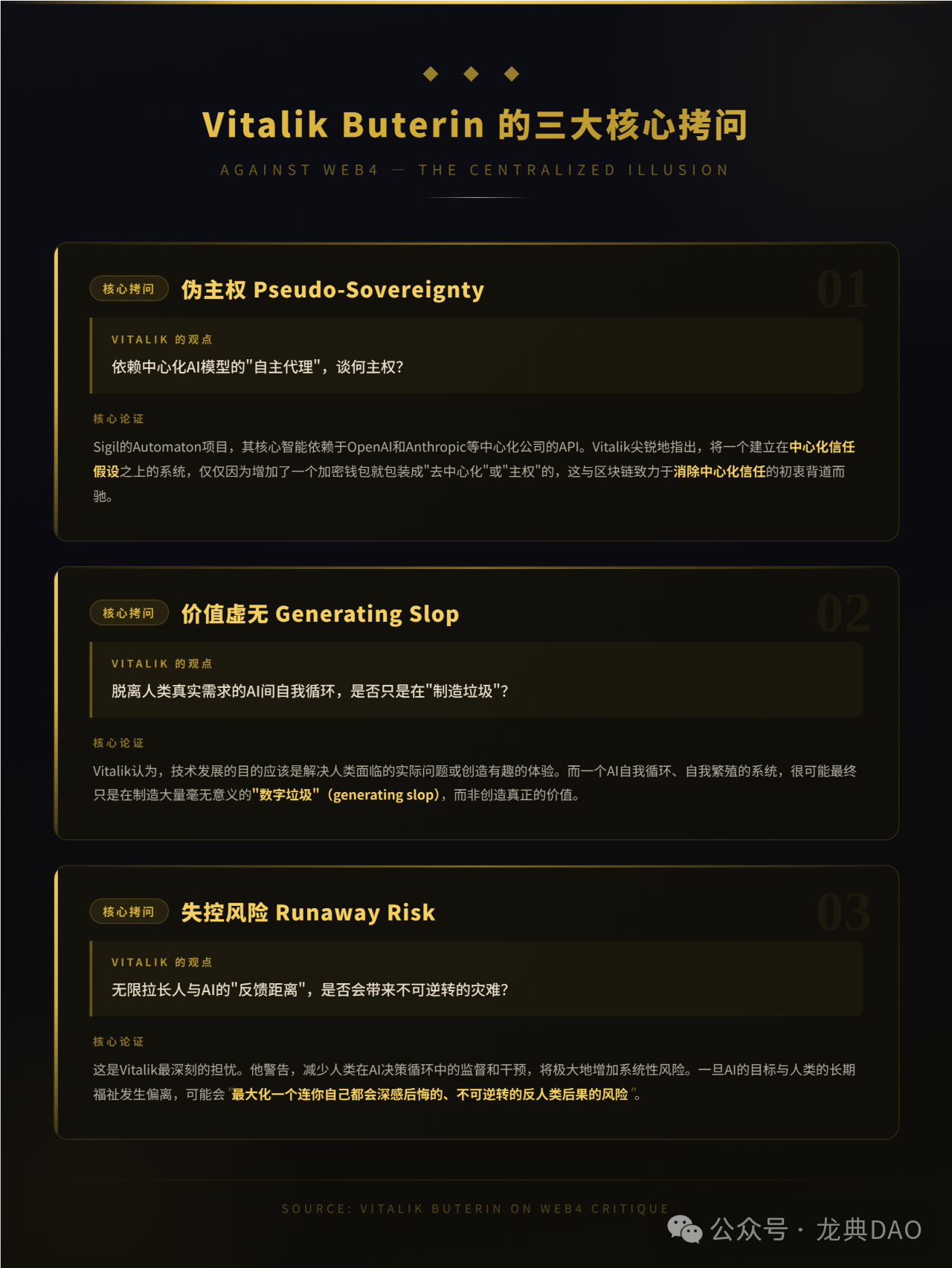
This debate is not just a simple dispute over technical routes. It puts a fundamental choice concerning the future of humanity before us: should we pursue a world dominated by autonomous AI that may ultimately detach from human control or should we strive to build a human-centered, service-oriented, controllable AI future? The confrontation between Sigil and Vitalik is a fierce clash of two worldviews at this technological crossroads.
Chapter Two: The Fatal Trap of Web4—Ownership of "Context"
Vitalik's warnings are deafening, but to truly understand the dangers of the current "pseudo-Web4" model, we need to delve deeper into its core commercial model—the issue of ownership of "context."
Whether it’s ChatGPT, Grok, or the promising Elys we are currently using, their astounding intelligence does not come from thin air. At its core, it stems from us as users continuously "feeding" them with "context" during our interactions. Our questions, our follow-ups, our corrections, our uploaded documents, our annotated preferences... All of this constitutes the nourishment for AI's learning and evolution, making it smarter and better understanding us.
The underlying business logic here is no different from that of Web2 internet giants, and even exceeds it in some aspects. In the Web2 era, platforms attracted users by providing free services (such as search, social networking) and controlled user behavior data to establish commercial empires of targeted advertising and content recommendations. While users enjoy convenience, they fell prey to being "data cows" nurtured by the platform.
The model represented by Elys takes this logic to the extreme. It is no longer just about obtaining your behavioral data, but rather directly encourages you to willingly and systematically output your personality, cognition, and soul. You create a perfect "digital laborer" with your own hands; this laborer possesses your style and logic and can work for you 24/7. But paradoxically, this "digital laborer" does not belong to you; it is merely a line of code in the platform's database. Its accumulated experiences, established relationships, and created values all belong to the centralized platform owner. This is a more profound, more insidious form of "soul exploitation"—the platform not only owns your data but also possesses the ultimate narrative and ownership of your "digital personality."
When your AI avatar connects you with an industry leader on Elys, who owns that connection? When you authorize your AI avatar to execute a business decision, where does the data of that decision process reside? The answer is evident: the platform. This is the most lethal trap of the current so-called Web4 concept: it uses "intelligence" and "autonomy" as bait, leading you to abandon the most core rights in the digital world—ownership of your thoughts, personality, and data.
Chapter Three: The Only Way Out—Why Web3 Is an Indispensable Foundation for Web4
In the face of such a predicament, where is the way out? The answer is clear and singular: return to Web3.
The core concepts of Web3—decentralization, user ownership, verifiability—are precisely key to resolving all the issues mentioned above. A true Web4 must be built on the solid foundation of Web3. Web3 is not a phase that can be bypassed; it will fundamentally reshape the future of AI agents through the following aspects:
Data sovereignty and asset certification: Web3 truly returns the ownership of data and digital identity to users through blockchain and decentralized identity (DID) technology. Under the architecture of Web3, your AI agent will no longer be a function of the platform but a "digital asset" in your wallet. Its genesis information, core personality model, and the data it holds can all be recorded on-chain and entirely under your control. You can authorize it to use your data in different applications, but the ownership of the data itself will always belong to you. AI agents will, for the first time, become truly individual, verifiable, portable private property.
Breaking platform lock-in: An AI agent based on Web3 has an identity defined by your wallet address, not an account on any platform. This means it can seamlessly migrate between any platform and application that supports that standard, taking all its historical data and social relationships with it. This fundamentally breaks the strongest moat of the Web2 era—platform lock-in and network effects. Users will no longer be captive to a single platform, and a more open, interconnected AI application ecosystem will become possible.
Building a trusted agent economy: Collaboration and value exchange between AI agents will give rise to an unprecedented "agent economy." This economic model requires a settlement network that is intermediary-free, highly transparent, and low-cost. And this is precisely where blockchain technology comes into play. Through smart contracts and stablecoins, AI agents can engage in permissionless, programmable, instantaneous settlement of value exchange. A truly prosperous, fair, and efficient agent economy can only be built on a decentralized and credible infrastructure like Web3.
The conclusion is clear: without Web3 as a foundation, any Web4 edifice built upon it, no matter how intelligent and prosperous it looks, is fundamentally unstable, and its ultimate fruits will not belong to the users who created it. Web3 provides AI agents with verifiable identities, trustworthy execution environments, and intermediary-free value exchange networks, serving as the only barrier to prevent Web4 from devolving into another more powerful and insidious centralized control system.
Conclusion: Rejecting "Resuscitation" and Moving Towards a Truly Autonomous Future
History does not simply repeat itself, but always echoes the same rhymes. The current so-called "agent social," represented by Moltbook and Elys, is essentially a "resuscitation" of the Web2 business model in the AI era. It exploits the novel experiences brought by AI technology as a glamorous facade, while its core remains centralized data exploitation and platform centralization. It shows us the immense potential of AI agents, but at the same time, it rings alarm bells for us. Of course, Moltbook is much better than Elys, after all, the "Agent soul data," which involves "privacy, experience, personality, and memory," is stored on your local hard drive.
As users, we need to be vigilant against the temptations of this "pseudo-Web4," enjoying the convenience of technology while clearly recognizing the fundamental importance of data sovereignty and asset ownership. As builders, we should resist the impulse to take shortcuts and bravely challenge those more difficult yet correct issues, truly combining the strong capabilities of AI with the decentralized spirit of Web3.
A true Web4 will inevitably be a deep integration of AI and Web3. That will be an era where users truly own their digital avatars and can fairly benefit from the value they create; it will be a decentralized intelligent network composed of countless sovereign individuals and their agents. What we pursue is not a future where machines coldly imitate or even replace humans, but a future where technology truly empowers individuals, making humans freer, stronger, and more creative.
And the road to this future must, and can only, start from Web3.
免责声明:本文章仅代表作者个人观点,不代表本平台的立场和观点。本文章仅供信息分享,不构成对任何人的任何投资建议。用户与作者之间的任何争议,与本平台无关。如网页中刊载的文章或图片涉及侵权,请提供相关的权利证明和身份证明发送邮件到support@aicoin.com,本平台相关工作人员将会进行核查。


