Author: Jae, PANews
The Bitcoin network is undergoing an ideological debate that rivals the "block size war" of 2017.
The trigger is a technical proposal called BIP-110. It attempts to set a red line on the amount of data that can be fit into a Bitcoin block through a soft fork. Simply put, it aims to restrict the behavior of "engraving" images, videos, or even code onto the chain facilitated by protocols like Ordinals and Runes.
The emergence of BIP-110 marks the readiness of the "minimalist" camp, led by developer Dathon Ohm, to launch a counterattack against the "libertarian" camp.
Supporters say it is a "restoration of order," while opponents criticize it as "extreme conservativeness." This debate has spread from the technical circle to miners, institutions, large node holders, and even caught the attention of community leaders like Adam Back.
This is not just a battle over bytes, but a dispute about the definition of Bitcoin's value proposition.
BIP-110, Targeting the Engraving Protocol
BIP-110 is not a spur-of-the-moment idea; its early form can be traced back to BIP-444 proposed by Dathon Ohm in October 2025, aiming to temporarily limit the scale of non-monetary data to observe the network's operating status under low load.
At that time, it was only intended to "observe for a year," but as Bitcoin Core v30 lifted the byte limit on OP_RETURN, fundamentalists grew restless, believing this was a betrayal of Bitcoin's "monetary function," akin to giving the "green light" to "blockchain spam."
Thus, Dathon Ohm presented the more stringent BIP-110 last December, with even stricter constraints than before.
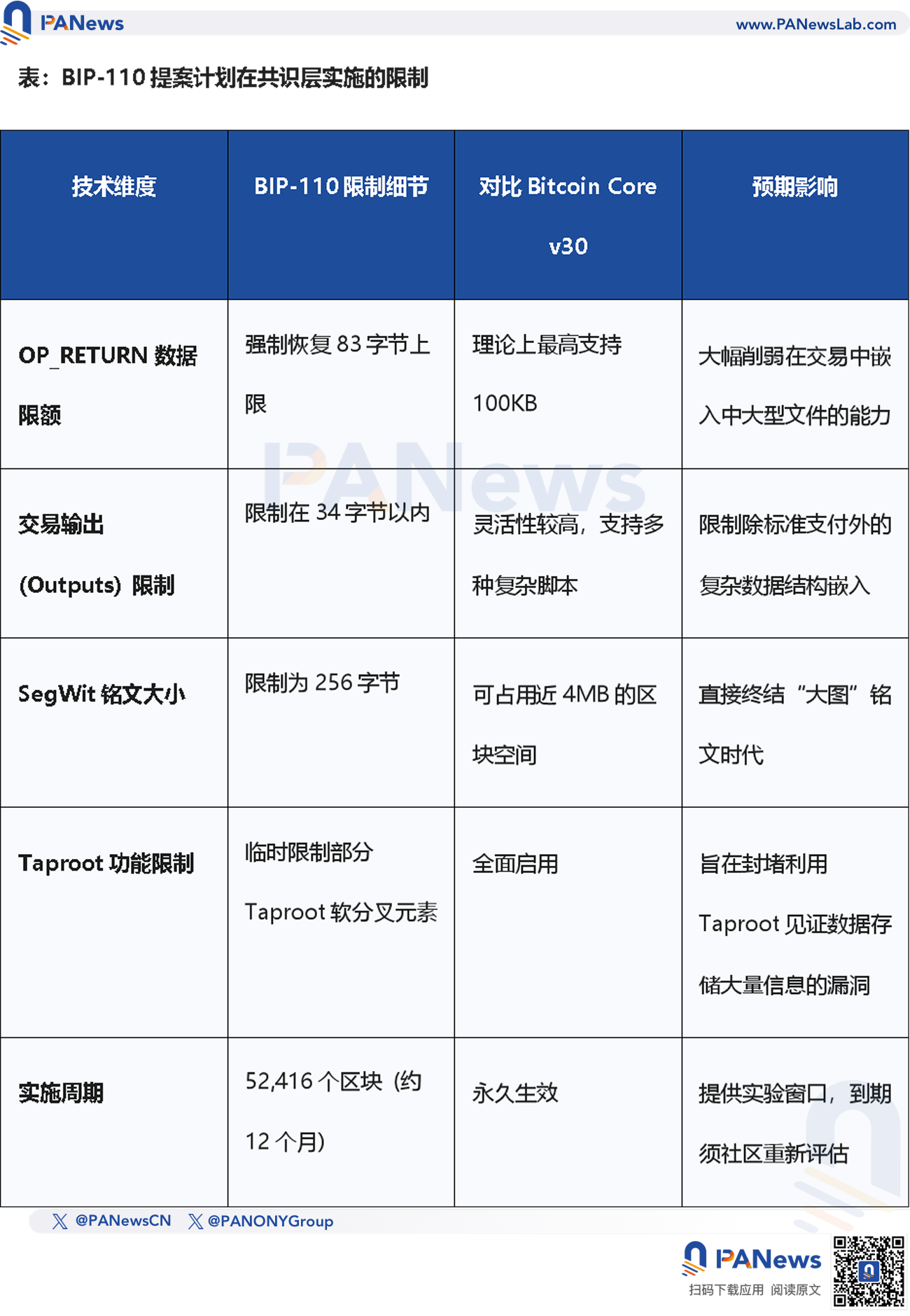
Supporters of BIP-110 argue that these restrictions are not meant to stifle innovation but to restore the technical prudence that Bitcoin maintained in its early days. This set of rules does not affect normal "payment" and "store of value" use cases, directly targeting non-financial records that are seen as "data abuse."
55% Activation Threshold Sparks Controversy: Mob Assault or Decentralization of Power?
What truly caused an uproar in the community is BIP-110's activation threshold: it can pass with support from just 55% of the hashing power.
In Bitcoin’s governance tradition, major consensus changes typically require 95% support from miners' hash rates to ensure network stability and prevent chain splits. Previous activations of significant upgrades like SegWit and Taproot adhered to this unwritten rule.
The establishment of this threshold has sparked a massive governance turmoil within the community.
Supporters argue that a 95% threshold effectively grants the minority a "veto power." Garbage data remains because a few stakeholders are stubbornly holding out. The 55% setting is primarily a form of "defensive activation," aimed at breaking the stalemate in protocol upgrades.
Opposition leader Adam Back accused this of being "a mob assault on Bitcoin's reputation," attempting to push through rule changes without broad consensus.
55% means that as long as a simple majority of miners agree, the remaining 45% of miners and users will have to accept it. This is using a low threshold to hijack the entire network, easily leading to chain splits, resulting in two or even more Bitcoin assets.
More disturbingly, once this precedent is set, if data can be limited today, can addresses be frozen tomorrow? Bitcoin's "immutability" would be rendered meaningless.
Factions Clash: Minimalism or Cutting Off Miners' Revenue?
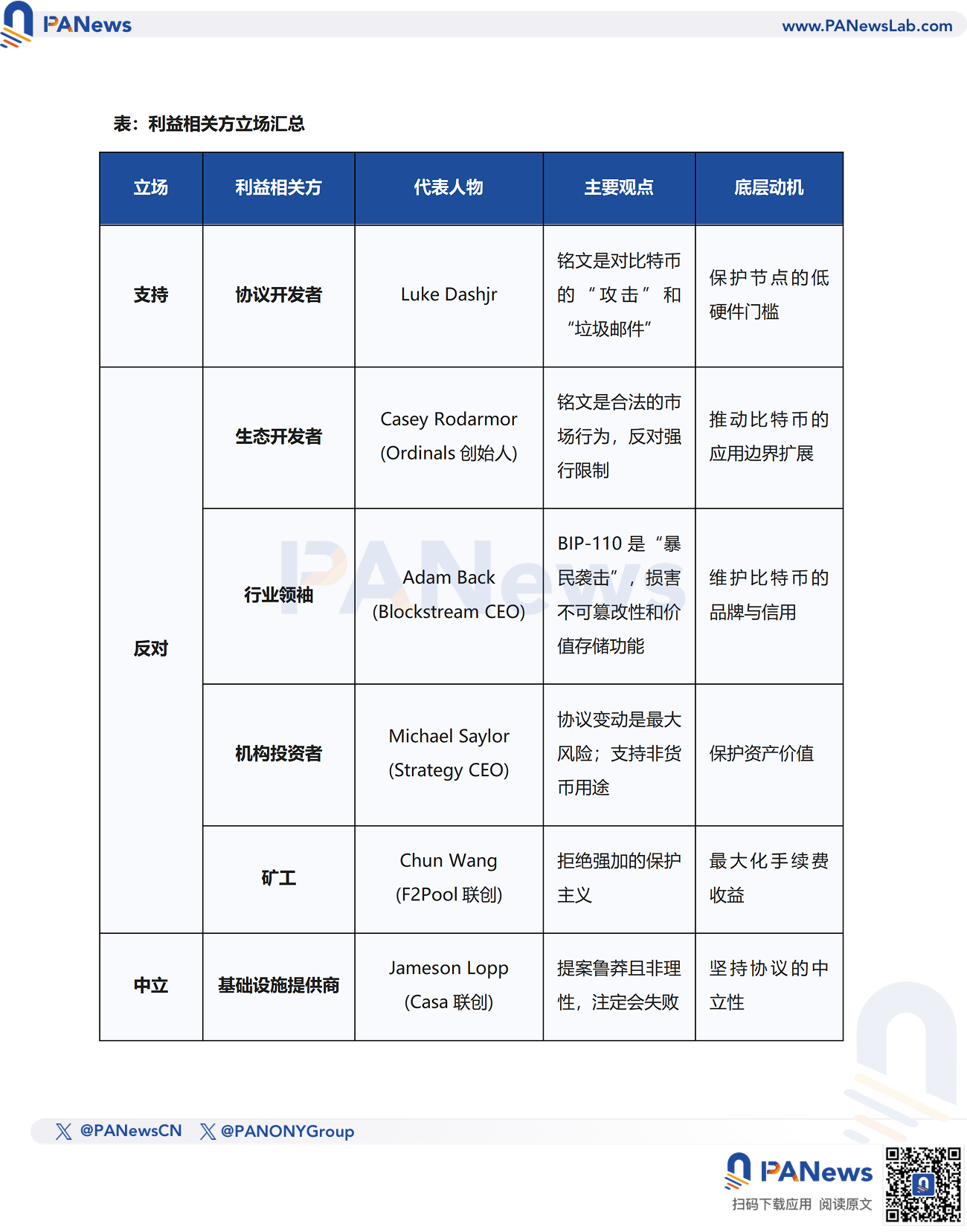
The developer group led by Luke Dashjr and loyal users of the full node client Bitcoin Knots are the driving force behind BIP-110. Their logic is rooted in concerns about the underlying hardware requirements for Bitcoin.
Bitcoin advocate Matthew Kratter likens the engraving protocol to ivy, suggesting that while they cling to the Bitcoin (tree) and grow, they ultimately will crush the tree's structure, leading to the demise of both.
If block space is filled with images, the size of the blockchain will grow exponentially. This means that ordinary users will be unable to run full nodes on standard consumer-grade hard drives, concentrating the verification power in the hands of large nodes and undermining Bitcoin's foundational decentralization.
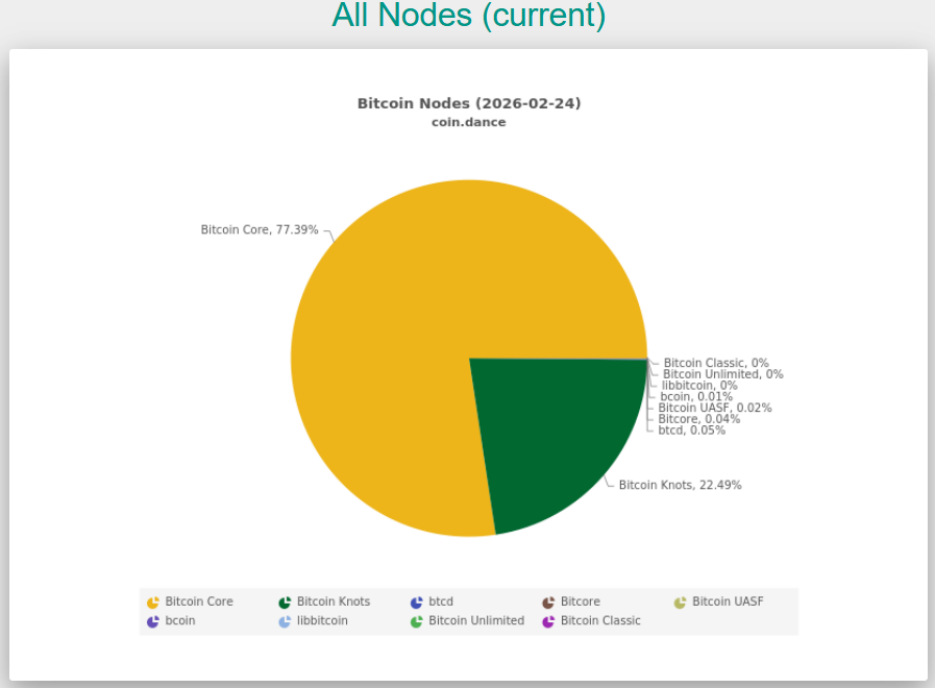
As the controversy has intensified, Bitcoin Knots' market share has surged to 22.49%, while the full node client Bitcoin Core's share has substantially dropped to 77.39%. This trend indicates that a considerable portion of nodes is expressing support for data restrictions by switching clients.
The opposition is composed of influential opinion leaders and miners, including Adam Back, with a more luxurious lineup.
Strategy CEO Michael Saylor warns that frequent changes to the protocol pose the greatest threat to Bitcoin.
Blockstream CEO Adam Back also points out that the greatest value of Bitcoin lies in its immutability. If rules can be easily changed due to a part of the preference, then Bitcoin's credibility as "digital gold" will vanish.
From an economic perspective, the controversy surrounding BIP-110 also reflects the community's anxiety about Bitcoin's "long-term security budget." As the halving cycle progresses, Bitcoin's security will increasingly depend on transaction fees rather than block rewards.
The fees contributed by non-monetary transactions to the Bitcoin network are highly volatile. Dune data shows that so far, the daily fees associated with the engraving protocol have dropped below $10,000, but they contributed nearly $10 million in a single day in December 2023. With block rewards continually halved, miners do not want to close off any revenue source.
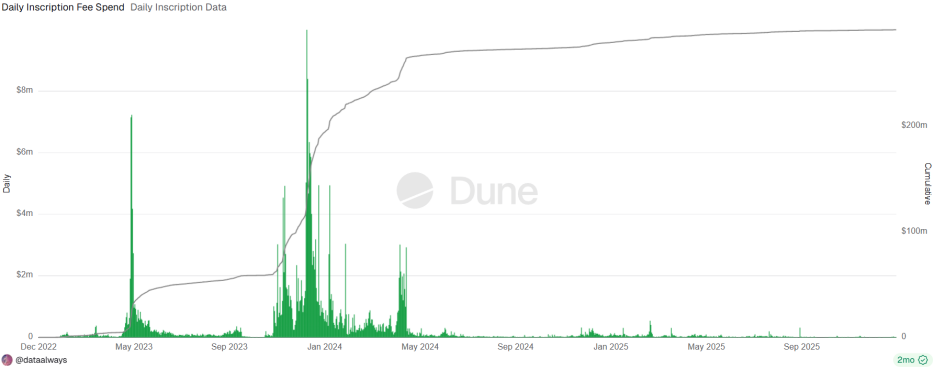
Miners generally believe that market cycles should not justify altering the underlying protocol; once the market warms up, such non-monetary transactions will remain an important source of income.
Fee Market Competition Lacks Fairness, Governance Decline and Legal Risks Coexist
However, the decline in engraving fees has also provided ammunition for supporters. Since the economic benefits from engraving are now negligible, the network optimization (such as reducing UTXO set size, lowering node pressure) gained from clearing them appears more cost-effective.
The deeper economic logic supporting BIP-110 is: the current SegWit discount mechanism effectively subsidizes non-monetary transactions. Under the existing billing rules, storing 1MB of image data is much cheaper than sending a monetary transaction of the same size.
BIP-110 aims to end this "unfair competition" by setting data limits at the consensus layer, forcing these "low-value" data to compete for more expensive non-discounted space, or to simply leave the mainnet.
Proponents believe that only in this way can the fee market return to reality, ensuring that monetary transactions willing to pay a premium for "global consensus" are prioritized for packing.
However, if a proposal like BIP-110, labeled with "temporary + low threshold," passes, it will break the institutional trust in the Bitcoin network. For institutional investors, the most attractive aspect of Bitcoin lies in its rules being immutable.
Once a precedent is set, will there be asset freezes targeting specific addresses in the future? Or forced adjustments based on specific fee rates?
This kind of "governance decline" is the risk that Adam Back and Michael Saylor worry about the most. For Bitcoin, even a protocol containing garbage data is stronger than a "high-quality protocol" that can be modified at any time. Because the latter is unpredictable, whereas institutions seek certainty.
Furthermore, BIP-110 may lead to certain existing UTXOs becoming "dead money," effectively temporarily depriving some users of their property rights. This action might expose miners to accusations of "interfering with private property" at the legal level.
The emergence of BIP-110 is an inevitable product of Bitcoin's growing pains, and its activation possibility remains questionable, especially as the 55% threshold faces significant challenges within the community tradition.
The greatest significance of this debate is that BIP-110 puts the issue of "data abuse" on the table, forcing the community to contemplate "what the Bitcoin mainnet should actually accommodate?"
The greatest value of Bitcoin is not in its unchanging nature, but in each of its changes undergoing the strictest tests. The future Bitcoin may become purer because of this dispute, or it may open a new chapter of diversification due to this split.
In this value defense battle of digital gold, every user running a node is casting a precious vote about the future with their hard drives and bandwidth.
免责声明:本文章仅代表作者个人观点,不代表本平台的立场和观点。本文章仅供信息分享,不构成对任何人的任何投资建议。用户与作者之间的任何争议,与本平台无关。如网页中刊载的文章或图片涉及侵权,请提供相关的权利证明和身份证明发送邮件到support@aicoin.com,本平台相关工作人员将会进行核查。


