Written by: Yangz, Techub News
While the market experiences a cold wave and most players choose to hibernate for winter, leading players are accelerating their layouts. Following yesterday's announcement by crypto VC Dragonfly completing a fundraising of $650 million for its fourth fund, today, the established exchange Kraken, which was founded even earlier than Coinbase, has also quietly made a move. Its parent company Payward announced the completion of its acquisition of the token management platform Magna, completing a key puzzle piece before its IPO.
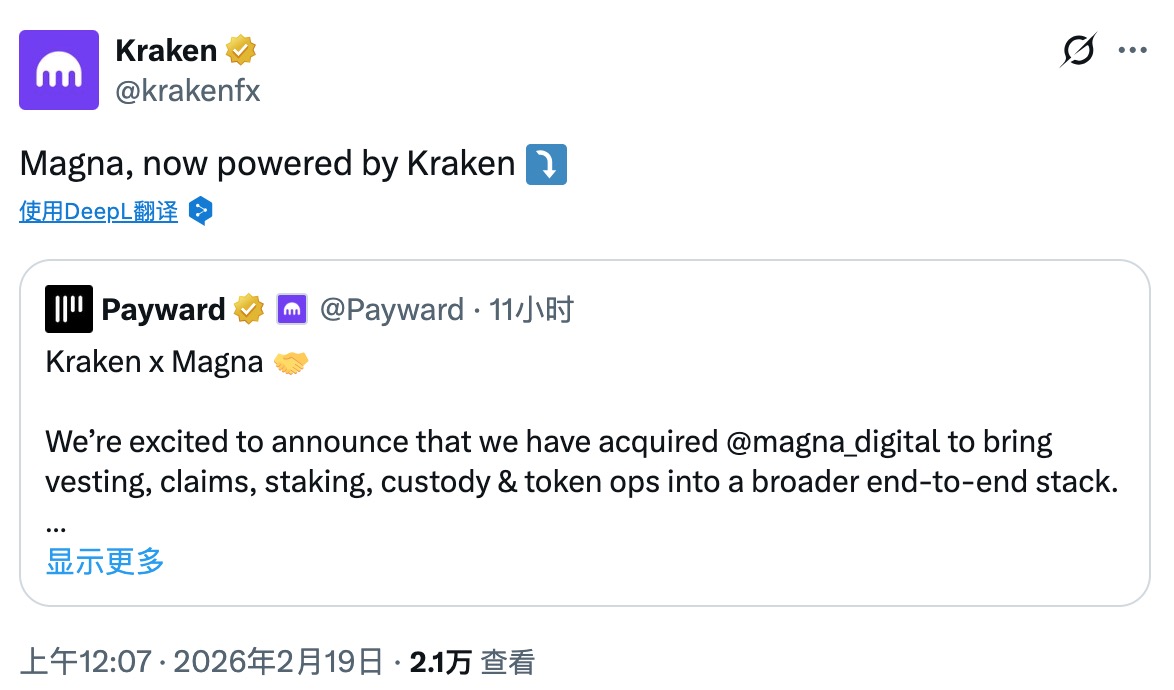
Extending the timeline, this is Kraken's sixth move in the past 12 months, which means there is an average acquisition every two months. Compared to last March's stunning $1.5 billion acquisition of the well-known futures brokerage NinjaTrader, this deal may not seem as impressive (the acquisition amount is undisclosed; according to Pitchbook data, Magna's last round was valued at $70 million), but its strategic significance is similarly directional: Kraken is extending from a pure trading execution channel to upstream, aiming to become a comprehensive infrastructure service provider covering the entire lifecycle of token issuance, distribution, and listing.
Capturing the "source of vitality" in token issuance
For ordinary crypto users, the name Magna may be unfamiliar, but early in its establishment, the platform attracted the attention of top capital. In 2022, Magna completed a seed round financing of $15 million at a valuation of $70 million, led by Tiger Global and Tusk Ventures, with participation from Circle Ventures, Solana Ventures, Galaxy Labs, and others.
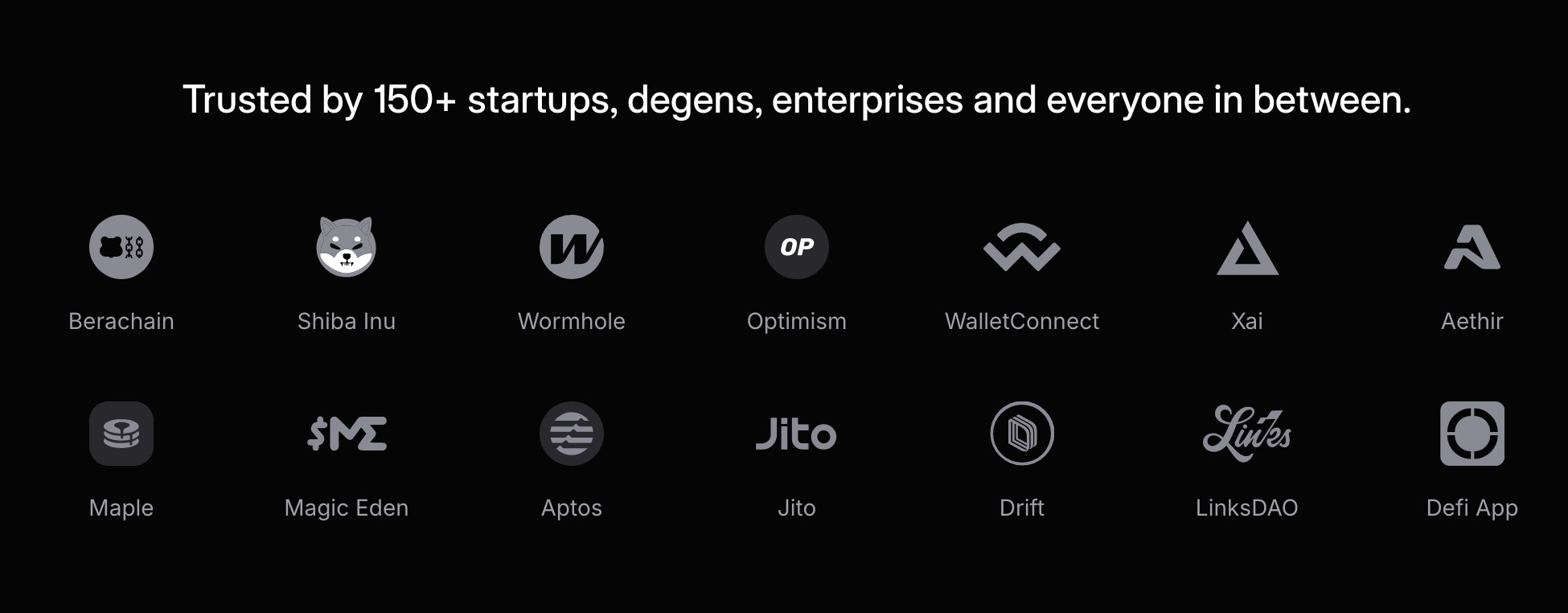
This startup, incubated from Y Combinator's Winter 2022 batch, solves the "dirty work" during the token distribution stage, including managing complex vesting schedules, airdrop distributions, and asset allocations for early investors. In the traditional model, a startup often needs to track the unlocking progress of hundreds of addresses after the token goes live, which is not only inefficient but also prone to governance disputes or market pressures due to operational errors. Magna precisely hits this pain point. According to Magna's CEO Bruno Faviero, over the past four years, Magna has grown to become the largest token lockup platform, "serving over 160 clients, with a projected peak total locked value of $60 billion in 2025." Additionally, the platform's official website shows that its partnered protocols include Aptos, Wormhole, Optimism, Magic Eden, and others.
For Kraken, acquiring Magna is a significant extension of its reach. The company's co-CEO Arjun Sethi articulated the core logic of this timing: "We want to provide support early in the lifecycle of token issuers, rather than waiting until they are close to needing liquidity to intervene." In other words, Kraken aims to establish partnerships at the financing and token design stages through Magna's tools. Once this "early bird" strategy forms a closed loop, when these projects seek to list later on, Kraken will undoubtedly hold a natural advantage, thus gaining a head start in the competition for quality assets.
Seizing "full lifecycle management" of tokens
If acquiring Magna captures the "source of vitality" in token issuance, then Kraken's acquisition map over the past year clearly outlines its strategic ambitions before going public—seizing "full lifecycle management" of tokens. These acquisitions are not merely scattered financial investments, but a meticulous layout surrounding "asset types" and "asset flow stages."
From a timeline perspective, this layout began with the heavyweight deal in March 2025: Kraken acquired the American futures platform NinjaTrader for $1.5 billion, directly entering the realm of traditional financial derivatives. After that, its pace of acquisitions noticeably accelerated—acquiring the no-code trading automation platform Capitalise.ai in August, purchasing the proprietary trading firm Breakout in September to strengthen its professional trading capabilities, and in October spending $100 million to buy the CFTC-regulated derivatives exchange Small Exchange from IG Group. By the end of 2025, Kraken extended its reach into the asset side by acquiring the tokenized stock platform Backed, bringing traditional assets like Tesla and Nvidia onto the chain. Now, the addition of Magna completes the "token distribution management" key segment.
At this point, Kraken's infrastructure map is clearly discernible:
- Asset creation side: Backed (real-world asset tokenization), Magna (token distribution and vesting management);
- Trading execution side: NinjaTrader, Small Exchange, Breakout, Capitalise.ai (derivatives, compliant trading, professional trading, and automated trading);
This "one-stop comprehensive" model is one of the narratives that the current capital market values most in leading crypto firms. When Goldman Sachs upgraded Coinbase's rating this January, it pointed out that as the market matures, platforms that solely rely on trading fees will face pressure from revenue volatility, while platforms that can build stable income sources through custody, staking, and asset tokenization will receive higher valuation premiums.
This logic is unfolding within the track. Before Kraken acquired Magna, Coinbase had already acquired the token management platform Liquifi last July, and Anchorage Digital had absorbed Hedgey last December. Leading players are scrambling into this emerging field of "token lifecycle management," as Sethi mentioned, "If we do not build reliable lifecycle infrastructure, the market will concentrate in the hands of anyone controlling distribution and access channels."
Preparing for the IPO
After BitGo fired the first shot for crypto IPOs in 2026, Kraken, Consensys, Ledger, CertiK, and others are queuing up to plan their public listings. Kraken's IPO confidence has already been revealed in its financial data and fundraising rhythm.
The financial report released by its parent company Payward for 2025 shows that adjusted revenues reached $2.2 billion, a year-on-year increase of 33%. More significant is the $800 million fundraising completed last November, raising the company's valuation to $20 billion. This fundraising was completed in two phases, with the main round led by institutions like Jane Street and DRW Venture Capital, and the strategic investment round attracting a $200 million entry from Citadel Securities. Additionally, Kraken's listing process is also progressing concurrently. In the month of financing, Kraken secretly submitted the S-1 document to the SEC, aiming for an IPO in the first half of 2026. Moreover, in January of this year, Kraken's affiliate KRAKacquisition over-raised $345 million on Nasdaq.
From financial performance to fundraising endorsements, all signals point in the same direction: in 2026, Kraken may become the second mainstream crypto exchange listed on U.S. stocks after Coinbase.
Conclusion
Acquiring Magna, on the surface, seems just another small line in Kraken's acquisition list, but in reality, it is a key part of its plan to build a "token economy operating system." Before the IPO quiet period, Arjun Sethi and his team are using real-money acquisitions to send a clear signal to the market: Kraken is no longer merely an exchange that provides cryptocurrency transactions, but a comprehensive financial infrastructure covering the entire chain of asset issuance, trading, and derivatives. When the next cycle arrives, Kraken may no longer be the passive "channel" waiting for projects to list their tokens but a "co-builder" that is deeply involved from the token design phase.
免责声明:本文章仅代表作者个人观点,不代表本平台的立场和观点。本文章仅供信息分享,不构成对任何人的任何投资建议。用户与作者之间的任何争议,与本平台无关。如网页中刊载的文章或图片涉及侵权,请提供相关的权利证明和身份证明发送邮件到support@aicoin.com,本平台相关工作人员将会进行核查。


