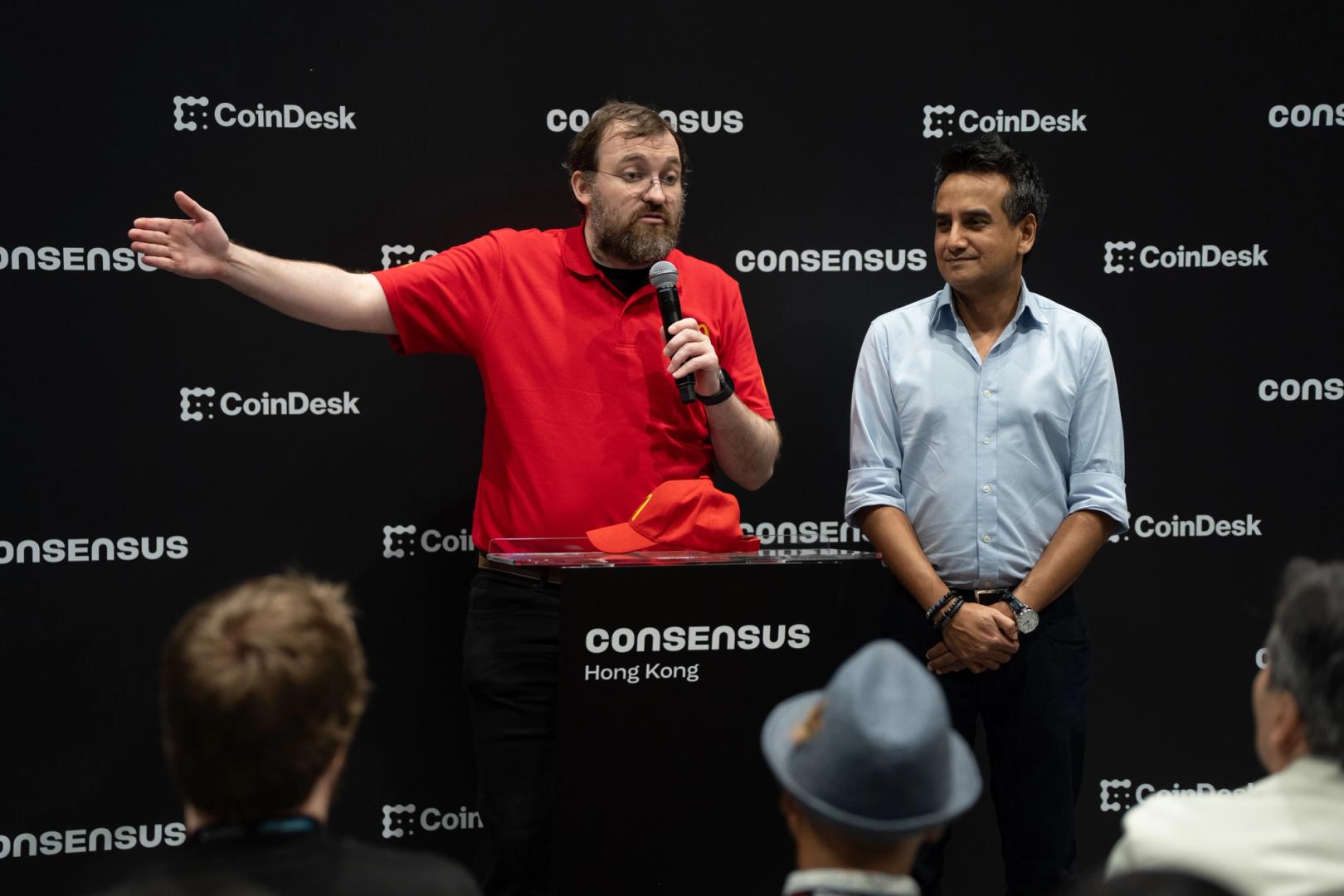
What to know : At Consensus Hong Kong 2026, Cysic founder Leo Fan warned that blockchain projects relying heavily on hyperscalers like Google Cloud and Microsoft Azure risk recreating single points of failure that undermine crypto’s decentralization ethos. Cardano founder Charles Hoskinson defended partnerships with major cloud providers for the Midnight privacy-focused network, arguing that global, privacy-preserving systems require hyperscaler-level compute while cryptography and confidential computing protect underlying data. The debate between Hoskinson and Fan centers on how to define decentralization, with Hoskinson prioritizing cryptographic neutrality over hardware ownership and Fan urging a hybrid model that limits reliance on Big Tech and extends decentralization to the compute layer itself.
Cysic founder Leo Fan argued that blockchain projects relying heavily on hyperscalers like Google Cloud and Microsoft’s Azure risk undermining crypto’s decentralization ethos, at Consensus Hong Kong 2026.
Fan’s comments came after Cardano founder Charles Hoskinson outlined Midnight, Cardano’s privacy-focused project, and announced partnerships with companies including Google and Telegram. Midnight is scheduled to launch its mainnet at the end of March, according to Hoskinson.
Hoskinson defended working with hyperscalers, arguing that no single layer-1 blockchain can handle the computational demands required for global, privacy-preserving systems.
“When people spend a trillion dollars building data centers,” he said, referring to major cloud providers, “we should probably use what they spent the trillion dollars on instead of trying to build a completely different network.”
Midnight Foundation CEO Fahmi Syed said the network will debut with 10 federated nodes as part of what he described as a “responsible” path toward decentralization. Google Cloud is among early collaborators providing infrastructure support.
Justifying the single point of failure
Hoskinson said Midnight is designed to offload heavy computational workloads, particularly those tied to privacy and zero-knowledge cryptography, to cloud providers such as Google Cloud and Microsoft Azure. He added that technologies like multi-party computation and confidential computing would allow providers to supply hardware capacity without accessing the underlying data.
During a stage demonstration, Hoskinson said Midnight processed thousands of transactions per second with Microsoft Azure powering the backend compute layer.
Fan, however, argued that relying on hyperscalers for core compute still introduces structural centralization risks.
“If your validators look decentralized but all run on the same data center in that’s still a single point of failure,” Fan told CoinDesk. “Blockchain is supposed to remove single points of failure. If the infrastructure is centralized, that’s a contradiction.”
Cysic, operates a decentralized compute network focused on zero-knowledge proof generation. He said one customer reduced proof-generation time from as much as 90 minutes on AWS to roughly 15 minutes using Cysic’s distributed hardware network.
“In some scenarios, we can deliver better performance,” Fan said. “We don’t need to defeat them immediately, but we can compete.”
How decentralization should be defined
Midnight is not outsourcing its blockchain to Google or Microsoft. The base network runs its own nodes, and Hoskinson emphasized that hyperscalers provide hardware capacity rather than governance or protocol control.
He described Midnight as a neutral coordination layer that could dynamically route workloads between cloud providers, arguing that encrypted computation and confidential computing environments ensure providers “just provide the hardware.”
Fan’s critique focuses on a different layer of the stack.
Even if data is encrypted and workloads can shift between providers, reliance on a small number of global infrastructure operators concentrates power at the compute layer, particularly as demand for GPUs and data center capacity intensifies, Fan said.
The disagreement is less about whether Midnight is centralized in a strict technical sense and more about how decentralization should be defined.
Hoskinson’s approach prioritizes cryptographic neutrality over hardware ownership. Fan said that decentralization must extend to the compute layer itself.
Rather than calling for a complete rejection of hyperscalers, Fan advocated a hybrid approach.
“Use big vendors in a limited way,” he said. “Combine them with decentralized networks to make the system more robust. Do not give up decentralization because that’s the nature of our community.”
As blockchain networks pursue enterprise adoption and global scale, the divide between building parallel infrastructure and integrating with Big Tech may define crypto’s next phase.
免责声明:本文章仅代表作者个人观点,不代表本平台的立场和观点。本文章仅供信息分享,不构成对任何人的任何投资建议。用户与作者之间的任何争议,与本平台无关。如网页中刊载的文章或图片涉及侵权,请提供相关的权利证明和身份证明发送邮件到support@aicoin.com,本平台相关工作人员将会进行核查。


